
The Evolution of Technology: Past to Present
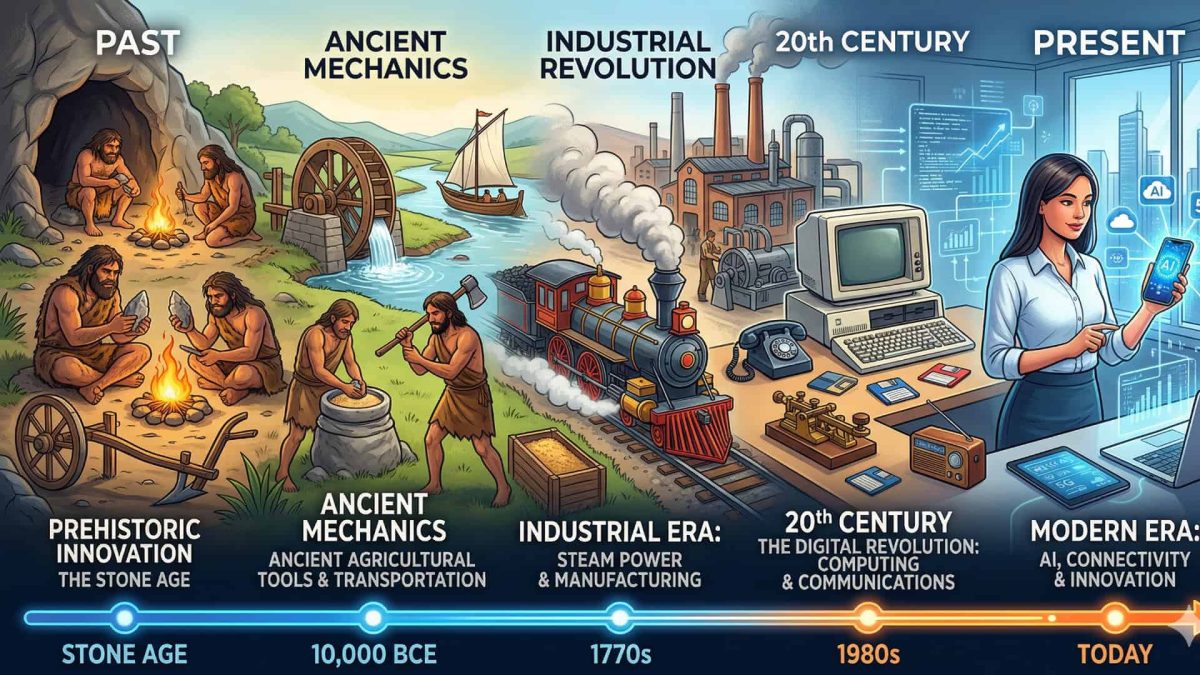
Introduction
Human history is fundamentally the history of technology. When we look back, we can clearly see how small discoveries brought us to this highly advanced modern world. This incredible journey did not happen overnight.
From the early cave dwellers to modern astronauts, human beings share one common trait. That trait is a strong desire to create new things to make life easier. This relentless desire is exactly what keeps pushing us forward.
Understanding the Importance of Technological Evolution
The history of technology is not just a simple list of gadgets and machines. It is a unique story of human intelligence and our ongoing struggle for survival. This evolution helps us understand where we came from and where we are heading.
Knowing how past technological shifts impacted society helps us face future challenges with more confidence. It teaches us to appreciate the modern conveniences we often take for granted. At the same time, it expands our innovative thinking for the future.
How Technology Has Shaped Human Civilization
Technology has always been the primary driving force in society. It has brought massive changes to every aspect of our lives, including communication, education, and healthcare. From the discovery of fire to the invention of the Internet, every step has improved the human standard of living.
We now live in a world where the entire planet has become a global village. Technology deserves the most credit for this massive transformation. It has removed our physical limitations and opened the door to infinite possibilities.
What is Technology?
Hearing the word “technology” usually brings images of smartphones, computers, or robots to mind. However, the true scope of technology is much broader than that. It is absolutely not limited to modern electronic gadgets.
In simple terms, technology is the practical application of scientific knowledge to solve everyday problems. Everything from a basic wooden wheel to a modern supercomputer falls under the umbrella of technology.
Definition of Technology and Its Purpose
Technology is a process or system designed to make human tasks easier, faster, and much more effective. Its primary purpose is to improve the overall quality of human life. Whenever humans faced a difficult problem, they invented something new to solve it.
The goal of technology is not just to build new machines. Saving time, preventing waste, and increasing productivity are its main objectives. It helps us adapt to our natural environment and shape the world around us to our advantage.
The Role of Innovation in Human Progress
Behind every major leap in human civilization lies a groundbreaking innovation. The invention of the wheel completely changed how we travel and transport goods. Similarly, the printing press played a massive role in spreading education across the globe.
Without continuous innovation, society would have been stuck in one place. New ideas and their successful applications are constantly driving us forward. Through innovative thinking, we have been able to transcend Earth’s boundaries and reach outer space.
Earliest Forms of Technology
Technology began in a very simple, humble way. For ancient humans, simply staying alive was the biggest challenge. They created the earliest forms of technology specifically to survive in a harsh world.
Compared to today’s massive automated factories, those early discoveries might seem insignificant. However, the very foundation of human civilization was built upon those primitive tools.
Stone Tools and Primitive Discoveries
The first major technological revolution in human history occurred when humans learned to make stone tools. These stone tools made hunting, self-defense, and food gathering much easier.
Then came the discovery of fire, which completely changed human life forever. Fire protected humans from the cold winter and kept wild animals away. Most importantly, cooking food over a fire helped the human brain develop much faster.
How Early Humans Used Technology for Survival
Early humans constantly fought against a hostile natural environment to stay alive. They used their intelligence to create necessary items directly from nature. Using tree branches, animal bones, and stones, they crafted spears, bows, and arrows.
They quickly realized that working in groups and using the right tools increased their chances of survival. Using animal skins to make warm clothing was another highly important technological step for them.
Technology in Ancient Civilizations
When humans left their nomadic lifestyle and started living in permanent settlements, civilization began to blossom. During this time, human societies learned to cultivate crops and began building villages and cities.
Living permanently in one place gave humans the free time to think about new concepts. That is when a series of brilliant technological innovations began to emerge across various ancient civilizations.
Innovations in Ancient Egypt, Mesopotamia, and China
The ancient Egyptians set an incredible example in architecture. The massive pyramids they built continue to amaze engineers today. They were also highly advanced in astronomy and mathematics.
The people of Mesopotamia invented the wheel and the plow. On the other side of the world, the ancient Chinese invented groundbreaking technologies such as paper, gunpowder, and the magnetic compass. These discoveries eventually spread across the globe and changed the course of human history.
The Development of Writing, Agriculture, and Engineering
The invention of writing systems for communication was one of the most important events in human history. From Sumerian cuneiform to Egyptian hieroglyphics, writing paved the way for preserving knowledge for future generations.
The development of agriculture provided humans with a guaranteed food supply. The technique of bringing river water to crop fields through irrigation systems was a brilliant example of early engineering. These changes allowed trade, commerce, and local economies to expand rapidly.
The Impact of the Industrial Revolution
In the late eighteenth century, the world entered a brand new era known as the Industrial Revolution. This was a massive turning point in human history.
Huge engines and machines began to replace manual hand tools. Human reliance on physical labor decreased significantly, and production capacity increased tremendously.
The Rise of Machinery and Mass Production
The invention of the steam engine brought new life to factories. This revolution began in England and quickly spread across Europe and America. You can read more details about the Industrial Revolution in this excellent article by History.com.
Thanks to the invention of new machinery, goods like clothing and iron could be produced much faster and in massive quantities. This concept of mass production completely transformed human lifestyles and the global economy.
Transformation of Transportation and Manufacturing
The Industrial Revolution did not just change the inside of factories; it also changed the outside world. To transport manufactured goods from one place to another, a faster transportation system was desperately needed.
The invention of steam-powered trains and steamboats made travel much easier and faster. This led to the rapid expansion of global trade and to drastic improvements in communication between countries.
The Electrical and Communication Revolution
In the late nineteenth and early twentieth centuries, another major revolution took place. This was the era of the discovery of electricity and its versatile applications.
Electricity illuminated human life and opened a completely new horizon for communication. It felt as if the world suddenly became much smaller.
The Discovery of Electricity and Its Applications
The discovery of electricity lit up the dark nights. Thomas Alva Edison’s invention of the practical electric light bulb extended the hours humans could work and socialize.
Electricity made it much easier to run heavy factory machinery. It also paved the way for the use of various electrical appliances in homes, making human life significantly more comfortable.
The Era of the Telegraph, Telephone, and Radio
In the field of communication, the invention of the telegraph was the first major milestone. Later, when Alexander Graham Bell invented the telephone, people could talk to each other across long distances in real time.
Following that, the invention of the radio played a massive role as a medium for entertainment and information sharing. These inventions proved that physical distance was no longer a barrier to sharing information.
The Birth of the Digital Age
In the mid-twentieth century, the world was introduced to a technology that would change human civilization forever. That technology was the computer.
The beginning of this digital age took human capability for processing and storing information to unimaginable levels. Analog signals were replaced by digital technology relying entirely on zeros and ones.
The Development of Computers
The earliest computers were massive. A single computer required a room the size of a large hall. The development of computers continued through the efforts of brilliant scientists like Charles Babbage and Alan Turing.
Later, the invention of the transistor and the microchip allowed computers to become much smaller while their processing power multiplied. Once personal computers became available for regular consumers, the world entered a totally new era.
The Advent of the Internet and Digital Networks
The greatest wonder of the digital age is undoubtedly the internet. The network, born in the 1960s as the ARPANET for the US military, eventually evolved into today’s internet. The invention of the World Wide Web brought searching and sharing information to the fingertips of the general public. Looking into the history of the Internet on Wikipedia shows exactly how fast it spread globally.
The internet has connected the entire world like a giant, invisible web. Thanks to email, websites, edge networks, and digital infrastructure, any piece of information can reach the other side of the planet in a fraction of a second.
The Rise of Mobile Technology
After computers and the internet, mobile technology created the biggest wave in the tech world. This wireless communication medium brought people a completely new level of freedom.
People no longer needed to sit in a specific location to communicate. They could stay connected with the entire world while walking, traveling, or commuting.
From Early Cell Phones to Smartphones
The earliest cell phones were quite large and heavy. They only offered the ability to make voice calls and send short text messages.
Over time, mobile phones shrank in size and gained a variety of new features. Then came the smartphone. A modern smartphone is essentially as powerful as a small computer resting in the palm of your hand.
How Mobile Devices Have Changed Daily Life
Smartphones have impacted almost every single aspect of human life. We now use our phones to take photos, listen to music, watch movies, and browse the internet.
Mobile banking, online shopping, and various utility apps have made our daily chores incredibly easy. From checking digital maps to booking a taxi, everything is now possible with just a single tap.
Advancements in Artificial Intelligence and Automation
The most talked-about technological innovation of the current century is Artificial Intelligence. Giving machines the ability to think and make decisions like humans is the main goal of this technology.
This tech is no longer limited to the pages of science fiction books. It has now become an integral and undeniable part of our real lives.
Understanding AI and Machine Learning
Machine learning is a massive branch of artificial intelligence. Through this process, computers analyze huge amounts of data to learn on their own and make new decisions based on past experiences.
The voice assistants in our smartphones, product recommendation engines on e-commerce sites, and social media news feeds are all examples of successful AI and machine learning applications.
The Impact of Automation on Industries
Artificial intelligence and robotics are coming together to create a new revolution in factories, which we call automation. Instead of humans, robots can now perform complex tasks much faster and with perfect accuracy.
As a result, production costs are dropping,g and the quality of work is rising. However, this also creates a risk of decreasing human employment, a topic that experts worldwide are currently debating.
Major Technological Milestones That Changed the World
Certain specific moments in the history of technology completely changed the trajectory of the world. These milestones redefined the limits of human capability.
These massive achievements showed us that with endless curiosity and an unbreakable will, the impossible can be made possible.
The Space Age and Satellite Technology
The human moon landing in 1969 remains one of the greatest technological achievements in human history. Space research has given us technologies that have become absolutely essential in our daily lives.
The Global Positioning System, accurate weather forecasting, and satellite television broadcasting are all contributions of space technology. Thousands of satellites orbiting the Earth continue to make our lives easier every single day.
Cloud Computing and Big Data
Cloud computing has brought a revolutionary change to data storage. We no longer need to save large amounts of data on physical computer hard drives. We can now securely store our necessary files on massive remote servers through the internet.
At the same time, businesses and researchers are making critical decisions by analyzing the vast amounts of data generated worldwide each day. This massive data analysis process is paving the way for even more new innovations.
Social Media and Global Connectivity
Social media platforms have completely transformed the way people communicate. They have brought people together on a virtual platform, transcending all geographical borders.
Social media plays an important role not just in communication but also in business, politics, and the shaping of public opinion. It has gifted humanity a massive, open stage to express opinions freely.
The Impact of Technology on Society
Technology is not just limited to machines or software code. It has deeply impacted our society, culture, and global economy.
These impacts can be positive or negative. Overall, technology has given our society a completely new shape and structure.
Transforming Communication and Relationships
We have moved from the era of writing physical letters to the era of instant video calls. It is now possible to communicate instantly with loved ones sitting thousands of miles away.
However, many experts believe that excessive reliance on technology is reducing face-to-face interaction. Virtual relationships are sometimes damaging real-life connections, causing people to feel isolated.
Advancements in Healthcare and Education
The contribution of technology to medical science is undeniable. Diagnosing diseases has become much easier due to modern equipment, such as MRI and CT scanners. Through telemedicine, people can now get advice from specialists from the comfort of their homes.
The education sector has also seen massive changes. People can now learn new skills from anywhere in the world through online e-learning platforms. We all came to deeply appreciate the importance of online classes during the recent global pandemic.
Economic Growth and Globalization
Technology has tied the global economy together with a single thread. Thanks to the expansion of e-commerce, business is no longer limited to a specific local area.
Through freelancing and remote work, professionals can now work from home for companies based in entirely different countries. Technology has rapidly accelerated globalization and created countless new employment opportunities.
Challenges Posed by Technological Advancements
Just as everything has a good side, there are also bad sides. Along with this massive technological advancement, human society is facing new and complex challenges.
If we cannot solve these problems, the positive aspects of technology might eventually fade away.
Privacy and Cybersecurity Concerns
In the digital age, our personal information is constantly being stored on various online platforms. Keeping this huge amount of data secure is a massive challenge for developers and server administrators.
Hacking, data theft, and cybercrimes are increasing every single day. Personal privacy is under serious threat. Ensuring safe internet usage has become a major concern worldwide.
The Environmental Impact of Technology
Our environment is paying a heavy price for rapid technological development. Smoke emitted by industrial factories and vehicles is a major contributor to air pollution and global warming.
Additionally, discarded electronic goods, or electronic waste, pose a serious threat to the natural ecosystem. Inventing sustainable and eco-friendly technology is now the biggest demand of our time.
Ethical Questions in the Digital Age
Artificial intelligence and other advanced technologies are raising complex ethical questions. For example, if a fully automated self-driving car is involved in an accident, who should bear legal responsibility?
Furthermore, attempting to destabilize society by spreading fake news on the internet and social media has created a massive ethical crisis. Creating strict policies to prevent the misuse of technology has become absolutely essential.
Emerging Technologies Shaping the Future
We are currently standing at a time where technology is changing faster than we can imagine. Over the next few decades, technologies will develop that will make our lives even more astonishing.
Let us take a look at the emerging technologies that will define our future.
Artificial Intelligence and Generative AI
Generative AI tools are completely changing the way humans work. These systems are capable of generating original images, writing text, and even writing complex computer code all on their own.
In the future, AI will become even more intelligent and highly creative. It will act as a reliable assistant in human decision-making processes. However, ensuring proper control over these systems is also extremely important.
Quantum Computing
Research into quantum computers, which are millions of times more powerful than standard computers, has advanced significantly. These machines will be able to solve highly complex scientific problems in mere seconds.
Quantum computing will play a groundbreaking role in discovering new medicines, forecasting perfect weather patterns, and building complex economic models. Along with this, advanced cryptographic technologies such as zero-knowledge proofs and fully homomorphic encryption are becoming increasingly critical for data security. These encryption methods allow data to be processed while remaining completely hidden, which will bring a massive revolution to future cybersecurity.
The Internet of Things (IoT)
The Internet of Things is a concept where every everyday item around us will be connected to the internet. The smart home concept is just an early version of this massive idea.
Everything from your home refrigerator, air conditioner, and washing machine to your personal car will share data with one another over a secure network. This will make our daily lives much more automated and hassle-free.
Virtual Reality and Augmented Reality
Virtual reality and augmented reality will not be limited to playing video games. These immersive technologies will bring massive changes to the worlds of education, medicine, and entertainment.
Medical students will be able to practice complex surgeries safely using virtual reality headsets. We might also be able to enjoy a live music concert from the other side of the world in our living rooms, feeling as if we are physically there.
The Future of Technology
Scientists are constantly researching what the future of technology will look like. However, one thing is absolutely certain: future technology will be much more human-centric and environmentally friendly.
In the coming decades, the relationship between humanity and machines will become even closer and more integrated.
Expected Trends That Will Define This Decade
In the coming days, we will see the rapid expansion of smart cities. Everything from city traffic systems to waste management will be efficiently managed by advanced technological networks.
The use of renewable energy will increase on a massive scale. Electric vehicles will become highly affordable for the general public, which will help drastically reduce environmental pollution. Space tourism might also emerge as a brand new industry within this decade.
Preparing for a More Connected World
To keep pace with these rapid technological changes, we must actively prepare ourselves. Learning new skills and acquiring up-to-date technical knowledge is absolutely essential.
We must understand that technology is not magic; it is simply a tool created by human beings. We can build a beautiful and safe world only by ensuring the proper and responsible use of these tools.
Lessons Learned from the Evolution of Technology
History teaches us many valuable things. We also have several important lessons to learn from this long history of technological evolution.
These lessons will make our future journey much smoother and help us avoid repeating past mistakes.
How Past Innovations Influence Future Breakthroughs
No invention is ever created out of thin air. Behind every new technology today lies countless stories of past failures and successes. Innovation is only possible by building upon the knowledge and experience of our predecessors.
Without the telegraph, the telephone would never have been invented. Without the telephone, we would not have the modern smartphones in our hands today. Therefore, it is extremely important to show respect to past inventors and draw inspiration from their hard work.
The Importance of Responsible Technological Development
The biggest lesson we can learn is that technological development must be responsible and focused on human welfare. Simply building something new is not the final goal. We must always evaluate the impact a new invention will have on society and the environment beforehand.
We must ensure that technology creates equal opportunities for everyone instead of increasing social inequality. Ethics and human values must always take precedence over technological advancement.
Frequently Asked Questions (FAQs)
How has the evolution of technology occurred over time?
The evolution of technology is an ongoing process. It started with stone tools and fire in the primitive age, moved through the agricultural and industrial revolutions, and has now entered the digital age. The human desire to solve problems drove this evolution, step by step.
What were the most important technological discoveries?
Some of the most critical discoveries in human history include the wheel, fire, the printing press, the steam engine, electricity, the computer, and the internet. These inventions have completely changed the course of human civilization.
How has the internet changed society?
The internet has turned the entire world into a highly connected global village. It has made information sharing, education, online commerce, and human communication unbelievably fast and accessible.
Which technologies will shape the future?
Modern technologies such as artificial intelligence, quantum computing, the Internet of Things, virtual reality, and fully homomorphic encryption will play a major role in shaping the future of our world.
Why is understanding the history of technology important?
The history of technology helps us understand the foundation of the modern conveniences we enjoy today. By learning from past mistakes and successes, we can build future technologies in a much more eco-friendly, secure, and responsible manner.
Conclusion
The evolution of technology is an unforgettable story of the human journey. From the darkness of ancient caves to the vastness of outer space, this progression proves that there is no limit to human intelligence and innovative power. In every era, humans have used their knowledge and hard work to create new tools, leaving a better world for the next generation.
Key Lessons from Technological Evolution
Throughout this long journey, we have learned that technology is a servant to humanity, not our master. If used properly and ethically, technology can achieve the impossible. However, its misuse can bring terrible disasters to human civilization. Therefore, we must always remain highly responsible when developing and applying new technology.
Embracing Innovation While Learning from the Past
We should remain deeply grateful to past inventors and take inspiration from their incredible work. At the same time, we must keep an open mind and embrace new technologies without fear of change. Only then will we be able to build a better, highly connected, and livable future. This journey of technology is never-ending; it is a continuous path of infinite possibilities.