
How Major Religions View Adam, the First Human
Introduction
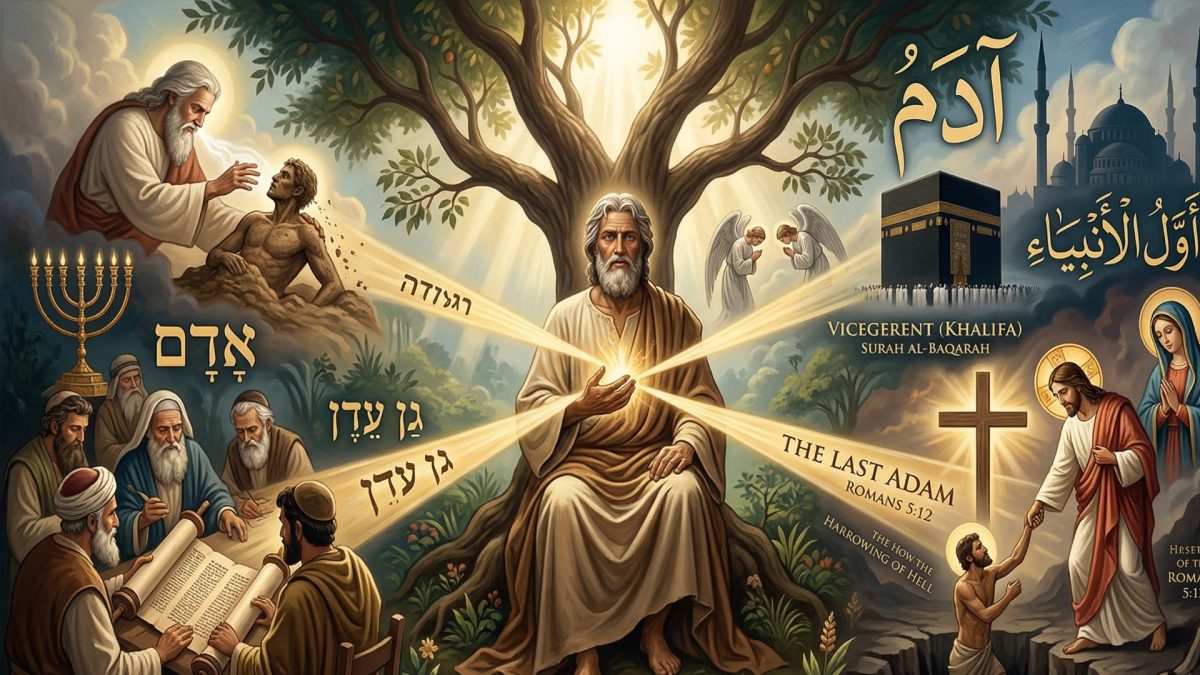
Human curiosity about our origins is eternal. Where we came from, how we began, and what our purpose is on Earth have fascinated people for ages. The world’s major religions have attempted to answer these questions through a specific figure: the first human, Adam. Have you ever wondered how different faiths describe this original father? In today’s blog, we will explore how the world’s major religions view the first human, Adam, and what lessons we can learn from his life story.
Who is Adam?
In simple terms, according to Abrahamic religions (Judaism, Christianity, and Islam), Adam is the first human being on Earth. It is believed that he was created directly by God’s hand. Unlike ordinary humans, he had no parents.
According to religious texts, God formed him from dust or clay and breathed His spirit or soul into him. Adam was not just an ordinary person; he was the original father of all humanity, through whom the human race began to multiply on Earth.
Why Adam is Important in Multiple Religions
Adam is not merely a character; he is an integral part of humanity’s existence. His importance across multiple religions is immense because it is through his story that the primary relationship between God and humans is established.
The arrival of humans on Earth, the ability to distinguish between good and evil, the exercise of free will, and the first test of obedience to God’s commands are all intertwined with Adam’s life. Understanding Adam means understanding the original form of human nature and the beginning of our spiritual journey on Earth.
Understanding Religious Perspectives on Adam
Different religions view Adam from different perspectives. In some faiths, he is simply the first man, while in others, he is God’s first messenger or prophet. His first mistake is viewed by some religions as an original sin, while others describe it as human frailty and a beautiful example of forgiveness.
By understanding these diverse perspectives, we can comprehend how each religion explains human nature and divine mercy. For more details, consult reliable sources such as the Encyclopedia Britannica.
Adam in Judaism
Judaism is the oldest of the Abrahamic religions. Its primary text, the Hebrew Bible (Tanakh, or Torah), contains detailed discussions of Adam. In Judaism, the story of Adam is highly significant because it highlights the very early stages of human creation.
How Judaism Describes Adam
In Judaism, Adam is seen as the original father of the human race. However, Jewish theology does not consider Adam’s mistake to be a permanent curse or “original sin” for all of humanity, unlike Christianity.
Instead, Jewish scholars believe Adam’s mistake was an example of human free will. God gave humans the power to make independent decisions, and Adam was the first to exercise that power. Although his mistake led to his expulsion from paradise to Earth, Judaism teaches that every person is born sinless and is solely responsible for their own actions.
Adam in Genesis
The first book of the Hebrew Bible, Genesis, provides a detailed account of Adam’s creation. The first chapter of Genesis states that God created humans in His own image. Here, the word “Adam” refers not only to a specific individual but also to the entire human race. In Hebrew, the word “Adam” comes from “Adama,” which means “earth” or “ground.” This highlights the truth that human origins lie on Earth and that, ultimately, humans must return to it.
Creation of Adam in Jewish Tradition
Jewish tradition and Talmudic literature offer many fascinating explanations regarding the creation of Adam. Jewish Midrash (explanatory texts) state that when God decided to create Adam, He gathered dust from the four corners of the Earth.
The purpose was so that, no matter where a person dies in the world, the Earth would accept them. God breathed His breath into this earthen framework, turning Adam into a living being. This breath or soul is what makes humans distinct from and superior to other animals.
The Story of the Garden of Eden
After creating Adam, God placed him in a beautiful garden called the Garden of Eden. He was given responsibility for looking after it. So that Adam would not feel lonely, God created the first woman, Eve, from Adam’s rib.
They were given complete freedom, but they were forbidden to eat the fruit of one specific tree, which was the tree of the knowledge of good and evil. However, persuaded by a serpent, they ate the forbidden fruit. As a result, God exiled them from the Garden of Eden to Earth. This marked the beginning of a new chapter in human life, in which people would have to work hard to survive.
Adam in Christianity
In Christianity, the concept of Adam is profound and intricately tied to the faith’s core foundations. Like Judaism, Christianity follows the accounts in Genesis, but its interpretation of the consequences of Adam’s mistake is completely different and deeply spiritual.
How Christianity Describes Adam
In Christianity, Adam is the person through whom sin and death entered the world. Christians believe that Adam’s mistake led to the spiritual fall of humanity, creating a separation between God and humans. Adam’s disobedience is not seen merely as a simple error in Christianity; rather, it is considered a massive catastrophe for humanity. It was to rescue mankind from this fall that the arrival of Jesus Christ later became necessary.
Adam as the First Man in the Bible
The Holy Bible clearly states that Adam is the father of the human race. According to the accounts in Genesis, Adam was a perfect creation of God. He was sinless and had direct communication with God. But his single wrong decision destroyed that purity. The Bible clearly states that human lineage began with Adam, and that all people on Earth are his descendants.
The Fall of Man and Original Sin
One of the most important concepts in Christianity is “Original Sin.” Theologians such as St. Paul and, later, St. Augustine firmly established this idea. According to them, when Adam disobeyed God by eating the forbidden fruit, humanity fell.
This fall did not belong to Adam alone; rather, this sin spread to the entire human race through inheritance. This means that every person born into the world is inherently burdened by this original sin. Because of this concept, Baptism is extremely important in Christianity, as it is a symbolic act of seeking deliverance from original sin.
The Role of Adam in Christian Theology
In Christian theology, Adam is often contrasted with Jesus Christ. In the Bible, St. Paul draws a deep comparison between Adam and Jesus in his epistles to the Romans and Corinthians. Paul refers to Adam as the “first Adam” and Jesus as the “second Adam” or “last Adam.”
According to him, the disobedience of the first Adam brought sin and death into the world. On the other hand, the extreme obedience and sacrifice of the second Adam (Jesus Christ) on the cross allowed humans to regain God’s grace. This sits at the very center of the Christian concept of Salvation.
Adam in Islam
In Islam, the position of Adam (peace be upon him) is highly respected. According to Islamic belief, Adam is not only the first human but also the first Prophet of Almighty Allah on Earth. The Quran and Hadith beautifully describe the creation of Adam and the various stages of his life.
How Islam Describes Adam
Islam views Adam as a revered Prophet. He was sent to Earth as Allah’s representative or “Khalifa.” Islam completely rejects the concept of original sin or inherited sin. Islam teaches that every person is born in a completely sinless and pure state. Adam did make a mistake, but he repented, and Allah forgave him. Therefore, no other human being has to carry the burden of Adam’s sin.
Adam as the First Prophet in Islam
According to Islamic belief, Allah has sent countless Prophets and Messengers throughout the ages to guide humanity. This continuous chain of sending Prophets began with Adam. Besides being the first human, he was the first Prophet who taught his children to worship the One Allah. He provided humanity with the basic concepts of language, knowledge, and a civilized way of life.
The Creation of Adam in the Quran
The Holy Quran contains a very vivid description of Adam’s creation. In Surah Al-Baqarah, it is mentioned that when Allah intended to send His representative to Earth, He informed the angels. The angels then asked why someone would be created on Earth who would cause bloodshed and mischief.
In response, Allah said, “I know that which you do not know.” Allah created Adam from clay or mud and taught him the names of all things. The angels did not possess this knowledge. Then Allah commanded the angels to prostrate themselves in respect for Adam. All angels obeyed Allah’s command except Iblis (Satan). Out of arrogance, Iblis refused to prostrate to Adam and became cursed.
The Story of Adam, Eve, and the Forbidden Tree
The Quran states that Allah allowed Adam and his wife Hawwa (Eve) to live in Jannah (Paradise). They were told they could eat and enjoy anything in paradise, but they were forbidden to go near one specific tree. However, Satan tempted them and swore that eating the fruit of that tree would make them immortal. Misled by Satan’s deception, they ate the fruit. Realizing their mistake, they felt deep remorse for their actions.
Repentance and Forgiveness in Islamic Teachings
The most beautiful aspect of Adam’s story in Islam is the concept of repentance and forgiveness. After eating the fruit, Adam and Eve realized their mistake and begged Allah for forgiveness. Surah Al-Araf in the Quran mentions their famous prayer, which translates to: “Our Lord! We have wronged ourselves.
If you do not forgive us and have mercy upon us, we will surely be among the losers.” Allah accepted their sincere Tawbah (repentance) and forgave them. However, they were sent to Earth, not as a punishment, but according to Allah’s preordained plan for humans to fulfill their responsibilities on Earth. This teaches us that making mistakes is human nature, but if one sincerely seeks forgiveness, God is extremely forgiving.
Adam in Other Religions
Outside the Abrahamic faiths, the concept of the first human, or Adam, appears in various forms in other religions and philosophies. In these beliefs, Adam is often viewed more as a metaphor or symbol rather than a historical figure.
Interpretation of Adam in the Baha’i Faith
The concept of Adam in the Baha’i Faith is quite distinct. This religion holds that Adam was not the very first human but rather the first Manifestation of God. According to the Baha’i faith, the history of humanity on Earth moves in cycles. Adam is the founder of the current religious cycle.
Baha’is do not take the stories of the Garden of Eden, the forbidden tree, and the serpent literally. They interpret them as metaphors for the human soul, materialistic desires, and spirituality.
Symbolic View of Adam in Comparative Religion
Those who study comparative theology observe that the story of Adam is actually a universal metaphor. It is not just the story of one person, but the story of all mankind. The cycle of birth, purity, making mistakes, self-realization, and improvement that exists in every human life is perfectly reflected in Adam’s story.
Many theologians believe that the purpose of this narrative is not to recount history but to make humans aware of their moral responsibilities and their relationship with God. To learn more, the Wikipedia page on Comparative Religion is a great resource.
Adam from Hindu and Philosophical Perspectives
There is no direct character named “Adam” in Hinduism. However, Hindu mythology mentions a primordial man named “Manu,” who is considered the first man of the human race and the protector of the Earth. Interestingly, the word “Manav” (human) is derived from the word “Manu.”
From a philosophical standpoint, both Adam and Manu represent a primordial concept of human origin. In both narratives, the first human is created by a higher power, and through him, civilization and human lineage begin on Earth.
Comparing Religious Perspectives on Adam
Although there are many similarities in the story of Adam across major religions, there are several fundamental differences in the interpretations and underlying lessons. These similarities and differences help us understand the unique philosophies of each faith.
Similarities in How Religions Describe Adam
The basic structure of Adam’s story is almost identical in Judaism, Christianity, and Islam. All three religions believe that:
- Adam is the first human created by God.
- He was made from dust or clay.
- He was placed in a beautiful garden or paradise.
- He was forbidden to eat the fruit of a specific tree.
- He disobeyed God’s command and, as a result, had to come down to Earth.
These similarities prove that these three religions share a common origin and are bearers of the same tradition.
Key Differences in the Creation and Fall Narratives
While the story’s structure is the same, there are massive differences among religions regarding the consequences of the “fall” or mistake.
- In Christianity, Adam’s mistake is called “original sin,” which corrupted the souls of all humanity, making the sacrifice of Jesus necessary for Salvation.
- In Islam, Adam simply made a mistake and apologized for it. Allah forgave him. Therefore, Adam’s children do not have to inherit his mistake. No one is born a sinner in Islam.
- In Judaism, Jews do not believe in the concept of original sin. They view Adam’s mistake as a historical event that exercised human free will, allowing humans to fulfill their responsibilities on Earth.
Why Adam is a Universal Human Symbol
Adam is not just a character in religious texts; he is a universal human symbol. We can see our own reflections in him. Like us, he fell into temptation, made mistakes, felt remorse, and tried to start anew. His story reminds us that humans are not perfect, but we can learn from our mistakes and move forward.
The Story of Eve and Adam
The story of Adam is never complete without mentioning the first woman, Eve. In religious texts, the relationship of this first human couple is a unique example for mankind.
The Role of Eve (Hawwa) in Different Religions
In Judaism and Christianity, it is said that God created Eve from Adam’s rib so that Adam would not feel lonely. Islam also believes that Hawwa was created as Adam’s life partner. In some ancient accounts, Eve is depicted as the first person to be tempted by the serpent, who later persuaded Adam as well.
However, from an Islamic perspective, the Quran clearly holds both of them equally responsible for being tempted and making the mistake, rather than blaming the woman alone.
Paradise and Human Free Will
In the Garden of Eden or Jannah, Adam and Eve were completely free. They were given only one condition. God had given them free will. If they did not have free will, they would have just followed orders like machines. The decision to eat the forbidden fruit was the first exercise of that free will. This teaches us that freedom always comes with responsibility. We can choose whatever we want, but we must be prepared for the consequences of those choices.
Lessons from the First Human Couple
The story of Adam and Eve teaches us about the complementary roles of men and women. They shared happiness, made mistakes together, and struggled together when they came to Earth. Their relationship teaches us that a life partner is there to stand by you in times of trouble and to complete one another.
Historical vs. Symbolic Perspectives
In the modern era, under the influence of science and the theory of evolution, various scholarly doctrines have emerged regarding the story of Adam.
Is Adam a Historical or a Symbolic Figure?
Those who believe religious texts literally accept that Adam was a real, historical figure who lived on Earth thousands of years ago. On the other hand, many modern theologians and scholars view Adam as a metaphorical figure. According to them, the story of Adam metaphorically represents the evolution of primitive humans and the dawn of moral consciousness.
Scholarly Views on Adam and Early Humanity
In trying to reconcile science and religion, many scholars suggest that at some point in human evolution, God bestowed spiritual knowledge or a soul on a specific human group or individual. This individual might have become known as Adam in religious texts. This creates a bridge between the concept of evolution and creation.
Significance of Adam in the Origin Story of Humanity
Whether Adam is historical or symbolic, his significance in the story of humanity’s origin is immense. The story of Adam provides humans with a common origin. No matter how different we are in race, language, or nationality, the story of Adam reminds us that our roots are the same. This concept plays a major role in establishing universal brotherhood and equality among humans.
Moral and Spiritual Lessons
Adam’s life is not just a historical tale; it is full of moral and spiritual teachings.
Lessons on Obedience and Free Will
Adam’s story teaches us that obedience to God is for our own good. At the same time, it reminds us that free will is humanity’s greatest gift and also its biggest test. Our future depends entirely on making the right decisions at the right time.
Humanity, Responsibility, and Choice in Adam’s Story
When we read the story of Adam, we understand that human actions have consequences. Every action we take has a result. Adam lost paradise through his own choice, but upon coming to Earth, he accepted his responsibility. This teaches us that we must take responsibility rather than run away from difficult situations in life.
The Concept of Forgiveness After Making a Mistake
The most beautiful lesson derived from Adam’s story is the power of forgiveness. As humans, we will make mistakes, and that is natural. But the mark of a true human being is to ask for forgiveness with humility, rather than to show arrogance after a mistake. Satan showed arrogance after making a mistake, whereas Adam asked for forgiveness. This difference teaches us how to grow spiritually.
Frequently Asked Questions (FAQ)
Which religions believe in Adam?
Primarily, the Abrahamic religions, namely Judaism, Christianity, and Islam, believe in Adam. Additionally, the concept of Adam exists in the Baha’i Faith and the Druze religion.
Is Adam mentioned in the Quran and the Bible?
Yes, Adam is mentioned in both the Quran and the Bible. The story of Adam’s creation is described in detail in the Bible’s Book of Genesis and in various chapters of the Quran (such as Surah Al-Baqarah and Surah Al-Araf).
Was Adam the first human according to religion?
Yes, according to Judaism, Christianity, and Islam, Adam was the first human, created directly by God, and the original father of the human race.
What is the difference between Adam in Islam and Christianity?
The biggest difference lies in the concept of “Original Sin.” In Christianity, it is believed that due to Adam’s mistake, the entire human race is born as sinners. On the other hand, in Islam, it is believed that Allah forgave Adam for his mistake, so humans are born sinless, and no one carries the burden of someone else’s sin.
What lessons can we learn from the story of Adam?
We can learn that humans possess free will. We may make mistakes, but if we sincerely repent, God forgives us. Furthermore, Adam’s story reminds us that the entire human race comes from a single family.
Conclusion
The story of the first human, Adam, is one of the most influential narratives in human history. For thousands of years, this story has shaped human beliefs, cultures, and morality.
Final Thoughts on Adam Across Different Religions
In Judaism, Adam is a symbol of free will; in Christianity, he is the person through whom sin entered the world, necessitating the coming of Jesus; and in Islam, he is the first Prophet and a shining example of Allah’s forgiveness. Each religion has emphasized different aspects of Adam’s life from its own perspective. However, all religions agree on this point: humanity’s journey on Earth began with Adam.
Realizing the Common Origin of Humanity Through Adam
The most powerful aspect of Adam’s story is that it teaches us to forget our differences and unite. Today, people in the world are divided based on race, language, country, and religion. But Adam’s story reminds us that we are all children of the same parents. The same stream of original humanity flows in all our blood. This realization can increase empathy and love among us.
Why the Story of Adam Continues to Influence Various Belief Systems
The story of Adam remains relevant today because it highlights the eternal psychological conflicts of humans. The struggle between good and evil, falling victim to temptation, the agony of a fall, remorse, and finally the desire to receive forgiveness, these feelings are universal. As long as humans exist on Earth, this primal desire to search for human origins, purpose, and destiny will remain.
And so, the story of the first human, Adam, will continue to inspire and influence people throughout the ages. Adam’s life serves as a mirror of how we want to live, showing that just as we have the right to make mistakes, we also have the opportunity to correct ourselves and build ourselves anew.