
Understanding Cain and Abel in World Religions
Introduction
One of the earliest stories in human history revolves around two brothers. This narrative explores highly significant topics such as jealousy, sacrifice, and moral responsibility. We are talking about the story of Cain and Abel. This tale of two brothers is deeply rooted in the world’s major monotheistic religions.
While the narrative has seen slight variations over time and across different religious texts, its core message remains nearly identical everywhere. In this comprehensive blog post, we will examine the story of Cain and Abel from Jewish, Christian, Islamic, and other religious perspectives. We will also analyze in depth why this ancient narrative remains relevant to us today.
Who Were Cain and Abel?
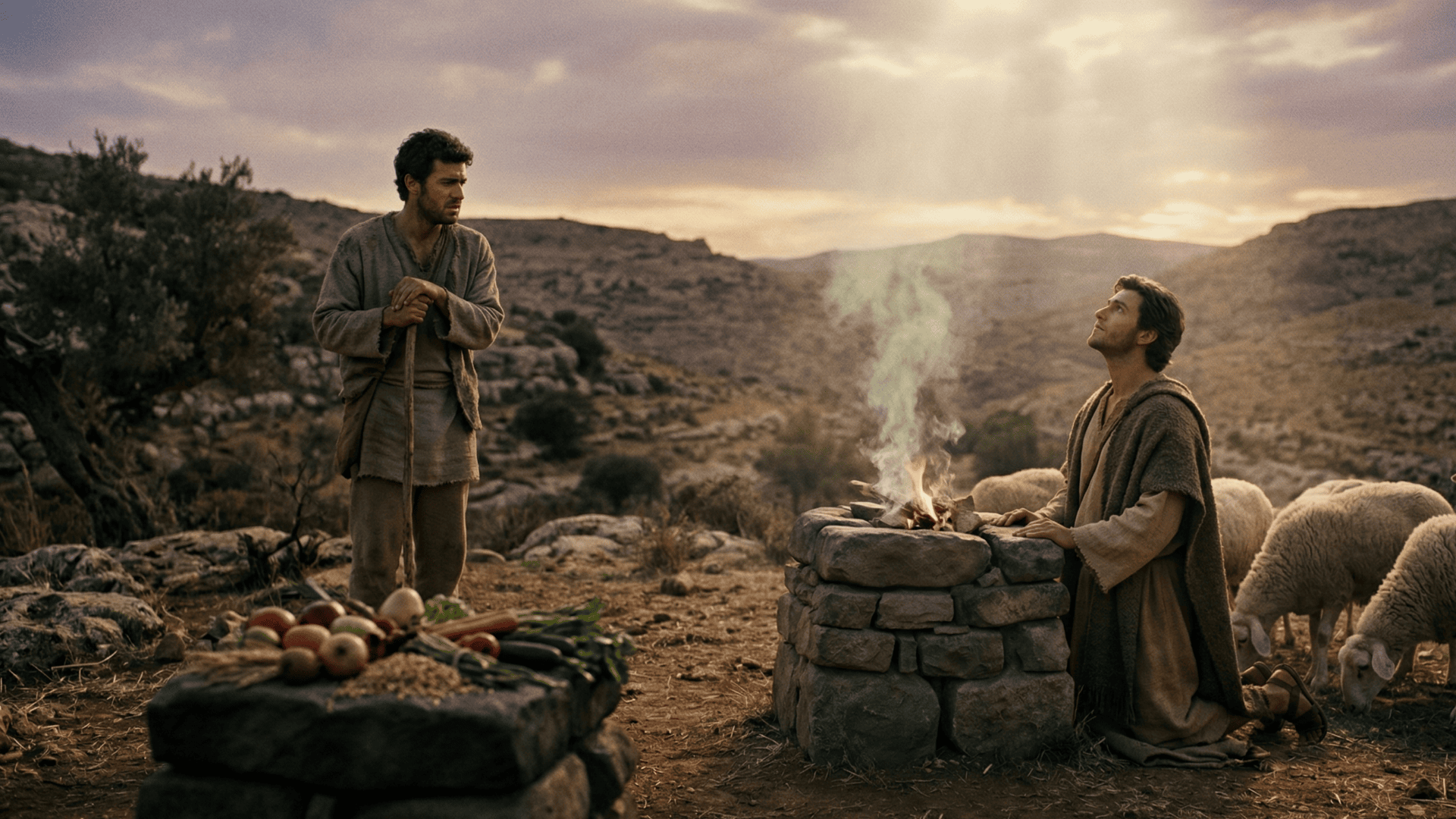
Cain and Abel were the first two children of the first man and woman, Adam and Eve. According to religious texts, they were the first siblings born on Earth. Cain was a farmer by trade, tilling the soil and growing crops. On the other hand, his younger brother, Abel, was a shepherd who tended animals.
This occupational difference extended beyond their work and profoundly affected their character and how they expressed devotion to God. Through these two brothers, human history witnessed the first religious worship, the first instance of jealousy, and tragically, the first act of murder.
Why the Story of Cain and Abel is Important in Multiple Religions
The story of Cain and Abel is not just an ancient myth. It serves as a clear mirror reflecting human nature. Why is this story so important across multiple religions? It highlights the eternal conflict between good and evil within humans.
When we read sources such as the Encyclopedia Britannica and other historical texts, we see that this story teaches us how unchecked human anger and jealousy can bring about destruction. It reminds us that we are ultimately accountable to God or cosmic laws for our actions. Religious texts use this story to encourage believers to avoid malice and to worship with absolute sincerity.
Understanding Religious Perspectives on Cain and Abel
Understanding how the major world religions interpret this story is crucial for us. Through this, we can gain insight into the core philosophies and moral frameworks of those faiths. Let us review this story from the perspectives of Judaism, Christianity, and Islam.
Cain and Abel in Judaism
In Jewish religious tradition, the story of Cain and Abel is discussed with immense importance. A detailed account of this story is found in Genesis, the first book of the Torah or the Hebrew Bible. Jewish scholars have analyzed every word and sentence of this story for hundreds of years.
How Cain and Abel are Described in Judaism
The story of Cain and Abel is narrated in Chapter 4 of Genesis. Here, Cain is mentioned as the firstborn child. The name Cain translates to “acquire” or “get.” Conversely, the name Abel (Hevel in Hebrew) means “breath” or “vanity,” foreshadowing his fleeting life. In Jewish scripture, Cain is portrayed as an agriculturist and Abel as a herdsman.
The First Siblings in the Hebrew Bible
According to the Hebrew Bible, these two brothers decided to present offerings to God. Cain brought some of the fruits of his soil to God. Abel, on the other hand, sacrificed the firstborn and the fattest animal from his flock. This event is considered the first formal instance of expressing gratitude to God in human history.
Why Cain’s Offering Was Rejected
The Genesis account shows that God accepted Abel’s offering but rejected Cain’s. But why did this happen? According to Jewish religious interpretation or “Midrash,” Cain’s offering lacked sincerity. Cain did not give the best part of his harvest; instead, he brought ordinary or inferior crops.
On the contrary, Abel offered the best and firstborn animal of his flock with great devotion and love. God does not look at a person’s outward actions but rather at their inner intention or motive. Cain’s heart held pride and stinginess, which God did not favor.
Jewish Interpretations of Jealousy and Responsibility
After his offering was rejected, Cain became intensely furious and depressed. God warned Cain that sin was crouching at his door, and he must master it.
However, Cain failed to control his jealousy. One day, finding his brother alone in the field, Cain murdered Abel. Later, when God asked Cain, “Where is your brother Abel?” Cain gave that famous reply, “I do not know. Am I my brother’s keeper?”
In Jewish philosophy, this question stands as an eternal warning for mankind. According to the rabbis, yes, we are all keepers of our brothers and fellow humans. Evading responsibility toward others is a grave offense.
Cain and Abel in Christianity
In Christian theology, the story of Cain and Abel is not just a historical event but a profound metaphor for the sacrifice and faith of Jesus Christ.
How Cain and Abel are Described in Christianity
Christianity accepts the Jewish Hebrew Bible as the “Old Testament.” Therefore, the foundational story of Cain and Abel remains the same for Christians. However, Christian spiritual leaders have interpreted this story in a new light. They view Abel as a true believer and Cain as someone led astray by the devil’s temptation.
Cain and Abel in the Old and New Testaments
Cain and Abel are mentioned several times in the New Testament. For instance, the Epistle to the Hebrews (11:4) states that by faith Abel offered to God a more acceptable sacrifice than Cain. It was because of this faith that he was declared righteous. The New Testament presents Cain as someone associated with evil deeds.
Abel as a Symbol of Faith and Righteousness
In Christianity, Abel is honored as the first martyr. His blood crying out to God from the ground is often compared to the blood of Jesus Christ. Christian theologians believe that Abel’s sacrifice foreshadowed the ultimate sacrifice of Jesus. Abel was killed by his brother despite being innocent, much like Jesus was crucified despite his innocence.
Christian Lessons from Cain’s Actions
The First Epistle of John (3:12) warns Christians not to be like Cain, who belonged to the evil one and murdered his brother. From Cain’s life, Christians learn that anger and jealousy destroy the soul.
The first condition for loving God is loving one’s brother or neighbor. Cain’s story reminds us that violence can never be a solution, as it only brings destruction.
Cain and Abel in Islam
In Islam, the story of Cain and Abel is narrated with great significance in the Holy Quran. In Islamic terminology, these two brothers are generally referred to as Qabil (Cain) and Habil (Abel).
How Cain and Abel (Qabil and Habil) are Described in Islam
Their names are not mentioned directly in the Quran; rather, they are referred to as the “two sons of Adam.” We learn their names, Qabil and Habil, from Islamic scholars’ Tafsir (Quranic exegesis) and Hadith literature. Islamic tradition also states that Qabil practiced agriculture while Habil tended livestock.
The Story of Adam’s Two Sons in the Quran
This story is detailed in verses 5:27-31 of Surah Al-Ma’idah in the Holy Quran. Allah commands Adam to have his two sons offer a sacrifice. The Quranic account states that one offering was accepted while the other was not. The one whose offering was rejected (Qabil) became angry and threatened to kill the other (Habil). Habil replied very calmly that even if Qabil stretched out his hand to kill him, he would not raise his own hand to kill Qabil, because he feared Allah.
Thereafter, Qabil murdered Habil. After committing this first murder, Qabil did not know what to do with his brother’s corpse. Allah then sent a crow. The crow scratched the ground to bury another dead crow, demonstrating how to bury the dead. Seeing this, Qabil felt remorse and realized he was even more helpless than a crow.
Why Abel’s Offering Was Accepted
The Quran clearly states why Habil’s offering was accepted. In verse 27 of Surah Al-Ma’idah, Habil says, “Indeed, Allah only accepts from the righteous (who fear Him).” The concept that the condition of your heart is much more important than what you are physically giving is very strong in Islam. Habil had Taqwa (deep reverence for Allah) in his heart, which Qabil lacked.
Moral Lessons from Qabil and Habil in Islam
The story of Qabil and Habil offers one of Islam’s greatest lessons on preserving humanity. Immediately following this event, the Quran (5:32) declares that whoever kills a soul unless for a soul or for corruption done in the land, it is as if he had slain mankind entirely. And whoever saves one, it is as if he had saved mankind entirely. This verse is most frequently used to illustrate the sanctity of life and the horror of murder in Islam.
The Cain Tradition in Religious Contexts
The story of Cain, or Qabil, has prompted people to reflect throughout the ages. His character is established as a negative example in religious texts.
How Cain is Seen as a Symbol of Jealousy and Sin
Cain is identified as the world’s first murderer. He symbolizes a person who fails to control his greed and jealousy. This failure pushes him far from God’s presence. He is the first person in human history to have tried to justify himself rather than to show repentance.
Cain’s Punishment and Exile Across Religions
Cain was given severe punishment for the crime of killing his brother. According to the biblical account, God cursed him so that the ground would no longer yield its crops for him, and he would have to wander the Earth as a fugitive. Banished from God’s presence, Cain settled in a place called Nod. Islamic tradition also records that Qabil spent the rest of his life in fear and remorse for his actions.
Interpretation of the Mark of Cain
A fascinating element in the Genesis narrative is the “Mark of Cain.” When Cain fears that someone might kill him while he is wandering the Earth, God gives him a special mark for protection. God declares that anyone who kills Cain will suffer vengeance seven times over. There is much debate about what this mark actually was. Some believe it was a physical scar, while others think it was a miraculous protective system from God. This proves that even though God punished Cain, He did not want to destroy him completely, bearing a subtle hint of God’s mercy.
Abel in Religious Traditions
On the other hand, the legacy of Abel or Habil is highly sacred and inspiring in the religious world.
How Abel is Seen as a Symbol of Innocence and Faith
Abel is remembered as the first innocent victim in human history. He was on the path of justice and lost his life solely due to his brother’s jealousy. He is depicted as a man who had complete trust in God and did not deviate from his principles, even in the face of death.
Abel’s Sacrifice and Its Spiritual Significance
The main significance of Abel’s sacrifice is that it was unconditional and represented his absolute best. He gave the finest portion of his property to God. This teaches us that one should never be stingy in worship or charity. From a spiritual standpoint, Abel’s action proves that God’s pleasure is far more valuable than material wealth.
Why Abel is Remembered as Righteous
Abel is recognized as righteous in Judaism, Christianity, and Islam alike. This is because he did not protest injustice with weapons, but rather relied on God’s judgment. His humble and honest nature has made him a unique model of righteousness across generations.
Cain and Abel in Other Religions
The influence and interpretation of this story can be found even outside the major monotheistic religions.
Interpretations in the Baha’i Faith
In the Baha’i faith, the story of Cain and Abel is viewed more metaphorically than literally. According to Baha’i scholars, Cain and Abel symbolize two distinct aspects within a human being. Cain represents the “lower self” or material desires, which are always filled with jealousy and pride. Abel, conversely, represents the “higher self” or spiritual soul. The core lesson of this story is to suppress our inner material desires and awaken our spiritual being.
Symbolic Readings in Interfaith and Comparative Religion
In comparative theology, this story is seen as a symbol of the evolution of human civilization. Many researchers believe it is actually an allegory for the conflict between ancient agrarian and pastoral societies. The primal conflict among humans over wealth and land is primitively expressed in the story of Cain and Abel.
Cain and Abel in Literature and Philosophy
Stepping beyond religious boundaries, the story of Cain and Abel has also made a massive impact on literature and philosophy. The famous novel “East of Eden” by world-renowned author John Steinbeck is heavily influenced by the Cain and Abel narrative. In literature, Cain is frequently portrayed as a tragic hero constantly battling his destiny and his own nature. Philosophers have used this story to engage in deep discussions regarding free will and predetermined fate.
Comparing Religious Perspectives
If we place the narratives from different religions side by side, we will notice some fascinating similarities and differences.
Similarities Among Jewish, Christian, and Islamic Accounts
- In all religions, Cain and Abel are the children of the first man, Adam.
- Both brothers offer sacrifices to gain closeness to God.
- Abel’s offering is accepted, while Cain’s is rejected.
- Driven by jealousy, Cain murders Abel.
- This was the first murder on the face of the Earth.
- Cain suffers punishment for his actions.
Main Differences in the Story of Cain and Abel
The differences are mostly limited to specific events and interpretations.
- Motive for Murder: In the biblical account, the primary reason for the murder is merely the rejection of the offering. However, Islamic commentaries state that alongside the offerings, there was a conflict between the two brothers regarding the right to marry their twin sisters.
- The Crow Incident: The profound and instructive incident of Allah sending a crow to teach burial practices is mentioned only in the Holy Quran. It is absent from the biblical narrative.
- Religious Focus: In Christianity, Abel is seen as a foreshadowing of Jesus’ sacrifice, a concept absent in Judaism or Islam.
Common Moral Lessons Across Religions
Regardless of the differences, the core lessons are identical everywhere. Jealousy brings about human downfall. Inner purity is far more important to God than outward displays. Furthermore, taking an innocent person’s life is never justifiable under any circumstances.
Historical and Symbolic Perspectives
Besides religious beliefs, historians and sociologists have also analyzed this story from their own viewpoints.
What Historians Discuss About the Story of Cain and Abel
According to many historians, the story of Cain and Abel captures a specific transitional period in human civilization. When humans abandoned nomadic life and began settling down for agriculture, conflicts often arose between herders and farmers over land rights. Cain (the farmer) killing Abel (the shepherd) could symbolize that ancient social conflict.
Symbolism of Brotherhood, Conflict, and Human Nature
According to the theory of psychologist Carl Jung, Cain and Abel are two different manifestations of the human subconscious mind. We all have a Cain inside us who gets jealous and an Abel who wants to do good deeds. A constant war is raging between these two forces. This conflict of brotherhood is not just between two siblings, but a psychological battle within all of mankind.
Why the Story is Still Relevant Today
Even in today’s modern world, this story remains incredibly relevant. Today, we still grow envious looking at each other’s wealth. People are killing others for political, social, or personal gain. We should ask ourselves Cain’s question today: “Am I my brother’s keeper?” Are we fulfilling our responsibilities toward the helpless people around us, or are we turning a blind eye?
Moral and Spiritual Lessons
We can draw countless crucial lessons for our daily lives from the story of Cain and Abel.
Lessons on Jealousy, Anger, and Envy
The story clearly shows that jealousy and anger act like poison. They destroy the bearer first. Had Cain managed to control his anger, he would not have had to wander as a cursed man for the rest of his life. Learning to manage frustration or anger when it arises is essential in our own lives.
The Importance of Faith and Sincerity in Worship
Whatever we give to God or society, it must be our very best. Like Habil or Abel, we must possess honesty and sincerity in our hearts. Showy actions or insincere worship never yield good results.
Brotherhood and Responsibility in Religious Teachings
We do not live in this world alone. Our actions affect others. We have specific responsibilities toward our brothers, neighbors, and society. We cannot simply close our eyes to the suffering of others, even if we want to.
Frequently Asked Questions (FAQ)
In which religions are Cain and Abel mentioned?
The story of Cain and Abel is primarily mentioned in the three major Abrahamic religions. These are Judaism (the Torah/Hebrew Bible), Christianity (the Old and New Testaments), and Islam (the Holy Quran). Additionally, metaphorical references appear in other belief systems, such as the Baha’i Faith.
What are Cain and Abel called in Islam?
In Islamic tradition and Tafsir literature, Cain is called “Qabil,” and Abel is called “Habil.” The Holy Quran refers to them not by their direct names, but as the “two sons of Adam.”
Why was Abel’s offering accepted?
The primary reason Abel’s offering was accepted was his sincerity and deep devotion to God. He lovingly sacrificed the very best animal from his flock for God. According to Islamic interpretation, he had “Taqwa” or the fear of God in his heart, which God favored.
What is the Mark of Cain?
The “Mark of Cain” is a symbolic or physical mark described in the Bible that God gave to Cain. After being exiled for the crime of murdering his brother, Cain feared that someone might kill him. God then gave him this mark for protection so that no one would harm him.
What moral lessons can be learned from the story of Cain and Abel?
The main moral lesson of this story is to be aware of the destructive consequences of jealousy and anger. It teaches that sincerity is the most required element in worship and that we must be responsible toward others as human beings. Killing an innocent person is a grave injustice under any circumstances.
Conclusion
Final Thoughts on Cain and Abel Across Religions
The story of Cain and Abel is one of the most influential narratives in human history. For thousands of years, this story has echoed in people’s mouths, in places of worship, and on the pages of literature. Although there are minor differences in the descriptions of this story across Jewish, Christian, and Islamic texts, the deep spiritual and moral message behind it is entirely universal.
Understanding Common Stories of Different Faiths
These shared stories across world religions remind us that, despite differences in race or faith, our core human problems and crises are the same. We all originate from the same source, and the internal battle between good and evil is identical for everyone. Comparative discussions of these stories are highly important for fostering interfaith understanding.
Why the Story of Cain and Abel Matters Today
As long as humans exist on Earth, and as long as jealousy and love reside in human hearts, the story of Cain and Abel will not lose its relevance. It is a mirror that shows us our own reflection when we stand before it. It reminds us every day that we must suppress our inner “Cain,” or violent nature, and awaken our “Abel,” or pure nature. Only then will it be possible to build a beautiful, peaceful, and responsible society.