
How Major Religions View the Patriarch Jacob
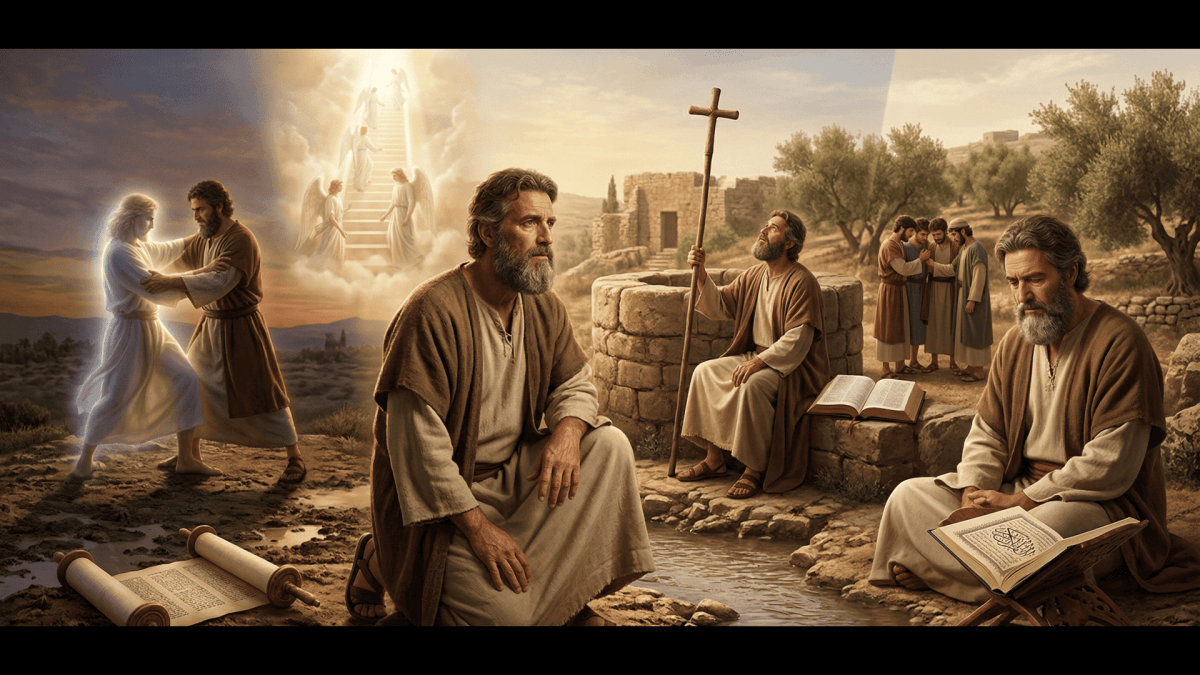
When we delve deeply into the history and belief systems of the world’s major monotheistic religions, we find certain personalities who bind these faiths together with an invisible thread. Among these great figures is Jacob, known as Yaqub in Arabic and Islamic traditions. This patriarch is a wonderful intersection of history, theology, and spirituality. He is not just a historical figure but the spiritual father to a significant portion of humanity.
In today’s detailed discussion, we will explore how the world’s major religions view and evaluate Jacob, the Patriarch of Israel. We will seek to gain a deep understanding of his life story, spiritual journey, and legacy.
Who is Jacob?
Jacob or Yaqub is one of the most prominent patriarchs of the Abrahamic religions. He was the son of Isaac and Rebecca, and the grandson of Abraham. According to religious texts, he was born in the land of Canaan and spent a large part of his life there and in Egypt. Jacob’s life story is a unique blend of human emotions, mistakes, struggles, divine grace, and ultimate victory. Every turn of his life teaches us how an ordinary human being can become a great leader through divine blessing.
Why Jacob is an Important Figure in Multiple Religions
Jacob or Yaqub is equally revered in Judaism, Christianity, and Islam. These three religions are collectively known as the “Abrahamic religions” because they all consider Abraham as their spiritual father. Jacob is a direct part of that lineage. His greatest identity is that the twelve tribes of Israel originated from his twelve sons.
These twelve tribes later formed the core foundation of the Jewish nation. In Christianity, he is seen as an ancestor of Jesus Christ. In Islam, he is a respected prophet well known for his boundless love and patience for his son Yusuf (Joseph). This is why Jacob is not the exclusive property of any single religion but a highly revered figure for billions of people worldwide.
Understanding Religious Perspectives on Jacob
Each religion has its own perspective on Jacob. While the core stories of his life are largely similar across faiths, interpretations of various aspects of his character and life events differ from one religion to another. Judaism emphasizes his struggles and his role as the father of the nation. Christianity highlights how his life paved the way for God’s grace and the coming of Jesus. Islam glorifies his prophetic qualities, unwavering faith, and patience. By understanding these diverse perspectives, we can truly grasp Jacob’s true greatness.
Jacob in Judaism
In Judaism, Jacob or Yaakov is one of the most important figures. He is considered the father of the entire Jewish nation. According to the Jewish religious text, the Torah, Jacob’s life is a perfect reflection of humanity’s relationship with God.
How Judaism Describes Jacob
Followers of Judaism view Jacob as a symbol of truth, honesty, and perseverance. He was a man who struggled throughout his life. He struggled with his brother, his father-in-law, his own mind, and even with an angel of God. Jewish tradition describes him as an “ideal man” who achieved spiritual perfection by overcoming his own weaknesses.
Jacob as One of the Three Patriarchs
There are three main patriarchs or “Avot” in Judaism. They are Abraham, Isaac, and Jacob. During prayers, Jews often address God as “God of Abraham, God of Isaac, and God of Jacob.” Among these three, Jacob is given a special status because none of his children went astray. Abraham’s son Ishmael and Isaac’s son Esau chose different paths, but all twelve of Jacob’s sons followed God’s path, and together they formed the nation of Israel.
The Story of Jacob and Esau
The story of Jacob and his twin brother Esau is one of the most discussed topics in Jewish literature. They used to clash even while in their mother’s womb. Esau was a hunter and his father’s favorite, while Jacob was quiet and his mother’s favorite. Jacob bought the elder brother’s “birthright” from Esau in exchange for a bowl of lentil stew. Later, with his mother’s help, he also received the blessing his blind father, Isaac, had meant for Esau. This incident has generated considerable debate among Jewish scholars. Many believe that Jacob’s actions were part of God’s greater plan because Esau was not suitable for spiritual leadership.
Changing Jacob’s Name to Israel
The most important event in Jacob’s life is his name change. According to the Book of Genesis in the Bible (Chapter 32), while Jacob was returning to meet his brother Esau, he wrestled with a mysterious man (often called an angel of God) at night. Jacob fought all night and won. The angel then blessed him and said that his name would no longer be Jacob but Israel, because he had struggled with God and humans and had overcome. The word “Israel” means “one who struggles with God.” This name became the identity of the entire Jewish nation.
Jacob’s Role in Forming the Tribes of Israel
Jacob had twelve sons. They were Reuben, Simeon, Levi, Judah, Dan, Naphtali, Gad, Asher, Issachar, Zebulun, Joseph, and Benjamin. The descendants of these twelve sons are the “Twelve Tribes of Israel.” Before his death, Jacob individually blessed each of his sons and prophesied about their future. These tribes later settled in the land of Canaan and became a powerful nation.
Jacob in Christianity
Jacob’s role in Christianity is extremely significant. The story of Jacob is described in detail in the Old Testament of the Bible. Christians see Jacob as a living example of God’s grace and forgiveness.
How Christianity Describes Jacob
In Christianity, Jacob is portrayed as a man who was not born perfect, but whom God chose for His work. Jacob’s deceptions and weaknesses were not hidden; they were used to show how God can transform an imperfect person into greatness. This is a major proof of the concept of “Grace” in the Christian faith, where the unworthy are rewarded.
Jacob in the Old Testament
A detailed biography of Jacob is found in the Book of Genesis in the Old Testament, the first part of the Christian Bible. There, he is presented as a hardworking shepherd, a devoted husband, and a thoughtful father. Jacob took shelter in his uncle Laban’s house and worked hard for fourteen long years to marry his two daughters, Leah and Rachel. This event proves the depth of his love and his commitment.
Lessons from Jacob’s Life in Christian Teachings
Christian theologians draw several important lessons from Jacob’s life. First, God’s plan does not falter because of human mistakes or flaws. Second, one should have a strong desire for spiritual blessings, just as Jacob did. Third, a person must sacrifice their pride to establish a personal relationship with God. When Jacob wrestled with the angel of God at a place called Peniel, his hip bone was dislocated. This physical weakness taught him that he must rely not on his own strength but on God’s.
Jacob as the Ancestor of the Israelites and Jesus
For Christians, Jacob’s greatest identity is as an important ancestor in the lineage of Jesus Christ. Jacob’s name is clearly mentioned in the genealogies of Jesus in the New Testament Gospels of Matthew and Luke. It was in the lineage of Jacob’s son Judah that King David and later Jesus Christ were born. Therefore, Jacob’s role in establishing the historical foundation of Christian belief is immense.
Jacob in Islam
In Islam, Jacob is a highly respected prophet known as “Yaqub” in Arabic. In Islamic literature and the Holy Quran, he is described as an extremely temperate, wise, and fully surrendered man to God.
How Islam Describes Jacob (Yaqub)
Islam considers Yaqub as a “Nabi” or messenger of God. While the Bible highlights some weak aspects of his life (such as resorting to deception), from an Islamic perspective, prophets are Masum or sinless. Therefore, in Islam, Yaqub is seen as an honest, righteous, and perfectly charactered person. He received Wahy (revelation) from Allah and called people to the worship of the one God.
Prophet Yaqub in the Quran
Prophet Yaqub is mentioned in several Surahs of the Holy Quran. He is spoken of in Surah Al-Baqarah, Surah Al-‘Imran, Surah Al-Nisa, Surah Al-An’am, Surah Al-Hud, and Surah Yusuf. In the Quran, he is also called “Israel,” and his descendants are called “Bani Israel” (Children of Israel). The Quran presents Yaqub as a wise and visionary prophet who received special knowledge from Allah.
Jacob as a Righteous Prophet in Islam
In verses 72 and 73 of Surah Al-Anbiya in the Quran, Allah says that He bestowed Isaac and Yaqub upon Abraham and made all of them righteous. Allah made them leaders who guided people according to His command. According to Islamic belief, Prophet Yaqub established justice among his community and spread the light of Tawhid (monotheism), freeing people from Shirk (polytheism).
The Sorrowful Tale of Yusuf (Joseph) and Jacob
The most emotional chapter of Prophet Yaqub’s life is the event of losing his son Yusuf. This story is beautifully described in the 12th chapter of the Quran, ‘Surah Yusuf’. Yaqub loved his son Yusuf very much, which sparked jealousy among his other sons. They threw Yusuf into a dark well and lied to their father, saying a wolf had eaten him. As proof, they showed Yusuf’s blood-stained shirt. Yaqub understood that his sons were lying, but he did not take any revenge. He lost his eyesight while weeping over the separation from Yusuf. This tragic story is an extreme example of the love between a father and a son.
Jacob’s Faith and Patience in Islamic Tradition
The reaction Prophet Yaqub showed after losing Yusuf is known in Islamic tradition as “Sabr-e-Jamil” or the most beautiful patience. Instead of mourning or complaining, he said that he only complained of his sorrow and pain to Allah. For years, he held on to the hope that Allah would return his son one day. Finally, when he learned that Yusuf had become a powerful man in Egypt and that the shirt Yusuf had sent was placed over his eyes, his eyesight returned. Yaqub’s unwavering faith and patience are an invaluable lesson for Muslims to rely on Allah during extreme crises.
Jacob in Other Traditions
Outside of Judaism, Christianity, and Islam, the presence of Jacob or Yaqub is also noticed in some religious and philosophical traditions. Although his role may differ across these religions, his spiritual significance cannot be denied.
Jacob in the Baha’i Faith
The Baha’i Faith believes in the unity of all major religions and the truth of all prophets. In the Baha’i Faith, Jacob is honored as a holy man of God and an important messenger of a previous era. According to Baha’i belief, Jacob had a specific role in humanity’s spiritual evolution. He is part of that continuity, which reached perfection through the arrival of Baha’u’llah. Jacob’s name is remembered with great respect in Baha’i writings.
Interpretation of Jacob in Symbolic Comparative Theology
In comparative theology and spiritual philosophy, Jacob is often seen as a “symbolic” character. His life is interpreted as a metaphor for the awakening of the human soul. For example, Jacob’s Ladder, a dream in which he saw a ladder between heaven and earth with angels ascending and descending, is considered by many to be a symbol of reaching the spiritual world from earthly life. It proves that there is always an invisible medium of communication between the Creator and creation.
Jacob from Historical and Cultural Perspectives
According to historians and sociologists, Jacob is not just a religious character; he is an important representative of ancient Middle Eastern culture. Jacob’s story is an excellent source for understanding ancient nomadic lifestyles, animal husbandry, tribal customs, and family structures. Jacob also has a massive influence on literature, painting, and music. Famous painters such as Rembrandt have depicted Jacob’s life on canvas, attesting to his vast cultural impact.
Comparison of Different Religious Views on Jacob
Although Jacob is present in the three main Abrahamic religions, there are similarities and differences in how he is viewed. This comparative discussion will help us better understand Jacob’s character.
Similarities Between Jewish, Christian, and Islamic Accounts
All three religions agree that Jacob was the grandson of Abraham and the son of Isaac. Everyone believes that he was chosen by God and that his descendants are the twelve tribes of Israel. There is complete harmony among the Jewish Torah, the Christian Bible, and the Muslim Quran regarding the facts that Jacob was a shepherd, had many children, and suffered extreme hardships for his beloved son Joseph or Yusuf. All three religions recognize him as a pioneer of monotheism.
Main Differences in the Story of Jacob Across Religions
The differences are mainly due to religious perspectives and the definition of prophethood. In Judaism and Christianity, Jacob is portrayed as an ordinary man with human weaknesses. He deceived his brother and played tricks with his father-in-law. These religions believe that God’s greatness lies precisely here, in the fact that He used this flawed man to fulfill His purpose.
On the other hand, in Islam, prophets are sinless and protected by Allah. Therefore, there is no mention of any deception or trickery by Yaqub in the Quran or authentic Hadith. Islam presents him only as a great, wise, and extremely patient prophet. Furthermore, while Jacob wrestling with the angel of God is very important in Judaism and Christianity, there is no such concept in Islam, as from an Islamic perspective, a human can’t wrestle with an angel of God.
Why Jacob is a Common Patriarch
Despite so many differences, Jacob brings the followers of three religions together in one place. He is the root from which three massive religious trees have grown. Jews consider him the father of their nation, Christians consider him the ancestor of Jesus, and Muslims honor him as a beloved prophet of Allah. This concept of a common patriarch can be a valuable tool for fostering interfaith dialogue and harmony.
Jacob’s Family and Legacy
Jacob’s life cannot be understood outside his family. His personal relationships determined the course of history. Every member of his family is an important character in religious history.
Isaac, Rebecca, Esau, and Joseph in Jacob’s Story
Jacob’s father, Isaac, was a calm man, while his mother, Rebecca, was intelligent and visionary. Rebecca knew that Jacob was God’s chosen one, so she helped Jacob. Jacob’s conflict with his brother, Esau, was a historical conflict that later gave rise to two nations (Israel and Edom). However, a beautiful reconciliation between Jacob and Esau occurred later in life, a unique example of forgiveness.
On the other hand, Jacob’s relationship with his son Joseph (Yusuf) was the deepest. Just as he was overwhelmed with grief losing Joseph, he found immense peace reuniting with Joseph in Egypt towards the end of his life. These family relationships prove that even in the life of a great man, there are laughter, tears, love, and separation, just like in the lives of ordinary people.
The Twelve Tribes of Israel
Twelve sons were born to Jacob’s four wives (Leah, Rachel, Bilhah, and Zilpah). The twelve tribes of Israel originated from these twelve sons. These tribes are the core foundation of the Israeli nation. In ancient times, when these tribes returned to the land of Canaan after being freed from slavery in Egypt, each became the owner of a separate territory. Even in the modern era, the concept of these tribes remains deeply rooted in Jewish identity.
Jacob’s Covenant and Lineage
The covenant God made with Abraham was renewed through Jacob after Isaac. God promised Jacob that his descendants would be as numerous as the stars in the sky and would be a blessing to the earth. Through Jacob, this covenant did not remain confined to a family but extended to the entire nation. It is within this lineage of Jacob that great men like Moses, David, Solomon, and Jesus were born.
Historical and Symbolic Perspectives
Going beyond religious beliefs, how historians and archaeologists evaluate Jacob is also an intriguing subject. Scholars offer various theories regarding the historical authenticity of Jacob.
Was Jacob a Historical Figure?
There is debate among modern archaeologists about the historicity of Jacob. Some researchers believe that patriarchs such as Jacob, Abraham, and Isaac are metaphorical figures. According to them, when various ancient tribes were coming together to form a nation, these stories of patriarchs were created to unite them.
However, many historians believe that the stories of the patriarchs described in the Bible have a real historical basis. Jacob’s story aligns beautifully with the nomadic lifestyle, laws, and social customs prevalent in the Middle East during the second millennium BCE. Therefore, many scholars believe there is a strong possibility that a historical figure named Jacob existed, around whom these religious narratives later developed.
What Scholars Say About the Patriarch Jacob
Biblical scholars believe that Jacob’s story reflects the dual nature of human beings. On the one hand, he resorted to cleverness to serve his own interests, and on the other hand, he was desperate to attain closeness to God. According to scholars, Jacob’s mental conflict makes him very relatable to readers. He was no superhuman; rather, he was an ordinary man who constantly tried to improve himself.
Jacob as a Symbol of Struggle and Faith
Jacob is globally seen as a symbol of struggle and survival. He never gave up. To escape his brother’s wrath, he had to leave his country; he was deceived at his uncle’s house, he lost his beloved wife prematurely, and he had to endure the grief of losing his most dearest child. Even after all this, he did not stray an inch from his faith. This is why Jacob is one of the greatest examples of a “survivor” in human history.
Moral and Spiritual Lessons
Jacob’s life is not just a matter of history or theology; it is full of countless moral and spiritual lessons for our daily lives. Every event of his life teaches us to think anew.
Lessons of Patience and Faith from Jacob
The greatest lesson we get from the life of Prophet Yaqub, or Jacob, is patience. When his sons brought the news of Yusuf’s death, he did not get agitated and punish them or lose faith in God. He said, “Sabr-e-Jamil,” meaning “beautiful patience.” He maintained this patience for years. In our lives, too, when danger or grief arrives, we should rely on God with absolute patience, as Jacob did.
Family Conflict and Resolution in Jacob’s Story
Family conflict was a major part of Jacob’s life. Enmity with his brother and jealousy among his children made him suffer a lot. But he taught us how to resolve these conflicts. When he faced his brother Esau after twenty long years, he did not show arrogance. He apologized to his brother and offered gifts. Esau also embraced him. This proves that with sincerity and forgiveness, even the oldest enmity can be removed.
Trusting God Amidst Life’s Adversities
Jacob’s life was full of adversities. But he maintained communication with God at every step. When he was fleeing his home, God’s word in a dream gave him courage. He understood that wherever he went, God was with him. When people of the modern era suffer from depression and loneliness, this reliance on God by Jacob can be a great inspiration for them.
Frequently Asked Questions (FAQ)
Which Religions Believe in Jacob?
The world’s three major monotheistic religions, Judaism, Christianity, and Islam, recognize Jacob (Yaqub) as a respected patriarch and religious figure. Furthermore, the Baha’i faith also honors him as a holy man of God.
Is Yaqub Mentioned in the Quran?
Yes, the name Yaqub is mentioned 16 times in the Holy Quran. The Quran describes him as a chosen prophet of Allah. Especially in Surah Yusuf, the story of him and his son Yusuf is described in great detail.
What is the Difference Between Yaqub in Islam and Judaism?
In Judaism, Jacob is seen as the father of the Israelite nation and as an ordinary man with human flaws. It is believed that he wrestled with an angel of God. On the other hand, in Islam, Yaqub is a sinless prophet of Allah. In Islamic belief, he committed no deception, and there is no concept of wrestling with God or His angels in Islam.
Why was Yaqub Called Israel?
According to Jewish and Christian beliefs, when Jacob wrestled with an angel of God at night and prevailed, the angel changed his name to ‘Israel’, meaning ‘one who struggles with God’. In Islamic belief as well, he is called Israel, but the meaning there is ‘servant of Allah’ or ‘slave of Allah’.
What Can We Learn from the Story of Yaqub?
The story of Yaqub teaches us to have unwavering faith, to maintain patience amid extreme danger and sorrow, to resolve family conflicts beautifully, and to rely on the sole Creator in all circumstances of life.
Conclusion
The Patriarch of Israel, Jacob, or Prophet Yaqub, is such a personality without whom the history of the world’s major religions cannot even be imagined. Just as he is the father of the Jewish nation, he is also the ancestor of Jesus Christ and a great prophet of Islam. His life story is not confined merely to the pages of ancient manuscripts but remains alive in the hearts of billions of people today.
Final Thoughts on Yaqub Across Different Religions
Although there are differences in how Jacob is viewed across Judaism, Christianity, and Islam, the core message remains the same. He is the person who established an intimate relationship with God. His mistakes, struggles, tears, and victories reflect human life. Forgetting religious differences, Jacob should be considered an ideal spiritual leader.
Understanding the Common Patriarchal Heritage Through Yaqub
Jacob’s life reminds us that the roots of the world’s great religions are grounded in the same place. If we can understand this common patriarchal heritage of Jacob, we can come much closer to each other, forgetting religious divisions. Jacob is a living symbol of interfaith harmony.
Why the Story of Yaqub Still Inspires Faith Today
Even after thousands of years, Jacob’s story has not grown old. When modern people suffer from family disputes, personal depression, and crises of faith, Jacob’s life shows them the way. How a person can hold firmly to God’s hand amidst hundreds of adversities is best exemplified by Jacob. His life teaches us that no matter how difficult the struggle, ultimate victory can be achieved through faith and patience. And for this reason, the story of Jacob, or Yaqub, has inspired humanity for ages and will continue to do so.