How is Mary Described in Different Religions?
Introduction
Who is Mary?
Mary, or Maryam, is a historical figure whom billions of people worldwide remember with deep respect and love. She is not just a historical personality but a shining example of motherhood, purity, faith, and complete surrender to God. It is truly amazing how an ordinary Jewish woman from the first-century town of Nazareth became the focal point of the world’s largest religions.
Historically, she is best known as the mother of Jesus. However, her identity is not limited to this alone. She is honored in various ways across different religions and cultures, and many aspects of education are drawn from her life. She is simultaneously a compassionate mother, a spiritual guide, and a symbol of mercy. Her life story has inspired countless people throughout the ages, and today she remains a unique symbol of unity worldwide.
To learn more about Mary’s life, see the biography in the Encyclopedia Britannica.
Why Mary is Revered in Multiple Religions
To understand why Mary is revered across so many religions, we must examine her spiritual qualities. Her character possesses universal traits that touch the hearts of people of all faiths. Qualities like humility, patience, profound faith in God, and selfless love are praised in all religions.
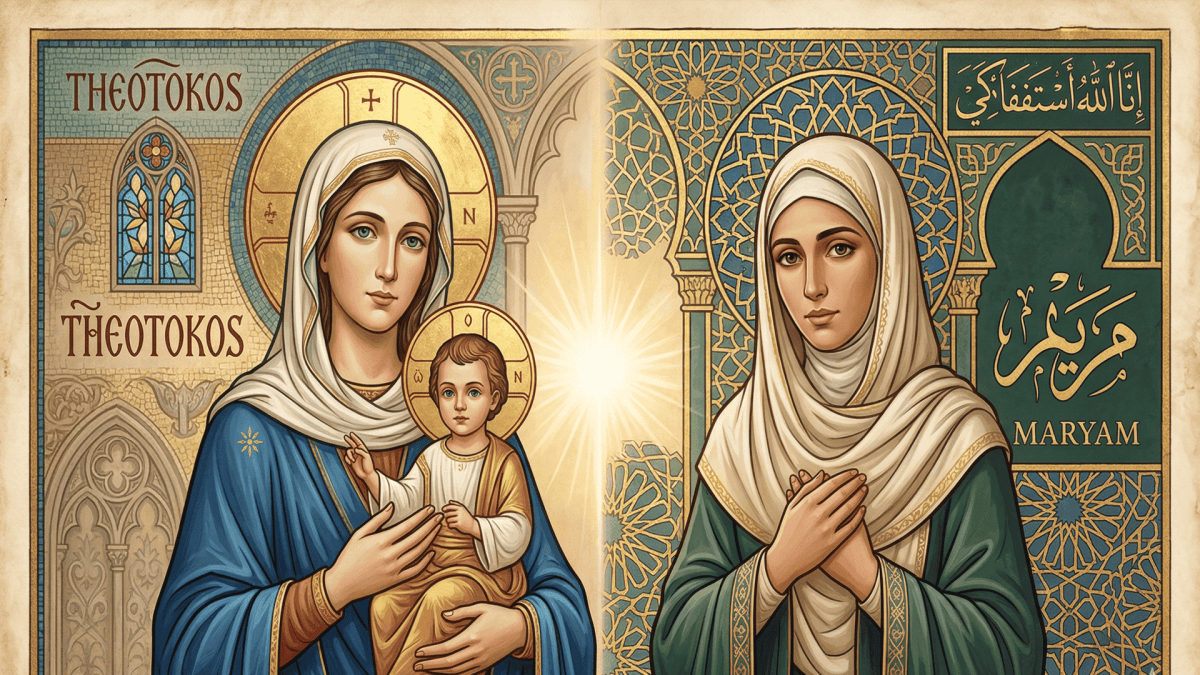
When Mary received God’s message, she accepted it without any hesitation. This modesty and surrender established her as an ideal for humanity. In Christianity, she is revered as the mother of Jesus, the Son of God. On the other hand, in Islam, she is remembered with the utmost respect as ‘Maryam’, and the Quran describes her as the greatest of women.
Not only in the Abrahamic religions, but also in Eastern religions such as Hinduism and Buddhism, deep respect is shown to mother figures like Mary. Her life story inspires hope, teaches patience in times of danger, and inspires unwavering faith in God. Thus, transcending religious boundaries, Mary has become a universal mother figure who helps tie humanity together with a single thread.
Understanding Religious Perspectives on Mary
By understanding how different religions view Mary, we can see a beautiful picture of interfaith harmony. Each religion evaluates Mary from its own perspective. In some beliefs, she is the Mother of God, in others, the mother of a great Prophet, and elsewhere, she is the very embodiment of compassion and purity.
These diverse perspectives teach us that, despite our different religious beliefs, we can still honor a particular ideal or personality. Discussing Mary means building bridges between different religions. When we see an ordinary woman receiving so much global respect for her extraordinary faith, we are awakened to a renewed interest in spirituality.
In this blog post, we will discuss in depth how the world’s major religions portray Mary and what we can learn from her life. Let us begin this exciting and enlightening discussion about Mary.
Mary in Christianity
How Christianity Describes Mary
Mary holds a very high place in Christianity. She is not just the mother of Jesus Christ but an integral part of the Christian faith. Christians believe that Mary was the woman chosen by God through whom the path of humanity’s salvation was paved.
Various aspects of Mary’s life are highlighted in the New Testament. It shows that Mary was a very pious and humble woman. When the angel Gabriel told her she would be the mother of the Son of God, she humbly accepted God’s will. Her statement, “I am the Lord’s servant, may your word to me be fulfilled,” is considered a great example of complete surrender in Christianity.
Mary not only gave birth to Jesus but also stood devotedly by his side during his upbringing, preaching, and crucifixion. To Christians, Mary is the ultimate symbol of motherhood, mercy, and unwavering faith.
Mary as the Mother of Jesus
Mary’s role as the mother of Jesus is immense. She took care of him in every step of his life, starting from his childhood. In the Bible, we see that Mary and Joseph raised Jesus in a simple and religious environment.
Mary knew that her child was no ordinary human being, yet she fulfilled her duties just as any other mother would. Mary played an important role in Jesus’ first miracle, which occurred at the wedding feast in Cana. At her request, Jesus turned water into wine. This proves how much Jesus respected his mother.
Furthermore, when Jesus was crucified, Mary was courageously present there. It is easily imaginable how painful it must be for a mother to see her own child suffer like that. But Mary endured that pain with extraordinary patience and faith. Therefore, Christians respect Mary not just as a birth mother but as a resilient and ideal mother.
The Virgin Birth in Christian Belief
The virgin birth is one of the main beliefs in Christianity. According to the Gospels of Matthew and Luke in the Bible, Mary became pregnant not through any human relationship but by the Holy Spirit.
This miraculous event proves that Jesus was the Son of God and that his birth was completely divine. Christians believe that to free humanity from sin, God needed a pure and sinless medium, and that medium was Mary. The concept of the virgin birth further glorifies Mary’s purity. It is not just a physical matter, but an expression of God’s infinite power.
For ages, Christian theologians have deeply discussed this, and it remains a core foundation of their faith. Giving birth to Jesus while remaining a virgin sets her apart from other ordinary women and establishes her as specially blessed by God.
Mary’s Role in Catholic, Orthodox, and Protestant Traditions
There is some variety in the perspective on Mary across different branches of Christianity.
Deep devotion and respect are shown to Mary in the Catholic Church. Catholics acknowledge Mary as the ‘Mother of God’. They believe that Mary was conceived without sin, which is known as the ‘Immaculate Conception’. Additionally, Catholics believe that Mary was taken bodily into heaven after her death, known as the ‘Assumption of Mary’. Catholics seek Mary’s intercession in prayer, believing that, as a mother,
Mary can convey their prayers to Jesus. To learn more about Catholic perspectives, you can visit the official Vatican website.
Mary is also highly respected in the Eastern Orthodox Church. They call her ‘Theotokos’ or God-bearer. Orthodox belief emphasizes Mary’s purity and her divine motherhood. Her presence is very noticeable in their worship and in their icons and artwork.
On the other hand, the perspective on Mary in the Protestant tradition is somewhat different. Protestants highly respect Mary and acknowledge her as a faithful servant of God and the mother of Jesus. However, unlike Catholics or Orthodox Christians, they do not pray to Mary or consider her a mediator.
According to Protestants, prayers should only be directed to God, and the sole mediator is Jesus Christ. Nevertheless, all Christian denominations agree that Mary was an extraordinary woman whose faith and loyalty are exemplary for everyone.
Titles of Mary in Christianity
Throughout its long history, Christianity has bestowed countless titles on Mary. These titles reflect the various aspects of her character and her influence on people’s lives.
The most familiar title is ‘Mother of God’. She is also called ‘Queen of Heaven’, ‘Our Lady’, ‘Virgin Mary’, and ‘Mother of the Church’.
In the Litany of Loreto, Mary is called by various other names, such as the Mystical Rose, the Tower of David, and the Morning Star. She has various forms and titles in different countries and cultures. For instance, in Mexico, she is known as ‘Our Lady of Guadalupe’, a deeply emotional figure for people in Latin America.
These numerous titles prove how deeply Mary is integrated into the lives of Christians and how much love and respect she is remembered with.
Mary in Islam
How Islam Describes Mary (Maryam)
The status of Mary, or Maryam (Peace Be Upon Her), in Islam is highly esteemed. In Islam, she is regarded as a symbol of purity, devotion, and complete submission to Allah.
The way Maryam is described in the Quran is in no way less than in the scriptures of any other religion. In fact, in many cases, her status in Islam has been presented even more specifically. According to the Wikipedia article on Mary in Islam, she is named in the Quran as the greatest of women.
There is an entire chapter in the Quran named after her, called ‘Surah Maryam’. It is the 19th chapter of the Quran. According to Islamic belief, Maryam was the daughter of Imran and Hannah. Even before her birth, her mother dedicated her to the service of Allah.
From childhood, Maryam was raised in the Baitul Muqaddas (Temple) in Jerusalem, and the Prophet Zakariya (PBUH) took charge of her guardianship. There she remained deeply engrossed in worship all day, and food reached her miraculously. In Islam, Maryam is given the highest honor as a truthful and pure woman.
Mary as One of the Most Honored Women in Islam
According to Islamic tradition and the Hadith of Prophet Muhammad (PBUH), Maryam is one of the four greatest women in the world. Verse 42 of Surah Al-Imran in the Quran states, “And mention when the angels said, ‘O Mary, indeed Allah has chosen you and purified you and chosen you above the women of the worlds.'”
This verse clearly proves how high Maryam’s status is in Islam. She was a woman who had never been associated with any sin, and her life was entirely dedicated to the worship of Allah. Muslims honor Maryam not just as the mother of Isa (Jesus) (PBUH), but also for her own spiritual heights.
Her patience, courage, and Tawakkul (reliance) on Allah are great inspirations for Muslim women.
The Story of Mary in the Quran
The story of Maryam is described in the Quran with great beauty and emotion. The Quran tells us how the angel Jibrail (Gabriel) (PBUH) came to Maryam in the form of a man and gave her the glad tidings of a pure child.
Maryam asked in utter astonishment how she could have a child when no man had touched her. Jibrail (PBUH) then assured her that it was the command of Allah, and everything is easy for Allah.
The Quran then describes the difficult days of Maryam’s pregnancy. Fearing that society would misunderstand and slander her, she went far away from populated areas.
During childbirth, she took shelter under a date palm tree, and agonizing in labor pains, she wished she had died before this! Allah then comforted her and miraculously provided water and fresh dates.
When she returned to society with the child, people started saying various things to her. Then the infant Isa (PBUH) miraculously spoke, declaring his and his mother’s purity.
This story mentioned in the Quran is a wonderful testament to Maryam’s indescribable suffering, her patience, and ultimately her gaining Allah’s help.
The Virgin Birth in Islamic Belief
Like Christianity, Islam also places full belief in the virgin birth. Islam firmly believes that Maryam conceived Isa (PBUH) by the miraculous power of Allah, without the touch of any man.
In the Quran, Isa (PBUH) is repeatedly addressed as ‘Isa ibn Maryam,’ or ‘Isa, son of Maryam,’ which is significant. Because in Arab society, a child was usually introduced by their father’s name, but in the case of Isa (PBUH), his mother’s name was used.
In Islam, Isa (PBUH) is described as Allah’s ‘Kalima’ (Word) and ‘Ruh’ (Spirit). The event of the virgin birth is considered in Islam as a sign of Allah’s infinite power. Muslims believe that just as Allah created Adam (PBUH) without parents, He similarly created Isa (PBUH) without a father, solely through his mother.
Therefore, there is no scope to deny the concept of the virgin birth in Islam.
Similarities and Differences Between Christian and Islamic Views on Mary
There are many similarities between Christianity and Islam regarding Mary. Both religions believe that Mary was an extremely pure and pious woman. ..Both religions acknowledge her virgin birth and accept her as being miraculously chosen. Both religions honor her as one of the greatest women in human history.
Mary’s humility, devotion, and maternal qualities are praised in both religions.
However, there are some fundamental differences as well. In Christianity, Mary is called the ‘Mother of God’ because Christians believe Jesus to be God or the Son of God. But in Islam, Isa (PBUH) is regarded as a great prophet and messenger of Allah, in no way God or the Son of God. Thus, in Islam, Maryam is called the ‘Mother of a Prophet’, not the Mother of God.
Besides, in the Catholic and Orthodox branches of Christianity, prayers are offered to Mary, and she is accepted as a mediator. But in Islam, prayers are made to Allah alone, and no one is made a partner in worship, so there is no provision in Islam to pray to Maryam.
Despite this, Mary or Maryam is a powerful medium for building mutual respect and bridges between the followers of these two major religions.
Mary in Judaism
Jewish Perspectives on Mary
Mary’s place in Judaism is not as central as it is in Christianity or Islam. In Judaism, Jesus is not recognized as the Messiah or the Son of God, so naturally, his mother Mary is not shown special religious respect or devotion.
From a Jewish perspective, Mary was an ordinary Jewish woman living in the Galilee region in the first century. Her lifestyle, religious beliefs, and customs were all part of Jewish tradition. Modern Jewish scholars view Mary as a historical figure who lived in the social and political context of that time.
Jews do not worship Mary or consider her to possess any divine power. However, they acknowledge that Mary was devoted to her own religion (Judaism) and raised her child Jesus as a Jew.
Mary’s Historical Context in Jewish Tradition
Historically, Mary was a devout Jewish woman. According to biblical accounts, she strictly followed the Jewish laws Moses introduced. For example, after Jesus’ birth, Mary went to the temple to purify herself according to Jewish law and had Jesus circumcised. She went to Jerusalem every year to celebrate Passover.
Mary’s prayers, like the ‘Magnificat’, were deeply influenced by the language and sentiments of the Old Testament or Hebrew Bible. Her historical identity is of great importance to Jewish and Christian researchers. Studying Mary in a Jewish context provides valuable insights into first-century Jewish society, women’s status, and religious practices.
Why Mary is Not a Central Character in Judaism
The main reason Mary is not a central character in Judaism is their theological beliefs. Judaism is completely monotheistic, and its faith relies on the Torah or laws given by Moses and other prophets.
Since they did not accept Jesus’ divine claims or the New Testament as scripture, characters associated with Jesus also remained outside their religious framework. In Judaism, women such as Miriam (Moses’ sister), Sarah, Rebecca, and Rachel are honored as matriarchal figures.
But Jesus’ mother, Mary, is not part of their religious narrative. Despite this, Mary can play a vital role in interfaith dialogue, as she was a Jew by birth and lifestyle.
Mary in the Baha’i Faith
How the Baha’i Faith Views Mary
The Baha’i faith recognizes almost all the world’s major religions and holds that the core source of all religions is one. From that perspective, Mary is held in great honor and respect in the Baha’i faith. Baha’is accept Mary as the Virgin Mother of Jesus.
Baha’u’llah, the founder of the Baha’i faith, and his son ‘Abdu’l-Baha mentioned Mary’s purity and spiritual dignity in their writings. In Baha’i belief, Mary is a woman who completely surrendered herself to God’s will. Her unwavering faith and spiritual clarity made her worthy to carry God’s light.
The Spiritual Significance of Mary in Baha’i Teachings
In Baha’i teachings, Mary’s life is seen as an example of spiritual perfection. Baha’is believe that the virgin birth was a real event, but they focus more on its spiritual significance. According to them, Mary was completely free from worldly corruption, and her heart was like a clear mirror, reflecting God’s Holy Spirit.
Mary’s spiritual state is a lesson for every human being. Baha’is believe that when a person purifies their soul and obeys God’s will, as Mary did, they too can achieve spiritual rebirth.
Reverence for Mary as the Mother of Jesus
In the Baha’i faith, Jesus is given a very high place as a Manifestation of God. And as the mother of that great entity, Baha’is have deep devotion towards Mary. ‘Abdu’l-Baha spoke highly of Mary and described her as the greatest among women. Baha’is consider Mary a great blessing to humanity.
The topic of Mary often comes up in their prayers and discussions as a beautiful and inspiring example.
Mary in Hinduism
Interpretation of Mary in Hindu Thought
Hinduism is a very diverse and pluralistic religion. Although there is no direct historical mention of Mary in Hinduism, Hindu thought easily accepts Mary as a divine mother figure or ‘Mata’.
Hinduism has a long tradition of worshipping God in the form of a mother. So when Hindus hear the story of Mary, they see her as the living embodiment of compassion, love, and purity.
Many Hindu scholars and spiritual gurus have described Mary as a great saint and a soul completely surrendered to God. Great sages like Ramakrishna Paramahamsa are also known to have shown deep devotion towards Mary and Jesus.
Comparison Between Mary and Hindu Mother Figures
Some similarities can be found between Mary and Hindu mother figures such as Goddess Durga, Saraswati, Lakshmi, and Sita. Like Sita, Mary’s life also involved immense sacrifice and endurance. Just as Goddess Durga is a protector, many Christians view Mary as a protector in times of danger.
However, Hindu goddesses are direct forms or energies of God, whereas Mary is a human woman who received God’s special grace. When Hindus see statues of Mary in Catholic churches, they offer flowers or light candles there, because honoring any holy entity in a maternal form is part of their culture.
In India, Hindus also regularly visit many Christian pilgrimage sites and pray to Mary.
Mary as a Symbol of Compassion and Purity
In Hinduism, non-violence, compassion, and purity are considered the highest spiritual virtues. Mary’s life is a shining example of these qualities. Her selfless motherhood and acceptance of hardships with a smile deeply resonate with Hindus. They see Mary as the ‘Compassionate Mother’.
According to Hindu philosophy, anyone can attain closeness to God through selfless love and devotion. Mary is a perfect example of that pure devotion or ‘Bhakti Yoga’.
Mary in Buddhism
Buddhist Perspectives on Mary
Although Buddhism has no concept of God or the Son of God, Mary is highly regarded by Buddhists as an extraordinary figure. From a Buddhist perspective, Mary can be compared to a Bodhisattva who sacrificed her life for the welfare of others.
Buddhists highly respect Mary’s endurance, infinite kindness, and maternal qualities. The way Mary loved Jesus unconditionally and stood by him during his suffering aligns with the Buddhist concepts of ‘Metta’ (loving-kindness) and ‘Karuna’ (compassion).
Mary as a Symbol of Mercy and Kindness
Compassion is a very important matter in Buddhism. In Mary’s life, we see her make a tremendous sacrifice not just for her own child but also for the salvation of all humanity through her courage. Her tears and the pain in her heart are proof of her deep love for people.
Buddhists view Mary as a vessel of compassion that helps remove human suffering. Many Buddhists believe that figures like Mary are essential to society because they show people the path of love and peace.
Similarities Between Mary and Buddhist Mother Figures
Buddhism has powerful mother figures, such as Kuan Yin and Tara, known as goddesses of compassion. Kuan Yin is extremely popular in Mahayana Buddhism. She is committed to removing human suffering. Many researchers have found striking similarities between Mary and Kuan Yin.
Both are often seen in white garments, with serene faces, and sometimes holding a child. When Christianity was first preached in Asia, local Buddhists embraced Mary just as they did their familiar goddess of compassion.
This proves that the language of maternal compassion and love is the same in all religions. According to Wikipedia, mother figures have a significant influence in Mahayana Buddhism.
Mary in Sikhism
Sikh Perspectives on Mary and Jesus
Sikhism is a monotheistic religion that believes God is formless and omnipresent. Neither Jesus nor Mary has a theological role in Sikhism, but Sikhs respect the great figures of all religions worldwide.
Sikh Gurus taught that the saints and holy souls of all religions are examples of humility and devotion. In that regard, Sikhs respect Mary as an extremely pure, pious, and God-obedient woman.
Reverence for Mary in Sikh Interfaith Understanding
Sikhism emphasizes interfaith harmony and equality for all people. The Guru Granth Sahib praises the righteous people of other religions. Sikhs believe that Mary is a woman who accepted God’s will without hesitation.
Her quality of accepting this ‘Hukam’ (will of God) is a major teaching of Sikh philosophy. Therefore, when Sikhs sit down in dialogue with Christians or Muslims, they show deep respect for Mary.
Shared Values of Humility and Devotion
Renouncing pride and cultivating humility, along with relentless devotion (Simran) to God, are immensely important in Sikhism. We see the ultimate expression of these qualities in Mary’s life.
Her simple lifestyle and unpretentious nature made her great. Sikhs believe that people of any religion can learn humility and devotion from Mary’s life story.
Comparing Religious Perspectives on Mary
Similarities in How Religions Describe Mary
Analyzing the perspectives of different religions reveals some wonderful similarities in the descriptions of Mary. Firstly, almost all religions acknowledge her as a symbol of purity and chastity.
Secondly, her maternal qualities, especially her infinite patience, compassion, and selfless love, are appreciated in all religions.
The event of her virgin birth is recognized in Christianity, Islam, and the Baha’i faith. Besides, Eastern religions like Hinduism or Buddhism also honor her as an equivalent of maternal compassion and divine love. All religions agree that Mary was an extraordinary woman whose faith stood firm like a mountain.
Main Differences in Beliefs About Mary
Alongside the similarities, there are also several significant differences. In Christianity, she is honored as the mother of the Son of God and is often regarded as a mediator in prayer. In Catholic belief, she was inherently free from sin. On the other hand, although she is the greatest woman and the mother of a great prophet in Islam, she is not given any divine status or prayed to.
She has no religious significance in Judaism. In Hinduism and Buddhism, she is honored as a conceptual or spiritual symbol rather than as a historical figure. These differences were primarily due to variations in each religion’s theology and fundamental beliefs.
Why Mary is a Global Symbol of Motherhood and Faith
Despite the differences, Mary has become a unique symbol worldwide. The main reason for this is her human aspect. Even as an ordinary woman, she faced extraordinary circumstances. The agony she suffered watching her child in pain as a mother touches the people of any country and any religion. Her story is one of conquering fear and walking the path of faith.
This universal appeal has not kept Mary confined to any specific religion but has instead made her a symbol of motherhood, hope, and resilience for all of humanity.
Historical Context
What Historians Say About Mary
From a historical perspective, there is little information available about Mary’s life. There is no detailed biography of her in any independent historical document from the first century. Whatever we know about her is primarily derived from the New Testament and the Quran.
However, historians agree that Mary was indeed a real Jewish woman who lived in Judea or Galilee under the Roman Empire during the first century. Modern historical research primarily seeks to reconstruct Mary’s life by drawing on evidence about women’s status, marriage customs, and the daily life of Jewish society at the time.
According to historians, Mary was likely married at a very young age and lived in an ordinary peasant or working-class family.
Ancient Texts and Traditions Related to Mary
Outside the canonical or approved scriptures, there are many writings about Mary in ancient Christian tradition. Among them, the ‘Protoevangelium of James’ is notable. Written in the second century, this text contains many detailed descriptions of Mary’s birth, childhood, and upbringing in the temple that are not found in the Bible.
Many popular beliefs about Mary originated from this text, including the names of her parents, Joachim and Anne. These ancient texts prove that there was a deep interest in and devotion to Mary from a very early period.
In Islamic tradition, too, many Tafsirs, or commentaries, have been written on the life of Maryam, enriching the Quranic narrative.
Mary’s Impact on Art, Culture, and Society
Mary’s impact on art and culture is unimaginable. Mary was a primary subject for Renaissance painters. From Leonardo da Vinci, Michelangelo, and Raphael, to modern artists, many have portrayed Mary on canvas. Michelangelo’s famous sculpture ‘Pieta’, depicting Mary holding the dead Jesus in her lap, is an immortal creation in the history of art.
In music, there are numerous timeless compositions about Mary, the most famous of which is ‘Ave Maria’. Countless churches, schools, hospitals, and charitable institutions around the world are dedicated to Mary. In the social sphere, Mary has played a positive role in elevating women’s status. Centered around her, the respect for motherhood and the concept of women’s purity have been further strengthened in society.
Frequently Asked Questions Titles (FAQs)
Which religions honor Mary?
Mary is primarily honored with great respect in Christianity, Islam, and the Baha’i faith. Christians show her the highest devotion as the mother of Jesus Christ. In Islam, she is honored as the greatest woman, known as ‘Maryam’. Furthermore, she is respected as a symbol of compassion and motherhood in Hinduism and Buddhism.
Is Mary mentioned in the Quran?
Yes, Mary (Maryam) is mentioned very extensively in the Quran. The 19th chapter of the Quran is named after her (‘Surah Maryam’). She is mentioned more than 70 times in the Quran, and according to Islamic belief, she is the only woman whose name is explicitly mentioned in it.
Why is Mary important in Christianity and Islam?
In Christianity, Mary is important because she is the mother of Jesus Christ, the savior of humanity, and a symbol of complete surrender. In Islam, she is important because she is the mother of Isa (PBUH), a great prophet of Allah, and is considered the ultimate example of purity, patience, and unwavering faith in Allah.
Do all Christians worship Mary?
No, all Christians do not worship Mary. Catholic and Orthodox Christians are deeply devoted to Mary and request her to pray for them. But while Protestant Christians respect Mary as the mother of Jesus, they do not pray to her. They believe that prayers should only be made to God.
Was Mary a historical figure?
Yes, historians agree that Mary, or Maryam, was a real historical figure who lived in the first century. She lived in the Nazareth region of ancient Israel. Although all the detailed information about her life is not available in historical documents, there is no doubt about her existence.
Conclusion
Final Thoughts on Mary in Different Religions
Analyzing the life story of Mary, or Maryam, helps us understand how the good deeds and faith of a single person can influence billions of people for generations. She was not just a person of a particular time or religion. Her life was a wonderful blend of love for God and a sense of responsibility toward humanity. Rising above religious boundaries, she has become a universal symbol today.
Understanding Religious Diversity Through Mary’s Story
The perspectives of various religions on Mary help us appreciate the beauty of religious diversity. We have seen how, from their respective viewpoints, different religions have recognized an ordinary woman as extraordinary. Instead of creating divisions among us, this diversity helps to increase mutual respect. When we learn that Mary is also highly respected in Islam, a spiritual connection is forged between Christians and Muslims. Similarly, followers of other religions can learn much from Mary’s life.
Why Mary Continues to Inspire People Worldwide
Mary still inspires people today because her story is profoundly human. She suffered, felt fear, and wept, but she never deviated from her faith. In the modern era, when people face various frustrations and hardships, the image of a resilient mother like Mary offers hope. She teaches us to remain calm and to put our trust in God, even in difficult situations. Mary is not just a character from the past; she is a living inspiration of love, peace, and unity for the present world.