
Jesus in Different Religions: Beliefs and Perspectives
Introduction
There are very few figures in world history who have left as deep and far-reaching an impact as Jesus. Jesus is not only significant to a specific community, but his position in several of the world’s major religions is highly profound. In today’s blog, we will discuss how different religions evaluate Jesus and their perspectives on him. We will explore these topics in very simple and friendly language so that the beliefs of people from every religion are respected.
Who is Jesus?
Jesus, widely known as Jesus Christ, was a first-century Jewish preacher and religious leader. Historically, it is believed that he lived in the region of modern-day Palestine and Israel. His birth, life, teachings, and death remain some of the most discussed topics in human history. He preached a message of love, forgiveness, compassion, and total submission to God. Born into the family of an ordinary carpenter, this man left behind messages that continue to guide the lives of billions today. To learn more about the historical identity of Jesus, you can read the article on Encyclopedia Britannica.
Why Jesus is Important in Multiple Religions
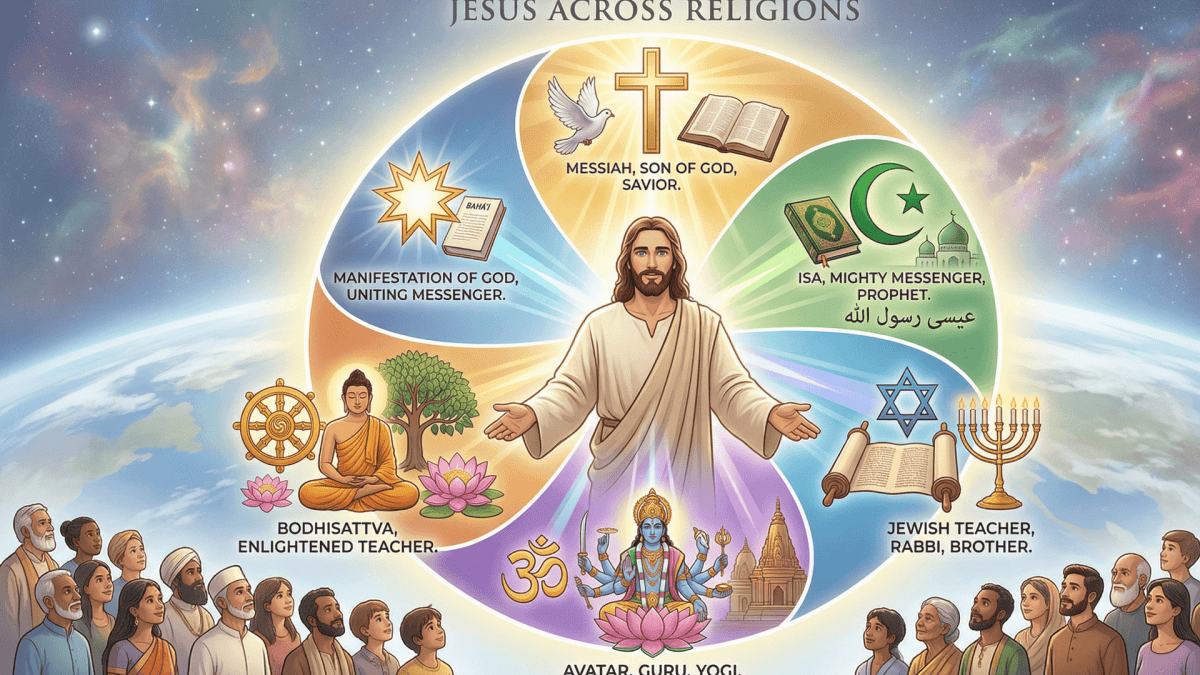
The influence of Jesus is not limited to Christianity alone. In Islam, he is revered as a great Prophet. In Judaism, his historical standing is a subject of discussion. On the other hand, Hinduism and Buddhism respect him as a great spiritual teacher or an enlightened being. The presence of Jesus in multiple religions proves that his teachings have a universal appeal. The moral values he preached have crossed boundaries and left a mark on human hearts.
Understanding Religious Perspectives on Jesus
Understanding the perspectives on Jesus in different religions can help us become more sensitive to each other’s beliefs. This helps build religious tolerance and harmony. When we see how a single figure is honored in different religious contexts, our mutual respect grows. In this blog post, we will explore Jesus from the perspectives of the world’s major religions.
Jesus in Christianity
The very foundation of Christianity is Jesus. In this religion, all beliefs revolve around him. For Christians, Jesus is not just a historical figure; he is the focal point of their spiritual lives.
How Christianity Describes Jesus
In Christianity, Jesus is described as the incarnation of God or God Himself in human form. The New Testament of the Holy Bible contains detailed accounts of his life and teachings. Christians believe that God came to Earth, taking the form of Jesus, to save humanity from sin. The arrival of Jesus on this Earth was a great proof of God’s infinite love for mankind.
Jesus as the Son of God and Savior
In Christian belief, Jesus is called the only Son of God. Here, the word “son” is not used in a literal sense, but rather in a spiritual sense. Christians believe that due to the sin of the first humans, Adam and Eve, humanity fell under a curse, and Jesus emerged as the Savior or Messiah to rescue them from it. Christians firmly believe that Jesus sacrificed his own life to atone for the sins of humans.
Teachings and Miracles of Jesus in Christianity
The teachings of Jesus are primarily based on love and forgiveness. One of his most famous discourses is the Sermon on the Mount. There, he stated that blessed are the meek and those who seek peace. The Bible mentions numerous miracles performed by Jesus. For example, granting sight to the blind, bringing the dead back to life, feeding thousands with a few loaves and fish, and walking on water. Christians view these miracles as proof of his divine power.
The Death and Resurrection of Jesus
The most important belief in Christianity is the crucifixion and Resurrection of Jesus. Christians believe that Jesus was crucified and killed under the orders of the Roman governor Pontius Pilate. However, three days after his death, he came back to life, which is known as the Resurrection. This Resurrection proves that Jesus has victory over death and that those who believe in him will attain eternal life. Christians celebrate the festival of Easter centered around this very event.
Jesus in Islam
In Islam, Jesus is accorded high honor. In Arabic, he is called Isa (AS) and is recognized as one of the greatest prophets in Islam.
How Islam Describes Jesus (Isa)
In Islam, Isa (AS) or Jesus is a great messenger sent by Allah. His name is mentioned twenty-five times in the Holy Quran. Islam does not recognize Jesus as the son of God or as God Himself, but rather sees him as a guide for humanity. The Quran describes Jesus as being extremely pure and honorable.
Jesus as a Prophet in Islam
According to Islamic belief, Allah has sent many prophets and messengers throughout the ages to show people the right path. Isa (AS) was the Prophet who came just before Prophet Muhammad (PBUH). Allah bestowed upon him a divine book called the Injil (Gospel). The main task of Jesus was to call people to worship one God and to remind the Jews of the teachings of the previous scripture, the Tawrat (Torah). For more details, you can view BBC Religion: Jesus and Islam.
The Virgin Birth of Jesus in Islamic Belief
Much like Christianity, Islam completely believes in the virgin birth of Jesus. In Surah Maryam of the Quran, Mary (Maryam), the mother of Jesus, is mentioned as a highly pure woman. Islam believes that Jesus was born in Maryam’s womb without the touch of any man, solely by the special command of Allah (“Kun Faya Kun” or “Be, and it is”). This miraculous birth does not prove the divinity of Jesus; rather, it is a sign of Allah’s infinite power.
Miracles of Jesus Mentioned in the Quran
The Quran mentions several miracles of Jesus, which he performed by the permission of Allah. One of these was speaking while still in the cradle during infancy to prove his mother’s purity. Furthermore, making clay birds and breathing life into them, healing the blind and lepers, and bringing the dead back to life are events detailed in the Quran.
Differences Between Islamic and Christian Views on Jesus
Although Jesus is respected in both religions, there are some fundamental differences. First, Islam does not accept Jesus as the son of God or a divine being. Second, Islam does not believe in the Trinity. Third, and the biggest difference, surrounds the death of Jesus. Islam believes that Jesus was not killed by crucifixion. Instead, Allah raised him bodily to the heavens, and he will return to Earth again before the Day of Judgment.
Jesus in Judaism
In the context of Judaism, Jesus is viewed from a completely different perspective. Since Jesus himself was a Jew, he holds a particular place in Jewish history.
How Judaism Views Jesus
In Judaism, Jesus is not recognized as God, the son of God, or a prophet. According to Jewish theology, God is one and indivisible, and He cannot have a human form. Jews view Jesus as a typical first-century Jewish preacher or teacher who propagated his own ideas within the social and political context of his time.
Why Jesus is Not Considered the Messiah in Judaism
Jews are waiting for a Messiah or savior. However, they do not accept Jesus as the promised Messiah. The reason is that, according to the Hebrew Bible (Tanakh), certain specific events will occur when the Messiah comes to Earth. For instance, absolute peace will prevail on Earth, the Holy Temple in Jerusalem will be rebuilt, and Jews from all corners of the world will return to their homeland. Jews believe that these conditions were not fulfilled during the lifetime of Jesus.
Historical Jewish Perspectives on Jesus
During the first century, Jews suffered much oppression under the Roman Empire. At that time, many Jewish leaders and preachers spoke out against the Romans. Many historical Jewish scholars think that Jesus was a social reformer of that era. He emphasized spirituality outside of conventional religious regulations. From a historical perspective, Jews do not deny the existence of Jesus, but they did not accept the new religious doctrines created by his followers.
Jesus in Hinduism
Hinduism is an ancient and highly inclusive religion. In this religion, Jesus is viewed from a very liberal perspective without binding him to any specific dogma.
Interpretations of Jesus in Hindu Thought
In Hinduism, there is the opportunity to perceive God in various forms. Many Hindu thinkers consider Jesus to be an Avatar. An Avatar is a divine being who takes human form and descends to Earth. Hindus believe that whenever unrighteousness increases on Earth, God comes down to protect righteousness (Dharma). From this perspective, Jesus’ message of love and compassion is seen as an expression of divine power.
Jesus as a Spiritual Teacher in Hinduism
Many Hindus respect Jesus as a great Yogi or spiritual guru. The teachings of Jesus, which speak of sacrifice, self-control, and unconditional love for God, share many similarities with the Bhakti Yoga and Karma Yoga of Hinduism. In many Hindu homes in India, pictures of Jesus are kept, and he is offered reverence just like other deities or saints.
Comparisons Between Jesus and Hindu Saints
Great Hindu saints like Ramakrishna Paramahamsa and Swami Vivekananda expressed deep respect for Jesus. Swami Vivekananda described Jesus as a great ascetic monk of the East. The forgiving nature of Jesus and his principles of non-violence also share a deep resemblance to the philosophy of leaders like Mahatma Gandhi. In Hindu philosophy, the crucifixion of Jesus is interpreted as a symbol of the death of the human ego and the liberation of the soul.
Jesus in Buddhism
Buddhism is not primarily God-centered; rather, it emphasizes self-purification and the attainment of Nirvana. However, there is deep respect for Jesus in Buddhism as well.
Buddhist Perspective on Jesus: Enlightened Teacher or Compassionate Figure
Buddhists can view Jesus as a Bodhisattva or a highly enlightened human being. A Bodhisattva is a person who, despite being worthy of attaining Nirvana or liberation, remains on Earth to free all other beings from suffering. The boundless compassion of Jesus and the sacrifice of his life for humanity serve as a perfect example of the Bodhisattva ideal for Buddhists.
Similarities Between Buddhist Teachings and the Teachings of Jesus
There are many striking similarities between the teachings of Gautama Buddha and those of Jesus Christ. Both spoke of non-violence, compassion, giving up greed, and forgiving enemies. Reading the Dhammapada of the Buddha and the Sermon on the Mount of Jesus reveals that both texts advise abandoning the illusion of worldly wealth in pursuit of spiritual peace. The 14th Dalai Lama has praised the teachings of Jesus on multiple occasions, stating that Jesus was a great teacher who taught humanity the lesson of love.
Jesus in the Baha’i Faith
The Baha’i Faith is a relatively new religion that believes in the unity of all the world’s major religions. In the Baha’i perspective, Jesus holds a special and highly respected place.
How the Baha’i Faith Describes Jesus
According to Baha’i belief, God is one, and He has sent various messengers in different eras to advance humanity’s spiritual development. Baha’is believe that spiritual truth evolves gradually. They accept Jesus as a highly important divine messenger who came in that succession.
Jesus as a Manifestation of God
In Baha’i terminology, Jesus is called a Manifestation of God. Baha’is believe that Jesus was a perfect mirror of God. In other words, the attributes of God were reflected on Earth through the life, actions, and teachings of Jesus. They acknowledge the virgin birth of Jesus and his miracles, but they interpret many of them as spiritual metaphors.
The Role of Jesus Among Other Divine Messengers
Baha’is consider that Jesus, Ibrahim (Abraham), Musa (Moses), Krishna, Buddha, Muhammad (PBUH), and Baha’u’llah all came from the same divine source. The teachings of each were appropriate for their own time. Therefore, the Baha’i Faith does not reject the teachings of Jesus, but rather sees them as an essential part of humanity’s spiritual journey.
Jesus in Sikhism
Sikhism originated in the Punjab region of India in the fifteenth century. Sikhs believe in one God and hold equal respect for all religions.
Sikh Perspectives on Jesus and His Teachings
The name of Jesus is not directly mentioned in the holy scripture of the Sikhs, the Guru Granth Sahib, as it was composed in the context of the Indian subcontinent. However, Sikhs respect Jesus as a highly pure soul and a great teacher dedicated to God. The core principles of Sikhism are honesty, equality, and service to humanity. The life of Jesus also echoes these very ideals.
Respect for Jesus in Sikh Tradition
Sikhs believe that there can be many paths to reach God. They view Jesus’ sacrifice and his standing with the oppressed with great respect. The Sikh tradition of Langar, or free food distribution, bears a striking resemblance to Jesus’s teaching on feeding the hungry.
Similarities Between Sikh and Christian Moral Teachings
Both religions emphasize the fatherhood of God and the brotherhood of man. Just as the Sikh Gurus taught to eradicate caste discrimination in society and look at everyone equally, Jesus also embraced the marginalized and neglected people of society. Because of these moral similarities, Sikhs feel a deep spiritual kinship with Jesus.
Comparing Religious Perspectives on Jesus
From the discussion above, we can see that there are various beliefs regarding Jesus across different religions. Now, let us engage in a comparative discussion of these perspectives.
Key Similarities Among Different Religious Views on Jesus
The biggest similarity is that almost every major religion acknowledges the historical existence of Jesus and his moral teachings. No religion denies Jesus’ contributions to love, forgiveness, non-violence, and service to humanity. In Islam, Hinduism, Buddhism, and the Baha’i Faith, Jesus is honored as a highly elevated spiritual leader, Prophet, or enlightened man. Everyone agrees that the life of Jesus was a unique example of purity and sacrifice.
Major Differences in Beliefs About Jesus
The differences are primarily theological. Christians worship Jesus as the Son of God and God Himself, which no other religion does. While Islam accepts Jesus as a prophet, it completely denies his crucifixion and does not accept his divine nature. Judaism rejects the claim of Jesus being the Messiah. On the other hand, while Hinduism and Buddhism respect Jesus, they do not place him at the core center of their religious structures.
Why Jesus Remains a Global Spiritual Figure
There is a strange universality in the teachings of Jesus. He said things that shake the deepest core of the human heart. His teaching to love one’s enemies is one of the most difficult yet beautiful philosophies in human history. Because of this message of selfless love and forgiveness, Jesus has not remained confined only to Christians; he has become a spiritual leader for the entire world.
Historical Context
Beyond religious beliefs, Jesus also has a historical identity that has been the subject of much research.
What Historians Say About Jesus
Modern historians and scholars are almost unanimously in agreement that a historical figure named Jesus lived in first-century Palestine. He grew up in Galilee, was baptized by John the Baptist (Prophet Yahya AS), and preached religion. Historians also agree that he was crucified under the orders of the Roman Empire.
Ancient Historical References to Jesus
Outside the Bible, mentions of Jesus are also found in the writings of ancient Roman and Jewish historians. The famous first-century Jewish historian Flavius Josephus mentioned Jesus in his book. Roman historians Tacitus and Pliny the Younger also wrote about Jesus and the early Christians in their records. These historical proofs confirm that Jesus was not a fictional character. To learn more about historical evidence, you can read the National Geographic report.
The Impact of Jesus on World Civilization
The impact of Jesus on world civilization is immense. The modern world calendar is centered around the approximate time of the birth of Jesus (AD and BC). Western art, literature, music, law, and social systems are deeply influenced by the teachings of Jesus. Countless hospitals, universities, and charitable organizations worldwide have been established inspired by the ideal of service shown by Jesus.
Frequently Asked Questions
Which religions believe in Jesus?
Christianity believes in Jesus as God and Savior. In Islam, Jesus (Isa) is a highly respected Prophet. ..In the Baha’i Faith, he is considered a manifestation of God. In Hinduism and Buddhism, he is revered as a great spiritual teacher.
Is Jesus considered God in every religion?
No, not at all. Only in Christianity is Jesus considered God or the Son of God. In Islam, Judaism, Hinduism, and Buddhism, he is not worshipped as God, but most of these religions respect him as a great human being or a Prophet.
What is the difference between Jesus in Christianity and Islam?
In Christianity, Jesus is the Son of God who died by crucifixion and was resurrected. On the other hand, in Islam, Jesus (Isa) is a great Prophet who is not the son of God. Islam believes Jesus was not crucified, but rather Allah raised him alive to the heavens.
Why are the views of different religions on Jesus different?
Every religion has its own theological framework, holy scriptures, and historical context. Because their fundamental beliefs about God and humanity differ, their evaluation or perspective on Jesus also differs.
Was Jesus a historical figure?
Yes, the majority of modern historians agree that Jesus lived on Earth in the first century as a real, historical figure. Evidence of this is also found in Roman and Jewish historical documents.
Conclusion
Jesus is such a personality about whom discussions have no end. Even after more than two thousand years, he remains an inseparable part of the lives of billions of people worldwide.
Final Thoughts on Jesus in Different Religions
We have seen that, regardless of religious identity, almost everyone holds a positive view of Jesus’ life and teachings. Some consider him God, some consider him a Prophet, and some accept him as an enlightened social reformer. But no one can deny the message he preached of love, forgiveness, and peace.
Understanding Religious Diversity Through the Figure of Jesus
These different yet respectful views of Jesus across various religions help us understand religious diversity. It teaches us that despite differences in opinion, we can respect each other’s beliefs. Jesus is like an invisible thread with which it is possible to build a bond of harmony among the followers of different religions.
Why Jesus Continues to Influence Billions Around the World
The appeal of Jesus is eternal because the most fundamental desires of the human heart are peace and love. In today’s conflict-ridden world, the teachings of Jesus on forgiveness and compassion are more relevant than ever. He is not just a character confined to the pages of history but also the inspiration for the daily journeys of billions of people worldwide. And for this very reason, Jesus survives today as a bright and relevant spiritual figure in different religions.