
How AI Is Transforming Industries Worldwide in 2026: A Comprehensive Guide
Introduction to AI Transformation in 2026
Artificial intelligence, or AI, is the greatest example of technological excellence in the modern world. What was once science fiction has become an integral part of our daily lives. Standing in 2026, we can see that artificial intelligence is no longer confined to the laboratory. It is now redefining every major industry worldwide.
Today, AI technology is making human tasks easier, saving time, and opening doors to new possibilities. From simple chatbots to complex data analysis, the touch of AI is everywhere. This technology is completely changing the way we think, work, and solve problems. In 2026, the AI transformation has reached a point where no business can hope to survive the competition without this technology. We have entered an era where humans and machines work together to achieve extraordinary goals.
Why Artificial Intelligence is Growing Rapidly
There are several important reasons behind this incredible momentum of artificial intelligence. First, massive improvements in computing power have made AI much stronger. Modern processors and cloud computing systems can process huge amounts of data very quickly. As a result, AI models have become much more efficient.
The second reason is the easy availability of data. With the expansion of the internet and the rise of smart devices, massive amounts of data are generated every day. AI systems learn from this data to improve themselves. Furthermore, the continuous development of various algorithms and machine learning methods is making AI even smarter. Major technology companies worldwide, such as Google and Microsoft, are investing billions of dollars in AI research. It is because of this massive investment and the combined efforts of public and private institutions that AI technology is growing so rapidly in 2026.
How AI is Reshaping Global Industries
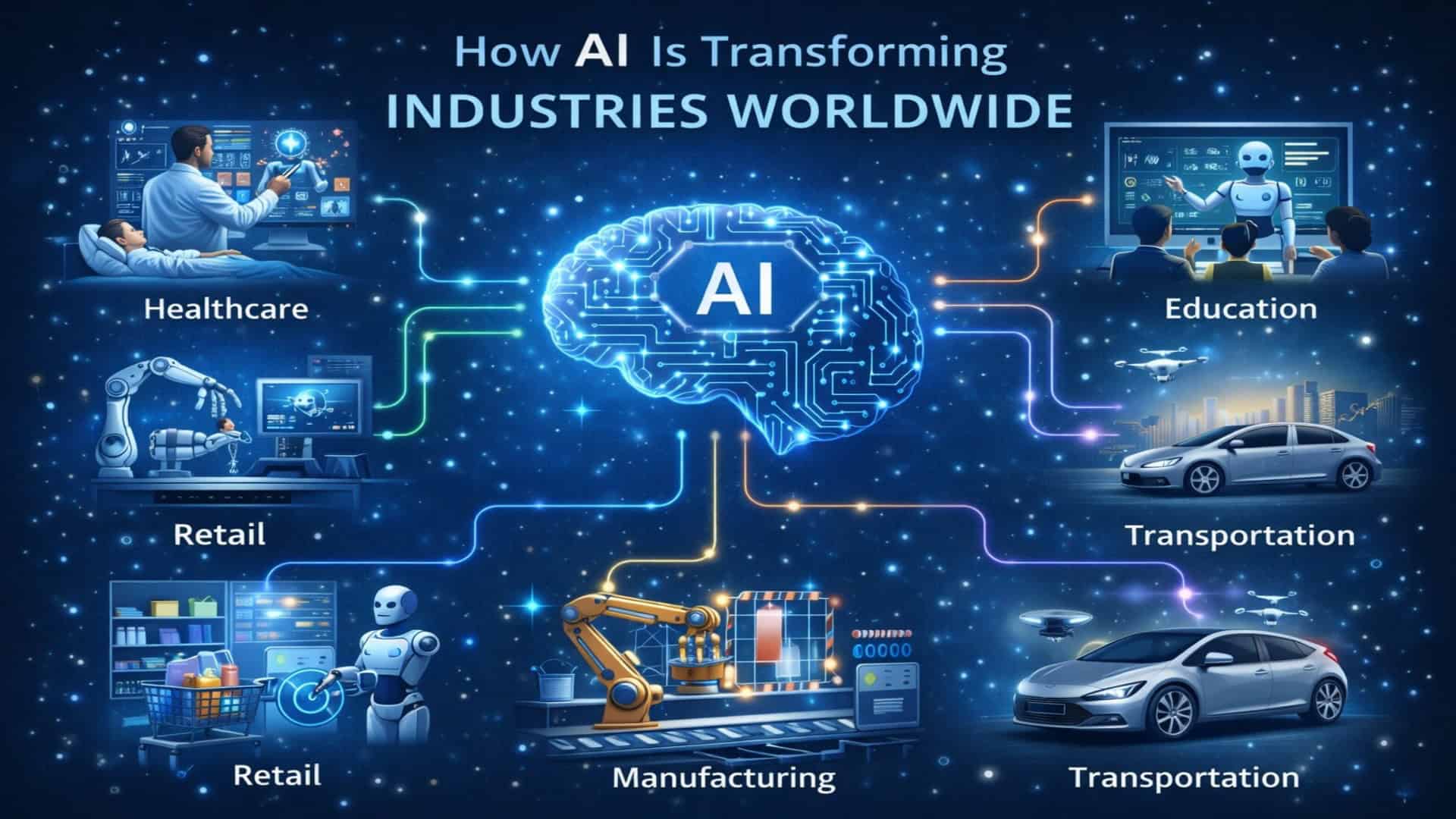
Artificial intelligence has brought a silent revolution to global industrial sectors. It not only speeds up work but also improves the quality of the output. Although AI applications vary across industries, their main goal is to increase efficiency and reduce costs. With the help of AI, organizations can now analyze massive datasets to make more accurate decisions.
Tasks that previously took humans days to complete are now being done by AI in a matter of seconds. As a result, employees can focus more on creative and strategic work rather than routine tasks. According to the world-renowned research firm McKinsey & Company, AI technology could add trillions of dollars to the global economy in the coming decades. From manufacturing to the service sector, the impact of AI is clearly visible everywhere.
AI in Healthcare: Smart Diagnostics and Patient Care
The impact of artificial intelligence in the healthcare sector is considered to be the most profound and positive. In 2026, AI is helping doctors diagnose diseases much more accurately. AI is highly effective at detecting issues such as cancer, heart disease, and neurological conditions at an early stage. By analyzing medical images such as X-rays, MRIs, and CT scans, AI can detect subtle changes that often go unnoticed by the human eye.
In addition, AI is paving the way for personalized medical treatments. By analyzing a patient’s genetic information, lifestyle, and medical history, AI can recommend the most effective medications. In hospitals, smart chatbots are answering general patient queries and simplifying the appointment booking process. The World Health Organization (WHO) has already emphasized the ethical use of AI in the health sector, as it has the potential to improve the quality of medical care in both developed and developing countries.
AI in Finance: Fraud Detection and Automated Banking
Security is a massive concern in the banking and financial sectors. In 2026, the most critical use of AI in finance is fraud detection. AI systems can analyze millions of transactions per second. If any transaction pattern seems unusual, the AI immediately sends an alert and blocks the transaction. This keeps customers’ money much safer than before.
Automated banking is another major contribution of AI. Customers can now check account balances, transfer funds, and apply for loans through AI-driven virtual assistants without ever visiting a bank. Additionally, in the stock market, AI performs predictive analysis to help investors make informed decisions.
AI in Education: Personalized Learning Experiences
A major problem in the education system is that students’ learning paces differ. Artificial intelligence has brought a wonderful solution to this problem. In 2026, AI technology will ensure personalized learning experiences in education. AI systems analyze each student’s intellect, weaknesses, and learning style to create customized syllabi and study methods.
AI is also acting as a great assistant for teachers. Tasks like grading exam papers and creating quizzes for students are being handled effortlessly by AI. This allows teachers to devote more time to their students’ mental development. Virtual tutors are helping students with their studies at any time, making the learning process much more enjoyable and effective.
AI in Retail: Smart Shopping and Customer Insights
In the retail industry, AI has completely transformed the shopping experience. In 2026, when customers shop online or in a supermarket, AI analyzes their preferences and past shopping history to recommend the most suitable products. This saves the customer time and helps them find the exact product they are looking for.
AI is also extremely important for shop owners. By using AI, they can identify which products might see increased demand in the future or which need to be kept in stock urgently. This is called inventory management. By analyzing customer insights with AI, retailers are successfully expanding their businesses.
AI in Manufacturing: Automation and Predictive Maintenance
Automation is not a new concept in the manufacturing sector. However, after AI integration in 2026, this automation reached a whole new level. AI-driven robots in factories are performing product assembly, packing, and quality control tasks with extreme precision. As a result, production capacity is increasing while product defects are decreasing.
Another huge benefit of AI in the manufacturing sector is predictive maintenance. By collecting data from machine sensors, AI can predict exactly when a machine might break down or need repairs. This reduces the risk of sudden factory shutdowns and saves significant money.
AI in Transportation: Self-Driving Cars and Smart Logistics
The use of AI in the transportation system is making our daily commutes safer and faster. Autonomous vehicles or self-driving cars are no longer just a dream. In 2026, AI-driven cars and buses started running on the streets of many cities in the developed world. These vehicles use sensors, radars, and AI algorithms to understand roads, signals, and the positions of other vehicles.
AI has also brought unimaginable changes to the logistics and goods transportation sector. AI calculates the most accurate routes to ensure that products reach their destinations as quickly as possible while avoiding traffic jams and saving fuel. Large delivery companies rely entirely on AI to keep their supply chains running smoothly.
AI in Agriculture: Precision Farming and Crop Monitoring
As the population grows, demand for food increases. To meet this extra demand, the use of artificial intelligence in agriculture has become essential. In 2026, farmers have adopted precision agriculture methods using AI drones and sensors. Drones fly over crop fields to take pictures, and AI analyzes those images to report whether crops have been attacked by disease or are short of water.
From testing soil quality to providing weather forecasts, AI is assisting farmers in every task. As a result, it is possible to grow more crops using fewer fertilizers and pesticides. The Food and Agriculture Organization (FAO) views the use of this technology in agriculture as a key to sustainable development.
AI in Cybersecurity: Rapid Threat Detection
Cyberattacks are a major concern in the digital world. Hackers are constantly trying to launch cyber attacks in new ways. It is difficult to prevent these modern attacks using traditional cybersecurity measures. This is where AI plays the most crucial role. In 2026, AI in cybersecurity can instantly detect any abnormal activity within a network.
AI systems continuously analyze network traffic and can quickly recognize new types of viruses or malware. Even before an attack occurs, AI automatically strengthens the security system. Because of this, the confidential information of large organizations and government agencies remains much safer.
AI in Marketing: Personalized Advertising and Content Creation
Artificial intelligence has made marketing work much easier and more effective. You may have noticed that you are seeing ads exactly related to what you are searching for on the internet. This is the work of AI. In 2026, marketers are using AI to analyze customer behavior, age, and location to create highly precise personalized advertisements.
Furthermore, AI is proving incredibly useful for creating the necessary marketing content. Writing blog posts, drafting social media statuses, and even creating ad images or short videos are being done by AI in the blink of an eye. This is saving companies both time and money.
AI in Entertainment: Content Recommendations and Media Production
AI has completely changed how we watch movies or listen to music. Platforms like Netflix, YouTube, and Spotify use AI to bring your favorite content right to you. AI analyzes the kinds of movies you like to watch or the songs you listen to most, and then recommends new content accordingly.
Not just content recommendations, AI is also playing a huge role in media production. In 2026, AI is being used to create visual effects (VFX) for many movies and video games. Testing is even successfully underway in some cases to write movie scripts or create background music using AI.
AI in Human Resources: Smart Hiring and Employee Analytics
The key to the success of any organization is capable employees. The hiring process in the human resources (HR) department is often time-consuming. In 2026, AI made this recruitment process much easier. In the blink of an eye, AI can shortlist the most qualified candidates from thousands of CVs or resumes.
AI is also being used to measure employee performance and satisfaction after hiring. By analyzing data, AI can inform HR managers in advance about how an employee is performing, who needs training, or who might leave the job. This helps maintain a positive work environment within the organization.
AI in Real Estate: Property Analysis and Virtual Tours
AI is playing an important role in the buying and selling of real estate properties. With the help of AI, highly accurate forecasts of future land prices in a specific area can be generated. Investors can analyze this data to invest in profitable properties.
Additionally, virtual tours created using a combination of virtual reality and AI have made buying a house much easier for customers. Buyers can now explore every corner of a house from the comfort of their homes using AI. This saves them time and helps them make decisions. In smart buildings, AI is also being used to automatically control electricity and security systems.
AI in E-commerce: Enhanced Recommendations and Customer Support
The contribution of AI to the success of the e-commerce sector is undeniable. When you visit an e-commerce website, AI looks at your previous search and shopping patterns and shows you your favorite items first. This greatly enhances the customer’s shopping experience.
In terms of customer support, AI-driven chatbots are providing service 24 hours a day. AI chatbots are very efficiently answering customer queries, processing refunds, and providing order updates. Because of this, customers no longer have to wait on hold for a long time when calling customer care.
AI in Energy and Utilities: Smart Resource Management
AI is playing a vital role in ensuring the proper use of essential utilities like electricity, gas, and water. In 2026, AI has integrated into smart grid technology to create an excellent balance between electricity demand and supply. AI can analyze and predict when electricity demand will be highest, and the supply is adjusted accordingly.
AI is also being used in the production of renewable energy, such as solar power and wind power. By analyzing weather data, AI can predict in advance when more sunlight or wind will be available. This prevents energy waste and makes resource management much more effective.
AI in Government and Public Services
The use of AI in government and public services is improving citizens’ quality of life. Governments in many countries are now using AI for traffic and waste management, and to keep public transport schedules on track. These are known as smart city projects. With the help of AI, reducing street traffic jams and preventing accidents has become possible.
Besides, AI is analyzing data to ensure that government benefits reach the right people. Citizens can easily apply for government services and check their application status through AI-driven portals. This is increasing transparency and accountability in government operations.
AI in Space Exploration and Scientific Research
The use of AI in space research has brought unimaginable success. In 2026, NASA and other space research organizations are using AI technology in their spacecraft. Rovers sent to planets like Mars can make their own decisions through AI about which path to take or which rock to collect for research.
Scientists are using AI to analyze massive amounts of data coming from galaxies, black holes, and other cosmic objects. AI can find patterns in this data much faster than humans. Not just in space, but AI has also multiplied the speed at which scientists create new materials and conduct chemical research.
Top AI Technologies Driving Innovation in 2026
Artificial intelligence is not a single technology. It is a combination of several technologies. Below is a discussion of some of the most impactful AI technologies in 2026.
Machine Learning
Machine learning is one of the most important branches of AI. It is a process in which computers are trained to learn from data without explicit programming. Machine learning algorithms analyze old data and adapt to new situations. Most of the AI systems around us are fundamentally based on machine learning.
Generative AI
Generative AI is currently one of the most talked-about technologies. It can generate new content, images, code, or audio. Tools like ChatGPT or DALL-E are examples of generative AI. With human instructions, it can perform entirely new and creative tasks that were previously possible only for humans.
Natural Language Processing (NLP)
Natural Language Processing, or NLP, helps computers understand and analyze human language. When we talk to Google Assistant or Siri, NLP translates our words into computer language and returns the computer’s response in our language. It is because of NLP technology that chatbots can chat with humans so naturally.
Computer Vision
Computer vision is a technology that enables computers to extract information from digital images and videos. It works much like the human eye. Computer vision is widely used in self-driving cars, facial recognition systems, and medical diagnostics. It can identify objects from images and understand their movements.
Robotics and Automation
When AI is combined with robots or machines, it is called intelligent robotics. This technology is being used in various tasks, from manufacturing goods in factories and organizing products in warehouses to performing surgeries in hospitals. These robots are much more precise than humans and can work continuously without getting tired.
Benefits of AI Across Industries
The benefits of AI technology across industries are vast and multifaceted.
- Increased Speed and Efficiency: AI automates routine, tedious tasks, accelerating human work.
- Reduced Errors: Humans are prone to making mistakes during continuous work, but AI systems do not get tired and operate with extreme precision.
- Cost Savings: In the long run, using AI significantly reduces an organization’s operational costs.
- 24-Hour Service: AI systems can provide nonstop customer service day or night.
- Accurate Decision-Making: By analyzing vast amounts of data, AI helps companies make data-driven, accurate decisions.
Challenges and Ethical Concerns of AI
Along with the benefits of artificial intelligence come major challenges and ethical concerns. The biggest worry is regarding the job market. With AI taking over many automated tasks, a fear of job loss has emerged among people in certain professions.
Furthermore, data privacy is extremely important. AI systems collect a massive amount of personal data. If this data falls into the wrong hands, it could lead to major security risks. Also, AI systems sometimes develop biases due to the human-generated data they are trained on. Eliminating this bias and making AI fair and safe for everyone remains a major challenge for technologists.
How Businesses are Adapting to AI
Business organizations have realized that surviving future competition is impossible without AI. Therefore, they are adapting quickly. First, companies are providing specialized training to their employees on using AI tools, a process known as upskilling.
They are building AI systems that are tailored to their specific business needs. Small businesses are taking advantage of cloud-based AI services at a lower cost. Successful organizations are not viewing AI as a replacement for humans but as a tool to make human work easier.
Future Trends of Artificial Intelligence Beyond 2026
It is expected that AI technology will reach even greater heights after 2026. Scientists are working on Artificial General Intelligence, or AGI. AGI will be an intelligent system capable of understanding new situations and learning new tasks, just like a human being.
Additionally, when AI combines with quantum computing, a new technological horizon will unfold. Quantum AI will work several times faster than any current supercomputer and will easily solve difficult problems such as climate change and the discovery of new medicines. The future of AI is much broader than we can imagine.
Frequently Asked Questions About AI in Various Industries
People often have many questions about artificial intelligence. Below are the answers to some of the most important questions.
Which industries use AI the most?
Currently, healthcare, finance or banking, manufacturing, retail, and e-commerce use AI technology the most. Because the volume of data is massive and the need for automation is highest in these sectors, they have adopted AI very quickly.
How is AI changing the job market in 2026?
AI has indeed automated some traditional routine tasks, but it has also created many new job opportunities, such as data analysis, AI maintenance, and machine learning engineering. It is changing the very nature of work.
What are the biggest benefits of AI?
The biggest benefits of AI are increased work speed, cost savings, accurate analysis of massive amounts of data, and 24-hour, uninterrupted service. It enhances the quality of human work and decision-making capabilities.
Is AI replacing human workers?
Not entirely. AI is primarily handling repetitive and dangerous tasks. AI lacks human creativity, emotional intelligence, and the ability to solve complex problems. Therefore, instead of replacing human workers, AI is acting as their assistant.
What is the future of AI in business?
The future of AI in business is extremely bright. In the coming days, thinking of any business without AI will be impossible. Every business decision, customer service interaction, and marketing strategy will rely entirely on AI, making businesses even more profitable.
Conclusion
Standing in 2026, we can see that artificial intelligence is not a passing trend. It has become an essential part of modern civilization. From healthcare to space research, the positive impact of AI is evident in every field. However, it is everyone’s responsibility to ensure the proper and ethical use of this powerful technology.
We must prepare ourselves accordingly for the new challenges arising from AI. Our future lies in not fearing technology but in utilizing it for the betterment of humanity. In the coming days, through the combined efforts of artificial intelligence and humans, our world will become even more beautiful, safe, and advanced.