
The Ultimate Guide: Business Model Canvas Explained (With Examples)
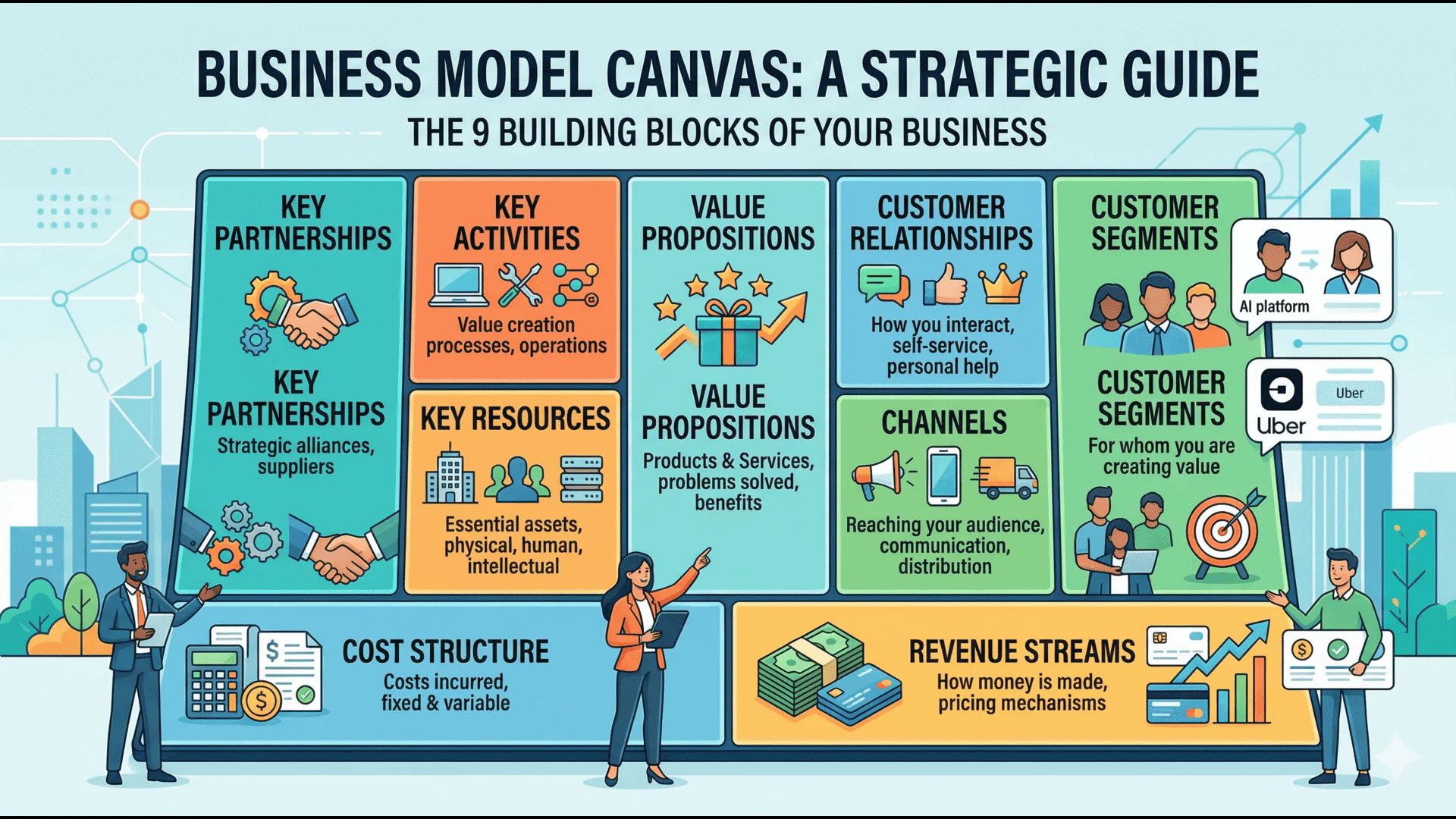
Starting a new business or restructuring an existing one requires a clear and actionable plan. This is exactly where the Business Model Canvas (BMC) comes into play. It is a one-page visual template that clearly outlines the fundamental building blocks of your business.
Instead of writing a massive and complex traditional business plan, this canvas allows you to see the entire picture of your enterprise at a single glance. It helps you instantly understand who your customers are, what unique value you are offering them, and how your business will generate revenue. The framework is simple, fast, and incredibly effective for modern entrepreneurs.
Why the Business Model Canvas is Important for Modern Businesses
In today’s rapidly changing business environment, spending hours or weeks drafting a fifty-page business plan is rarely practical. The market is constantly evolving. Your business must adapt quickly to survive and thrive.
The Business Model Canvas provides the flexibility that modern companies desperately need. You can easily sit down with your team, map out your ideas on a whiteboard, and update the canvas as you learn new things about your market. It improves communication across your entire team and ensures everyone is working together toward the exact same business goals.
The Origin of the Business Model Canvas (Alexander Osterwalder Framework)
The concept of the Business Model Canvas was originally developed by Swiss business theorist Alexander Osterwalder. His framework later gained massive global popularity through platforms like Strategyzer.
Osterwalder and Yves Pigneur co-authored the book “Business Model Generation,” which introduced this framework to a mainstream audience. Their primary goal was to create a universal tool that entrepreneurs anywhere in the world could easily understand and use to map out complex business strategies on a single page.
Brief Overview of the 9 Key Elements of the Business Model Canvas
A complete Business Model Canvas is divided into nine specific building blocks. These blocks work together to create a comprehensive picture of your business strategy. Below is a detailed breakdown of each essential component.
1. Customer Segments
The primary task of this section is to correctly identify the people or organizations your business is designed to serve. No business can survive without the right customers.
Identifying Your Target Customers
First, you must determine exactly whose problems you are solving. It is critical to figure out who needs your product or service the most. You cannot be everything to everyone.
Understanding Different Types of Customer Segments
Customers can fall into several different categories. You might be targeting a massive general audience (mass market) or focusing on a highly specific and specialized group (niche market). You must clearly understand whether your customers are everyday consumers or other business entities.
Real-World Examples of Customer Segmentation
A newspaper company serves multiple customer segments simultaneously: everyday readers who buy the paper and advertisers who purchase ad space. Conversely, a luxury watch brand has a completely different and highly specific customer segment focused entirely on high-net-worth individuals.
2. Value Propositions
Your value proposition is the precise reason why customers will choose you over your competitors. It acts as the beating heart of your entire business model.
What a Value Proposition Means in Business
This is exactly what you are offering to the customer to make their life easier or to solve a major problem they are facing. It could be groundbreaking innovation, superior performance, a more affordable price tag, or exceptionally beautiful design.
How to Create a Strong Value Proposition
To build a powerful value proposition, you must think from the perspective of the customer. Identify their specific pain points and clearly demonstrate how your product serves as the absolute best solution to those problems.
Examples of a Successful Value Proposition
Uber’s core value proposition is the ability to tap a button and get a reliable ride in minutes. It promises fast, trackable, and dependable transportation, which solves a massive problem for everyday commuters.
3. Channels
The channels block defines exactly how you will deliver your value proposition to your targeted customer segments. This covers communication, marketing, and sales pathways.
How You Deliver Value to Customers
Determining how customers will discover your product and how they will ultimately purchase it is crucial. Even the greatest product in the world will fail if you do not choose the right delivery channels.
Types of Marketing and Distribution Channels
Channels generally fall into two categories. You have direct channels like your own physical storefront or e-commerce website. You also have indirect partner channels like retail distributors, third-party marketplaces, or affiliate marketers.
Examples of Channel Strategies from Successful Companies
Apple sells products directly through its own Apple Stores and official website. At the same time, they reach a broader audience through authorized premium resellers and major electronics retail chains.
4. Customer Relationships
This block defines the type of relationship your business will establish with its specific customer segments. This is vital for long-term business sustainability.
Building and Maintaining Customer Loyalty
Acquiring a new customer is always more expensive than retaining an existing one. Therefore, you must build relationships that encourage people to return to your business repeatedly.
Types of Customer Relationship Models
Relationships can range widely based on your business type. They include dedicated personal assistance, standard self-service, fully automated services, or highly engaged user communities.
Real-World Business Examples
Amazon maintains relationships with millions of users primarily through its automated recommendation system and self-service platform. On the other hand, a high-end boutique shop provides dedicated, one-on-one personal assistance to every shopper who walks through the door.
5. Revenue Streams
This section details exactly how your business will generate cash from each Customer Segment. A business cannot exist without a clear path to generating money.
How the Business Makes Money
You need to discover exactly what value your customers are truly willing to pay for. Answering this question dictates your primary sources of income.
Different Types of Revenue Models
Income can be generated in many different ways. Options include direct asset sales, recurring subscription fees, renting or leasing equipment, licensing intellectual property, or generating income through advertising space.
Examples of Revenue Streams in Action
Netflix relies heavily on a monthly subscription fee model for its revenue stream. Conversely, Google generates the vast majority of its massive income through targeted advertising.
6. Key Resources
Key resources are the most important assets required to make your business model work. They are the engines that power your company.
Essential Assets for Business Success
Without these vital resources, your business simply cannot achieve its goals or deliver its value proposition. They are strictly necessary to keep the doors open.
Physical, Intellectual, Human, and Financial Resources
Resources come in several forms. They can be your manufacturing facility (physical), your brand patents and copyrights (intellectual), your highly skilled software engineers (human), or your startup capital (financial).
Examples from Leading Companies
Microsoft’s greatest assets are its software development teams (human resources) and its massive portfolio of software patents (intellectual resources). A global courier company’s main resources are its massive fleet of delivery trucks and cargo planes (physical resources).
7. Key Activities
These are the most important daily or strategic actions your company must take to operate successfully.
Core Activities That Create Business Value
These activities are directly linked to creating your value proposition, reaching markets, maintaining customer relationships, and earning revenues.
Which Activities Matter Most Across Different Industries
The key activities for a software company revolve around coding, testing, and continuous problem-solving. A consulting firm focuses almost entirely on problem-solving and delivering expert advice to corporate clients.
Real-World Examples of Key Activities
A successful restaurant’s key activities include sourcing fresh ingredients, cooking high-quality meals, and delivering excellent table service. A manufacturing plant’s primary activity is maintaining uninterrupted and efficient supply chain production.
8. Key Partnerships
No business operates in total isolation. You will need the help of reliable suppliers, vendors, and strategic partners to succeed.
Why Partnerships Are Crucial for Business Growth
Strategic partnerships help reduce business risks, optimize resource allocation, and acquire necessary assets. They are highly effective for scaling up your business operations rapidly.
Types of Strategic Partnerships
You can form strategic alliances with non-competitors. You can also establish long-term buyer-supplier relationships to ensure a steady supply of crucial materials. Sometimes, companies even partner with direct competitors (coopetition) to grow a mutual market.
Real-World Partnership Examples
Smartphone manufacturers frequently partner with specialized companies for camera lenses or microprocessors. For instance, Apple often relies on companies like Samsung or LG to manufacture the OLED screens for their iPhones.
9. Cost Structure
This block maps out all the costs and expenses required to operate your specific business model.
Understanding Business Costs
It is critical to accurately calculate the financial expense of maintaining your Key Resources, Key Activities, and Key Partnerships. You must know what it costs to keep the business running.
Explanation of Fixed vs. Variable Costs
Some expenses remain completely stable regardless of how much you produce. These are fixed costs, like office rent or employee salaries. Other expenses fluctuate based on your production volume. These are variable costs, like the price of raw materials or shipping fees.
Examples of Cost Structures in Startups
A brand new e-commerce startup’s major costs usually include website hosting and maintenance, aggressive digital marketing campaigns, and shipping or fulfillment logistics.
Step-by-Step: How to Create a Business Model Canvas
Building your own canvas is a highly intuitive process. Follow these straightforward steps to get started:
-
Start with the customer: First, define your specific Customer Segments and the exact Value Proposition you are offering them. These two blocks form the fundamental foundation of your entire canvas.
-
Establish your connections: Think carefully about the Channels you will use to deliver your value and the specific Customer Relationships you need to build.
-
Calculate the money: Clearly list out exactly how your business will generate Revenue Streams from those customers.
-
Organize the backend: Identify the Key Resources you need to acquire and the specific Key Activities you must perform daily to make the model work.
-
Find your allies: List out the Key Partnerships you need to form to ensure smooth operations.
-
Map out the expenses: Finally, calculate the total Cost Structure required to maintain all the previous elements.
Business Model Canvas Example: Startup Case Study
Let us look at a famous startup like Airbnb to see the canvas in action. Their business model is quite fascinating because it serves a multi-sided market.
They have two distinct customer segments: property owners who want to rent out their spaces, and travelers looking for unique places to stay. Their value proposition for travelers is offering affordable, authentic local lodging experiences. For hosts, the value proposition is an easy way to generate extra income. Their key resource is their digital platform, and their primary key activity is continuously maintaining and improving that platform while ensuring customer safety.
Business Model Canvas Example: E-commerce Business
The canvas for a standard e-commerce business looks quite different.
Their primary customer segment consists of people who prefer the convenience of shopping online. The core value proposition is the ability to browse a massive catalog of products from the comfort of home and have them delivered directly to the door. Their main channels are their website, mobile app, and social media platforms. Key partnerships heavily involve logistics providers, courier services, and secure payment gateway companies.
Business Model Canvas Example: SaaS Company
A Software as a Service (SaaS) company relies on a heavily tech-driven model. Let us consider a digital project management tool.
Their targeted customers are various small to medium-sized business teams. The value proposition is drastically improving team productivity and collaboration. Revenue streams flow steadily from tiered monthly or annual subscription fees. Their most critical key resources are their elite software development team and reliable cloud server infrastructure.
Common Mistakes When Using the Business Model Canvas
Entrepreneurs often make a few preventable mistakes when filling out their first canvas.
The first major mistake is writing down far too much detail. The canvas is specifically designed to be brief, concise, and easy to read at a glance. The second mistake is focusing entirely on the product features while completely ignoring the actual customer needs. Finally, the biggest mistake of all is treating the canvas as a finished, static document. The market changes constantly, and your canvas needs regular updates to stay relevant.
Tips for Optimizing Your Business Model Canvas
To get the absolute most out of your canvas, try implementing these proven tips:
Print the canvas on a large poster board and hang it in a highly visible area where your entire team can see it daily. Use different colored sticky notes for different customer segments so you can easily visually track how value flows to each group. Furthermore, continuously test the assumptions you write on the canvas by getting real feedback from actual customers, and adjust the notes accordingly.
How the Business Model Canvas Works for Startups and Entrepreneurs
Startups naturally suffer from a severe lack of time and financial resources. Asking a lean startup team to draft a fifty-page traditional business plan is often a massive waste of precious time.
The Business Model Canvas empowers entrepreneurs to rapidly test and pivot their initial ideas. When pitching to potential investors, there is no better way to quickly and clearly explain the entire scope of a business. Extensive research published in the Harvard Business Review consistently highlights that startups using lean, agile methodologies like the BMC have a significantly higher success rate.
Business Model Canvas vs. Traditional Business Plan
A traditional business plan is a lengthy, highly detailed text document that takes weeks to write. It is typically required when you are trying to secure a massive bank loan or court a traditional private equity firm.
Conversely, the Business Model Canvas is a one-page, highly dynamic framework. It is designed to be changed rapidly and is far more effective for managing daily operational strategy and team alignment. The canvas exists to help you visually understand the core logic of the business without getting bogged down in rigid financial projections.
Tools and Templates for Creating Your Own Business Model Canvas
Today, there are countless digital tools available that make creating your canvas incredibly easy.
You can easily find dozens of free, highly customizable templates on design platforms like Canva. If you are working with a remote team spread across different locations, Miro serves as a fantastic digital whiteboard where everyone can collaborate in real time. Additionally, the official Strategyzer website offers excellent, high-quality templates and comprehensive guides for beginners.
Frequently Asked Questions About the Business Model Canvas
Is the Business Model Canvas completely free to use?
Yes, the core Business Model Canvas template is entirely free to use. It was released under a Creative Commons license. You can easily search for it online, download it as a PDF or image file, print it out, and start using it immediately for your business.
Can small local businesses use the Business Model Canvas?
Absolutely. This framework is not reserved strictly for massive corporations or Silicon Valley tech startups. Whether you run a small neighborhood grocery store, a local restaurant, or a solo freelance graphic design business, the canvas is an incredibly effective tool for mapping out your strategy.
How often should you update your canvas?
There is no strict timeline or rule for updating it. However, you should review and update your canvas whenever you launch a brand new product, when a major new competitor enters your market, or when you notice a significant shift in what your customers are demanding.
What is the core difference between a business plan and a canvas?
A traditional business plan is a formal, highly detailed document outlining exhaustive marketing plans and multi-year financial projections. The canvas is a visual, one-page summary that captures the foundational logic of that entire plan, making it infinitely easier to read, understand, and adjust on the fly.
Conclusion: Turning Your Business Idea into a Clear Strategy using the Business Model Canvas
Even the most brilliant and innovative business idea in the world can easily fail if it lacks a solid, actionable strategy behind it. The Business Model Canvas takes the chaotic, disorganized thoughts floating around in your head and organizes them into a beautiful, crystal-clear framework.
It helps you instantly identify where your business is strong and where you need to focus more of your attention. By utilizing this simple nine-block framework, you can start designing a robust business model today. In a constantly shifting global market, the Business Model Canvas will serve as your absolute best friend in guiding your enterprise straight to the peak of success.