A Detailed Comparison of Global Education Systems
Education is the most powerful tool for shaping our society and building a better future. Every country worldwide designs its educational framework based on its unique culture, economy, and social needs. When we compare education systems around the world, we can easily identify which methods work best. This gives us fresh ideas for improving educational standards in our own communities.
Today, the world has become a highly connected global village. Staying limited to the educational practices of just one country is no longer enough. The way a nation’s younger generation learns and grows has a massive impact on the global economy.
The Importance of Understanding International Education Models
Understanding international education models allows us to learn from the best teaching methods from around the globe. Some countries might be far ahead in technology, while others might place a stronger emphasis on students’ mental health. Discussing these diverse models makes the core purpose of education much clearer.
Furthermore, international models offer teachers new perspectives and methodologies. This helps foster student creativity and builds responsible global citizens. According to UNESCO, sharing international educational concepts is a vital step toward equalizing the quality of education worldwide.
How Education Systems Impact National Development
The economic and social development of a country depends directly on its education system. The more advanced a country’s educational framework is, the faster its economy grows. Educated and skilled citizens drive innovation and boost national productivity.
Education improves people’s standard of living and plays a massive role in eradicating poverty. At the same time, a robust education system helps maintain the rule of law and democratic values in society. Therefore, modern education is the primary engine of national development.
What is the Definition of an Education System?
In simple terms, an education system is a well-organized structure through which a country imparts knowledge, skills, and values to its citizens. This includes everything from schools, colleges, and universities to curricula, teachers, examination methods, and government regulations.
An education system is not limited to just reading textbooks. It creates an environment where students can develop socially, mentally, and professionally. A successful educational framework is dynamic and adapts to changing times.
Core Components of Modern Education Systems
A modern education system features several essential components. First, it requires an updated curriculum or syllabus that prepares students to face current and future challenges. Second, it needs a qualified and trained community of teachers who act as guides rather than just information providers.
Technology is another major component of modern education. Access to smart classrooms, digital libraries, and internet-based learning is crucial. Above all, there must be a fair evaluation process that does not rely solely on rote memorization.
Common Goals Across Different Countries
Although the structures of education systems vary greatly around the world, their core goals remain remarkably similar. Every country wants its students to grow up as good citizens. Building a beautiful society through knowledge acquisition and character building is a universal objective.
All nations want their students to succeed in the workplace and contribute to the economy. The goals of fostering critical thinking, problem-solving skills, and creativity are visible in the education policies of almost every country.
Major Types of Education Systems Around the World
We can observe a few primary types of education systems globally. These are usually categorized based on government funding, private initiatives, and religious or social values. These variations reflect the unique socio-economic realities of each country.
In some countries, a single system dominates the landscape. In many others, multiple education systems operate side by side.
Public Education Systems
Public education systems are fully managed and funded by the state. Under this system, education is highly accessible to all citizens and, in most cases, free of charge. Its primary goal is to ensure equal educational opportunities for people from all levels of society.
Public schools follow curricula mandated by the government. Everything from drafting education policies to paying teachers’ salaries is funded by state funds. In developed nations, the quality of public education is outstanding and meets world-class standards.
Private and Independent School Models
Private education systems are usually run by individuals, organizations, or trusts. These schools do not rely on government funding but operate using the tuition fees paid by students. They frequently offer premium facilities and smaller classroom sizes.
Independent schools have the freedom to design their own curricula. Many people believe the learning environment in private schools is much more competitive. However, because this system is expensive, not everyone has the opportunity to study here.
Hybrid and Alternative Education Methods
A hybrid education method is a blend of public and private models. Sometimes, a government might hand over the management of a school to a private organization while still providing the funding. This brings innovation to educational quality while keeping costs under control.
Alternative education methods include homeschooling, Montessori, and Waldorf models. These approaches move beyond the traditional classroom setting, focusing heavily on students’ personal interests and psychological development. The popularity of alternative education is growing steadily in the modern era.
Education Systems in North America
North American countries, particularly the United States and Canada, are known globally for their strong and diverse educational frameworks. In this region, education is largely viewed as a local government responsibility. As a result, educational structures vary significantly from one area to another.
The North American education system places heavy emphasis on practical knowledge, sports, and extracurricular activities.
The Structure of Education in the United States
The United States does not have a single national education framework. Each state and local school district creates its own curriculum and regulations. Generally, education is divided into stages from Kindergarten to 12th grade, widely known as K-12.
The US education system highly values student independence and creativity. Its universities, such as Harvard and MIT, are recognized as some of the best in the world. According to data from the National Center for Education Statistics, massive amounts of money are invested annually to modernize education in the US.
Canada’s Approach to Inclusive and Accessible Education
Canada’s education system is one of the most successful and inclusive models in the world. Education is seen as a fundamental right in Canada, and the quality of public schools is exceptionally high. Unlike in the US, the quality of education in Canada does not vary drastically across provinces.
Canada excels at integrating immigrant and special-needs children into the mainstream educational flow. Their goal is to ensure no child falls behind academically. As a result, Canadian students consistently achieve top scores in international assessments.
Education Systems in Europe
European education systems are incredibly rich in history and tradition. A major feature of European countries is the provision of free or very low-cost higher education. Equal importance is given to vocational skills alongside theoretical knowledge.
While the educational structures differ across European nations, the Bologna Process helps maintain a unified standard of higher education throughout the continent.
Finland’s Student-Centered Learning Model
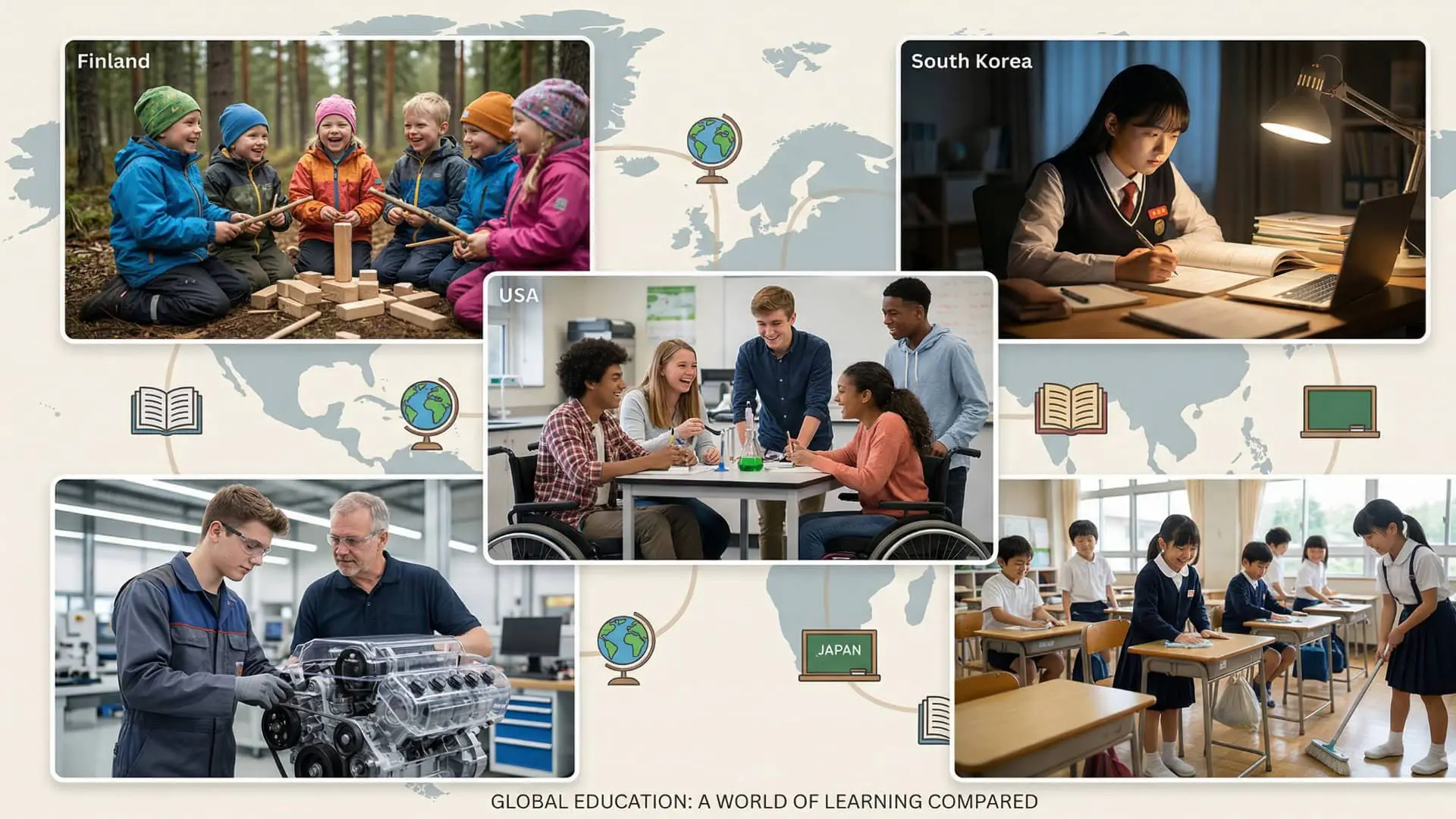
Finland’s education system is frequently recognized as the best in the world. Their core philosophy is less stress and more learning. Children in Finland are not sent to formal schools until they reach seven years of age. The system places a massive emphasis on learning through play.
There are no standardized tests or school ranking systems in Finland. Teachers are highly respected in society, and a master’s degree is a strict requirement for entering the teaching profession. This student-centered model serves as a perfect example for educators worldwide.
Germany’s Vocational Education Pathway
Germany’s education system is famous for its “Dual System” of vocational training. Students do not just study in schools; they also work as apprentices in various factories or businesses. This ensures they are fully prepared for the job market even before they finish their formal studies.
Because of this system, Germany’s unemployment rate is very low. Students can decide at a very young age whether to pursue academic studies at a university or take a vocational route to enter the workforce more quickly.
The Academic Structure of the United Kingdom
The education system in the United Kingdom is highly disciplined and globally respected. Its structure is primarily divided into primary, secondary, further education, and higher education. At age 16, students take their GCSE exams, which essentially map out their future career paths.
UK universities, such as Oxford and Cambridge, have maintained top-tier educational standards for centuries. Their curricula apply a very strict focus on theoretical knowledge and intensive research.
Education Systems in Asia
Asian education systems are changing rapidly and building a strong position on the world stage. In Asian countries, there is deep social respect for education and strong family support.
The learning environments in this region are usually highly competitive. Exam results and academic success are taken extremely seriously.
Japan’s Emphasis on Discipline and Academic Excellence
In Japan’s education system, morality, character building, and discipline are prioritized even more than academic subjects in the early years. Students do not take exams during their first few years of elementary school. Instead, they are taught how to respect society and nature.
In Japanese schools, students clean their own classrooms. This tradition builds a strong sense of teamwork and responsibility. Due to this discipline and hard work, Japanese students consistently rank at the top globally in mathematics and science.
South Korea’s Competitive Learning Environment
South Korea’s education system is one of the most competitive in the world. Students here study for very long hours every day. After regular school, they frequently attend private academies known as “Hagwons”.
The Korean university entrance exam, known as Suneung, is considered one of the most important days in a student’s life. While this intense competition makes students highly skilled, it often has negative impacts on their mental health.
Singapore’s High-Performing Education Model
Singapore’s education system established itself as one of the world’s best in a very short time. Their approach is highly specific and well-planned. Singapore firmly believes in the “Teach Less, Learn More” policy.
They invest heavily in teacher training and only recruit the brightest minds into the teaching profession. Singapore’s methodology for teaching science and math is now being adopted worldwide.
India’s Diverse and Expanding Education System
India’s education system is one of the largest and most diverse in the world. Alongside national boards, every state has its own education board. India recently launched its National Education Policy, aiming to move away from rote learning and promote skill-based education.
India is home to world-class institutions like the IITs and IIMs. However, due to a massive population and limited resources, a significant gap in educational quality remains between urban and rural areas.
Education Systems in Africa
The education systems across the African continent are undergoing numerous transitions. Overcoming the impacts of the colonial era, countries are now working to build educational frameworks that are grounded in local cultures and specific needs.
With a very large youth population, the education sector in Africa holds massive potential, even though it faces several tough challenges.
Opportunities and Barriers Across African Nations
The biggest barriers to educational expansion in many African countries are poverty and inadequate infrastructure. Many villages still lack school buildings, books, and qualified teachers. Political instability also frequently hinders educational progress.
However, opportunities are also expanding rapidly. With the help of international organizations, literacy rates in Africa are increasing significantly. If the youth demographic is equipped with technological education, Africa will make significant contributions to the global economy in the coming decades.
Efforts to Improve Access and Education Quality
Over the past two decades, primary school enrollment rates in Africa have surged. Many countries have introduced free primary education. Organizations like the World Bank are working hard to bring internet access and digital technology to African schools.
Various government and non-government projects have been launched to provide advanced training to teachers and ensure equal educational opportunities for girls.
Education Systems in Latin America
There is a great deal of diversity in the educational structures across Latin American countries. Nations in this region have done a great deal to expand education over the past few decades. However, the quality of education often fluctuates due to political and economic shifts.
In Latin America, public universities frequently offer higher education completely free of charge, which is a major positive aspect for the region.
Progress in Expanding Educational Access
The rate of students attending primary and secondary school has increased significantly in Latin America. Countries like Mexico, Brazil, and Chile have expanded their education budgets.
Scholarship programs and food assistance initiatives have been highly successful in bringing poor children in rural areas back to school. As a result, dropout rates have decreased dramatically compared to the past.
Addressing Inequality and Resource Shortages
Despite this progress, extreme inequality remains a reality in Latin America. Children from wealthy families receive advanced education in expensive private schools, while children from poorer families must rely on under-resourced public schools.
A lack of proper resource distribution is a major problem. To eliminate this inequality, much more attention needs to be given to improving public school infrastructure and teacher quality.
Comparing Curricula and Teaching Methods
When we compare the curricula and teaching methods of different countries, two main trends stand out. One is the traditional method, and the other is the modern or student-centered method.
A curriculum does not just determine what will be taught; it also provides a clear outline of exactly how it will be taught.
Traditional vs. Student-Centered Education
In traditional education, the teacher is the main controller of the classroom. The teacher delivers lectures, and students take notes to memorize them. While discipline is highly maintained in this method, students have fewer opportunities to ask questions. This approach is still quite popular in many Asian countries.
Conversely, student-centered education places the highest importance on student participation. Here, the teacher acts as a facilitator. A heavy emphasis is placed on project-based work, group studies, and hands-on learning, which is common in countries like Finland and Canada.
The Role of Creativity, Critical Thinking, and Innovation
Textbook knowledge alone is not enough to tackle 21st-century challenges. Teaching creativity and critical thinking is absolutely essential in modern education. The focus is on ensuring students can solve any problem using their own intelligence.
Advanced countries are adding subjects like coding, robotics, and artificial intelligence to their curricula. Innovative thinking is what will lead the world in the coming days.
Global Assessment and Examination Systems
Evaluation systems are essential to measure how much students have learned. However, there are vastly different opinions globally on exactly how this evaluation should be conducted.
Examination methods have a profound impact on a student’s mental well-being.
Standardized Testing Models
A Standardized Test is an exam in which all students are given the same questions and evaluated against the same criteria. The SAT in the United States or the Gaokao in China are prime examples.
The advantage of this exam is that it easily evaluates the merit of a massive number of students. However, critics argue that it pushes students toward rote memorization and fails to judge their true creativity.
Continuous Assessment and Alternative Evaluation Methods
Many countries are now shifting away from a single massive year-end exam toward continuous assessment throughout the year. Student performance is judged through class tests, assignments, presentations, and project work.
These alternative methods are highly popular in Finland and Norway. It removes the extreme pressure of exams from students and allows them to learn with joy. This is much more effective in developing their true intellectual potential.
Technology and Digital Learning in Global Education
In current times, it is impossible to think about education without technology. The internet and digital devices have completely transformed the way we learn.
During the COVID-19 pandemic, we saw exactly how technology helped keep educational activities running even when schools were entirely shut down.
The Rise of Online and Hybrid Education
Online education is no longer a luxury; it is a necessity. Students from any corner of the globe can now take courses from universities like Harvard or MIT.
The hybrid education model, in which classroom learning is combined with online instruction, is quickly gaining popularity. It saves students time and gives them much more freedom in how they choose to learn.
How Different Countries Integrate Educational Technology
Developed countries ensure the use of laptops, tablets, and smartboards in every single school. They use virtual reality (VR) to make complex subjects like science and history easy to understand.
Developing countries are also using mobile internet to spread education through learning apps. However, to make technology equally accessible everywhere, reducing internet costs and ensuring uninterrupted electricity is absolutely vital.
Teacher Training and Professional Development
Teachers are the very heart of any education system. Advanced education cannot be ensured merely with a good syllabus or beautiful buildings. It requires highly qualified and motivated teachers.
Regular professional training is extremely important for continuously enhancing teachers’ skills.
Regional Teacher Qualification Requirements
The requirements to become a teacher vary widely around the world. In Finland or Singapore, becoming a teacher is incredibly difficult and prestigious. Teachers there must hold a master’s degree and are selected through rigorous examinations.
On the other hand, in many developing countries, underqualified individuals are sometimes hired just to fill teacher shortages, which negatively impacts the quality of education. There should be a specific standard for teachers in every country.
The Impact of Teacher Quality on Student Success
Research shows that a teacher plays the most significant role in a student’s success. A good teacher can explain even the most difficult subjects easily and joyfully.
Teachers help build student confidence. Therefore, increasing teachers’ salaries, giving them high social status, and providing regular training on modern teaching methods is an excellent investment for any country.
Funding and Access in Education Systems
Adequate funding is the primary condition for expanding education and improving its quality. A country’s future depends heavily on the percentage of its national budget allocated to education.
Without proper distribution of funds, it is simply impossible to create equal educational opportunities.
Publicly Funded vs. Private Education Models
Schools run on public funding keep the doors of education open for everyone. In Scandinavian countries, the state covers the entire cost of a student’s education, right up to the university level. This helps maintain a high level of equality in society.
In contrast, under the private education model, students must bear the complete cost themselves. While the quality of service in these schools is high, this approach often turns education into a commercial business.
Ensuring Equal Access to Quality Education
Merely getting students enrolled in school is not the ultimate goal; providing everyone with equal quality education is the real challenge. Comparing a modern city school with a dilapidated village school clearly highlights this extreme disparity.
It is the state’s responsibility to invest much more heavily in underdeveloped regions. Providing special scholarships for disabled and marginalized communities can successfully ensure equal access to quality education.
Challenges Facing Global Education Systems
Even though modern education systems have come a long way, they face several complex challenges. Solving these problems requires global unity and long-term planning.
Educational Inequality and the Achievement Gap
The biggest challenge in global education is inequality. Educational opportunities vary widely by gender, race, and economic status. Children from poor families are frequently deprived of good schools and necessary learning materials.
If this achievement gap is not reduced, breaking the cycle of poverty in society will be incredibly difficult. Strong state-level initiatives must be taken to nurture every child equally.
Adapting to Rapid Technological and Social Changes
The world is changing at breakneck speed. A skill that is crucial today might hold absolutely no value ten years from now. Artificial intelligence and automation are completely transforming the future workplace.
Education systems must update their curricula to keep pace with these rapid changes. Students need to be prepared in ways that foster their interest in lifelong learning.
What Countries Can Learn from Each Other
No country’s education system is completely flawless. Every system has its strengths and its weaknesses. Therefore, one country can learn an incredible amount from others’ successful models.
Best Practices from High-Performing Education Systems
Other countries can learn from the United States and Canada about how to make the best use of technology in education. Finland teaches us how to maintain high educational standards without putting unnecessary pressure on students.
Countries like Japan and Singapore demonstrate the critical importance of combined participation from both teachers and society. By bringing these best practices together, every country can build its own powerful educational framework.
Opportunities for Improving Global Education
In today’s age of technology, educators from one country can easily exchange information with experts from another. The quality of global education can be improved rapidly through international seminars, joint research, and teacher exchange programs.
Developed countries should provide both financial and technical assistance to developing nations to help them upgrade their education sectors.
The Future of Education Systems Around the World
Extensive research is ongoing regarding what education systems will look like in the coming days. Future education systems will be highly flexible, heavily reliant on technology, and customized to personal needs.
Emerging Trends and Innovations
Artificial intelligence will play a massive role in the future of education. AI will help teachers easily identify individual students’ weaknesses. Through personalized learning methods, every student will be able to learn at their own specific pace.
Virtual reality will bring history and geography classes to life. Blockchain technology will be used to ensure the complete security and transparency of student certificates.
Preparing Students for a Globalized Future
The citizens of tomorrow cannot just think about their own countries; they must think about the entire world. Students need to be made deeply aware of climate change, human rights, and the global economy.
They must be taught empathy, communication skills, and respect for diverse cultures. Only then will they grow up to be worthy citizens of a fully globalized future.
Conclusion: Understanding Global Education for a Better Future
A strong education system does not just change a single person’s life; it transforms the picture of an entire society. By analyzing education systems around the world, we realize that there is no single magic formula for education.
Every country must choose the best possible method in harmony with its unique culture and economic condition. However, the core objective should always remain the same: ensuring a beautiful, safe, and promising future for every single child. The right investment in the education sector is what will build a prosperous and peaceful world.
Frequently Asked Questions (FAQs)
Which country has the best education system in the world?
It is difficult to declare a single country the absolute best. However, Finland, Singapore, South Korea, Canada, and Japan consistently rank at the top of international assessment indices like PISA. Finland is widely recognized for its stress-free environment, while Singapore is praised for its mathematics and science education.
How do education systems differ across countries?
Education systems across countries differ based on their funding, curricula, examination methods, and teacher quality. In some countries, the state bears all educational expenses, while in others, privatization dominates. Additionally, major differences are seen between standardized testing and continuous evaluation models.
Why is Finland’s education system frequently praised?
Finland’s education system is praised mainly for its student-centered approach. Young children do not take standardized tests; they have very little homework, and a huge emphasis is placed on play. Their teachers are highly educated and deeply respected in society, making the learning environment incredibly joyful.
What role does technology play in modern education?
Technology has brought a revolution to modern education. It has erased geographical boundaries in learning. It is now entirely possible to acquire knowledge from anywhere in the world via the internet. Smart classrooms, online libraries, and AI tools help students understand complex subjects easily and allow teachers to make their lessons much more effective.
How can countries improve their education systems?
Countries can improve their education systems by increasing education budgets, providing advanced training for teachers, and updating curricula to meet the demands of the modern world. Furthermore, shifting the focus from rote memorization to enhancing students’ creativity and problem-solving skills will massively elevate the overall quality of education.