10 Ways AI is Transforming the Future of Work
Introduction
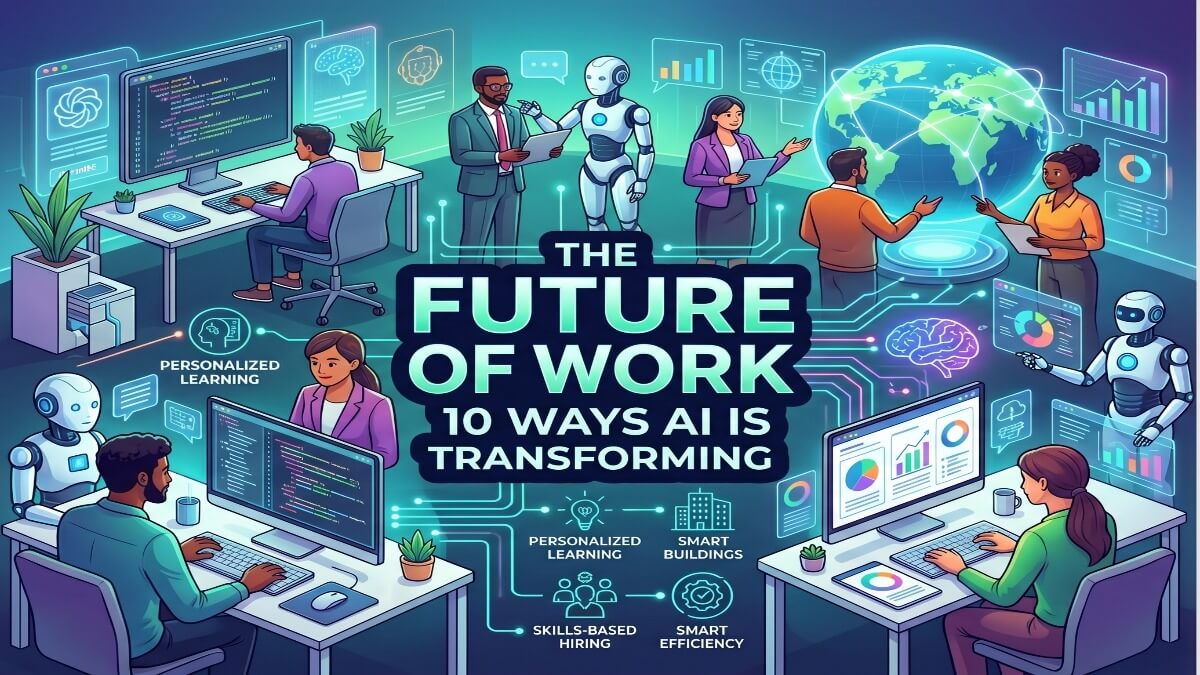
We are currently living in an era where technology is not just making our daily lives easier but fundamentally changing the way we work. Artificial Intelligence (AI) is no longer a science fiction concept. It has become an integral part of our reality. Whether you are a business owner, an employee, or a student, understanding how AI is transforming everything is essential to grasping the future of work.
The Growing Influence of Artificial Intelligence at Work
The impact of artificial intelligence in the workplace is now more visible than ever before. While technological progress has moved slowly in recent decades, the development of AI has gained incredible momentum in recent years.
Everyone from small startups to multinational corporations is relying on AI to manage their daily operations. According to reports from trusted international organizations such as the World Economic Forum, AI is set to bring a massive shift in global work patterns.
Although this technology may make some older jobs obsolete, it is simultaneously creating entirely new opportunities. AI in the workplace is not just a new tool. It marks the beginning of a completely new way of working. It simplifies human tasks, saves time, and improves the overall quality of work.
Why AI is Reshaping Modern Jobs and Industries
The role of AI in reshaping modern jobs and industries is highly significant. The primary reason for this is AI’s ability to analyze data and make rapid decisions. In a traditional manufacturing plant that previously relied entirely on manual labor, production can now be multiplied using robotics and AI-powered sensors.
Similarly, AI has become indispensable in the service sector to quickly meet customer demands. Businesses must now be more efficient than ever to survive in a competitive market. AI helps achieve that efficiency. It reduces the likelihood of human error and can perform tasks that once seemed impossible. This is exactly why every industry is adopting AI to sustain itself and reach the pinnacle of success.
1. Automating Repetitive Tasks
Every workplace involves many tasks that must be repeated the exact same way every day. These repetitive tasks are exhausting for employees and consume a significant amount of time. AI has brought a major change by automating these activities.
How AI Boosts Workplace Efficiency
AI-powered automation works like magic to increase workplace efficiency. When an employee enters the same data or answers similar emails every day, their creativity naturally declines. AI takes over these responsibilities. As a result, employees can spend their valuable time on tasks that require human judgment and creativity.
An AI system can work 24 hours a day without any breaks and has no chance of experiencing fatigue. This multiplies the speed of work. Furthermore, AI reduces the minor errors humans typically make to almost zero. Therefore, overall workplace efficiency increases in terms of both accuracy and speed.
Examples of Business Process Automation
There are countless real-world examples of Business Process Automation (BPA) around us. Consider an e-commerce company. When a customer orders a product, AI automatically generates an invoice, updates the inventory, and sends the information to the shipping partner. No human employee needs to input data manually for this.
Another example is the finance or banking sector. Thousands of transactions occur in banks daily. AI systems automatically record these transactions and provide instant alerts if they detect suspicious activity. Additionally, in the HR department, AI seamlessly handles tasks like tracking employee leave and processing payroll.
2. Enhancing Employee Productivity
One of the biggest advantages of AI is that it multiplies employee productivity. AI is not a substitute for humans. It is rather a powerful tool that helps people work better.
AI-Powered Tools for Daily Tasks
Today, almost all professionals use various AI-powered tools to simplify their daily tasks. Content creators and writers have tools like ChatGPT and Grammarly, which help improve writing quality and draft content quickly. Designers use platforms like Midjourney or Canva AI to create stunning visuals in just a few minutes.
For software developers, GitHub Copilot plays an incredibly helpful role in writing code. These tools give employees a superpower that lets them complete far more work in far less time than before. They have truly become an inseparable part of everyday work.
Reducing Time Spent on Administrative Work
Administrative work consumes a large portion of time in any office. Scheduling meetings, managing calendars, reading long emails, and creating meeting minutes are highly time-consuming tasks. Today, AI assistants can handle these tasks effortlessly.
For example, AI tools can analyze your calendar and automatically schedule a meeting. After a long virtual meeting, AI can listen to the entire conversation and generate a clean summary. This saves employees hours. They can then invest the time saved in strategic tasks necessary to achieve the company’s core goals.
3. Improving Decision Making Through Data Analytics
Data is often called the new oil of the modern age. However, just like crude oil, massive amounts of data are useless unless processed correctly. AI can analyze these massive databases to extract critical information.
AI-Driven Business Intelligence
Business Intelligence (BI) is the process of making informed business decisions using organizational data. AI-driven BI tools can analyze terabytes of data in seconds. According to a Forbes report, modern businesses are placing greater emphasis on data-driven decision-making.
AI tools can easily tell executives which product sold the most last year, which region had the lowest sales, and the exact reasons behind these trends. As a result, company leaders no longer have to rely on guesswork. They can make flawless decisions based on clear data presented on their dashboards. This reduces business risks and increases profit margins.
Predictive Analytics and Strategic Planning
Predictive analytics is a branch of AI that analyzes past data to forecast potential future events. This is a groundbreaking technology for strategic planning. Suppose a retail company wants to know which clothes will be in the highest demand during the upcoming winter season.
AI can provide accurate insights by analyzing past sales data, current market trends, and weather forecasts. Consequently, the company can stock the right amount of products well in advance. From supply chain management to budgeting in the financial sector, businesses are using predictive analytics to prepare for the future.
4. Revolutionizing Customer Service
Customers are the lifeblood of any business. The success of a business depends entirely on customer satisfaction. AI has completely transformed the concept of customer service.
AI Chatbots and Virtual Assistants
A few years ago, calling customer care meant waiting on the line for hours. That picture has changed thanks to AI chatbots and virtual assistants. An advanced AI chatbot can chat in natural human language. They can answer customer queries 24 hours a day, 7 days a week, without any breaks.
AI easily handles tasks like resetting passwords, tracking orders, or providing general information. Customers get their problems solved instantly. Meanwhile, human customer care agents can focus solely on resolving complex issues. This is highly beneficial for both the organization and the customer.
Delivering Personalized Customer Experiences
Today’s customers want every service customized to their preferences. AI has made it incredibly easy to deliver personalized customer experiences. Platforms like Netflix or Amazon are the best examples of this. When you watch a movie on Netflix, AI analyzes your viewing history and suggests other movies perfectly aligned with your taste.
Similarly, e-commerce sites recommend products based on a customer’s previous purchases and browsing history. This personalization not only makes customers happy but also works like magic to boost sales.
5. Transforming the Hiring and Recruitment Process
Finding the right employee for a company is an extremely challenging and time-consuming task. AI has made this difficult job much easier for the Human Resources (HR) department.
AI in Talent Acquisition
AI is now an integral part of the talent acquisition process. Previously, HR teams had to manually read hundreds of resumes for a single vacancy. Now, AI recruiting software can scan thousands of resumes in minutes to shortlist the most qualified candidates for the role.
AI does not just scan resumes. It can also analyze profiles from platforms like LinkedIn to find passive candidates (people who are not actively looking for jobs but are highly qualified for the role). This is a massive advantage for employers.
Faster and Smarter Candidate Screening
AI not only saves time in the candidate screening process but also makes it much smarter. Many organizations now use AI-powered video interview tools for preliminary interviews. These tools can analyze a candidate’s body language, confidence, and communication style alongside their answers.
Furthermore, AI can use gamified skill assessments to verify candidates’ practical skills. Human recruitment processes can sometimes be influenced by subconscious bias. While AI is not flawless, when programmed correctly, it helps select candidates objectively based on merit, without discrimination based on gender, age, or race.
6. Supporting Remote and Hybrid Work
Since the COVID-19 pandemic, remote and hybrid work models have gained worldwide popularity. AI is playing the biggest role in sustaining this new work structure.
AI Collaboration Tools for Distributed Teams
When team members are scattered across the globe, maintaining coordination can be quite difficult. AI-powered collaboration tools have eliminated this barrier. Platforms like Slack, Microsoft Teams, and Zoom now integrate advanced AI features.
These tools can automatically find the most suitable meeting times for employees in different time zones. Project management software uses AI to track work progress and determine who is best suited for a specific task. This makes communication among remote teams absolutely seamless.
Enhancing Virtual Communication and Productivity
AI is playing a revolutionary role in breaking down language barriers. Real-time AI translation can now be used during virtual meetings. This means if a Japanese employee speaks in their native language, a worker in Bangladesh will instantly see or hear the translation in Bengali or English on their screen.
AI is also used to reduce background noise during meetings and improve video quality. These benefits have elevated remote communication to the point where it hardly feels as if employees are thousands of miles apart. As a result, overall productivity is maintained and enhanced.
7. Creating New Career Opportunities
Many people assume AI is only taking away jobs. On the flip side, AI is creating an entirely new industry and countless new employment opportunities.
Emerging AI-Related Job Roles
As technology advances, many new positions have emerged that were unimaginable a decade ago. Take the “Prompt Engineer” as an example. The job of this professional is to craft the right commands or questions to extract the best answers from ChatGPT or other AI models.
The demand for roles like AI Ethics Officer, Machine Learning Engineer, Data Scientist, and AI Trainer is now skyrocketing. Experts are needed to implement AI across various industries. A massive door to career growth has opened up for those who understand and can manage these technologies.
Essential Skills for the Future Workforce
Workers must acquire new skills to survive in an AI-driven future. Traditional education alone is no longer enough. Equal emphasis must be placed on soft skills alongside technical expertise. AI can calculate or write code, but it lacks human emotions or empathy.
Therefore, emotional intelligence, complex problem-solving abilities, creative thinking, and teamwork skills will be even more valued in the future. Employees must always maintain an adaptable mindset to learn new things. The ability to adapt as technology changes will be the greatest weapon for the future workforce.
8. Strengthening Cybersecurity and Risk Management
Data is the most valuable asset in the digital age. Cyber attacks targeting this data are becoming more complex every day. AI is now serving as an essential shield for cybersecurity.
Threat Detection with AI
Traditional cybersecurity systems primarily work against known viruses or malware. However, hackers are constantly inventing new methods. AI and machine learning algorithms analyze the normal behavior of a network. Whenever there is the slightest anomaly on the network, AI detects it immediately.
It can identify potential threats before hackers even launch an attack. AI is much faster and more effective than humans at detecting phishing emails or blocking fake login attempts.
Protecting Business Data and Systems
AI has developed automated response systems to keep business data secure. When a cyberattack is detected, the AI system does not wait for human instructions; it can immediately take preventive measures.
For instance, it might block the attacker’s IP address or disconnect the infected system from the main network. This significantly reduces the amount of damage. In modern zero-trust architectures, AI continuously verifies the user’s identity and access level, thereby enhancing the system’s overall security.
9. Personalizing Employee Training and Development
Training is crucial for enhancing employee skills. However, everyone’s learning style and pace are different. AI has made employee training systems completely personalized.
AI-Powered Learning Platforms
In traditional corporate training, everyone is taught the same topics in the exact same way, which often fails to be effective for all. Today, AI-powered Learning Management Systems (LMS) have solved this problem. These platforms first analyze an employee’s current skills, interests, and career goals.
AI then recommends appropriate courses and materials for that specific employee. Platforms like Coursera and LinkedIn Learning use this type of AI technology. It helps tremendously in keeping employees engaged in the learning process.
Customized Skill-Building Programs
AI can create a distinct learning path for every employee. If a worker is weak in a specific area, AI provides them with additional practice and materials in that area. Conversely, if someone learns quickly, AI offers them more advanced modules.
Many companies are even using AI-powered virtual coaches that give employees real-time feedback. This customized approach ensures that every employee can achieve peak efficiency at their own pace.
10. Driving Innovation and Business Growth
AI is not just simplifying current tasks. It serves as a primary driver of future innovation and business expansion.
Accelerating Research and Product Development
Creating a new product or conducting research is highly time-consuming. In the pharmaceutical industry, for example, it can take decades to discover a new drug. With the help of AI, this timeframe has now been reduced to just a few years.
AI can analyze data on billions of chemical compounds to quickly find potentially effective medicines. Similarly, in other manufacturing industries, AI enables rapid product design and simulation. By creating fast prototypes, companies can bring their new products to market quickly, staying ahead of the competition.
Unlocking New Revenue Opportunities
AI is opening new avenues of income for businesses. Many companies are now launching new services that use their own data and AI models. One example is offering Artificial Intelligence as a Service (AIaaS) to smaller companies.
Moreover, AI makes it possible to uncover hidden market opportunities or customer needs that previously went unnoticed. Companies use these new insights to launch new products or services, directly boosting their revenue. AI has created a continuous cycle of business growth.
Overcoming Barriers and Ethical Considerations of AI at Work
Despite its numerous benefits, the application of AI comes with significant challenges and ethical questions. There is no room to ignore these issues.
Addressing Job Displacement Concerns
The biggest fear people have regarding AI is the threat of job loss. Automation will indeed eliminate some routine tasks. However, history testifies that every major technological revolution has created new opportunities in place of old jobs.
Governments and private organizations must work together to address this concern. Massive investments must be made in reskilling and upskilling workers. AI should be presented as a helpful tool rather than a human competitor. With the right guidance, employees will not fear working alongside AI but will feel comfortable with it.
Ensuring Responsible AI Adoption
Maintaining ethics is absolutely crucial when using AI. If the data used in an AI system is biased, the results will also be biased. This kind of prejudice in recruitment processes or loan approvals can create severe discrimination.
Therefore, we must ensure that AI models remain transparent and neutral. Furthermore, customer data protection must be treated as a top priority. Companies must clearly disclose how they use AI and how they protect people’s personal information. Achieving long-term success is impossible without practicing responsible AI.
The Future of Work: A Combined Effort of Humans and AI
The future of work is not a place where machines or robots rule alone. Instead, the future workplace will be a wonderful fusion of humans and AI.
Building a Collaborative Workforce
Experts refer to this as the “Centaur Model,” where humans and AI work together. AI will process data quickly and generate options, while humans will use their experience, emotions, and moral judgment to make the final decisions.
For example, in the medical field, AI will analyze X-rays or MRI reports to identify potential signs of disease. Still, a human doctor will make the final diagnosis and compassionately discuss treatment with the patient. In this collaborative environment, AI will enhance human capabilities, and humans will address AI’s limitations.
Preparing for the Next Wave of AI Innovation
Technological change never stops. The AI technology we see today will become exponentially more powerful in the next five years. Every organization and individual must become visionary right now to prepare for this future.
The education system needs to be redesigned so that students become familiar with AI tools from an early age. Companies must cultivate an agile mindset to quickly adapt to new technologies. Those who lead this transformation will be the ones who survive and thrive in the future world.
Frequently Asked Questions (FAQs)
Will AI completely replace human jobs?
No, AI will not completely replace human jobs. AI primarily automates repetitive and routine tasks. However, jobs that require creativity, empathy, complex problem-solving, and human judgment will remain in human hands. AI will instead make human work easier and more efficient while creating new types of employment opportunities.
Which industries benefit the most from AI?
Currently, almost all industries benefit from AI. However, the technology (IT), healthcare, financial (banking and finance), e-commerce, logistics, and retail sectors benefit the most. AI has brought groundbreaking changes to these sectors by accelerating work, analyzing data, and improving customer service.
How can workers prepare for an AI-driven future?
Workers should develop a mindset of continuous learning. It is essential to understand how AI tools work and how to apply them in one’s profession. Alongside this, they must focus on enhancing soft skills such as emotional intelligence, creative thinking, and leadership, as AI can never replicate these abilities.
What are the main benefits of AI in the workplace?
The main benefits of AI in the workplace include saving time, increasing accuracy, boosting productivity, making informed decisions by analyzing large volumes of data, and improving the quality of customer service. It frees employees from exhausting tasks, allowing them to dedicate more time to strategic and creative work.
Conclusion
Key Takeaways on AI and the Future of Work
From the discussion above, it is clear that AI is not just changing the future of work but elevating it to an entirely new level. From automating repetitive tasks to improving customer service, advancing data analytics, and securing cyberspace, AI has proven its indispensability in every field.
While there are some challenges and ethical questions, these can easily be managed through proper guidance and responsible use. The future of work is a powerful alliance between humans and technology that has never been seen before.
Embracing AI for Long-Term Success
There is no reason to fear AI if you want to survive and prosper in the future world. We must embrace it as an opportunity. Whether for an individual career or a business enterprise, the key to long-term success lies in how quickly we can adapt to AI technology.
Let us prepare ourselves for an AI-driven future and ensure we make the absolute most of this new potential.