
What is a Black Hole and How Does It Work? Universe’s Mystery
Introduction
When we look up at the night sky, we see countless twinkling stars. This infinite space hides many amazing objects within its vastness. Among them, the most mysterious and intriguing is the black hole.
It is a cosmic object that fascinates scientists and the general public alike. The very name “black hole” carries a sense of wonder and fear of the unknown. Many people think it might be a deep pit in space. In reality, it is not a hole at all.
Instead, it is a massive amount of matter packed into an incredibly tiny space. Today, we will explore black holes in detail in this article. Step by step, we will discover what they actually are and how they operate.
Why Black Holes Fascinate Scientists and the Public
Humans naturally want to understand the unknown. A black hole challenges the very limits of our imagination. Many rules of general physics completely break down inside a black hole.
For scientists, it serves as a massive cosmic laboratory. Through it, they gain new insights into gravity, time, and space. On the other hand, for the general public, it sounds like something straight out of a science fiction story.
The thought of a place from which even light cannot escape is enough to give anyone goosebumps. These extreme conditions make black holes universally fascinating.
Understanding One of the Universe’s Greatest Mysteries
To understand how our universe works, it is essential to learn about black holes. They do not merely destroy objects; they also help in creating new galaxies.
These mysterious objects deep in space play a massive role in galactic evolution. By unraveling this incredible mystery, we can learn a lot about the history of our own existence.
What is a Black Hole?
In simple terms, a black hole is a region in space where the gravitational pull is so strong that nothing can escape from it. Not even the fastest thing in the universe, which is light, can break free from this gravitational grip.
As you may know, we can only see an object when light bounces off it and reaches our eyes. However, a black hole absorbs all light.
Since no light reflects off it, we cannot see a black hole directly. It remains completely invisible against the backdrop of space.
Definition and Basic Characteristics
In scientific terms, a black hole is a geometric distortion of spacetime where the gravitational pull is infinite. Its main characteristic is its extreme density.
Imagine taking an object with the mass of our Earth and squeezing it into the size of a small marble. It would become a black hole. Because the mass remains the same while the size becomes extremely small, its gravitational force increases incredibly.
It does not have a solid surface or ground. It is essentially a region of empty space surrounded by an invisible boundary.
Why Black Holes Are Invisible
The main reason black holes are invisible is the absence of light. Light travels at a speed of about 300,000 kilometers per second. Nothing in the universe can travel faster than this.
However, the gravitational pull of a black hole is so terrifying that even light at this immense speed cannot escape it. Once light crosses a specific boundary of the black hole, it is lost forever.
Naturally, any place from which no light reaches our eyes will appear completely dark and invisible to us. That is why they are appropriately named black holes.
How is a Black Hole Formed?
Not every star becomes a black hole one day. To form a black hole, a star must be exceptionally massive. This is an event that occurs at the very end of a star’s life cycle.
After burning for billions of years in space, a massive star reaches the end of its life, resulting in a cosmic drama. This process is terrifying yet visually spectacular.
To understand how a bright star turns into the darkest object in space, we must first learn about the life cycle of a star.
Life Cycle of a Massive Star
A star is essentially born from a massive cloud of gas and dust. Most of this cloud consists of hydrogen gas. Due to the gravitational force, this gas gradually contracts.
This contraction creates intense heat and pressure at the star’s core. Under this heat, hydrogen atoms fuse together to form helium. This process generates massive amounts of energy and light.
Gravity constantly tries to pull the star inward, collapsing it. Meanwhile, the energy produced by fusion pushes outward. Because of these two opposing forces, the star remains stable for billions of years.
Stellar Collapse and Black Hole Creation
Eventually, the fuel inside the star runs out. When there is no more hydrogen or other elements left to burn in the core, the outward pressure stops entirely.
At that moment, gravity wins completely. The star begins to collapse inward under its own immense weight at a rapid speed. During this time, the outer layers of the star are blown off into space in a massive explosion.
This terrifying explosion is called a supernova. The core that remains after a supernova explosion, if it is massive enough (at least three times the mass of the Sun), will not stop collapsing. It shrinks down to a single point, giving birth to a black hole.
The Structure of a Black Hole
From the outside, a black hole might just look like a dark sphere. However, scientists state that it has a specific structure.
To understand its structure, we must have an idea about gravity and the curvature of spacetime. A black hole is basically composed of three main parts.
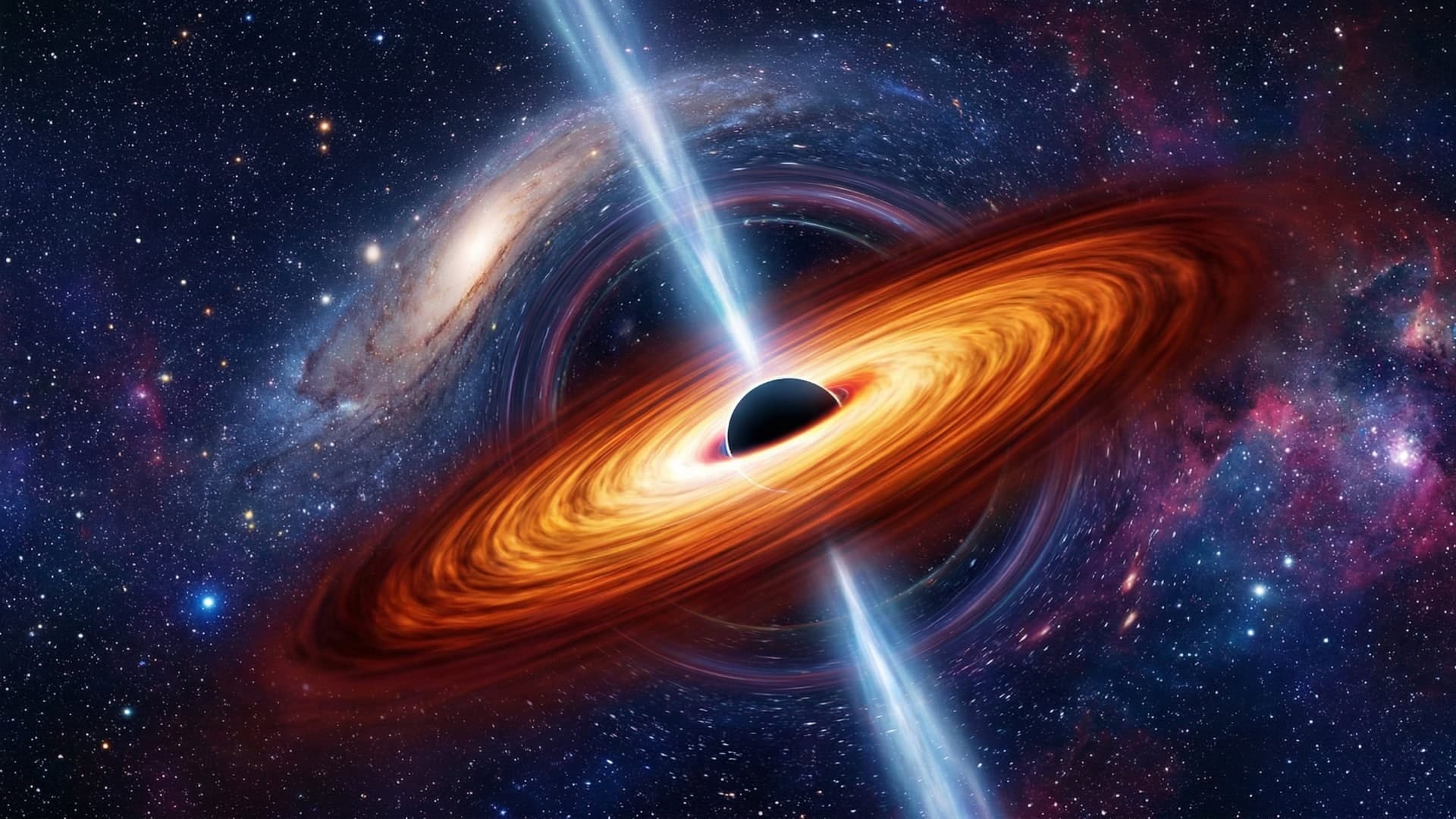
These are the event horizon, the singularity, and the surrounding accretion disk. Let us explore them in detail below.
Event Horizon: The Point of No Return
The event horizon is the outer boundary of a black hole. It can be described as the point of no return.
If something is just outside this boundary, it might still escape using extreme speed. But once it crosses this line and goes inside, there is no chance of liberation.
Inside the event horizon, the gravitational pull is so strong that escaping requires a speed greater than that of light. Since it is impossible to travel faster than light, we can never retrieve any information from inside the event horizon.
Singularity: The Mysterious Center
If you cross the event horizon and go deeper into the black hole, you will reach its exact center. This center is called the singularity.
It is a point where the entire mass of the star is packed into an infinitely small space. Here, the density of matter is infinite, and the volume is zero.
None of the current laws of physics work at the singularity. Our familiar concepts of space and time lose all meaning here. It remains a massive mystery to scientists today.
Accretion Disk and Surrounding Matter
Even though a black hole cannot be seen directly, we can infer its presence by observing its surroundings. If there is a gas cloud or a star close to a black hole, the black hole pulls those materials toward itself with its strong gravity.
This gas and dust do not fall straight into the black hole. Instead, they start spinning around it at incredibly high speeds, much like water creating a whirlpool as it goes down a drain.
This swirling disk of matter is called an accretion disk. Because they spin so fast, the gases in this disk experience immense friction and become incredibly hot. They then emit massive amounts of radiation, including X-rays, which scientists can detect from Earth.
How Does a Black Hole Work?
A black hole does not work like a normal object. It bends the space and time around it in ways that are hard to believe with the naked eye.
Albert Einstein’s General Theory of Relativity helps us understand how a black hole functions.
The extreme state of gravity and the distortion of spacetime form the core basis of a black hole’s mechanics.
Understanding the Extreme Force of Gravity
According to Einstein, gravity is not a simple pulling force. It is the curving of the fabric of spacetime caused by a massive object.
If you place a heavy iron ball in the middle of a tightly stretched sheet, the sheet will sink under the ball’s weight. Now, if you roll a small marble onto that sheet, it will rush toward that dip.
In space, a black hole does exactly this. Its mass is so great that it creates an infinitely deep hole in the fabric of spacetime. As a result, everything nearby is strongly attracted toward that hole.
What Happens to Matter Near a Black Hole?
If an object or an astronaut gets too close to a black hole, they will experience a terrifying effect. The gravitational force of a black hole changes extremely fast over a short distance.
Imagine you are falling toward a black hole feet first. The gravitational pull on your feet will be many times stronger than the pull on your head.
Because of this difference, your body would stretch out and tear apart like a long noodle. In scientific terms, this bizarre and horrific process is called “spaghettification”.
Can Anything Escape a Black Hole?
According to standard physics rules, nothing can escape a black hole once it crosses the event horizon. This is because escaping would require traveling faster than the speed of light.
However, according to certain theories of quantum mechanics, a tiny amount of radiation can leak from a black hole into space.
The famous scientist Stephen Hawking worked extensively on this specific type of radiation. We will discuss this in more detail later in this article. But in a general sense, there is no chance for any solid object or light to return once it enters a black hole.
Types of Black Holes
Not all black holes are the same. Based on their mass and size, scientists have divided them into several main categories.
The differences in their masses are so vast that comparing one to another is quite astonishing.
Let us find out how many types of black holes exist in the universe and where they are located.
Stellar-Mass Black Holes
These are the most common types of black holes. They are created when massive stars are destroyed in supernova explosions.
The mass of these black holes can range from three times the mass of our Sun to several dozen times its mass. They are abundant in the universe.
Scientists believe there are millions of stellar-mass black holes scattered just within our own Milky Way galaxy.
Intermediate-Mass Black Holes
For a long time, scientists thought black holes were either very small or incredibly massive. But later, they discovered medium-sized black holes.
Their mass can range from 100 to 100,000 times the mass of the Sun. Research is still ongoing to figure out how exactly they form.
Scientists suspect that these intermediate black holes might form when many smaller stellar black holes merge together or when multiple stars collide.
Supermassive Black Holes
These are the true monsters of the universe. Their mass can range from millions to billions of times the mass of our Sun. Interestingly, their size is not that large compared to their immense mass.
There is a supermassive black hole at the center of almost every large galaxy. Our Milky Way galaxy also has a giant black hole at its center named Sagittarius A*.
Primordial Black Holes: A Theoretical Possibility
These black holes did not form from the death of stars. Scientists theorize that they were created at the very beginning of the universe, just moments after the Big Bang.
At that time, the temperature and density of the universe were so high that small pockets of matter could have collapsed directly into black holes.
They could range in size from an atom to the mass of a mountain. However, they are still theoretical, and no direct evidence of their existence has been found yet.
How Scientists Detect Black Holes
Since black holes emit no light and are entirely dark, they are impossible to see with regular telescopes. So how do scientists know that a black hole is hiding in a specific part of space?
They mainly prove its existence by observing the environment around the black hole and the effects it has on other objects.
Below are the three most important methods for detecting black holes.
Observing the Gravitational Effect on Nearby Objects
Although a black hole cannot be seen directly, its gravitational force cannot be hidden. When astronomers see a star orbiting an invisible point in space at extreme speeds, they realize something incredibly massive is there.
The black hole at the center of our galaxy was discovered in exactly this way. Scientists monitored the movements of stars in that region for years.
They saw that the stars were orbiting an invisible object with a mass about four million times that of the Sun. Packing such massive weight into a small space is only possible for a black hole.
X-ray Radiation and the Accretion Disk
As mentioned earlier, when a black hole pulls gas from a nearby star, an accretion disk forms. The gases in this disk spin incredibly fast and become extremely hot.
Upon reaching millions of degrees Celsius, this gas starts emitting powerful X-rays.
Satellites like NASA’s Chandra X-ray Observatory can detect these X-ray signals coming from space. By looking at these bright X-ray emissions, scientists can easily pinpoint a black hole’s location.
Gravitational Waves and Modern Discoveries
The most modern and groundbreaking method for detecting black holes is the observation of gravitational waves. Einstein predicted these waves back in 1916.
When two black holes collide and merge into one, they create massive ripples in the fabric of spacetime. These ripples spread across the universe at the speed of light.
In 2015, the LIGO observatory successfully detected these gravitational waves for the first time. This was a historic achievement in the scientific community, opening new horizons in black hole research.
The Role of Black Holes in the Universe
Many people consider black holes destructive monsters in space that only swallow things. However, black holes play a highly important and creative role in the larger structure of the universe.
They are deeply connected to the formation and evolution of galaxies. Black holes have played a major role in shaping the universe into what it is today.
Let us look at how they function on a cosmic scale.
Formation of Galaxies and Cosmic Structures
The gravitational pull of the supermassive black holes located at the centers of large galaxies helps hold the entire galaxy together.
Due to their powerful gravitational pull, billions of stars, gas, and dust particles in the galaxy orbit in an organized structure.
To a large extent, these giant black holes act as the central hub of a galaxy’s massive spinning wheel.
Black Holes and Galactic Evolution
Black holes do not just consume matter; they also eject massive amounts of energy into space. When a black hole consumes matter very rapidly, incredibly powerful radiation and matter jets shoot out from its two poles via the accretion disk.
This energy heats up the gases inside the galaxy and pushes them away. As a result, the rate at which new stars are born in the galaxy is regulated.
If there were no black holes, all the stars in a galaxy would form too quickly, and the normal evolution of the galaxy would be disrupted.
Common Myths and Misconceptions About Black Holes
While black holes inspire awe, they also generate many irrational fears and misconceptions. In sci-fi movies or books, black holes are often misrepresented.
Because of these misconceptions, many believe that a black hole will eventually destroy everything in the universe.
Let us break down some common myths about black holes using scientific facts.
Do Black Holes Swallow Entire Galaxies?
No, this is a complete misconception. A black hole is not an all-powerful cosmic monster. Its attractive power only works up to a certain distance.
Even though a supermassive black hole is very large, its gravitational pull is not enough to drag in all the other stars in a galaxy. Stars remain at a safe distance and orbit the black hole, just like planets orbit the Sun.
Could Earth Fall Into a Black Hole?
The answer is no. There are no black holes near our solar system that could pose a threat to Earth. The closest known black hole is thousands of light-years away from us.
Moreover, if our Sun were magically replaced by a black hole of the exact same mass, Earth would still not fall into it. Earth would continue to orbit just as it does now. The only difference is that the Sun’s light and heat would be lost forever.
Are Black Holes Cosmic Vacuum Cleaners?
Many people think of a black hole as a giant vacuum cleaner that sucks up everything in space. This is a major myth.
Black holes do not roam around space vacuuming things up. Only objects that come very close to the event horizon fall into a black hole. For objects at a safe distance, a black hole exerts a normal gravitational pull just like any standard star.
What Happens Inside a Black Hole?
This is probably the most intriguing and difficult question in modern science. Once an object crosses the event horizon, it is almost impossible to know exactly what happens to it.
Since no information can be obtained from within, scientists rely on mathematical and physical theories to estimate the internal conditions.
The inside of a black hole is a place where all the known laws of science completely break down.
Scientific Theories and Unanswered Questions
According to the general theory of relativity, any object that enters the event horizon will inevitably move toward the center, which is the singularity. Once it reaches there, the object will be crushed into a point of infinite density.
But this creates a problem. Does the object disappear forever? What happens to its internal information? This contradicts the rules of quantum physics, which state that information in the universe can never be completely destroyed.
This is known as the “Black Hole Information Paradox”. It remains one of the greatest unsolved mysteries in physics today.
The Limits of Modern Physics
While trying to explain the conditions inside a black hole, scientists have realized that our current understanding of physics is incomplete.
Einstein’s theories work perfectly for explaining gravity in very large objects. On the other hand, quantum mechanics explains the world of tiny particles. But at the center of a black hole, where enormous mass is trapped in a tiny space, these two theories clash.
To solve this problem, scientists are trying to discover a “Theory of Everything,” or Quantum Gravity, that would unify these two opposing theories.
Stephen Hawking and Black Hole Research
When talking about black hole research, the first name that comes to mind is the world-famous theoretical physicist Stephen Hawking. He permanently changed our understanding of black holes.
He proved that black holes are not completely “black”. They actually radiate a certain type of energy.
Hawking’s groundbreaking work added a whole new dimension to black hole science.
Explanation of Hawking Radiation
In 1974, Stephen Hawking used quantum mechanics to show that particles and anti-particles are constantly being created from empty space just outside a black hole’s event horizon.
Normally, these particles destroy each other immediately after being born. But near a black hole, if one particle falls in, the other can escape into space.
From the outside, it appears as if the black hole is emitting these particles. This radiation is known as “Hawking Radiation”.
Major Contributions to Black Hole Science
The theory of Hawking Radiation proves that black holes are not eternal. They slowly lose their mass through this radiation and begin to shrink.
After losing mass for billions of years, a black hole might one day disappear into space in a massive explosion.
Hawking’s theory was the first to bridge Einstein’s theory of gravity and quantum mechanics, making an unforgettable contribution to science.
Recent Discoveries and Breakthroughs
Thanks to incredible technological advancements in the last few decades, there have been some unprecedented successes in black hole research. We are no longer just making theories; we are finding direct evidence.
One breakthrough after another is giving scientists a much clearer understanding of black holes.
The two biggest achievements are discussed below.
The First Image of a Black Hole
April 10, 2019, is marked as an unforgettable day in human history. On that day, scientists released the first actual image of a black hole.
It was an image of the supermassive black hole at the center of galaxy M87, located 55 million light-years away from Earth.
This impossible feat was achieved by connecting eight radio telescopes around the world under a project called the Event Horizon Telescope. In the image, a dark central region is surrounded by a bright orange ring, which is the black hole’s shadow, or event horizon.
New Insights from Space Telescopes and Observatories
Following M87, scientists released an image of Sagittarius A*, the black hole at the center of our own Milky Way galaxy, in 2022.
In addition, the James Webb Space Telescope is gathering new data on supermassive black holes found in the very earliest galaxies of the universe.
These telescopes are showing us how such massive black holes could form so quickly right after the universe began.
Black Holes in Popular Culture
Beyond science and space exploration, black holes have had a significant influence on the entertainment world. Their mysterious nature has allowed writers and directors to let their imaginations run wild.
Countless stories, novels, and movies have been created by mixing science with imagination.
However, not everything shown in entertainment media is scientifically accurate.
Black Holes in Movies, Books, and Media
Many people are familiar with the movie “Interstellar”. It featured a massive black hole named “Gargantua”.
The structure of the black hole and the time dilation (slowing down of time) around it were depicted highly scientifically and accurately in the movie. Nobel-winning physicist Kip Thorne was the scientific advisor for this film.
In addition, black holes have been featured in many books by famous science fiction authors like Arthur C. Clarke and Isaac Asimov.
The Difference Between Science and Sci-Fi
In science fiction, a black hole is often shown as a doorway or wormhole to another universe. A hero might travel through a black hole to reach a new dimension.
But in real science, there is no proof of this. According to the laws of physics, if a human enters a black hole, death by spaghettification is certain.
Therefore, while we enjoy the thrilling scenes in movies, we must keep the limitations of real science in mind.
The Future of Black Hole Research
Even though we know a lot about black holes, they remain a massive puzzle for scientists. New technologies will be introduced into this research in the coming days.
Scientists hope that in the next few decades, our understanding of black holes will change drastically.
Upcoming missions might finally provide answers to many unsolved questions.
Upcoming Missions and Technology
The European Space Agency (ESA) and NASA are working together on a project called LISA (Laser Interferometer Space Antenna). It will be the first gravitational wave observatory placed in space.
Free from Earth’s noise, it will be able to detect the collision signals of supermassive black holes much more precisely in space.
Additionally, next-generation radio telescopes are developing technologies to capture sharper, clearer images of black holes.
Questions Scientists Want to Answer
In future research, scientists primarily aim to answer two big questions. First, what is the solution to the information paradox? Where does the information that falls into a black hole actually go?
Second, how did supermassive black holes form so quickly at the beginning of the universe?
The answers to these questions might introduce us to a completely new branch of physics.
Frequently Asked Questions (FAQs)
What is a black hole actually?
A black hole is a region in space where the gravitational pull is so strong that absolutely nothing, not even light, can escape from it.
Can light escape from a black hole?
No, light cannot escape from a black hole. Its gravitational force is so immense that escaping it would require a speed greater than the speed of light, which is impossible in nature.
What happens if someone falls into a black hole?
If someone falls into a black hole, the gravitational pull on their feet will be so much stronger than on their head that their body will stretch out and tear apart like a noodle. This process is called spaghettification.
Are black holes dangerous to Earth?
No, none of the currently known black holes pose a threat to Earth. Even the closest black hole is located at a safe distance, thousands of light-years away.
How are black holes detected?
Since they are invisible, they cannot be seen directly. Scientists detect them through the motions of nearby stars, X-ray radiation from their accretion disks, and gravitational waves.
Conclusion
The black hole is one of the universe’s greatest and most terrifyingly beautiful creations. It is a symbol of both creation and destruction. Its mysterious nature forces us to think differently about our universe.
In today’s discussion, we have sought to gain a clear understanding of what a black hole is and how it works.
As science progresses, we might discover many more unknown facts about this cosmic wonder.
Key Facts About Black Holes
In conclusion, a black hole is an unimaginable convergence of immense mass and gravity. They are created from the death of massive stars.
We cannot directly know what lies inside its boundary, or even its horizon.
However, by observing its outer environment, we are constantly discovering new scientific facts.
Why Black Holes Remain the Universe’s Greatest Mystery
The black hole will forever remain the universe’s greatest mystery because it points directly to the limits of our current science.
Understanding how the laws of nature operate in a place where space and time do not exist is a massive challenge for humanity.
Perhaps in the near future, a brilliant scientist will use the black hole to finally solve the ultimate mystery of our universe’s creation. Until then, this dark cosmic hole will continue to exist as a marvel in our imagination.