
The Ultimate Guide to Understanding World Religions
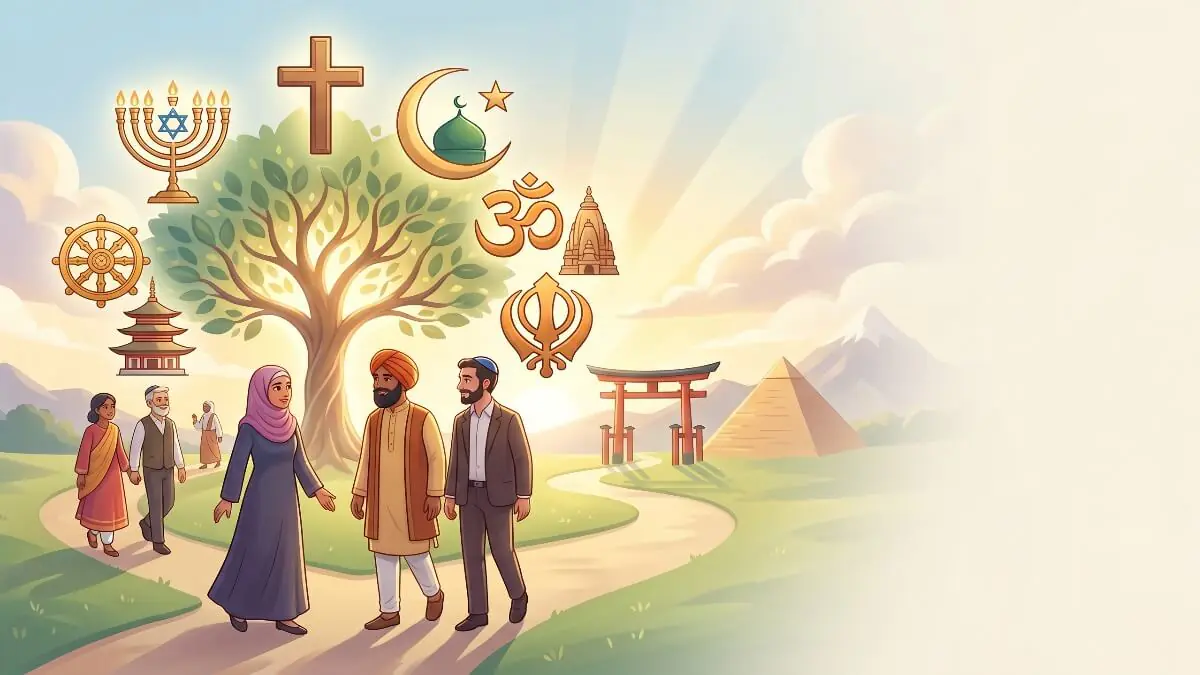
Our beautiful world is full of rich diversity. A major part of this diversity centers on human religious beliefs. Have you ever wondered what people on the other side of the globe believe? Or perhaps you want to understand the deeper meaning behind your neighbor’s religious practices.
Religion plays an essential role in human life. It guides individuals, offers peace of mind, and helps build a better society. Understanding other religions is crucial in today’s modern and connected world. It broadens our perspective. It also teaches us to be respectful of one another.
We will discuss the world’s major religions in this blog post. We will explore the core beliefs, history, and customs of each faith using simple language. Let us begin this wonderful journey of knowledge and understanding.
What is Religion and Why is it Important?
Religion is an organized system of beliefs, practices, and moral values. People generally practice religion out of faith in spiritual beings or a higher power. Religion helps individuals find meaning in life. It teaches us how to walk the right path.
Religion has played a vital role in human society since the dawn of history. It deeply influences art, literature, and architecture. You will see religion at the center of their cultures if you look at the world’s greatest civilizations. Religion gives people hope when they face despair or danger.
Religion also gives individuals a strong sense of community. People come closer to each other through festivals and prayers. Therefore, you must learn about world religions to fully understand global history and culture.
According to the Encyclopedia Britannica, religion remains one of the oldest and most universal aspects of the human experience.
Abrahamic Religions
Abrahamic religions originated in the Middle East. These faiths honor the Prophet Ibrahim or Abraham as their spiritual father. Monotheism, or the belief in one God, serves as the primary feature of these religions. More than half of the world’s population follows these faiths.
Judaism
Judaism stands as one of the oldest monotheistic religions in the world. It originated in the Middle East about four thousand years ago. Jewish people believe that God is one and unique. They believe God created the universe and watches every human action.
The ‘Tanakh’ is the holy text of Judaism. The Torah forms its most important section. The Torah basically contains a collection of laws and instructions given by God. Jewish people call their places of worship ‘Synagogues’. They call their religious leaders ‘Rabbis’.
Jewish people observe the Sabbath, or the day of rest. This period runs from Friday evening to Saturday evening. They refrain from work and focus on prayer during this time. Rosh Hashanah (New Year) and Yom Kippur (Day of Atonement) rank among their major festivals. Judaism primarily emphasizes justice, peace, and human welfare.
Christianity
Christianity is the largest religion in the world. It has about 2.4 billion followers globally. This religion began in the first century based on the life and teachings of Jesus Christ. Christians believe that Jesus is the Son of God and the savior of humanity.
Their holy book is the ‘Bible’. The Bible has two main sections. These are the Old Testament and the New Testament. The Old Testament relies heavily on Jewish scriptures. The New Testament records the life, teachings, and followers of Jesus.
Christians pray in Churches. Christmas and Easter serve as their main religious festivals. People celebrate the birth of Jesus on Christmas. They commemorate the resurrection, or return from the dead, of Jesus on Easter. Christianity essentially teaches love, forgiveness, and compassion. Jesus told people to love one another exactly as God loves humanity.
Christianity has several branches. Catholicism, Protestantism, and Orthodoxy are the largest ones. Each branch maintains its own distinct customs. However, the core beliefs remain identical everywhere.
Islam
Islam is the second-largest and fastest-growing religion globally. It originated in the seventh century in present-day Saudi Arabia. Muslims believe that Allah is one and supreme. They accept Prophet Muhammad as the final Prophet and messenger of Allah.
The ‘Quran’ is the holy book of Islam. Muslims believe Allah revealed the Quran to the Prophet Muhammad through the angel Gabriel. The Quran provides guidance for every aspect of human life. Muslims pray in Mosques.
Islam has five main pillars:
-
Shahada (Faith): Testifying that Allah is one and Muhammad is His messenger.
-
Salah (Prayer): Praying five times a day according to specific rules.
-
Sawm (Fasting): Refraining from food and drink from dawn to sunset during the month of Ramadan.
-
Hajj (Pilgrimage): Visiting the Kaaba in Mecca at least once in a lifetime if one has the financial and physical ability.
-
Zakat (Charity): Donating a specific portion of one’s wealth to the poor.
Eid al-Fitr and Eid al-Adha are the two main festivals of Islam. Islam places deep importance on peace, brotherhood, and social justice. You can read the Wikipedia article on Islam to learn more details.
Indian Religions
Several major religions originated in the ancient Indian subcontinent. Scholars collectively refer to these as Indian religions or Dharmic faiths. These religions generally believe in the concepts of karma (the result of actions) and reincarnation (rebirth after death).
Hinduism
Hinduism is one of the oldest religions in the world. It does not have a single founder. It represents a complex blend of various beliefs, traditions, and philosophies from ancient India. Hinduism is highly diverse. Its followers practice their religion in many different ways.
Hindus generally believe in a supreme being, whom they call ‘Brahman’. However, they also worship Brahman through the idols of various deities. Brahma, Vishnu, and Shiva stand as the three main gods in Hinduism. They symbolize creation, preservation, and destruction, respectively.
Hindus revere several holy texts. The Vedas, Upanishads, Ramayana, Mahabharata, and Bhagavad Gita rank among the most prominent. Hinduism rests on two core concepts: ‘Karma’ and ‘Dharma’. Karma represents the result of human actions. Good deeds bring good results. Dharma signifies human duty and righteous living.
Hindus worship in temples. They celebrate many joyful festivals. Diwali (Festival of Lights), Holi (Festival of Colors), and Durga Puja are the most famous ones. Hinduism teaches self-realization and kindness toward all living beings.
Buddhism
Buddhism originated in ancient India in the sixth century BCE. Siddhartha Gautama founded this religion. He later became known as the ‘Buddha’ (the awakened one). He left his royal life to find the cause of human suffering and the way to escape it.
Buddhism does not mandate belief in a specific creator God. Its main goal is to achieve ‘Nirvana’ or ultimate peace. The teachings of Buddha rely mainly on the Four Noble Truths and the Noble Eightfold Path.
The Four Noble Truths are:
-
Suffering exists in the world.
-
Human desire or thirst causes this suffering.
-
Eliminating desire eliminates suffering.
-
Following the Noble Eightfold Path is the way to eliminate suffering.
The Noble Eightfold Path guides people toward the right view, right speech, right action, and right mindfulness. Buddhists call their holy texts the ‘Tripitaka’. They meditate and pray in pagodas or viharas. Buddhism offers wonderful teachings on non-violence, compassion, and mindfulness.
Sikhism
Sikhism emerged in the Punjab region of India during the fifteenth century. Guru Nanak founded this religion. Sikhs believe in one God. They guide their lives using the teachings of ten human Gurus. The tenth Guru, Gobind Singh, declared their holy text, ‘Guru Granth Sahib,’ as the eternal Guru.
Sikhs reject the caste system completely. They believe all people are equal in the eyes of God. Sikhs call their places of worship ‘Gurdwaras’. Every Gurdwara features a free community kitchen called a ‘Langar’. People of all religions and races sit together and share meals there.
Sikhism has three core principles. These are remembering God, earning an honest living, and sharing one’s earnings with others. Sikhs are widely recognized for their courage, honesty, and community service. Vaisakhi serves as one of their major festivals.
Jainism
Jainism is another significant religion from ancient India. The core mantra of this religion is ‘Ahimsa’ or non-violence. Jains believe every creature in the universe has a soul. They even extend this belief to tiny insects. Therefore, they live an extremely strict vegetarian lifestyle.
Jainism follows the teachings of the twenty-four Tirthankaras (spiritual teachers). Mahavira was the last Tirthankara. He popularized Jainism. Jains believe in karma and reincarnation. Their primary goal is to free the soul from all karmic bonds.
Jains teach people to speak the truth, avoid stealing, and reject the accumulation of excessive wealth. Their peaceful and disciplined lifestyle continues to inspire many people today.
East Asian Religions
China and Japan developed several unique religious and philosophical systems. Scholars refer to these as East Asian religions. These belief systems place more emphasis on nature, society, and personal ethics than on a creator God.
Taoism
Taoism is an ancient Chinese philosophy and religion. Laozi founded this tradition. The word ‘Tao’ means ‘the way’ or the natural order of the universe. Taoism teaches people to live a simple life in harmony with nature.
The concept of ‘Yin and Yang’ forms the foundation of Taoism. This concept suggests that everything in the universe has opposite but complementary forces. Light and dark or male and female serve as common examples. Maintaining a balance between these forces is essential. Taoists seek mental peace by abandoning excessive desires.
Confucianism
Confucianism functions primarily as a moral and social philosophy. The famous ancient Chinese philosopher Confucius established it. He focused heavily on maintaining peace and order in society.
The Confucian philosophy teaches individuals how to become good human beings. It places the highest importance on respect for parents, reverence for elders, and education. Confucius believed that society would automatically become beautiful if everyone performed their duties correctly. The influence of Confucianism remains highly visible in modern Chinese culture.
Shinto
Shinto is the indigenous and ancient religion of Japan. It has no specific founder or holy text. Shinto followers believe in ‘Kami’ or spirits. They believe Kami exist in elements of nature like trees, mountains, rivers, and rain.
Shinto expresses deep respect for nature. Japanese people also honor their ancestors as Kami. They visit various Shinto shrines to pray. Builders usually construct these shrines in very beautiful natural environments. Shinto teaches people to maintain purity, cleanliness, and harmony with nature.
Other Notable Beliefs and Philosophies
The world holds many other belief systems beyond the major religions discussed above. These systems further enrich the diversity of human society.
Baha’i Faith
The Baha’i Faith began in Persia (modern-day Iran) during the nineteenth century. Baha’u’llah founded this religion. It represents a relatively new faith. Baha’is believe that the God of all religions is one and the same.
The core message of the Baha’i Faith is the unity of humanity. They view all people on Earth as a single family. They actively work to eliminate all forms of prejudice and support equal rights for men and women. Baha’is dedicate their lives to establishing world peace.
Folk and Indigenous Religions
Many people in different parts of the world still follow their indigenous beliefs. Local indigenous communities in Africa, the Americas, and Australia practice beautiful, unique customs. People usually pass these religions down orally from one generation to the next.
Indigenous religions respect the deep relationship between humans and nature. They believe nature is alive and humans must protect it. They often communicate with their gods and ancestors through songs, dances, and storytelling.
Atheism and Agnosticism
Understanding atheism and agnosticism is also important in this discussion of religion. Many people in the modern world do not believe in any institutional religion.
Atheists do not believe in any God or divine being. They believe the universe operates according to natural laws. On the other hand, agnostics believe that humans cannot know for sure whether God exists or not.
These individuals have their own strong moral values despite not practicing a religion. They guide their lives based on humanism, science, and logic. They work equally hard for human welfare and environmental protection.
Common Similarities Among World Religions
You will find many similarities among world religions if you look closely. They may look different in their external rituals, but the core values align. Every religion provides certain fundamental moral teachings.
The ‘Golden Rule’ serves as the greatest similarity. Almost every religion states, “Treat others the way you want to be treated.” This rule forms the core foundation of empathy and respect.
Furthermore, almost all religions teach people to speak the truth, avoid stealing, help others, and show kindness. Religions teach self-control. They tell us to stay away from greed, anger, and jealousy. These common values prove that humanity transcends all religious boundaries.
How to Be Respectful of Other Religions
We must respect each other’s religions to live peacefully in a diverse world. We can show this respect in a few simple ways:
-
Show curiosity: Try reading and learning about other religions. Most misconceptions stem from ignorance.
-
Ask questions instead of criticizing: Ask politely if you do not understand something. Do not argue with the intention of hurting someone.
-
Send festival greetings: Wish your friends well during their religious festivals. This will bring them joy and strengthen your relationship.
-
Follow the rules of worship places: Always adhere to the specific rules and dress codes when you visit a place of worship of another religion.
-
Be tolerant: Not everyone will think exactly like you do. Develop a mindset that accepts different opinions.
Conclusion
World religions represent a massive and fascinating chapter of human history. Each religion holds its own unique beauty and depth. Religion shows people the path of life. It inspires us to do good deeds and build a better society.
We all must live together in today’s global village. No divisions will exist among us if we can understand each other’s beliefs and cultures. We hope this guide has given you a clear understanding of different faiths.
Remember that our primary identity is human, regardless of our different religions. Let us remove divisions through love and build a peaceful world together.
Frequently Asked Questions (FAQ)
1. What is the largest religion in the world?
Christianity is the largest religion in the world. It has approximately 2.4 billion followers globally. Islam and Hinduism follow closely behind.
2. What is the main difference between Abrahamic religions and Indian religions?
The Abrahamic religions (Judaism, Christianity, and Islam) are fundamentally monotheistic. They believe a person lives only once. Indian religions (Hinduism, Buddhism, and Jainism) generally believe in karma and reincarnation.
3. Does Buddhism believe in God?
No, Buddhism does not require belief in a specific creator or God. It focuses primarily on spiritual awakening and showing compassion to others. Its main goal is to attain Nirvana.
4. Can non-religious people be moral?
Absolutely. People can be deeply moral without holding religious beliefs. Many atheists and humanists lead excellent moral lives grounded in logic and a love for humanity.
5. Are the core messages of all religions the same?
The rituals of all religions differ greatly. However, their fundamental moral teachings are very similar. Every religion teaches people to walk the right path, help others, and establish justice.
6. What is the difference between Taoism and Confucianism?
Taoism teaches people to live a calm life in harmony with nature. Confucianism places more emphasis on social order, family values, and human duties toward others.
7. How can I learn more about the customs of other religions?
You can read reliable books or gather information online. The best way to learn is to have friendly discussions with people of different faiths. You will also learn a lot by participating in their cultural festivals.