
How Is Joseph Described in Different Religions?
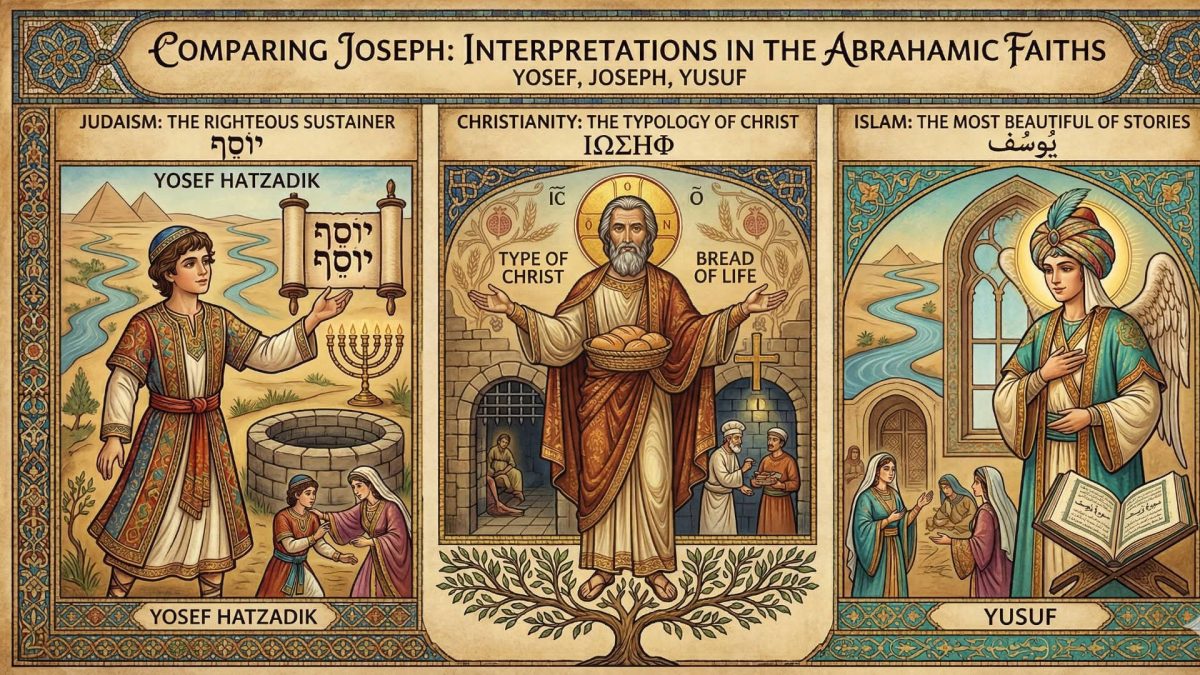
Among the world’s major religions, there are figures whose life stories have inspired humanity for ages. One of the most prominent among these great personalities is Yusuf, known in English and Hebrew as Joseph. His life story is not just a simple historical event. It is a wonderful blend of human rise, fall, betrayal, unwavering faith, and ultimate victory.
When we read the holy books of various religions, we find that each tradition has narrated its story with great respect and importance. In today’s post, we will explore how Joseph is presented across different religions and the invaluable lessons we can learn from his life.
Who is Joseph?
Joseph is a central figure in the Abrahamic religions (Judaism, Christianity, and Islam). He was the son of Prophet Jacob and the great-grandson of Abraham. According to religious texts, he was his father’s most beloved child.
Because of this special status, his half-brothers became jealous of him and plotted to kill him. Later, he was sold into slavery in Egypt. However, due to his extraordinary wisdom, his divine ability to interpret dreams, and his strength of character, he rose from an ordinary slave and prisoner to become the second-most-powerful ruler in Egypt after the Pharaoh.
Why Joseph is Important in Multiple Religions
Joseph’s importance is not limited to a specific community. He is equally revered by followers of all three major monotheistic religions. His story is a perfect portrayal of human emotions. From jealousy to forgiveness, and from extreme despair to receiving divine grace, everything can be seen in his life.
He was a leader whose wisdom saved an entire nation from impending famine. Because of this universal appeal and his extraordinary moral qualities, he is an exemplary figure for everyone, regardless of religion or race. For more details, you can read the Biography of Joseph from Encyclopedia Britannica.
Understanding Religious Perspectives on Joseph
Different religions have evaluated Joseph from varying perspectives. In Judaism, he is the founder of two of the twelve tribes of Israel and a visionary leader. In Christianity, he is seen as a type or foreshadowing of Jesus Christ, who, despite being rejected by his own people, later emerged as their savior. On the other hand, in Islam, he is revered as a great prophet, and his story is described in the Holy Quran as the “best of stories.” These unique perspectives from each religion help us better understand the different facets of Joseph’s character.
Joseph in Judaism
In Jewish religious tradition and the Hebrew Bible, the story of Joseph is described in great detail. The Torah, or the Book of Genesis, contains a meticulous account of every event from the beginning to the end of his life.
Description of Joseph in Judaism
In the Hebrew Bible, Joseph is depicted as an intelligent, handsome, and God-blessed young man. Chapters 37-50 of the Book of Genesis tell the complete story of his life. In Judaism, he is viewed not merely as an individual but as a crucial part of God’s greater plan. How God prepares an individual to save His chosen nation is perfectly exemplified by Joseph’s life.
Role of Joseph in Judaism
Joseph’s role in Jewish history is immense. He was the medium through which the Children of Israel entered Egypt. It was due to his visionary leadership that his family and, subsequently, the entire nation of Israel were saved from a terrible famine. He is the patriarch of two of the twelve tribes of Israel (Ephraim and Manasseh).
Joseph, the Son of Jacob and Rachel
Joseph was the eleventh son of Jacob and the first child of his most beloved wife, Rachel. Although Jacob had many other sons with his other wives and concubines, he had a special soft spot for this child born to Rachel in his old age. This extra love and attention created a sense of unease and jealousy within the family. Jacob made a special coat of many colors for Joseph, which further fueled the brothers’ resentment.
Joseph’s Dreams and Their Meanings
Dreams play a highly significant role in Joseph’s story. As a teenager, Joseph had two strange dreams. In the first dream, he saw that while harvesting crops in the field, his sheaf stood upright, and his brothers’ sheaves gathered around his and bowed down. In the second dream, he saw the sun, the Moon, and eleven stars bowing down to him. The meanings of these dreams were very clear. They indicated that Joseph would gain authority over his entire family in the future. Hearing about these dreams multiplied his brothers’ jealousy and anger.
Joseph’s Rise to Power in Egypt
After being sold into slavery in Egypt due to his brothers’ plot, Joseph was bought by Potiphar, a high-ranking official of the Pharaoh. There, he earned Potiphar’s trust through his honesty and efficiency. However, due to false accusations by Potiphar’s wife, he was sent to prison despite being innocent. Even in prison, he accurately interpreted his fellow inmates’ dreams. Later, when the Pharaoh had two bizarre dreams in a row, and no wise man in Egypt could explain them, Joseph was summoned from prison. Joseph told the Pharaoh that Egypt would experience seven years of abundant harvest followed by seven years of severe famine. Impressed by this wise interpretation and the proposed solution, the Pharaoh appointed Joseph as the ruler of Egypt.
Forgiveness and Family Reunion in Joseph’s Story
During the famine, when Joseph’s brothers came to Egypt to gather food, they did not recognize him. However, Joseph recognized them. Although he initially treated them harshly, he later revealed his identity. This scene is one of the most emotional moments in the Bible. Joseph forgave his brothers and told them that even though they intended to harm him, God turned it into good. He brought his father and the entire family to Egypt, which marked the beginning of a new chapter in Jewish history.
Joseph in Christianity
In Christianity, the story of Joseph is not just a historical lesson; it is also highly significant on spiritual and theological grounds. Christian scholars often analyze Joseph in the light of the New Testament.
Description of Joseph in Christianity
In Christian tradition, Joseph is described as a highly righteous, honest, and God-fearing person. He was a man who never lost his faith in God despite facing numerous hardships. In Christianity, resisting the temptation of Potiphar’s wife is taught as a major proof of his flawless character.
Role of Joseph in the Old Testament
In the Old Testament, Joseph is the last major figure of the patriarchal era. Through his story, a connection is established between the Book of Genesis and the Book of Exodus. In Christianity, he is often considered a “type” or foreshadowing of Jesus Christ. There are many striking similarities between the lives of Jesus and Joseph. Both were rejected by their own people, both were sold for silver coins, both were unjustly punished, and both ultimately emerged as the saviors of the very people who caused them pain.
Lessons from Joseph’s Faith and Perseverance
For Christian believers, Joseph is an ultimate example of perseverance and unwavering faith. In the New Testament’s Epistle to the Hebrews (Hebrews 11), Joseph is mentioned as a great hero of faith. The long period of imprisonment, the humiliation of slavery, and the false accusations could not shake his belief. He trusted that God was with him and that there was a noble purpose behind every event in his life.
Joseph as a Symbol of Forgiveness and Wisdom
Joseph embodies Christian forgiveness. Just as Jesus Christ taught to forgive one’s enemies, Joseph had set a practical example long before. Despite suffering extreme injustice, he did not seek revenge. Instead, he reunited his family through wisdom and love. This teaches Christian followers how to overcome hatred and anger to rebuild relationships through love and forgiveness.
Joseph in Islam
In Islam, Joseph is known as “Prophet Yusuf (AS).” His story is presented in the Holy Quran with great reverence and from a completely different perspective.
Description of Joseph (Yusuf) in Islam
In Islam, Yusuf (AS) is recognized as a great prophet and messenger. He is considered one of the most handsome men in human history. According to Islamic belief, Allah bestowed upon him not only physical beauty but also unparalleled character, profound wisdom, and divine knowledge. He was a shining example of patience, honesty, and absolute submission to Allah.
Prophet Yusuf in the Quran
The 12th chapter of the Holy Quran is named “Surah Yusuf.” While the stories of other prophets are narrated in fragments across various chapters, the complete story of Yusuf (AS) is narrated sequentially in a single chapter. Allah has referred to this story as “Ahsanul Qasas,” meaning “the best of stories.” This chapter beautifully highlights the complexities of the human mind, the whispers of Satan, and the infinite mercy of Allah.
The Story of Yusuf and His Brothers
According to the Quranic narrative, Yusuf’s brothers were intensely jealous of him because their father, Yaqub (Jacob), loved him dearly. They plotted, took Yusuf away, and threw him into a dark well. Later, they returned to their father and lied, saying a wolf had eaten Yusuf. As proof, they brought Yusuf’s shirt stained with fake blood. However, Yaqub (AS) did not believe them and sought help from Allah with immense patience. While in the well, Allah comforted Yusuf and informed him that one day he would remind his brothers of this deed.
Yusuf’s Beauty, Wisdom, and Patience in Islamic Tradition
Islamic tradition particularly emphasizes Yusuf (AS) ‘s physical beauty. The Quran states that the wife of an Egyptian minister (referred to as Zulaikha in Islamic literature) became infatuated with Yusuf. When other women in the city began criticizing Zulaikha, she invited them to a banquet and gave each a knife to cut fruit. At that exact moment, she asked Yusuf to appear before them.
Seeing Yusuf’s ethereal beauty, the women were so mesmerized that they cut their own hands instead of the fruit. They exclaimed that this was no ordinary human being but an honorable angel. Despite such beauty and temptation, Yusuf (AS) refrained from sin out of fear of Allah, preferring imprisonment over committing a wrong deed.
Significance of Surah Yusuf
Surah Yusuf is not just a story; it is a spiritual guide for Muslims. This chapter was revealed when Prophet Muhammad (PBUH) was enduring extreme sorrow and hardship in Mecca. That year is known as the “Year of Sorrow” due to the deaths of his beloved wife Khadija and his uncle Abu Talib. By revealing this chapter, Allah comforted His final prophet, showing that, just as Yusuf (AS) had, he too would face hardships from his own people, but, with Allah’s help, would ultimately emerge victorious. This chapter teaches that one must never lose Tawakkul (trust) in Allah, no matter how severe the crisis.
Joseph in Other Traditions
Beyond Judaism, Christianity, and Islam, Joseph or Yusuf has a strong presence in other religions and cultural spheres.
Joseph in the Baha’i Faith
In the Baha’i Faith, Joseph is honored as a highly spiritual figure. Baha’i writings highlight many allegorical meanings of Joseph’s story. Baha’u’llah, the founder of the Baha’i Faith, often compared himself to Joseph in a spiritual sense, as he too was persecuted by his own brothers (since Baha’u’llah’s half-brother opposed him). In Baha’i belief, Joseph is a unique manifestation of divine beauty and wisdom.
Symbolic Interpretation of Yusuf in Comparative Theology
Comparative theologians view the story of Yusuf as a magnificent symbol of human transformation. Yusuf’s fall into the dark well and his subsequent ascent to the throne are interpreted as stages of human spiritual awakening. How a person’s soul is purified through pain and suffering, leading to the attainment of higher knowledge, is classically exemplified by Yusuf’s life.
Yusuf in Literature and Cultural Traditions
The impact of Yusuf’s story on world literature is immense. Famous German author Thomas Mann portrayed Joseph’s story from psychological and mythological perspectives in his epic novel “Joseph and His Brothers.” Additionally, the love story of “Yusuf and Zulaikha” is a highly popular theme in Persian literature. Many Sufi poets, including Jalaluddin Rumi, have used the story of Yusuf as an allegory for the union of the soul and the Supreme Being.
Comparing Religious Views on Joseph
While there are wonderful similarities in the story of Joseph across the three main Abrahamic religions, there are also fundamental differences.
Similarities Among Jewish, Christian, and Islamic Accounts
The core structure of the story is almost identical across all three religions. All acknowledge that he was Jacob’s favorite son, his brothers betrayed him out of jealousy, he was sold into Egypt, he was imprisoned innocently due to Potiphar’s wife, he caught the Pharaoh’s attention by interpreting dreams, he saved Egypt from famine, and ultimately, he reunited with his family and forgave them. These core events remain unchanged everywhere.
Key Differences in Joseph’s Story
The differences mainly appear in theological perspectives and the narration of certain events. In the Hebrew Bible, Joseph’s human flaws are evident, including his teenage arrogance and his initially harsh behavior toward his brothers. However, in Islam, since prophets are believed to be sinless (Ismah), Yusuf’s (AS) character is portrayed from the very beginning as highly mature, flawless, and completely obedient to Allah. Moreover, the incident involving Potiphar’s wife is described in much greater detail in the Quran than in the Bible. While the Bible focuses on the history of the Israelite nation and their arrival in Egypt, the Quran focuses on the spiritual test of a Prophet and the absolute power of Allah.
Why Joseph is a Shared Spiritual Figure
Despite the differences, Joseph is a figure who can build bridges among various religious communities. The core lessons of his life are universal. He proved that righteousness, honesty, and forgiveness are qualities revered in all religions. His story reminds us that regardless of our background or religious beliefs, respecting human values and divine laws makes us noble.
Joseph’s Life and Legacy
Certain events in Joseph’s life have become iconic in history and religion. These events not only made his life memorable but also left an enduring legacy for faithful followers.
Joseph’s Coat of Many Colors
Joseph’s coat of many colors is one of the most discussed symbols of his story. In the Bible, this special coat symbolized his father’s profound love, which stoked his brothers’ jealousy. Although the Quran does not explicitly mention multiple colors, the shirt plays a role at three critical turning points of the story. First, the brothers bring it stained with false blood. Second, Potiphar’s wife tears it from behind, serving as proof of Yusuf’s innocence. Finally, this very shirt restores his father Yaqub’s (AS) eyesight.
Joseph’s Imprisonment and Dream Interpretation
Joseph’s time in prison was an ultimate test of patience. There, he accurately interpreted the dreams of two of the Pharaoh’s royal servants. He predicted that one would be freed and reinstated as the Pharaoh’s cupbearer, while the other would be executed. This special knowledge was not mere magic; it was divine revelation. This period of imprisonment helped prepare him mentally to become a ruler.
Joseph’s Leadership During the Famine
The incredible economic and administrative skills Joseph displayed as the ruler of Egypt remain astonishing even in the modern era. During the first seven years of abundance, he undertook a massive project to store surplus grain. Consequently, when the severe drought and famine began, not only Egypt but also people in neighboring regions were spared starvation. He set the standard for an ideal, compassionate administrator.
Joseph’s Relationship with the Pharaoh
Joseph’s relationship with the Pharaoh was highly respectful. Throughout ancient Egyptian history, Pharaohs claimed to be gods. However, according to Biblical and Islamic accounts, the Pharaoh was so impressed by Joseph’s knowledge and wisdom that he handed over all his power to Joseph. Historians believe this Pharaoh likely belonged to the Hyksos dynasty, which was of Semitic origin, making it easier for them to place a young Semitic man like Joseph in a high position. To learn more about ancient Egyptian history, you can check the History Channel’s article on Ancient Egypt.
Historical and Symbolic Perspectives
Historians and theologians have judged the story of Joseph from various angles. Much research has been conducted over the ages regarding its historical basis and symbolic meaning.
Was Joseph a Historical Figure?
Many wonder whether Joseph actually lived in ancient Egypt or if this is merely an allegorical tale. No ancient Egyptian inscription bearing the exact name of Joseph has been found yet. However, ancient Egypt has a history of foreigners being sold as slaves, later rising to high royal positions, and enduring large-scale famines. In particular, the ‘Famine Stela’ in Egypt, which mentions a seven-year famine, aligns remarkably well with Joseph’s story. Therefore, historians believe this narrative has a solid historical foundation.
Egypt During Joseph’s Time
During Joseph’s time, Egypt was at the pinnacle of civilization. The depiction of Egypt’s administrative system, agriculture, and grain storage found in Joseph’s story closely matches the archaeological evidence of ancient Egypt. The way the massive granaries of the Pharaohs were managed during that era provides practical evidence of Joseph’s tale.
Joseph as a Symbol of Patience and Divine Guidance
Symbolically, Joseph is a radiant example of the journey toward the ultimate destination of human life. Being sold, falsely accused, or imprisoned could not alter his destiny. This proves that when God or Allah decides to honor someone, no earthly conspiracy can stop it. He is a living symbol of divine guidance.
Moral and Spiritual Lessons
Joseph’s life is not just an ancient myth; it is a vast reservoir of moral and spiritual lessons for modern people today.
Lessons of Patience and Faith from Joseph’s Story
The greatest lesson from his life is unwavering patience. After being attacked by his brothers, living as a slave, and suffering unjust imprisonment, he never became depressed or complained to God. He knew that truth would triumph one day. This indomitable faith is a great source of inspiration for those facing various frustrations and struggles in life today.
Forgiveness and Reconciliation in Joseph’s Life
Even while sitting at the absolute peak of his power, Joseph did not become arrogant. When his brothers, who once wanted to kill him, stood helpless before him, he could have exacted severe revenge. But he chose not to. He forgave their past mistakes. He understood that this entire chain of events was part of a greater divine plan. Setting an example of forgiving one’s enemies after gaining power is rare in history.
How Joseph’s Story Inspires Faith and Hope
Joseph’s story teaches us that the darker the night, the closer the dawn. One should not lose hope even in the darkest moments of life. If one maintains integrity, purity, and honesty, success is ultimately guaranteed. This remains a beacon of hope for people of every generation.
Frequently Asked Questions
Which religions recognize Joseph?
The three main Abrahamic religions, Judaism, Christianity, and Islam, all recognize Joseph as a highly important figure. Furthermore, he is deeply revered in the Baha’i Faith.
Is Joseph mentioned in the Quran and the Bible?
Yes, detailed accounts of his story are found in the Book of Genesis in the Bible and the 12th chapter of the Holy Quran (Surah Yusuf).
What is the difference between Joseph in Islam and Christianity?
In Christianity, Joseph is viewed as one of the patriarchs and a foreshadowing of Jesus Christ. In Islam, Yusuf is viewed as a full-fledged prophet and messenger to whom Allah directly granted revelation and knowledge.
Why is Joseph famous for interpreting dreams?
God or Allah granted Joseph special knowledge to interpret dreams. He saved Egypt from impending famine by perfectly interpreting the Pharaoh’s dream of seven fat cows and seven sickly cows, which is why he is famous.
What can we learn from Joseph’s story?
From his life, we learn great lessons: unwavering patience, honesty, resisting temptation, trusting God in times of danger, and, above all, forgiving our enemies.
Conclusion
The story of Joseph is a priceless gem written in the pages of history, whose brilliance has not faded the slightest over thousands of years. Even when evaluated from different religious perspectives, the core beauty of his character remains intact everywhere.
Final Thoughts on Joseph in Different Religions
The visionary leader of Judaism, the symbol of forgiveness in Christianity, and the sinless prophet of Islam are essentially different reflections of the same great entity. Each religion has illuminated various aspects of life that teach humanity morality and spirituality.
Understanding Shared Religious Traditions Through Joseph
In today’s divided world, figures like Joseph are extremely important for maintaining religious harmony. When Jews, Christians, and Muslims recognize that they are paying respect to the same great person, their mutual respect increases. His story reminds us of these shared roots.
Why Joseph’s Story Continues to Inspire the World
Joseph’s story is fundamentally a tale of eternal human emotions. This narrative of jealousy, temptation, suffering, patience, and ultimate triumph deeply touches people across eras and cultures. The example he set of silent resistance against injustice and conquering hatred with love will continue to inspire people worldwide for all eternity.
We hope this post has provided you with a clear and comprehensive understanding of how Joseph is described across different religions. May your journey on the path of knowledge and truth continue.