Science vs. Fiction: Debunking 10 Common Misconceptions
Introduction
The world around us is constantly changing. As the world evolves, our scope of knowledge expands with it. However, it is quite interesting how often we accept certain pieces of information as absolute truth when they are not scientifically accurate at all. Through generations of storytelling or the rapid sharing on social media, many misconceptions have taken permanent hold in our minds.
Today, we live in a world with no shortage of information. But alongside accurate data, the flow of misinformation is equally active. Because of this, scientific truths often get hidden in the shadows. People naturally love mystery and thrill, and this creates the perfect environment for fiction to grow.
In this article, we will discuss 10 common misconceptions that you might have believed to be true your entire life. We will examine these myths under the light of science. By doing so, we will try to understand just how fascinating the actual truth can be.
Why Fiction Spreads Faster Than Science
From a psychological perspective, the human mind simply loves to hear a good story. When science reveals the truth through complex equations or dry data, it can feel a bit dull to many people. On the other hand, a myth or a fictional story contains a sense of drama and wonder. This drama directly touches our emotions.
In this age of social media, a thrilling but false piece of information easily catches the public eye. When people stumble upon something new and bizarre, they tend to share it before anyone else does. Studies have shown that false or fictional information quickly stimulates human curiosity. As a result, it spreads much faster than scientific facts do.
Proving any scientific truth requires considerable time and effort. But spreading a rumor takes only a few seconds. This difference in speed is exactly why fiction can dominate over science in our society.
The Importance of Distinguishing Fact from Fiction
Being able to distinguish fact from fiction is crucial for making the right decisions in our daily lives. When we base our lifestyle or health choices on a misconception, it can lead to major dangers. For instance, believing in a medical myth can put a person’s life at serious risk.
There is no substitute for scientific truth when it comes to building a rational society. Knowing the truth helps our thinking process mature. It frees us from blind faith and helps us grow into open-minded individuals. Therefore, it is our responsibility to verify the authenticity of any information before believing it.
Science teaches us to ask questions. It teaches us not to accept anything without solid proof. Once we understand this dividing line between truth and fiction, we can stay far away from confusion. This allows us to keep ourselves and our communities much safer and more aware.
What is Scientific Fiction?
In simple terms, scientific fiction, or a science myth, refers to ideas that sound or look scientific but have no basis in reality. These often stem from misinterpretations, incomplete research, or pure human imagination. Over time, these ideas become so deeply embedded in society that people assume they are established facts.
Sometimes, for the sake of entertainment in science fiction movies or books, certain scientific facts are highly exaggerated. Audiences mistakenly take those fictional scenes as rules of real life. This is how new scientific myths are born, ultimately confusing the general public.
Understanding Scientific Misconceptions
Scientific misconceptions do not form overnight. To understand them, we have to look at how humans learn. We often develop our own “common sense” by observing our immediate environment. However, many rules of science can be entirely at odds with our basic intuition.
For example, looking at the sky, it might seem like the sun is revolving around the Earth. But science has proven that the exact opposite is true. When this type of confusion spreads throughout a society or culture, it becomes a permanent misconception. Breaking these requires proper education and the promotion of a scientific viewpoint.
How False Beliefs Become Popular
There are specific psychological traits at play behind the popularity of a false belief. This is known as confirmation bias. People generally prefer information that aligns with their pre-existing beliefs. When false information is repeatedly broadcast through various media, our brains start to process it as the truth.
There is also the tradition of word-of-mouth storytelling. Since ancient times, humans have passed down stories from one generation to the next. During this process, many fictional elements get added to the original event. In the modern era, the internet and social media have accelerated this process thousands of times over. Consequently, a baseless claim can become globally popular overnight.
How Science Helps Eliminate Common Misconceptions
Science is not a rigid set of beliefs, but rather an ongoing process. It constantly revises old ideas based on new evidence. Science teaches us to look for logic and evidence rather than blindly trusting a claim. When a misconception takes root in society, science brings the truth to light through rigorous testing.
The main beauty of science is that it is equal for everyone. No matter where you are in the world, scientific principles and their outcomes remain the same. Because of this universality and honesty, science has played the biggest role in removing baseless myths and superstitions from human minds throughout history.
The Role of Evidence and Experimentation
The core foundation of science is evidence. No matter how big a claim is, science will never accept it without proper and verifiable proof. To gather this evidence, scientists conduct various experiments.
A scientific experiment is conducted in a highly controlled environment to prevent external factors from influencing the results. If the results of this experiment consistently yield the same outcome, only then is it considered a scientific truth. Because of this strict methodology, science can easily eliminate various unfounded myths from society.
Critical Thinking and Scientific Literacy
Critical thinking is the ability to analyze the source, logic, and reliability of information rather than believing it right away. Scientific literacy is not just about memorizing a few formulas. It is the skill of applying the scientific method to everyday life to make informed decisions.
When a person develops critical thinking, they can easily distinguish truth from lies. Whenever they see sensational news or a viral post, they do not get overly excited. Instead, they try to find the scientific basis behind it. The more scientific literacy grows in society, the more misconceptions will decrease.
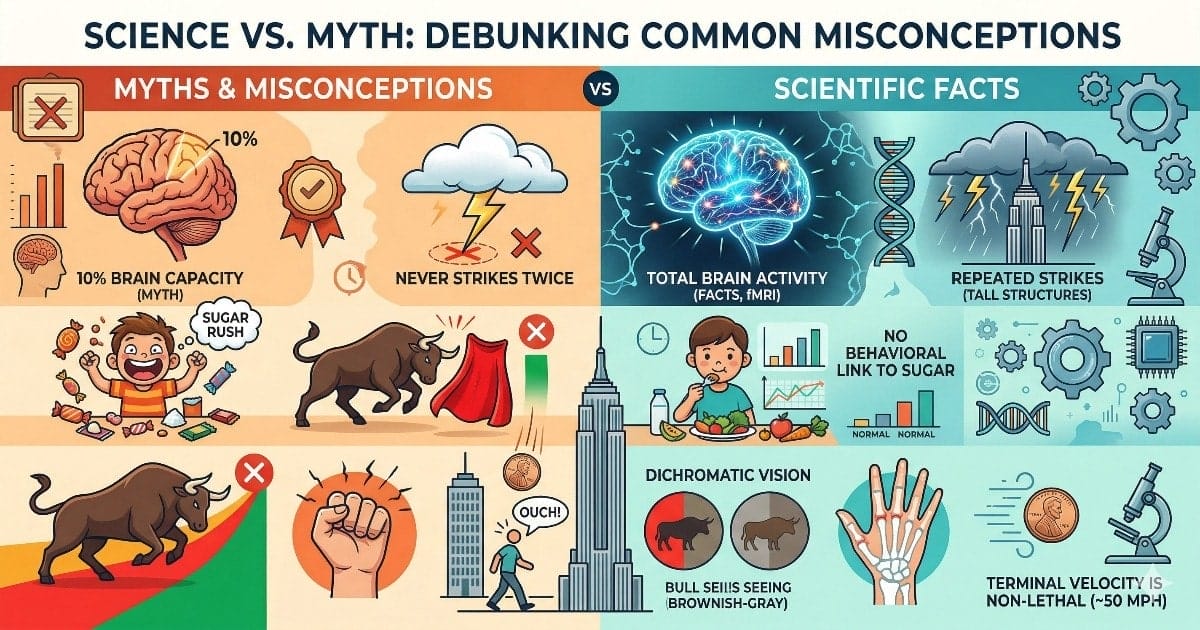
Common Misconception #1: We Only Use 10% of Our Brains
You have probably seen in movies or books that if humans could use the entirety of their brains, they would possess superhuman abilities. This idea is so popular in society that it is even used in many advertisements. But did you know that this fascinating piece of trivia is actually a massive misconception?
Let us look at what modern medicine and neuroscience have to say about this. Years of ongoing research into human brain function have completely debunked this myth.
What Science Actually Says About Brain Usage
Thanks to modern medical technology like fMRI and PET scans, we can now directly observe the internal activities of a living human brain. These scans have shown that no part of the human brain simply sits idle. Even when we are fast asleep, almost all parts of the brain remain active in some capacity.
Every part of the brain has a specific function. Some parts help us walk, others help us speak, and others help retain memories or control emotions. Even when we perform a very simple task like picking up a glass of water, much more than 10 percent of the brain works together at the same time.
Why This Common Misconception is Completely False
Even from an evolutionary standpoint, the 10 percent usage theory seems highly unscientific. The human brain makes up only about 2 percent of our total body weight, yet it consumes nearly 20 percent of our body’s total energy. If we did not use 90 percent of our brains, that unused portion would have been eliminated by evolution long ago. Nature would never sustain such an energy-wasting, useless organ.
Furthermore, medical history shows that even minor damage to a very small part of the brain can severely impair a person’s physical abilities. If 90 percent of the brain were truly unused, most head injuries would have no negative impact on a person. But in reality, that does not happen. Therefore, the idea of using only 10 percent of our brain is completely fictional.
Common Misconception #2: Lightning Never Strikes the Same Place Twice
On a stormy day, we often hear the saying that lightning will not strike the same place twice. Based on this idea, many people think that once a spot has been struck by lightning, it instantly becomes safe. However, real-world physics tells a completely different story.
Lightning is actually a massive electrical discharge from nature. Its behavior does not follow any rule that prevents it from returning to the exact same spot.
The Real Facts About Lightning Behavior
Lightning generally occurs due to the electrical potential difference between the clouds and the ground. Electricity always looks for the easiest and shortest path to reach the earth. This is why tall trees, mountains, or high-rise buildings become easy targets for lightning strikes. These structures are simply the closest things to the clouds in the sky.
The reality is that lightning can strike the same place not just twice, but hundreds of times. A great example is the Empire State Building in New York City. This famous high-rise building is struck by lightning an average of 25 times every single year.
Why This Belief is Misleading
This belief is not just wrong; it is also extremely dangerous. Relying on this myth, someone might take shelter in a place during a storm that is not safe at all. A person might think that standing where lightning just struck will cause no harm, which is a potentially fatal decision.
This electrical force of nature does not remember locations. Height and environmental conductivity are the main factors it responds to. Therefore, the only scientific solution during a storm is to stay away from open fields or tall trees and take shelter inside a building with proper lightning protection systems.
Common Misconception #3: Humans Swallow Eight Spiders a Year While Sleeping
This is one of the strangest and slightly terrifying myths floating around the internet. It is said that when we are in a deep sleep at night, spiders crawl into our mouths as uninvited guests. We supposedly swallow them without even realizing it. Hearing this story makes many people try to sleep with their faces covered.
However, spider experts and human anatomy specialists state that there is zero truth to this claim. It was actually a brilliant internet prank that later morphed into perceived truth.
Why This Internet Myth Spread So Widely
The history of this myth is quite amusing. In 1993, a columnist named Lisa Holst wrote an article about how easily people believe bizarre information found on the internet. As an example for her article, she fabricated this story about swallowing spiders in our sleep.
Later on, people forgot the article’s original purpose and just latched onto the thrilling claim. In the era of email and later social media, this fake information spread like wildfire across the globe. It proves just how easily humans can believe something purely for the thrill of it without verifying the facts.
What Actually Happens When We Sleep
The reality is that spiders are not stupid creatures. The human body constantly emits heat, our hearts beat, and we breathe and snore while sleeping. To a tiny creature like a spider, these vibrations and sounds serve as massive warning signs or sources of fear. They view the human body as a large predator and always try to avoid it.
Moreover, the human oral cavity and airway are extremely sensitive. If even a tiny insect touches our lips or mouth while we sleep, our body’s reflex action will cause us to wake up immediately or cough. Thus, the event of swallowing a live spider while unconscious is virtually impossible.
Common Misconception #4: Sugar Makes Children Hyperactive
Many parents complain that their children start misbehaving or running around wildly after eating chocolates, ice cream, or sugary foods. This is commonly referred to as a “sugar rush”. This belief is so prevalent in society that many people completely eliminate sugar from their children’s diets without consulting a doctor.
But what do nutritionists and pediatricians actually say about this? Let us examine the facts.
What the Research Actually Shows
In various double-blind studies conducted by scientists, there is no direct link between sugar consumption and hyperactivity in children. In these experiments, one group of children was given regular sugary foods, and the other group received artificial sweeteners or sugar-free foods. However, the parents were not told which child was eating which food.
The results showed no abnormal changes in the behavior of the children who consumed sugar. Sugar indeed provides quick energy to the human body, but it does not turn a child hyperactive or uncontrollable overnight.
The Psychology Behind the Misconception
So why do parents think this happens? Human psychological expectation is at play here. When a mother knows her child has eaten sugar, she tends to attribute every normal playful act to its effects. This is known as the expectancy effect.
Additionally, children usually get more sugary foods during birthdays, festivals, or happy events. These environments are naturally much more stimulating and exciting for kids. Children run around more because of the joy of the festive atmosphere, not because of the sugar. The blame lies with the excitement of the moment, not the sweets.
Misconception #5: Cracking Your Knuckles Causes Arthritis
When we pull or bend our fingers to make a popping sound, older adults often tell us to stop. They say that cracking knuckles like this can lead to rheumatism or arthritis as we age. Because of this fear, many people try to break the habit.
But you will be quite surprised when you learn the actual mechanism or scientific reason behind that popping sound. It has absolutely no connection to bone decay.
What Happens Inside Your Joints
Around the joints or bone connections in our bodies, there is a type of fluid known as synovial fluid. This fluid acts as a lubricant, making bone movements smooth. When we apply pressure to crack our knuckles, the distance between the joints increases, and the internal pressure drops.
As the pressure drops, the gases in the synovial fluid coalesce into tiny bubbles. When we apply a bit more pressure, those bubbles suddenly burst. The sound of these bubbles bursting is exactly what causes that popping noise. It is not the sound of bones rubbing together or breaking.
Scientific Evidence on Joint Health
The most fascinating and long-term research on this topic was conducted by a physician from California, Dr. Donald Unger. To test this myth himself, he cracked the knuckles of his left hand every single day for 60 long years, but never cracked the knuckles on his right hand. After 60 years, he examined his hands and found no signs of arthritis in either. He later won the Ig Nobel Prize for this unique research.
Large-scale studies have shown no link between knuckle cracking and arthritis. However, cracking your knuckles too forcefully or too often can slightly weaken the ligaments around your joints or temporarily reduce your grip strength. But it is certainly not the cause of arthritis.
Misconception #6: Vaccines Cause the Diseases They Prevent
There are various debates and misconceptions surrounding vaccines in modern society. One major misconception is that the vaccine being given to prevent a disease can actually infect a person with that very disease. Out of this fear, many people refrain from taking life-saving vaccines themselves or giving them to their children.
This myth is extremely harmful to public health. Let us learn what immunology tells us about this.
How Vaccines Actually Work
The main job of a vaccine is to train our body’s immune system to fight against a specific virus. A vaccine generally uses a dead, highly weakened, or specific inactive part of a virus. After it enters the body, our immune system thinks that the actual enemy has attacked.
As a result, the body creates antibodies against that virus. But since the component inside the vaccine is inactive or dead, it cannot cause any disease in the human body. It merely stores the fighting strategy against that virus in the body’s memory. Later, if the actual strong virus attacks, the body can defeat it very easily.
Immunity and the Role of Public Health Science
After receiving a vaccine, a person might experience minor side effects such as a mild fever, body aches, or redness at the injection site. Seeing these common symptoms, many people think they have been infected with the disease. In reality, these symptoms prove that your body’s immune system has been activated and is working properly.
History bears witness that terrifying pandemics like smallpox or polio were eradicated from the earth solely thanks to vaccines. A vaccine does not just protect an individual; it protects society as a whole. Therefore, believing such a scientific myth poses a major threat to public health.
Misconception #7: The Great Wall of China is Visible from Space
The Great Wall of China is an ancient man-made wonder. A very common saying about this massive wall is that it is so large it can be seen with the naked eye from the moon or in space. This used to be written in our textbooks and many general knowledge books.
However, if you ask any astronaut this question, they will smile and deny this claim. Because compared to the vastness of space, this wall is actually incredibly narrow.
What Astronauts Actually See from Orbit
Astronauts who have orbited the Earth, and even Neil Armstrong, who walked on the Moon, have clearly stated that the Great Wall of China cannot be seen with the naked eye from space or the Moon. While this man-made wall is very long, its width is only a few meters. When viewed from space, the wall blends in perfectly with the colors of the surrounding mountains and nature.
Even in Low Earth Orbit, it is nearly impossible to spot the wall without special lenses or binoculars. Instead, artificial city lights at night or massive highways are much more clearly visible from space.
Why This Misconception Became Popular
This misconception was actually popular long before the space age began. Around 1754, when humans could not even imagine space travel, some writers wrote in their books that the wall was so massive it should be visible from the moon. Later, people accepted this fictional information as truth.
This is primarily an example of national pride and human exaggeration. In trying to prove something extraordinary, we often attach fictional adjectives to it. In the age of science, verifying the truth of such information is now a matter of just a few seconds.
Misconception #8: Hair and Nails Continue to Grow After Death
When we watch a horror movie or listen to scary stories, we often hear descriptions of a corpse with long nails or hair after opening a coffin. A common biological misconception is that while other organs stop working after a person dies, their hair and nails supposedly continue to grow for a few days.
Although it sounds somewhat supernatural or bizarre, there is a completely normal physical change behind it. Biology provides a very simple explanation.
The Biological Explanation
New cells can’t form in the body after a person dies. The growth of hair and nails requires glucose and oxygen, which reach the cells through blood circulation. Since the heartbeat stops and blood flow ceases after death, biological cell division for hair or nails is impossible.
So why do the hair and nails of a corpse look longer? The real reason is dehydration. After death, the human skin begins to dry out, shrinking and pulling inward.
What Actually Happens to the Body After Death
When the skin dries and shrinks, the skin around the base of the nails and hair pulls back. As a result, the portion of the nail and hair that was previously hidden under the skin is exposed. This is why, from a distance or to the naked eye, it seems like the nails and hair have grown longer.
This is actually just an optical illusion. As students of science, we should understand that all biological growth processes permanently halt the moment life ends.
Misconception #9: Goldfish Only Have a Three-Second Memory
Many of us keep colorful goldfish at home, idly swimming around inside small aquariums all day. There is a common saying about these fish that their memory lasts only three seconds. In other words, after moving from one end of the tank to the other, they forget where they came from. Based on this information, lazy or forgetful people are often compared to goldfish.
However, scientific experiments conducted on these harmless fish tell a completely different story. Their intelligence and memory are much greater than we assume.
Scientific Research on Fish Memory
Scientists have used various mazes to test goldfish memory. The experiments showed that goldfish can not only remember the correct path through a maze but also remember the association between food and a specific color or sound.
Researchers started feeding the fish while playing a specific sound. A few days later, they observed that even without offering food, the fish would gather at the feeding spot just by hearing that sound. They were able to maintain this habit for several months.
Why This Idea is Wrong
The memory of a goldfish is not three seconds; it can last anywhere from several weeks to several months. They can recognize their owner’s face and remember exactly what time they are fed every day.
This myth was primarily created to entertain people and to justify keeping fish in tiny bowls. People thought that since their memory is short, they would not get bored or frustrated in a small container. But science has taught us that every animal has its own intelligence, which we must respect.
Misconception #10: Cold Weather Causes the Common Cold
Whenever winter arrives, our mothers tell us to stay out of the cold so we do not catch a chill. Since childhood, we have been conditioned to view cold weather and the common cold as complementary. People assume that simply experiencing a drop in body temperature causes a cold or the flu.
However, the straightforward medical truth is that cold weather cannot directly cause any disease. The real cause of the illness is hidden elsewhere.
What Actually Causes Colds and Flu
The common cold or cough is not caused by the weather or temperature; it is caused by a virus. We fall ill primarily due to infection with the rhinovirus or influenza virus. When these viruses enter our bodies through our nose or mouth, we catch a cold.
If you lived in a completely sterile, virus-free, freezing environment, you still would not catch a cold. Because there are no pathogens or viruses there to spread the disease. Cold air can only chill your skin, but it cannot create a disease without a virus.
Why Illnesses Spread More in Winter
So why do people get more colds and coughs during the winter? There are some environmental and behavioral reasons behind this. To escape the cold during winter, people usually spend more time indoors, in enclosed spaces, and in close proximity to each other. Because the house windows remain closed, the indoor air cannot circulate properly.
If one person has a cold in this enclosed environment, the virus spreads through the air when they sneeze or cough and easily infects others. Also, virus particles can remain airborne in dry winter air for longer. Therefore, the reason for increased illness in winter is not the cold weather itself, but changes in our lifestyle and the virus’s easier spread.
Why People Believe Scientific Fiction
After analyzing the 10 myths we just discussed, a question naturally arises. Why do people believe these unscientific facts so easily? The reasons behind this are not just a lack of information, but are deeply intertwined with our society, culture, and psychology.
To spot false information, we first need to understand which weak points of our minds it targets. Let us dig a little deeper to understand the reasons behind this.
The Influence of Media and Popular Culture
Movies, dramas, and fictional books are our primary sources of entertainment. But often, for the sake of the story or to make a scene more visually appealing, creators present flawed science. For example, movies show massive explosions producing loud noises in space, whereas real science dictates that without an atmosphere, sound cannot travel in space at all.
When audiences repeatedly watch these scenes on screen, they subconsciously accept them as the truth. The media also sometimes broadcasts sensational but false scientific news just to increase their views or ratings. This influence of popular culture pushes scientific truth away from the minds of the general public.
Cognitive Bias and Misinformation
Our brains always want to simplify complex information. In this process, the brain uses some shortcuts, which we call cognitive bias. One of these is the “illusory truth effect.” If you repeatedly hear a false piece of information from different people, your brain will eventually assume that the information must be true.
Another reason is our emotions. Information that triggers fear, wonder, or curiosity in our minds is absorbed very quickly. Purveyors of misinformation exploit this psychological weakness to spread confusion in society.
Lack of Scientific Knowledge
In the education system, science is often taught merely as a subject of memorizing formulas or facts. As a result, students fail to grasp the core spirit or the scientific method. Outside of institutional education, the general public lacks the skills to understand the language of scientific research.
When people cannot find a simple scientific explanation for a natural phenomenon, they often turn to traditional folklore or myths. It is the lack of accessible and enjoyable promotion of science in society that allows these misconceptions to survive.
The Role of Science in Combating Misinformation
In this vast ocean of misinformation, science is our only compass. Science does not just make new discoveries; it also plays a pioneering role in eliminating false information and superstition from society. Science has its own institutional methods to ensure the accuracy of information.
Today, due to the misuse of the internet, scientists’ responsibilities have increased even more. They are now stepping out of the laboratories and trying to spread science in a language the general public can understand.
Fact-Checking and Peer Review
In the world of science, simply making a claim does not make it accepted as truth. There is a method called peer review for this. When a scientist makes a new discovery, their research paper is sent to other independent scientists in the same field.
These other scientists thoroughly examine the research methodology, data, and results. If they find that everything is correct and that conducting the experiment elsewhere will yield the same results, only then is it published in a science journal. Because of this strict filtering system, false information cannot easily survive in the name of science.
The Importance of Reliable Sources
Today, there is no shortage of information; what we lack are accurate sources. To learn about any scientific topic, we should always rely on trustworthy and institutional sources. Examples include the World Health Organization (WHO), NASA, or various international science journals.
We should not make decisions based on an anonymous post or video on social media. Acquiring the ability to identify reliable sources is the first step toward avoiding misinformation.
How to Spot Scientific Fiction
You might be thinking, “I am not a scientist, so how can I tell which information is true and which is a myth?” You do not need to be a scientist for this. All you need is an aware mind and the habit of asking the right questions.
Here, we will discuss some simple methods you can use to easily catch any scientific misconception or fiction in your daily life.
Asking the Right Questions
Whenever you come across bizarre or sensational information, first ask yourself a few questions. For example, what is the source of this information? Does the person making the claim have institutional qualifications on the subject? Is there any reliable scientific experiment backing this claim?
Asking questions is the first step of science. Once you start questioning information instead of accepting it blindly, you will see the masks of many false ideas fall off on their own.
Verifying Evidence and Research
If a post claims “Scientists say,” try to find out which scientists from which country or university actually said it. Check if there are any links or references to that research provided.
Nowadays, verifying the truth of any information or fact-checking via Google is incredibly easy. Taking a little time to verify the information will save you from being misled and help you protect others as well.
Developing Critical Thinking Skills
Critical thinking is like a habit. It is built through daily practice. Do not assume information is true just because it matches your pre-existing beliefs. Keep the mindset of examining even your own mistakes under the light of science.
Try to find the logical reason behind any piece of information. This mindset will help you make the right decisions in other areas of your life as well.
The Impact of Fiction on Society
Many people might consider scientific myths or fiction to be harmless jokes. But their negative impact on society can often be extremely severe. It not only limits human knowledge but also blocks the path of social progress.
When blind faith and misinformation take institutional form in any society, they drag that society backward.
Health and Safety Risks
Human health is the biggest victim of scientific misconceptions. As we discussed with vaccine myths, if people refuse life-saving medical treatments or vaccines due to misinformation, it can lead to the resurgence of pandemics in society. Many people abandon scientific treatments for deadly diseases like cancer to chase miraculous or fake cures, which leads to premature death.
Similarly, misconceptions about lightning or natural disasters put human lives at risk. Therefore, knowing scientific truth is not just about gaining knowledge; it is equally critical for our survival.
Misconceptions About Science and Technology
When scientific myths reign over a society, they create fear or distrust among the general public towards science and technology. For instance, many people believe that 5G technology somehow spreads diseases, which is entirely baseless. This type of fear reduces the acceptance of new technology.
The expansion of science and technology is essential for the development of any country. And for that, a society free from superstition is required, which is only possible through the promotion of accurate science.
Frequently Asked Questions (FAQs)
Why does scientific fiction spread?
Scientific fiction usually spreads quickly because of human curiosity and our love for thrills. They sound highly appealing, and people pass them from person to person without any proof. In the modern era, social media has significantly accelerated this rate of spreading.
What are the most common science myths?
Some of the most prevalent science myths include: we only use 10% of our brains, the Great Wall of China is visible from space, and eating sugar makes children hyperactive. In this article, we have presented evidence that all of these ideas are completely false.
How can I verify scientific information?
To verify any scientific information, you can check reliable science websites on the internet, such as the official pages of NASA, WHO, Nature, or Harvard Health. Additionally, searching Google for the topic, along with the words “Fact Check,” reveals the truth.
Why is critical thinking important in science?
Critical thinking keeps us away from blind faith and false information. It teaches us to test any claim against the touchstone of evidence. As a result, we can make accurate and scientifically sound decisions in both our personal and social lives.
Are common beliefs always true?
No, common beliefs or folklore are not always true. Often, an idea accepted for years can be proven wrong by modern scientific testing. Therefore, just because something has been popular for a long time does not mean it should be accepted as truth.
Conclusion
In today’s lengthy discussion, we have seen how many pieces of information intertwined with our daily lives are actually just beautiful fables disguised as science. We have tried to uncover the real truth behind those myths using the light of science.
Truth is always beautiful, no matter how simple it might be. Science gives us the eyes to see the true form of the world.
Key Takeaways from Science vs. Fiction
The biggest lesson in this battle of science vs. fiction is to never believe anything blindly. Our brains, nature, and the universe around us operate according to precise scientific laws, not supernatural or fictional stories.
Myths or fiction might entertain us temporarily, but they can never solve real-world problems. Maintaining a scientific mindset in every aspect of life is the greatest lesson of our time.
Why Data-Driven Thinking Matters in the Modern World
We are currently living in a vast ocean of information. Thousands of good and bad pieces of information come before us every day. In this era, engaging in data-driven thinking has become an absolute duty for us.
Let us all pause, think, and verify the scientific accuracy of any information before we share or believe it. Your small step towards critical thinking can be the biggest contribution to building a scientific, superstition-free, and progressive society.