Online Education Pros & Cons: A Complete Guide
Our daily lives have become heavily dependent on technology. The availability of smartphones and high-speed internet has completely changed how we communicate, shop, entertain ourselves, and even work. The education sector is certainly not lagging behind in this digital transformation.
Over the past decade, the world of education has experienced a massive shift. Previously, we only thought of education as a physical classroom with four walls, a chalkboard, and printed notebooks. Today, anyone with a laptop or smartphone and a good internet connection can acquire knowledge from anywhere in the world.
Online education is no longer just an alternative or a luxury. It has become an integral and permanent part of the modern education system. In this article, we will discuss the advantages and disadvantages of online education in detail to help you understand its true impact.
How Online Education Has Transformed the Education System
Online education has redefined the core foundations of traditional schooling. In the past, educational opportunities were strictly bound by geographical borders. A student could not easily participate in a course offered by a foreign university without relocating. E-learning has completely broken down those physical boundaries.
Thanks to technology, the classroom is now in a student’s palm. Teachers are currently using digital whiteboards, slide presentations, and video lectures to deliver lessons. Students can watch these lectures at a time that fits their personal schedules.
Furthermore, the examination and evaluation methods have also evolved. Submitting assignments and taking quizzes online has become incredibly simple. As a result, the education system has become much more interactive and student-friendly than ever before.
Why Online Education is More Relevant Than Ever
The world is moving at an incredibly fast pace. The demand for new technologies and modern skills is growing every single day. To keep up with this ever-changing landscape, there is absolutely no alternative to continuous learning.
Traditional educational institutions often take a long time to introduce a brand-new course or update their curriculum. However, online platforms are constantly adding new, up-to-date courses. Therefore, online education is highly relevant for keeping your skills up to date with current career demands.
Additionally, recent global events have underscored the absolute necessity of an alternative system to keep educational activities running during crises. During those challenging times, online education was our only reliable hope. From that experience, people now understand the deep importance of digital learning systems.
What is Online Education?
Before diving deeper into the advantages and disadvantages, we need to understand exactly what this concept means. In simple terms, online education is a learning process conducted through digital platforms using the internet.
This could include joining a live virtual class, watching pre-recorded video lectures, or studying materials on a web-based portal. In this system, teachers and students can exchange knowledge without needing to be physically present in the exact same location.
Definition and Key Features of E-Learning
E-learning, or electronic learning, is the delivery of educational curricula through digital technology. Its primary feature is that it relies entirely on the internet and on computer devices such as laptops, tablets, and smartphones.
A major characteristic of e-learning is its extensive use of multimedia. Instead of just reading plain text from a book, students engage with audio, video, animations, and graphics. This makes the learning material much more engaging and easier to digest.
Moreover, e-learning systems usually feature automated evaluation tools. Students can see their quiz results instantly after submitting, which significantly accelerates the learning process.
Online Learning Platforms and Course Types
There are countless online learning platforms available today. Platforms like Coursera, Udemy, edX, and Khan Academy are highly popular worldwide. These platforms host thousands of courses created by top universities and industry experts.
You can find a wide variety of course types on these platforms. Some courses are skill-based, focusing on practical subjects like web development, graphic design, or digital marketing. Other courses are purely academic and align with standard school or college curricula.
Beyond short courses, many international universities now offer complete degree programs entirely online. This means you can earn an undergraduate or postgraduate degree from a prestigious foreign university while sitting comfortably at home.
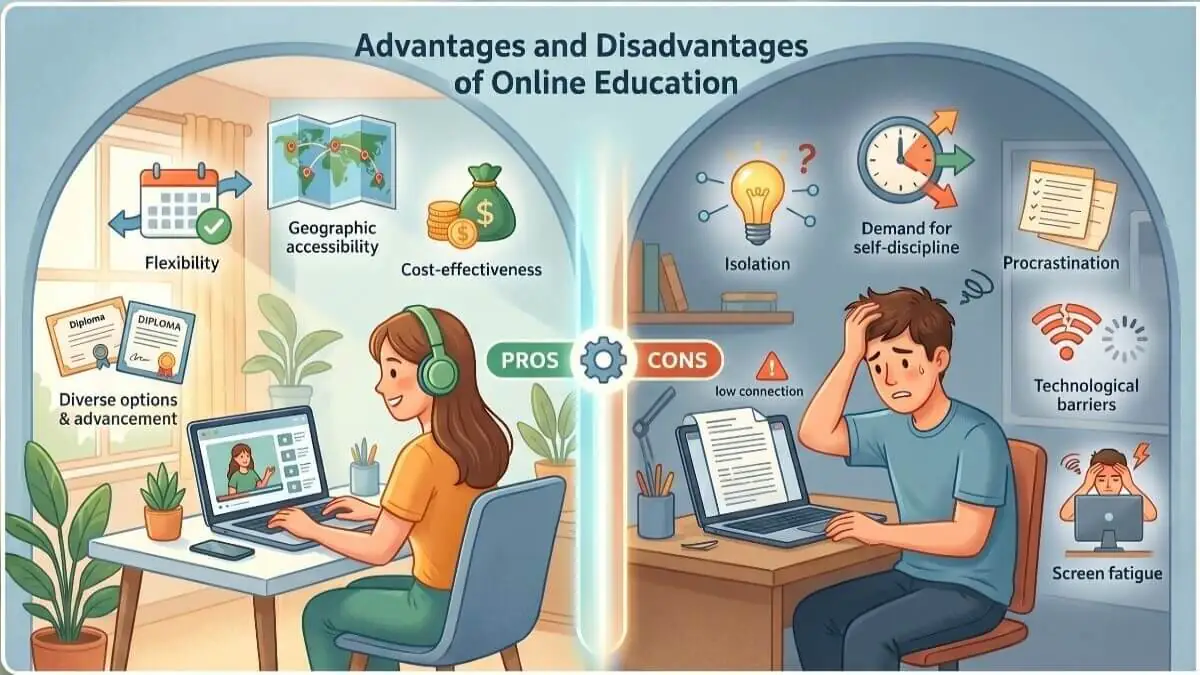
Advantages of Online Education
There are very solid reasons behind the rapidly growing popularity of online education. The benefits of this medium are so versatile that it attracts learners of all ages. Let us explore the main advantages of online education in detail.
Flexibility and Self-Paced Learning
The biggest advantage of online education is its incredible flexibility. In a traditional education system, classes are scheduled at fixed times. In contrast, online learning allows you to study at any time that suits you, especially when taking pre-recorded courses.
Everyone has a different learning pace. Some people understand a concept just by hearing it once, while others need to hear it multiple times. Online education allows you to pause the video, rewind it, or watch it repeatedly until the concept is completely clear.
As a result, students can learn at their own pace in a completely pressure-free environment. This is exceptionally beneficial for those who work full-time jobs or manage household responsibilities alongside their studies.
Global Learning Opportunities
In the past, students had to leave their hometowns or even move abroad to access high-quality education. Online education has entirely erased this geographical barrier.
Today, a student sitting in a remote village can easily listen to a lecture delivered by a professor at Harvard or MIT. This has created an unprecedented level of equality in terms of accessing world-class knowledge.
The opportunity to learn from the world’s best educators broadens students’ perspectives. It makes them highly competent and ready to compete on a global scale.
Cost-Effective Compared to Traditional Education
Traditional education involves many additional expenses beyond tuition. These hidden costs include transportation, hostel or apartment rent, and physical textbooks and supplies.
Online education completely eliminates these extra expenses. You are attending classes from your own room, so there are zero transportation or accommodation costs. Study materials are usually provided as free PDFs or e-books, which are significantly cheaper than printed books.
Furthermore, the tuition fees for online courses are generally much lower than those of offline courses. This affordability opens the doors of higher education for financially disadvantaged students.
Variety of Courses and Specialization Opportunities
A traditional college or university typically offers degrees in a specific set of standard subjects. The internet, however, has an abundance of unique and specialized courses.
If you want to learn a niche subject that is not taught in any local institution, you will definitely find a course for it online.
You can learn everything from robotics and quantum physics to cooking and music production on the internet. This massive variety helps students discover their true passions and hidden interests.
Comfort of Learning from Anywhere
To attend an online class, you do not need to dress up formally or commute to a campus. You can easily attend lectures while sitting on your most comfortable sofa or even while relaxing in your bed.
This high level of comfort makes studying an enjoyable experience for many students. Since they do not have to endure the physical exhaustion of sitting in traffic jams, they can focus all their energy solely on learning.
Additionally, if you are traveling, your studies will not be interrupted as long as you have your laptop or smartphone.
Disadvantages of Online Education
Just like anything else, online education comes with its own set of drawbacks. It has certain limitations that can create challenges for both students and educators.
Lack of Face-to-Face Interaction
Socialization is a massive part of the traditional education experience. The joy of playing on the school grounds, chatting with friends, and talking face-to-face with teachers is largely missing in online education.
There is a huge difference between communicating through a digital screen and talking to someone in real life. As a result, many online students often report feeling isolated or lonely.
Furthermore, discussing complex topics with friends in a physical classroom makes learning easier. While group work is technically possible online, it rarely feels as spontaneous or natural as it does in real life.
Need for Strong Self-Discipline and Motivation
The most important trait for success in online education is strict self-discipline. In a digital environment, there is no teacher physically present to push you to open your books or finish your tasks.
Consequently, the tendency to procrastinate or delay work becomes very common. Thinking you will watch the lecture tomorrow often leads to a massive backlog of unfinished lessons.
For individuals who struggle to stay internally motivated, online education can be extremely difficult. This is exactly why the dropout rate for online courses is notably higher than that of traditional classroom programs.
Technical Issues and Internet Dependency
The biggest weakness of online education is its total reliance on technology. Participating in an online class is virtually impossible without uninterrupted electricity and a high-speed internet connection.
In many developing nations, internet speed and network stability remain major challenges, particularly in rural areas. If the internet disconnects or the power goes out during a live class, a student’s focus is instantly broken.
Additionally, not everyone can afford a high-quality laptop or a capable smartphone. The lack of proper technical devices deprives many eager learners of the benefits of online education.
Limitations in Hands-on Practical Experience
It is simply not possible to teach every single subject online. Subjects such as medicine, mechanical engineering, and chemistry require hands-on practical work in a laboratory.
No matter how realistic a 3D simulation or video might be, it can never fully replace the authentic experience of working in a real lab.
For degree programs that heavily rely on in-person instruction and practical application, the limitations of online education become especially apparent.
Concerns About Accreditation and Quality
There are thousands of courses available online today, but not all are of equal quality. Many unverified institutions sell courses using flashy advertisements, but the actual educational content is very poor.
Moreover, many employers in the traditional job market still prioritize physical degrees over online certificates.
Although this corporate mindset is slowly shifting, students often still worry about whether an online degree will be accepted with the same respect as a traditional one.
Online Education vs Traditional Education
The debate between online education and traditional education is quite old. Even educational experts have different opinions on which one is the absolute best. The truth is that both systems have their own unique strengths and weaknesses.
Key Differences in the Learning Experience
Traditional education operates on a fixed routine within a highly structured environment. A teacher can look directly into a student’s eyes and instantly know if they are grasping the lesson or feeling confused.
Online education, on the other hand, is highly independent. The student essentially becomes their own manager. They must create their own study routine and strictly adhere to it.
While traditional education strongly fosters social and interpersonal skills, online education excels at making students highly proficient with modern digital tools.
Which Learning Method is More Effective?
Determining which method is more effective depends entirely on the student’s age, learning style, and specific needs.
Traditional education is generally more effective for school-going children because they desperately need discipline and social skill development at that age. However, online education is vastly more convenient for a working professional seeking to upgrade their skills.
Currently, many education experts believe that a combination of both methods is the most effective solution. This approach, known as Blended Learning, allows theoretical classes to be delivered online while practical labs and group work take place in a physical classroom.
The Role of Technology in Online Education
Online education simply cannot be imagined without technology. Over the past few years, technological innovations have elevated e-learning to entirely new heights.
Video Conferencing and Virtual Classrooms
Video conferencing tools like Zoom, Google Meet, and Microsoft Teams are now familiar to almost everyone.
These powerful tools allow teachers to conduct classes in real-time with students scattered across the globe. Features like screen sharing, digital whiteboards, and breakout rooms make the virtual classroom feel almost exactly like a physical one.
Students can simply use the “Raise Hand” feature to ask questions during a live class and interact directly with their instructors.
AI-Powered Learning Platforms
Artificial Intelligence is currently bringing revolutionary changes to the education sector. AI-powered platforms can actively analyze the specific learning patterns of individual students.
By identifying a student’s strengths and weaknesses, AI can automatically generate a highly customized study plan tailored to them.
Additionally, AI chatbots can instantly answer students’ queries and provide academic support, making the learning process smoother and more efficient.
Mobile Apps and Digital Resources
Smartphones are now in everyone’s hands. Thanks to educational apps like Duolingo, Photomath, and various other e-learning tools, education literally fits inside your pocket.
Students can comfortably complete short lessons or engage in microlearning while commuting on a bus or taking a quick break at work.
Furthermore, digital resources like PDFs, interactive e-books, educational podcasts, and YouTube video tutorials have made studying more accessible and engaging than ever before.
Who Benefits the Most From Online Education?
While the doors of online education are open to everyone, certain groups benefit most.
Working Professionals and Adult Learners
For people working full-time jobs, attending physical classes after a long day at the office is practically impossible.
Online education is a true blessing for them. They can carve out time on weekends or late at night to participate in various skill-development courses.
As a result, they can quickly advance in their careers and easily keep themselves up to date with new technologies and modern working methods.
Students in Remote or Underprivileged Areas
In areas lacking good schools, colleges, or experienced teachers, receiving quality education was once just a dream.
The internet has turned that dream into reality. Now, a student living in a remote village can easily attend classes taught by the best educators in the country or even abroad.
According to the World Economic Forum, digital education plays a massive role in connecting marginalized communities to the mainstream global economy.
Lifelong Learners and Skill Seekers
There is absolutely no age limit for learning. Many people simply love learning new things just for the joy of it. This could be learning a new foreign language, mastering digital illustration, or diving into computer programming.
For these passionate hobbyists, online platforms act as a giant, limitless library. They can easily search for courses based on their personal interests and satisfy their hunger for knowledge at any stage of life.
Barriers in the Online Education System
Online education is not completely flawless. To unlock its full potential globally, several major barriers must be addressed and overcome.
The Digital Divide and Accessibility Issues
The Digital Divide is a major global issue right now. While high-speed internet and smart devices are easily available in urban cities, the reality is very different in rural regions.
Students from low-income families simply cannot afford expensive laptops or heavy data packages. This naturally creates a significant gap in educational equality.
To solve this problem, both the government and the private sector need to take strong initiatives to provide affordable internet access and digital devices to students in need.
Student Engagement and Dropout Rates
Keeping students engaged during an online class is a huge challenge for educators. Staring at a screen for hours easily leads to boredom and screen fatigue.
Furthermore, with social media apps and YouTube just one click away, students lose their concentration incredibly fast.
Because of this, many people enroll in online courses but fail to actually complete them. To increase completion rates, course creators need to make their content much more interactive and visually stimulating.
Maintaining Academic Integrity
Preventing cheating and maintaining fairness during online exams is a major headache for institutions.
When students take exams from the comfort of their homes, it is very difficult to ensure they are not secretly consulting a textbook or searching for answers online.
Although many institutions now use strict webcam monitoring and Proctoring Software, maintaining total academic integrity remains a complex technical and ethical challenge.
How to Succeed in Online Education
To overcome the challenges and truly succeed in online learning, students need to follow some highly specific strategies.
Time Management Strategies
Since online education rarely provides a strict daily schedule, you must proactively build a routine for yourself.
It is crucial to have a clear timetable detailing exactly when you will attend lectures, complete assignments, and take breaks. Using the Pomodoro Technique is highly effective for maintaining deep focus.
This means studying with total concentration for 25 minutes, followed by a short 5-minute break. This prevents mental burnout and keeps your productivity high.
Creating an Effective Study Environment
If you try studying while lying in bed or sitting directly in front of the television, your concentration will inevitably break.
Therefore, pick a specific, quiet corner in your home strictly dedicated to studying. Set up a comfortable chair and a proper desk.
Ensure the study area has good lighting and proper airflow. These small physical adjustments create a strong psychological readiness that drastically improves the learning process.
Staying Motivated and Consistent
It is very easy to lose interest midway through a long online course. Keeping yourself motivated is absolutely vital for success.
You can write down your final goals on a piece of paper and pin it directly in front of your desk. Break down massive courses into smaller, easily achievable milestones.
Reward yourself every time you complete one of these small milestones. Also, stay actively connected with your classmates through online forums or social media groups. Discussing topics with them and seeing their progress will naturally spark your own desire to study.
The Future of Online Education
Given the incredible speed at which technology advances, it is safe to say that the future of online education is exceptionally bright. We will see many new dimensions added to this system in the coming years.
The Expansion of Hybrid Learning Models
In the near future, the Hybrid or Blended Learning model will become vastly more popular than strictly traditional or strictly online education.
Institutions will build flexible systems where students can choose to attend physical classes on campus or join the exact same lecture virtually from home.
This hybrid approach will perfectly combine the social benefits of offline education with the ultimate flexibility of online learning.
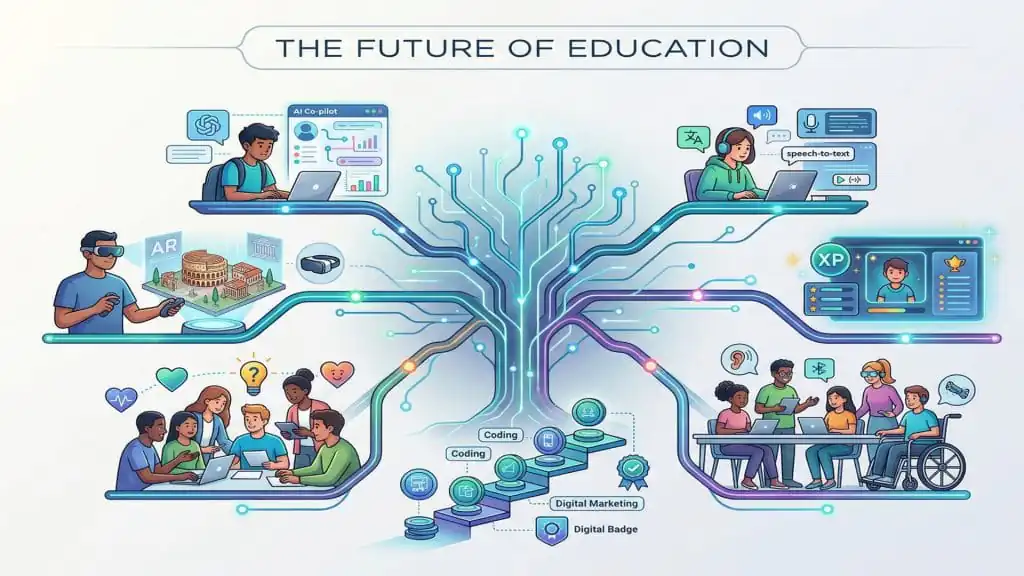
The Growing Role of Artificial Intelligence
In the coming days, artificial intelligence will completely personalize the global education system.
Future AI tutors will be able to analyze every single step a student takes and provide real-time, highly accurate feedback.
Real-time translation tools will become so advanced that language barriers will completely disappear. For example, a student from Bangladesh will instantly hear and understand a lecture given by a Japanese professor in flawless, native Bengali.
Global Expansion of the Digital Classroom
With the rapid advancement of Virtual Reality (VR) and Augmented Reality (AR) technologies, digital classrooms will feel incredibly realistic.
Students wearing VR headsets will experience walking on the surface of Mars right from their bedrooms or visually inspect a 3D model of the human heart floating right in front of their eyes.
These immersive technologies will finally eliminate the biggest weakness of online education by providing a highly realistic, hands-on experience currently missing.
Conclusion: Is Online Education Right for You?
After thoroughly discussing the advantages and disadvantages, this is the most natural question to ask. The final answer truly depends on your personal circumstances, preferred learning style, and ultimate career goals.
If you are a highly disciplined person, eager to learn new technologies, and prioritize absolute flexibility above all else, then online education is a magnificent opportunity for you.
On the other hand, if you strongly prefer a highly structured environment and need direct physical supervision from a teacher to stay focused, traditional education might still be your best option.
However, the harsh reality is that to survive and thrive in today’s fiercely competitive world, getting comfortable with digital learning is absolutely mandatory. The smartest approach is to consciously navigate the limitations of online education while fully leveraging its incredible advantages.
Frequently Asked Questions (FAQs)
What are the main advantages of online education?
The biggest advantages include massive flexibility, the comfort of learning from anywhere, saving money on commuting and housing, and easy access to world-class courses from top-tier global institutions. It uniquely allows students to study at their own pace and convenience.
Is online education as effective as traditional education?
This heavily depends on the student’s dedication and the specific subject being taught. Online education is highly effective for theoretical and tech-related subjects such as coding and marketing. However, for subjects requiring intensive laboratory work, traditional education remains superior. With proper discipline, online learning delivers phenomenal results.
What are the biggest barriers to online education?
The primary barriers include unreliable internet connections, the high cost of digital devices, the absence of face-to-face social interactions, and high dropout rates due to a severe lack of student self-discipline. Screen fatigue from staring at monitors for hours is also a notable physical issue.
Who should choose online education?
Working professionals who lack the time to attend regular daytime classes benefit the most. Additionally, people looking to learn modern technical skills, students living in remote rural areas without access to good local schools, and independent individuals who prefer self-paced learning should strongly choose online education.
How can I stay motivated in online classes?
To stay highly motivated, immediately create a clear daily study routine and set up a completely distraction-free study zone at home. Break massive courses into smaller, daily targets. Join virtual study groups to interact with peers, and make sure to reward yourself with short breaks after hitting your daily learning goals.