The Secrets of Light: Reflection, Refraction, and You
Introduction
Every day we wake up, open our eyes, and see a beautiful world around us. Have you ever wondered about the magician behind this ability to see? That magician is light. Without light, our familiar world would remain completely dark and unknown.
Today we will embark on a fascinating journey into the world of light. We will learn how light works and how it illuminates our surroundings. This science is not difficult at all. In fact, it is deeply connected to our everyday lives.
Why Light is Essential for Everything You See
From the computer or mobile screen in front of you to the moon in the night sky, light is required to see absolutely everything. When light falls on an object and bounces into our eyes, that is the exact moment we can see it.
If a room has absolutely no light, our eyes cannot see even the most beautiful object placed inside it. Therefore, light is not just a medium for vision. It serves as the primary carrier of visual information to our brains.
Understanding How Light Shapes Our World
The role of light is not limited to our vision alone. It influences our surrounding environment in many profound ways. From the photosynthesis of plants to the regulation of Earth’s weather, light has a direct and powerful impact.
Sunlight brings heat to the Earth. This heat is essential for our survival. By understanding how light interacts with different materials, we can easily solve many mysteries of the natural world.
What is Light?
Light is a form of energy. It is a type of electromagnetic radiation that our human eyes can detect. The universe contains many forms of energy, and light is one of the most familiar forms.
With the naked eye, we simply perceive light as a general brightness. However, from a scientific perspective, the structure of light is much more fascinating and mysterious.
A Simple Explanation of Light in Physics
Scientists describe light in two different ways, as both a particle and a wave. This dual nature of light is called wave-particle duality in physics.
This means light sometimes behaves like waves in the ocean, and at other times it behaves like tiny packets of particles. These tiny particles of light are called photons. Photons have no mass, but they carry energy.
How Light Travels
Light does not need a physical medium to travel. While sound cannot travel through a vacuum, light easily can. Sunlight reaches the Earth by crossing the vast, empty vacuum of space.
In a vacuum, the speed of light is roughly 300,000 kilometers per second. This is the highest known speed in the universe. Light generally travels in a straight line, unless there is an obstacle or a change in the medium along its path.
The Behavior of Light
When light hits an object, it exhibits several interesting behaviors. The future path of the light depends entirely on the nature of that object.
These behaviors of light have a massive impact on our daily lives. They are the reason we can see so many brilliant colors and forms in the world.
How Light Interacts with Different Surfaces
Light can interact with different surfaces in three main ways. First, light can hit a surface and bounce back. This is called reflection.
Second, light can pass directly through certain materials. Clear glass and water are great examples. Third, light can be absorbed by an opaque object. A black shirt feels warm in the sun precisely because it absorbs almost all the light that hits it.
Why Light Changes Direction and Speed
When light moves from one medium into another, its speed can increase or decrease. For instance, when light enters water from air, the water’s higher density causes the light to slow down slightly.
This change in speed is exactly what causes light to change its direction. Scientists use different terms to describe these changes in direction. The density of a medium is a major barrier or influence on the journey of light.
Reflection of Light
Reflection is one of the most common and familiar properties of light. When we see our face in a mirror, it is entirely possible because of this reflection.
This process of light bouncing back follows some very specific rules. Let us simply explore these rules.
What is Reflection?
In simple terms, when light hits a smooth or shiny surface and bounces back into the original medium, the phenomenon is called reflection.
If you throw a tennis ball at a wall, the ball bounces back. Light behaves very similarly when it hits a mirror or another shiny surface.
A Simple Explanation of the Laws of Reflection
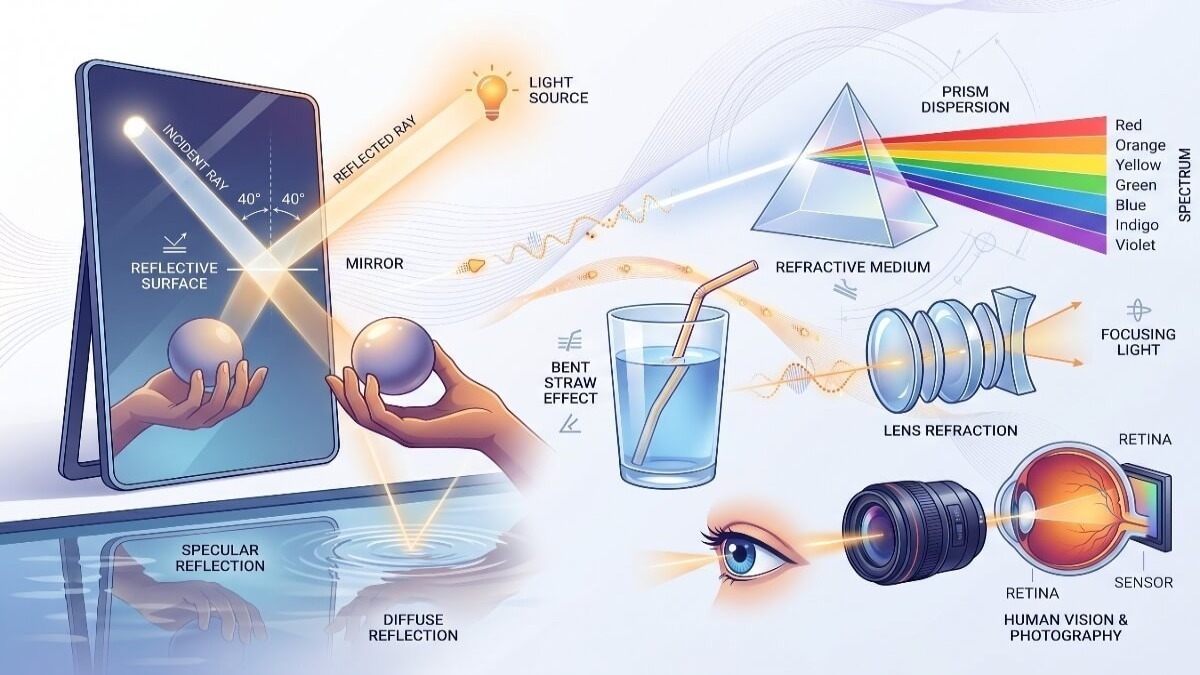
There are two main laws of light reflection. The first law states that the incident ray, the reflected ray, and the normal drawn at the point of incidence all lie in the exact same plane.
The second law is even simpler. The angle at which light hits a surface is equal to the angle at which it bounces off. In other words, the angle of incidence is always equal to the angle of reflection.
Real-Life Examples of Reflection
Countless examples of reflection surround us. Seeing the reflection of trees in the still water of a pond is a wonderful natural example.
Looking at a car’s rear-view mirror, seeing your face in a shiny steel spoon, or catching a glimpse of yourself in a polished window are all caused by this same scientific principle.
Mirrors and Image Formation
Mirrors are the best medium for reflection. A flat mirror provides a perfect reflection of light. As a result, we see an exact, proportional reflection of ourselves.
The image is always formed exactly as far behind the mirror as the object is placed in front of it. This is a brilliant calculation our brain makes based on how light behaves.
Refraction of Light
After reflection comes refraction. This is another magical property of light that often leaves us puzzled.
Refraction is the reason an object underwater appears slightly higher than its actual position.
What is Refraction?
When light travels obliquely from one transparent medium to another, it changes direction at the boundary between the two media. This phenomenon of changing direction is called refraction.
For example, when light enters water from the air, it can no longer travel in a perfectly straight line. It bends slightly.
Why Light Bends When Passing Through Different Mediums
The primary reason light bends is a change in the medium’s density, which alters the speed of light. Light travels fastest in a vacuum.
However, in denser media such as water or glass, the speed of light is reduced. This sudden change in speed forces the light to deviate from its straight path and bend.
Real-Life Examples of Refraction
Take a clear glass of water and dip a pencil into it. If you look from the outside, the pencil will look broken at the water level. This is the most classic example of refraction.
Additionally, the illusion of water pooled on a hot highway in the distance is called a mirage. A mirage is a stunning combination of light refraction and total internal reflection.
Water, Glass, and Optical Illusions
Water and glass can play many tricks with light. The bottom of a swimming pool often looks much shallower than it actually is.
This is an optical illusion caused purely by refraction. Experienced fishers know this concept very well. They calculate this illusion to determine the actual position of a fish underwater.
Dispersion of Light
The dispersion of light plays a massive role in making our natural world so colorful. White light is not actually a single color. It is a combination of many different colors.
Because these colors are blended together perfectly, our eyes perceive them as a single white or colorless beam.
How White Light Splits into Different Colors
When white light is passed through a special transparent medium, such as a prism, it splits into seven distinct colors. This process is called the dispersion of light.
As light passes through the prism, different colors of light bend at different angles. Violet light bends the most, while red light bends the least.
A Simple Explanation of Rainbows
A rainbow appearing in the sky after a rainstorm is the most beautiful natural example of dispersion. The tiny water droplets floating in the air act as thousands of natural prisms.
When white sunlight passes through these water droplets, it refracts and disperses to create a giant bow of seven colors across the sky. You can read more about the light spectrum and how colors work in this detailed NASA Science article.
Light and Vision
Because light exists, our eyes can see. But the way our eyes convert this light into a beautiful image is an amazing scientific process.
Our eyes work very much like a modern camera. They collect incoming light and send detailed pictures to the brain.
How the Human Eye Sees Light
Light first enters our eyes through the cornea and the lens. The lens focuses light onto the retina at the back of the eye.
The retina contains millions of light-sensitive cells. These cells convert the light into electrical signals and send them to the brain through the optic nerve. The brain analyzes those signals, and we finally perceive the object.
The Role of Reflection and Refraction in Vision
Both reflection and refraction are necessary for our entire visual process. Light must first reflect off an object to reach our eyes.
Then the internal lens of the eye refracts the light, focusing it perfectly onto the retina. If the lens cannot refract light correctly, our vision becomes blurry and out of focus.
Everyday Examples of Light’s Behavior
Beyond science textbooks, these properties of light are working every single moment in our daily lives. We just might not always notice them.
Let us discuss some very common items around us where the science of light is directly at work.
The Mirrors in Your Home
The mirror in your bathroom or on your dressing table is an extraordinary instrument of physics. It can reflect almost 100% of the light that hits it.
The back of the mirror has a thin coating of silver or aluminum. Because this coating reflects light rather than absorbing it, we can see our clear reflection.
Glasses and Contact Lenses
For those who have poor vision, glasses or contact lenses are essential. These tools operate entirely on the rules of light refraction.
When the eye’s natural lens cannot focus light properly, the lens in the glasses refracts the light before it reaches the eye.
Water Reflections and Optical Effects
If you stand by a river or the ocean, you can see the reflection of the surrounding scenery on the water’s surface. But if the water has ripples, the reflection breaks apart.
This happens because the ripples make the water’s surface uneven. The light then reflects in many different directions, creating what physicists call a diffuse reflection.
Camera Lenses and Photography
Modern photography relies entirely on light. A good camera is essentially just a collection of high-quality lenses.
The camera lens refracts light to create a sharp, inverted image on the film or digital sensor. By changing the focus, we can take clear photos of objects that are very close or very far away.
Applications of Light in Technology
Light is not only useful for seeing. Many cutting-edge technologies in the modern world are built on the principles of light.
From global communication networks to medical science, light has incredible and diverse applications.
Fiber Optic Communication
The high-speed internet we use today is powered by fiber optic cables. These cables are made of very thin strands of glass or plastic.
Total internal reflection of light occurs inside these cables. Light carries digital data through these cables from one place to another at lightning speed.
Medical Imaging and Laser Technology
Laser beams are a revolutionary invention in the medical field. A laser is a highly intense, controlled beam of light.
Lasers are now used in everything from corrective eye surgery to tumor removal operations. Additionally, X-ray scanners use invisible X-ray radiation to take pictures of the inside of the human body.
Smart Devices and Displays
The screens of our mobile phones, televisions, and computers operate through the controlled emission of light.
LCD or LED screens contain tiny pixels. These pixels produce red, green, and blue light at varying intensities. The mixing of these three colors allows us to see any image or video on the screen.
The Physics Behind Lenses
A lens is a transparent medium made of glass or plastic with at least one curved surface. The primary job of a lens is to refract light.
Lenses generally come in two types. One is the convex lens, and the other is the concave lens.
Convex and Concave Lenses Explained
A convex lens is thick in the middle and thin at the edges. It converges light rays to a specific meeting point. A magnifying glass is a perfect example of a convex lens.
On the other hand, a concave lens is thin in the middle and thick at the edges. It spreads light rays outward. Concave lenses are used in glasses to correct myopia or nearsightedness.
How Cameras and Telescopes Work
Camera lenses are usually convex. They refract light coming from the outside scene to create a small, inverted image on the camera’s sensor.
Telescopes also use multiple lenses. This allows them to collect light from very distant stars and make them appear large and clear right in front of our eyes.
Common Misconceptions About Light
As much as science has advanced in understanding light, some minor misconceptions still persist among the general public. It is important to clear these up with scientific explanations.
Here we will discuss a few of these common misunderstandings.
Light Does Not Always Travel in a Straight Line
In our childhood science books, we read that light always travels in a straight line. While this is true in general everyday scenarios, it is not entirely accurate on a cosmic scale.
Albert Einstein proved in his theory of general relativity that light can change its path and bend under the influence of extreme gravitational forces. When light passes near a black hole, it bends significantly.
Reflection and Refraction are Not the Same
Many people confuse seeing their face in a mirror with a stick bending in water, thinking they are the same phenomenon. But these are two completely different scientific processes.
When light reflects, it hits a barrier and bounces back. In refraction, light passes entirely through one medium into another, bending its travel path as it crosses the boundary.
Why Light Matters in Everyday Life
Humans can survive for a few weeks without food. But it is difficult to even imagine life on Earth without light.
The importance of light is not just a topic for scientists to research. It is a fundamental condition for our survival.
Communication, Vision, and Energy
As mentioned earlier, light keeps our global communication systems running through fiber optics. Our entire ability to see is based on light.
Most importantly, solar energy is the root source of all energy on our planet. Plants use sunlight to create food, which sustains the entire animal kingdom.
How Light Enables Modern Technology
Through solar panels, we are converting sunlight directly into electricity. This is a massive source of eco-friendly, renewable energy.
From barcode scanners at the grocery store to DVD players, light-based technology roams freely in every sector of modern life.
The Future of Light-Based Technology
Scientists are constantly conducting new research on light. It is expected that light will bring even greater revolutions to the technology sector in the coming days.
Light has the potential to bring massive changes, particularly in the computing and communication sectors.
Advancements in Photonics
Just as electronics deals with electrons, photonics deals with photons, the particles of light.
In the future, photonics will allow us to build microchips that operate thousands of times faster than current silicon chips. This will completely transform the world of computing.
Faster Communication Through Light
Currently, researchers are working on a new technology called Li-Fi. It is a wireless communication system very similar to Wi-Fi.
However, instead of radio waves, Li-Fi will use the light from standard LED bulbs to transmit data. This has the potential to increase internet speeds multiple times over our current capabilities.
Frequently Asked Questions (FAQs)
What is the reflection of light?
When light hits a smooth or shiny surface and bounces back into the original medium, this is called reflection. Seeing your reflection in a mirror is possible due to reflection.
What is the refraction of light?
When light enters from one transparent medium into another transparent medium with a different density, its path bends slightly. This phenomenon of changing direction is refraction.
Why does light bend in water?
Water has a higher density than air. When light enters water from the air, its speed decreases. This change in speed is the exact reason the light changes direction or bends.
How do mirrors work?
The back of a mirror has a special coating that reflects light completely. Light bounces off our bodies, hits the mirror, and reflects back into our eyes in the exact same pattern. This is how we see an image in a mirror.
What is the difference between reflection and refraction?
When light reflects, it hits a surface and bounces back into the same medium. In refraction, light passes entirely through one medium into another, bending its path as it travels.
Conclusion
We have learned a great deal about the wonderful world of light. It is as simple as it is mysterious. Studying light reveals many hidden beauties of nature right before our eyes.
There is no need to fear science or think it is too difficult. By paying a little attention to our surroundings, we can easily understand these scientific laws.
Key Takeaways About Light and Its Behavior
Reflection, refraction, and dispersion are some of the fundamental properties of light. These properties dictate exactly how we perceive the world around us.
From the formation of a rainbow to the transfer of internet data, these rules are working brilliantly everywhere. These behaviors of light maintain a beautiful order in the universe.
Understanding the Science Behind What You See
Hopefully, reading this blog post has answered many of your questions about the mystery of light. You might now look at the ordinary things around you with the fresh perspective of a scientist.
Stay tuned to our website to learn more about these extraordinary rules of nature and discover new things. We will see you again with another fascinating scientific mystery. Happy learning!