What is Science? A Simple Guide to the Universe
Introduction
The world around us is a vast and mysterious place. Every day we see the sun rise, hear the sound of rain, and watch the stars twinkle in the night sky. Have you ever wondered why these things happen? The process of finding the answers to these “whys” and “hows” is what we call science.
Science is not just the work of people wearing white coats in laboratories. It is a wonderful way for all of us to gain a deep understanding of the universe. In this guide, we will easily explore the world of science.
Why Science Matters in Daily Life
From waking up in the morning to going to sleep at night, we rely on science. The smartphone in your hand is a brilliant scientific invention.
How the food we eat is digested and how medicine works when we fall ill are both parts of science. Science has made our lives easier, safer, and more comfortable. Modern life is unimaginable without it.
How Science Helps Us Understand Our Universe
The vastness of the universe is beyond imagination. Science helps us understand this infinite void and the planets and stars within it.
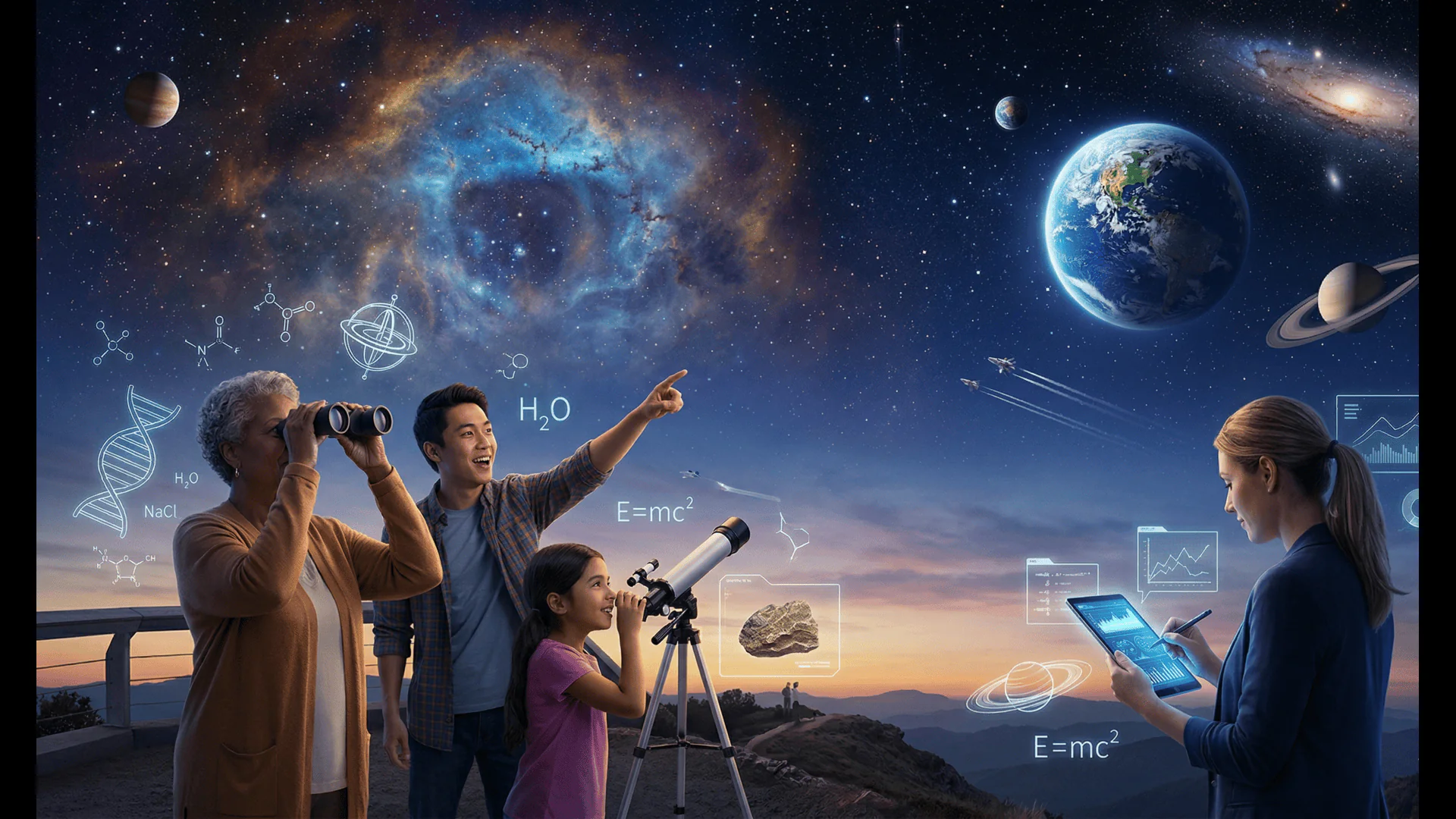
With the help of telescopes, we can see galaxies billions of light-years away. Science tells us how stars are born and how they die. It teaches us to understand our place in the grand picture of the universe.
What is Science?
Many people think science is just about difficult formulas and complex calculations. In reality, the core concept of science is quite simple.
Science is an unyielding desire to know. It is a systematic method of understanding the natural world around us through observation and logic.
A Simple Definition of Science
In simple terms, science is a systematic way of acquiring knowledge. It observes the surrounding world, asks questions, and seeks answers through testing.
It does not rely on blind faith. Instead, it stands on evidence and logic. Science is always in pursuit of the truth.
Goals and Objectives of Scientific Inquiry
The main goal of science is to discover the laws of nature. Finding out why an apple falls to the ground or why ice melts into water is science’s job.
Its purpose is not just to collect facts. Using the gathered information to improve human life and predict the future is one of the primary objectives of science.
The History of Science
The journey of science began with early human curiosity. When humans first learned to make fire, that was an early form of science.
Over thousands of years of relentless human effort, science has reached its modern form today.
Early Human Curiosity and Discoveries
People in ancient times feared many aspects of nature. They thought lightning strikes or solar eclipses were the gods’ anger.
But gradually, some people became curious. They began observing the stars’ movements in the sky. They learned to make fire by rubbing stones together and invented the wheel. These were the early steps of science.
Major Milestones in Scientific Development
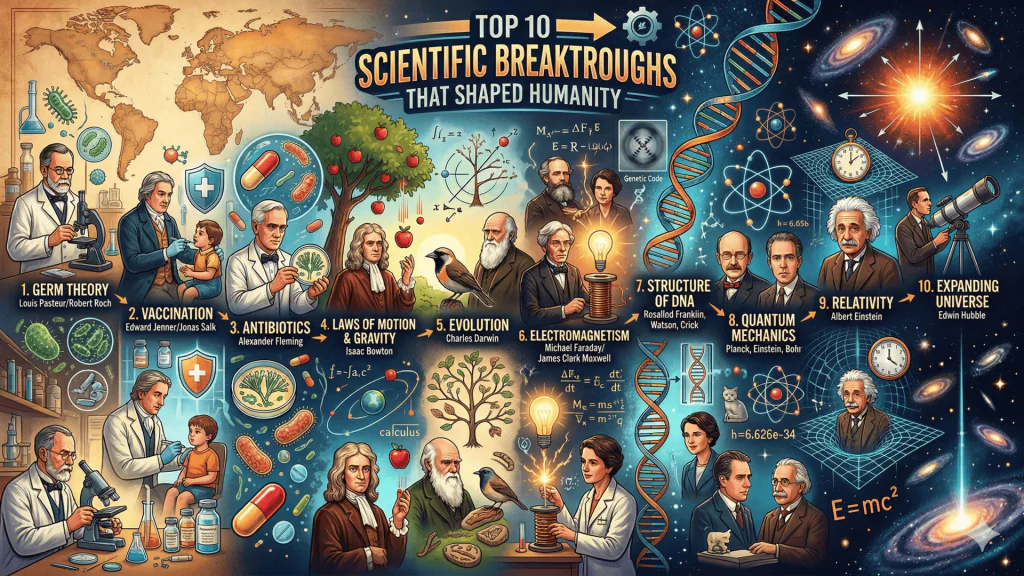
There are many important milestones in the history of science. In ancient Greece, scholars such as Aristotle and Archimedes began to study the laws of nature.
Then came the Renaissance period. Galileo Galilei proved that the Earth revolves around the sun using a telescope he built himself. Isaac Newton’s law of gravity completely changed the world of science.
The Evolution of Science Over Time
In the past, science was mostly limited to philosophy or thought. But over time, it took a specific shape.
The practice of proving things through experiments began. Albert Einstein’s theory of relativity and Charles Darwin’s theory of evolution added new dimensions to human thought. You can read the Wikipedia page on the history of science to learn more.
The Scientific Method Explained
How does science work? Do scientists just make things up? Not at all.
They follow a specific system called the scientific method. It is a step-by-step process.
Observing and Asking Questions
Everything starts with observation. Suppose you see a plant in your garden dying.
This is an observation. Next, you will ask, “Why is the plant dying? Is it lacking water or sunlight?” Asking questions is the first step of science.
Forming a Hypothesis
After asking a question, scientists think of a possible answer. This is called a hypothesis.
In the example above, your hypothesis might be, “The plant is dying because it is not getting enough water.” Before proving it, this is merely an educated guess.
Conducting Experiments
Now it is time to test whether the hypothesis is true. Scientists conduct experiments to do this.
You start watering the plant regularly. This is your experiment. During the test, you must carefully monitor all surrounding conditions.
Analyzing Data and Drawing Conclusions
After the experiment, scientists analyze the gathered data. If the plant regains its freshness after you water it, you will know your hypothesis was correct.
If the plant still dies, you must understand there is another problem. You then need to form a new hypothesis and test it again.
Main Branches of Science
Our world is so diverse that it is impossible to limit science to a single subject. To make it easier to study, science is divided into several main branches.
Physics: Understanding Matter, Energy, and Motion
Physics is the branch that discusses the most fundamental aspects of the universe. It deals with energy, force, light, sound, and motion.
Physics answers questions such as how gravity works and how electricity is generated. Modern technology relies heavily on physics.
Chemistry: Exploring Substances and Reactions
Chemistry is the branch of study dealing with the composition of matter and its changes. Everything is made of atoms and molecules.
Chemistry teaches us how water forms, why iron rusts, and how medicine works in our bodies. It uncovers the inner secrets of the materials around us.
Biology: The Science of Life
Biology is the study of all living things, including plants, animals, and microorganisms. ..Biology explains how a tiny seed grows into a massive tree.
We must seek help from biology to understand how our internal organs function or how germs spread.
Earth Science: Studying Our Planet
Earth science examines how our beautiful planet formed and what lies within it.
Earthquakes, volcanic eruptions, and changes in the weather are all topics of earth science. It helps us better understand our planet.
Astronomy: Exploring Space and the Universe
Astronomy is the science of studying the night sky and the vastness of space. It researches stars, planets, comets, and galaxies.
Astronomers work tirelessly to discover what lies beyond our solar system or how black holes work. You can find excellent information about space on the official NASA website.
Why Science is Important
Today’s modern world cannot be imagined without science. It has multiplied our standard of living many times over.
Not only that, science helps eliminate superstitions by providing an accurate understanding of the world around us.
Advancing Knowledge and Innovation
Science is constantly expanding the boundaries of human knowledge. We learn new things through new discoveries.
Scientific innovations are making our lives better. Everything from computers to the internet is a product of scientific contribution.
Improving Health and Quality of Life
One of the greatest contributions of science is in the medical field. In the past, many people died from common diseases.
Today, thanks to science, we have medicines like antibiotics and vaccines. As a result, the average human lifespan has increased significantly, and the quality of life has improved. The World Health Organization (WHO) regularly publishes new health science information.
Solving Global Challenges Through Research
Currently, our Earth faces massive problems such as climate change and pollution. Science is showing us the way to solve these issues.
Scientists are trying to save the Earth by discovering eco-friendly technologies and utilizing solar energy.
Science in Everyday Life
We may not always notice it, but there is a touch of science in every moment of our daily lives.
From the toothpaste we use in the morning to the vehicles we travel in, science is blended into everything.
Technology and Modern Communication
Science has brought a revolution to communication. Once, talking to someone far away was like a dream.
Today, thanks to the internet, we can instantly talk on video calls with people anywhere in the world. This is one of science’s greatest gifts.
Medical and Healthcare Advancements
Modern hospital equipment like X-ray, MRI, and ultrasound machines is a gift of science. They help doctors accurately visualize the body’s internal structures.
Because of advanced surgical techniques and new medicines, many complex diseases can now be easily cured.
Transportation, Energy, and Infrastructure
We can travel from one place to another very quickly by bus, train, or airplane. This is possible because of science.
Electricity lights our homes and runs factories. There are perfect scientific calculations behind the construction of large bridges and tall buildings.
How Scientists Explore the Universe
Space is so massive that it is almost impossible to go there and conduct direct research. So how do scientists know so much?
The secret behind this lies in advanced technology and the relentless observational skills of scientists.
Observation and Measurement Techniques
Scientists observe the night sky very deeply. They accurately measure the light, speed, and distance of stars and planets.
By analyzing the spectrum of light, they can understand what elements a star is made of. This is highly precise work.
Telescopes, Microscopes, and Advanced Tools
We can see very little of space with the naked eye. Therefore, scientists use powerful telescopes. Instruments like the James Webb Space Telescope can show us images of the early universe.
On the other hand, scientists use electron microscopes to see extremely tiny objects.
The Role of Data and Evidence
Scientists do not just make up stories. They collect data from telescopes and other instruments.
They then analyze that data to reach conclusions. In science, it is mandatory to verify any claim against the touchstone of evidence.
Understanding Scientific Theories and Laws
When studying science, we often hear the words “theory” and “law”. Knowing their meanings is very important for understanding science.
The way we use the word “theory” in everyday conversation is a bit different from its scientific meaning.
What is a Scientific Theory?
A scientific theory is a broad, well-tested explanation of a natural phenomenon. It is built upon many experiments and pieces of evidence.
For example, evolution is a scientific theory. It explains how the animal kingdom has changed over time. It is not just a mere guess.
What is a Scientific Law?
A scientific law is a specific rule of nature that always holds true. It is usually expressed through mathematical equations.
For example, Newton’s law of universal gravitation tells us exactly how much attractive force exists between two objects. It describes what happens, but it does not explain why.
Key Differences Between Theories and Laws
A law tells us what happens in nature. A theory tells us why it happens.
A law and a theory are not bigger or smaller than one another. They are two different parts of science. A law never becomes a theory, and a theory never becomes a law.
Critical Thinking and Science
The most important aspect of learning science is critical thinking. This is the ability to judge logically rather than believe blindly.
Science teaches us to ask questions.
Evaluating Evidence and Claims
Science does not accept a big claim just because someone made it. Science looks for evidence.
It checks whether the claim can be tested and whether other scientists can prove the test results.
The Importance of Skepticism and Inquiry
Healthy skepticism is very necessary in science. This means asking questions rather than immediately believing or disbelieving a new idea.
Science advances by asking the right questions and seeking the truth.
Avoiding Misinformation Through Scientific Thinking
There is a lot of misinformation spread on the internet today. Scientific thinking helps us identify these falsehoods.
By checking whether a news source is reliable or whether there is scientific evidence to back it up, we can easily avoid rumors.
Common Misconceptions About Science
There are several misconceptions about science in our society. Clearing these up is crucial for building a scientifically-minded community.
Many people think of science as something akin to magic.
Science is More Than Just Facts and Formulas
Many people believe science is just memorizing difficult formulas and facts. This is completely wrong.
Science is fundamentally a way of thinking. It is a problem-solving process and a way of looking at the world around us from a new perspective.
Why Scientific Knowledge Can Change Over Time
Science never claims to be the absolute truth. If new evidence is found, old scientific ideas can change.
This is not a weakness of science; rather, it is its greatest strength. Science always corrects its mistakes and moves forward.
The Impact of Science on Society
The impact of science on human society is immense. Science has completely changed human lifestyle, thought processes, and culture.
It has turned our world into a global village.
Transforming Daily Life Through Innovation
New scientific innovations have made our daily tasks much easier. From washing machines to microwave ovens, these appliances save us time.
Due to advancements in agricultural science, we can now grow much more food, meeting the dietary needs of the world’s growing population.
Science and Global Progress
The development of science and technology is essential for a country’s progress. Countries lagging in science are also falling behind economically.
Science-based industries and technologies create employment in a country and impact the global economy.
Ethical Considerations in Scientific Research
Science is a very powerful tool. But its misuse can bring terrible danger.
Therefore, maintaining ethics in scientific research is vital. Just as the invention of the nuclear bomb brought destruction, ethical questions are also involved in subjects like gene editing in medical science.
The Future of Science
The future of science is extremely exciting. New technologies arrive every day that surpass our imaginations.
In the coming decades, science will change our lives in even more incredible ways.
Emerging Fields and New Discoveries
New fields like quantum computing, nanotechnology, and genetic engineering are bringing a revolution to the scientific world.
Through these, scientists will be able to do things that previously seemed impossible, such as creating artificial organs or finding a permanent cure for diseases like cancer.
The Role of Artificial Intelligence in Research
Artificial Intelligence (AI) has greatly accelerated scientific research. Scientists are using AI to analyze massive amounts of data.
From discovering new drugs to space research, AI is acting as a reliable assistant.
Exploring the Frontiers of Space and Technology
In the future, scientists plan to build human settlements on Mars. Perhaps one day we will find signs of life in another solar system.
Science will help us cross the boundaries of this blue planet and spread out into the infinite expanse of space.
How to Learn Science as a Beginner
You do not have to be a scientist to learn science. Anyone at any age can learn it.
All you need is curiosity and a desire to learn.
Building a Strong Foundation
There is no need to read difficult books right at the start. Try to easily understand the fundamental concepts of science.
You can start with basic topics like what gravity is, what an atom is, or how a cell works.
Recommended Learning Materials and Strategies
There are plenty of excellent books, YouTube channels, and websites available today for learning science.
You can watch various science documentaries online. Additionally, learning science can be fun by doing small science experiments at home.
Developing Curiosity and Critical Thinking Skills
Always build the habit of asking questions. Think about how the things around you work.
If you do not understand something, search the internet or ask experts. Curiosity will take you deep into the heart of science.
Frequently Asked Questions (FAQs)
What is science in simple terms?
Science is a systematic way of knowing our surrounding natural world and the universe through observation, testing, and logic.
Why is science important?
Science improves our standard of living, helps eradicate diseases, and frees us from superstitions by providing accurate knowledge.
What are the main branches of science?
The main branches of science are physics, chemistry, biology, earth science, and astronomy.
How does the scientific method work?
It works step by step through observation, asking questions, forming hypotheses, conducting experiments, and analyzing results.
Can anyone learn science?
Yes, absolutely. Learning science requires only strong curiosity and an open mind. Anyone can enjoy the beauty of science by reading books or watching videos.
Conclusion
The world around us is surrounded by countless mysteries. Science is the key we can use to unlock the doors to these secrets.
Hopefully, this guide has helped you understand the basic concepts of science.
Key Takeaways About Science
We have learned that science is not just difficult formulas; it is a way of thinking. It teaches us to seek the truth based on evidence and logic.
The main branches of science work together to help us understand our complete universe.
Embracing Curiosity to Understand the Universe
Never stop asking questions. Look up at the sky and wonder how far away those stars are.
Keep your curiosity alive. Because this curiosity is constantly pushing human knowledge forward. Welcome to this wonderful journey of science.