
What Is Artificial Intelligence and How Does It Work?
Introduction to Artificial Intelligence
In today’s digital era, technology is advancing faster than we could have ever imagined. From unlocking our smartphones with facial recognition to self-driving cars and customer service chatbots, we see this technology everywhere. The name of this groundbreaking technology is Artificial Intelligence or AI.
Nowadays, the term AI comes up repeatedly in the news, on social media, and in tech discussions. However, many people do not fully understand what this technology actually is and how it can think like a human being. AI has become an integral part of almost every aspect of our daily lives. When you search for something on the internet or optimize a website on a content management system, some AI algorithm is working behind the scenes. In this blog post, we will discuss the ins and outs of Artificial Intelligence.
What is Artificial Intelligence (AI)?
In simple terms, Artificial Intelligence is a branch of computer science and technology that enables machines to think and make decisions like humans. Just as humans learn from their experiences, surroundings, and information, artificial intelligence can learn from massive amounts of data.
AI is not just a single piece of software, but rather a vast combination of many technologies. It is a system that receives data from its environment, analyzes it, and acts independently to achieve a specific goal. According to Stanford University, it is the science and engineering of making intelligent machines. When a machine can solve problems, understand language, recognize images, or make decisions like a human, we can call it an AI-powered machine.
History and Evolution of Artificial Intelligence
Although artificial intelligence is popular today, the concept is not new. The idea of artificial automatons appears in ancient Greek mythology. The journey of modern artificial intelligence began in the mid-twentieth century.
In 1950, the famous mathematician Alan Turing raised a fundamental question: “Can machines think?” He proposed a test known as the “Turing Test” to determine whether a machine could exhibit human-like behavior. Later, in 1956, John McCarthy coined the term “Artificial Intelligence” during a conference held at Dartmouth College. This conference is widely considered the birthplace of AI.
Extensive research on AI took place over the following decades. Occasionally, the pace slowed due to a lack of funding, a period known as the “AI Winter.” In 1997, the world was astonished when IBM’s supercomputer “Deep Blue” defeated chess champion Garry Kasparov. Entering the 21st century, the expansion of the internet, the availability of massive data, and the rise of advanced computing power led to unimaginable advances in AI.
How Does Artificial Intelligence Work?
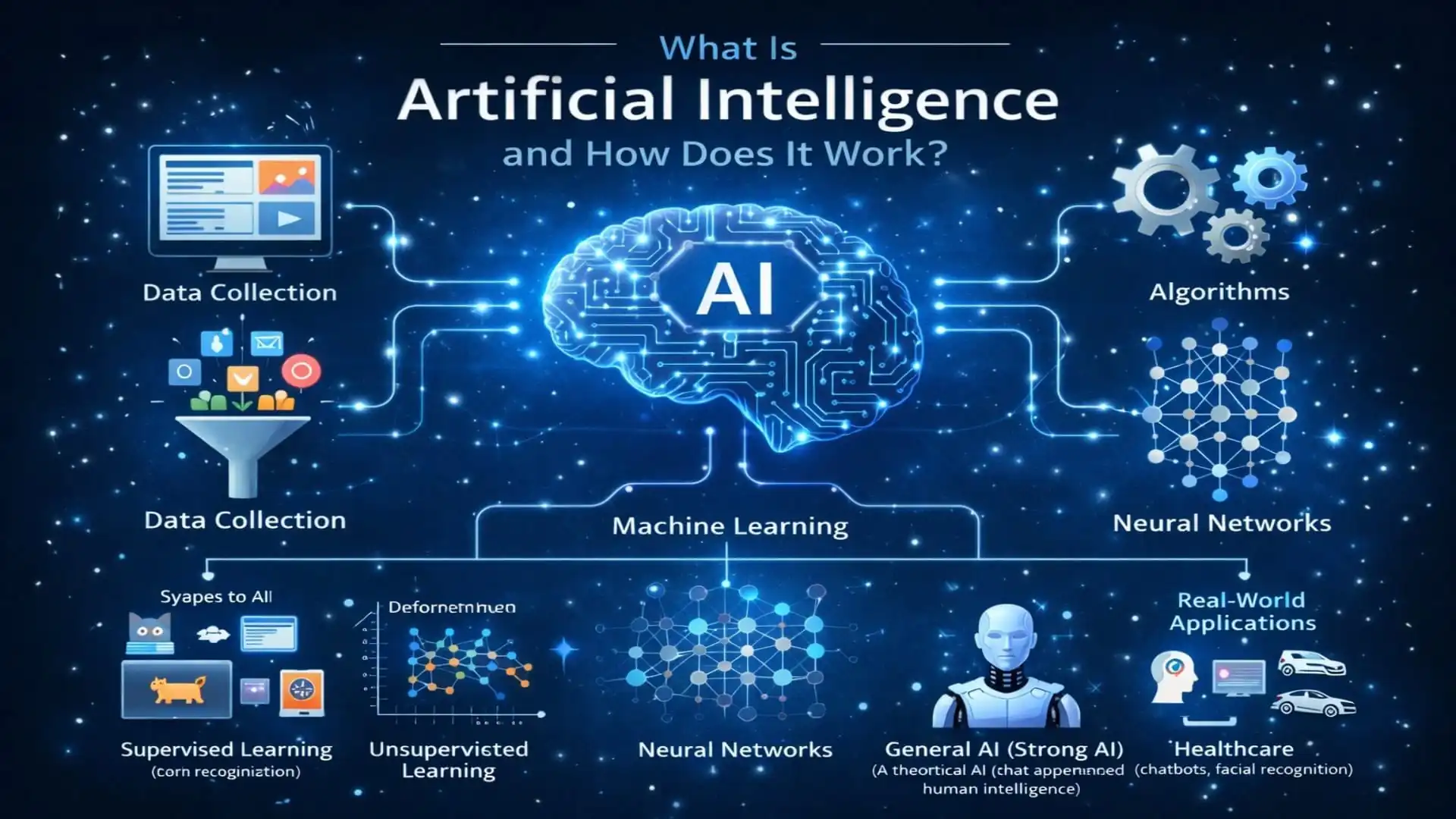
The way artificial intelligence works involves several distinct steps. It does not work by magic; rather, it relies on the precise application of complex mathematics and algorithms. Generally, an AI system follows three main steps to function:
- Data Collection and Input: For an AI model to work, it must first be fed a massive amount of data. This data can be text, images, sounds, or numbers.
- Processing and Analysis: The AI analyzes the input data using its own algorithms. In this step, the machine seeks patterns or rules hidden within the data.
- Output and Learning: After the analysis, the AI provides a result. Based on feedback on whether the result is correct, it improves itself. This is how a machine becomes smarter over time.
Core Components of Artificial Intelligence
To truly understand the vast world of artificial intelligence, one must grasp its core technologies and components. Below is an explanation of some of the most important elements:
Machine Learning Explained
Machine learning is one of the primary branches of artificial intelligence. Just as the name suggests, its job is to teach the machine. Usually, to get a computer to do something, you have to write code for it in advance. But in machine learning, the machine is not directly programmed for a specific task. Instead, it is given plenty of data and learns to perform tasks by analyzing it on its own. For example, if you want to teach a machine to recognize pictures of cats, you have to input thousands of cat photos. Gradually, the machine will learn to identify a cat’s characteristics.
Deep Learning and Neural Networks
Deep learning is an advanced form of machine learning that mimics the structure of the human brain. Just as billions of neurons are connected to each other in the human brain, “artificial neural networks” are used in deep learning. These contain layers of information. When very complex problems need to be solved, such as perfectly replicating a human voice or driving an autonomous car, deep learning is used.
Natural Language Processing (NLP)
Natural Language Processing, or NLP, is the technology that allows computers to understand and analyze human speech and written language. When you translate something on Google Translate or speak with a customer service chatbot, NLP is at work there. Because of this technology, computers are no longer limited to the language of zeros and ones but can also fluently understand human languages such as Bengali, English, and Spanish.
Computer Vision Technology
Computer vision is a technology that helps computers see and understand their visual surroundings. This technology analyzes photos or videos to extract necessary information. Computer vision is widely used in smartphone facial recognition, license plate recognition in street traffic cameras, and analysis of X-ray reports in medical science.
Types of Artificial Intelligence
Based on capabilities and scope of work, artificial intelligence can be divided into several categories. The main types are discussed below:
Narrow AI vs. General AI
- Narrow AI: All the AI we use today falls under Narrow AI. It is also called “Weak AI.” It is only proficient in one specific task. For instance, an AI designed to play chess can only play chess; it cannot write a poem for you.
- General AI: This is the AI of the future, which will be able to perform any intellectual task just like a human. It is known as “Strong AI.” General AI will be able to think, learn, and adapt to new environments like a human. However, scientists have not yet reached this stage.
Reactive Machines
Reactive machines are the most basic form of AI. They have no memory or ability to store past experiences. They only analyze the current situation and make decisions accordingly. IBM’s Deep Blue supercomputer was a reactive machine. It would consider only the current state of the chessboard when making a move and could not remember past games.
Limited Memory AI
This type of AI can remember some past experiences and data for a limited time. Most AI used today falls into this category. For example, self-driving cars remember the movements and signals of other cars on the road to maintain a safe distance.
Theory of Mind AI
Theory of Mind AI is a field of research in which machines can understand human emotions, beliefs, thoughts, and social behavior. It will be able to interact with humans more naturally and empathetically. Although this technology has not yet been fully realized, it is extremely important for the future of robotics.
Self-Aware AI
This is the ultimate stage of artificial intelligence, where the machine will have its own consciousness or self-awareness. The machine will understand that it has its own existence and feelings. For now, this is limited to science fiction movies or stories. In reality, it may take several decades or more to create this kind of AI.
Real-World Applications of Artificial Intelligence
The impact of AI on our daily lives and various professions is immense. Below are the real-world applications of AI in several major fields:
AI in Healthcare
AI has revolutionized the medical field. It helps doctors detect early symptoms of disease, analyze MRI or X-ray reports, and discover new drugs. AI can even analyze and predict whether a patient is likely to develop a specific disease.
AI in Education
Artificial intelligence is also modernizing the education system. Every student’s talent and learning style are different. Through AI, personalized learning curricula are now possible. Additionally, AI is used to grade papers, answer students’ questions, and simplify administrative tasks.
AI in Business and Marketing
When it comes to expanding a business and determining marketing strategies, AI is unmatched. AI can easily handle tasks such as analyzing customer preferences to show them the right advertisements, optimizing website SEO, generating meta tags, and creating content. Furthermore, it is possible to provide 24-hour customer service through chatbots.
AI in Transportation
The biggest surprise in the transportation sector is self-driving or autonomous cars. We use AI every day to find the fastest routes to our destinations, using GPS navigation and maps to avoid traffic jams.
AI in Smart Devices
From the smartphone in our hands to the smart TV, refrigerator, or smart speaker in our homes, AI is integrated everywhere. Amazon’s Alexa, Apple’s Siri, and Google Assistant listen to our voices and follow commands, turning the concept of a smart home into reality.
Benefits of Artificial Intelligence
Artificial intelligence has many benefits that have made human life much easier:
- Lower error rate: Machines do not get tired like humans, so if the data input is correct, the results are almost 100 percent accurate.
- Uninterrupted service: Humans cannot work continuously, but AI systems can operate 24 hours a day, 7 days a week.
- Faster decision-making: By analyzing large datasets, AI can make decisions more accurately and much faster than humans.
- Use in risky jobs: In hazardous roles such as space exploration, mining, or bomb disposal, using AI-powered robots instead of humans reduces the risk to human lives.
Challenges and Risks of AI
Alongside the benefits, AI also has some negative aspects and challenges:
- Job displacement: Due to AI automation, many traditional job opportunities are decreasing, which is a major concern.
- Data privacy: AI systems collect massive amounts of personal data. Therefore, there are concerns about data security. However, advanced encryption methods such as Zero-Knowledge Proofs and Fully Homomorphic Encryption are currently being developed to help maintain privacy throughout data processing.
- Bias: If an AI is trained with biased data, its results will also be biased.
- Lack of creativity: Although AI can create new things from vast amounts of data, it does not possess any independent creativity or original thinking of its own, as humans do.
How AI is Changing Everyday Life
You might not even notice it, but you use AI many times throughout the day. Based on what kind of videos you like to watch on YouTube or Netflix, AI suggests new videos to you. Filtering spam messages in emails, suggesting the next word as you type, or setting a route on Google Maps are all tasks performed by AI. It has made our decision-making process faster and easier.
Artificial Intelligence vs. Human Intelligence
There is a significant difference between artificial intelligence and human intelligence. Human intelligence works primarily based on experience, emotion, creativity, and environment. Humans have the capacity for empathy. On the other hand, artificial intelligence operates through code, algorithms, and data. While it is much more efficient and faster than humans at mathematical calculations or data analysis, it registers a zero when it comes to emotion or morality.
The Future of Artificial Intelligence
According to experts, the real magic of artificial intelligence is yet to be seen. In the future, AI will move closer toward general intelligence. When quantum computing merges with AI, an unimaginable revolution will occur in the tech world. However, to ensure that the use of AI does not harm humans, it is essential to establish clear policies and ethical guidelines.
Common Misconceptions About AI
The general public holds some misconceptions about AI. Many believe that robots or AI will one day take over the world, just as shown in science fiction movies. In reality, current AI systems cannot do anything beyond the commands given by humans. Another misconception is that AI will take away all human jobs. The reality is that while some tasks are being automated, new job opportunities are also emerging in AI management and development.
Is Artificial Intelligence Safe?
This question is currently being debated worldwide. AI technology itself is not inherently harmful. However, its safety depends on how it is being used. To ensure the ethical use of AI, developers must be responsible. Moreover, data encryption and security protocols need further improvement to prevent hacking and cyberattacks. If properly regulated by rules and laws, AI can be completely safe and a blessing to humanity.
How to Learn Artificial Intelligence
If you are interested in learning about AI or artificial intelligence, you can follow some specific steps:
- Mathematics and Statistics: Mathematics is the core foundation of AI. A good understanding of linear algebra, calculus, and statistics is essential.
- Learn Programming Languages: Python is the most popular programming language for AI and machine learning. You can also learn R or C++.
- Online Courses: You can take basic courses on machine learning or deep learning from platforms like Coursera, Udemy, or edX.
- Build Projects: Just reading theory is not enough. You need to build your skills by creating small projects on platforms like GitHub or Kaggle.
Best AI Tools and Technologies in 2026
With the evolution of technology, new AI tools are constantly hitting the market. By 2026, many advanced tools will have gained popularity beyond basic chatbots. For writing content, generating images, or coding, tools like ChatGPT, Claude, and Midjourney are ubiquitous. In addition, no-code automation and AI platforms like PlayAI are incredibly useful for web developers and creators. Furthermore, technologies combining blockchain and AI, such as Brevis and Zama, have become highly popular among developers for ensuring data privacy.
Frequently Asked Questions About AI
What is AI in simple words?
In simple terms, AI, or artificial intelligence, is the capability of a computer to think, learn, and make decisions like a human.
How does AI learn?
AI primarily learns through data. When fed massive amounts of information (images, text, or numbers), it uses its internal mathematical algorithms to analyze the patterns in that data and learn new things, a process known as machine learning.
Can AI replace humans?
AI can replace humans in some routine or repetitive tasks. However, in areas that require creativity, emotion, or complex human decision-making, AI can act as an assistant but cannot completely replace humans.
What are examples of AI in daily life?
Smartphone face unlock, Google Maps navigation, YouTube or Netflix video recommendations, email spam filters, and ChatGPT or Google Assistant are all common examples of AI in our daily lives.
Is AI dangerous?
AI technology itself is not dangerous, but its misuse can be. To prevent its use from spreading misinformation, violating privacy, and committing cybercrimes, the practice of adhering to proper policies and ethics is absolutely crucial.
Conclusion
Artificial intelligence is not a passing trend; rather, it is one of the most important technological revolutions in human history. It is radically changing the way we work, communicate, and live. Although it presents some challenges, when properly guided and used ethically, AI can unlock boundless potential for our society and economy. Therefore, instead of fearing technology, learning its proper application and preparing oneself for the future is the wiser course.