Cooking Science & Food Chemistry: True Kitchen Secrets
Introduction
Why Cooking Is More Than Just Following Recipes
When we step into the kitchen, we usually follow a specific recipe book or family guide. We mix exact amounts of salt, spices, and main ingredients, then place them on the heat. But have you ever wondered about the precise science working behind this entire process? Cooking is not just a mixture of some ingredients or a blind process. It is actually a living laboratory where the complex rules of physics and chemistry are constantly at play.
A recipe can tell you how long to boil an egg or fry a piece of meat. However, the science of cooking tells you exactly why the liquid part of the egg solidifies at that specific time or why the color of the meat turns from red to brown. Once you know the answers to these “whys” and “hows,” you will no longer be a slave to recipes. You will become your own kitchen scientist and master chef. Knowing the reasons behind ingredient behavior allows you to correct mistakes and elevate the taste of your cooking to a new level.
Calling cooking a creative art is not wrong, but the canvas for that art is built with the rules of science. When you understand how different temperatures and ingredients interact, your cooking skills will transform completely. You will realize that baking a perfect cake or thickening a meat stew is not a miracle but the result of pure chemistry.
The Fascinating Chemistry Happening in Your Kitchen
Your kitchen is actually a high-end laboratory. Every day when we chop onions, our eyes water. There is a chemical reaction behind this. When onion cells break, an enzyme and an amino acid mix together. This creates a volatile gas that comes into contact with the water in our eyes, forming a mild acid and causing a burning sensation. This is a very common yet fascinating example of kitchen chemistry.
Similarly, when we add lemon juice to milk, the milk curdles and turns into cheese. Here, we are essentially changing the milk’s acidity (pH). As a result, the milk proteins lose their normal structure and clump together. Again, when we fry potato chips, their crispiness and beautiful golden color are also gifts of chemistry.
Thousands of such chemical events are constantly happening in every corner of your kitchen. Every step, from turning on the stove to dining at the table, represents a fascinating chapter of chemistry. Understanding this entire process deeply makes the food preparation experience much more enjoyable and meaningful.
What is Food Chemistry?
Understanding Food Science
Food chemistry is a branch of science and technology that deals with the chemical transformations and interactions of the biological and non-biological components of food. It primarily seeks to understand how major ingredients such as carbohydrates, proteins, and lipids (fats) behave during processing and preservation. Food science teaches us how ingredients change naturally and how to keep them safe and nutritious for human consumption.
The history of food chemistry is quite old and forms one of the main foundations of human survival. According to Britannica, food science not only enhances the taste of food but also provides scientific solutions to prevent food waste and keep food fresh for longer. It is a field where biology, chemistry, and physics come together.
When we cut an apple and leave it exposed to air, it slowly turns brown. Explaining why this happens and how to stop it using lemon juice or acid is possible through food chemistry. In short, all the changes that occur from the raw state of food until it reaches our digestive system fall under the scope of food science.
How Chemical Reactions Transform Ingredients
The main goal of cooking is to transform raw ingredients. This transformation occurs primarily through various chemical reactions. When we apply heat to an ingredient, its molecules start moving rapidly. This extra energy breaks the chemical bonds between the molecules and helps create new ones.
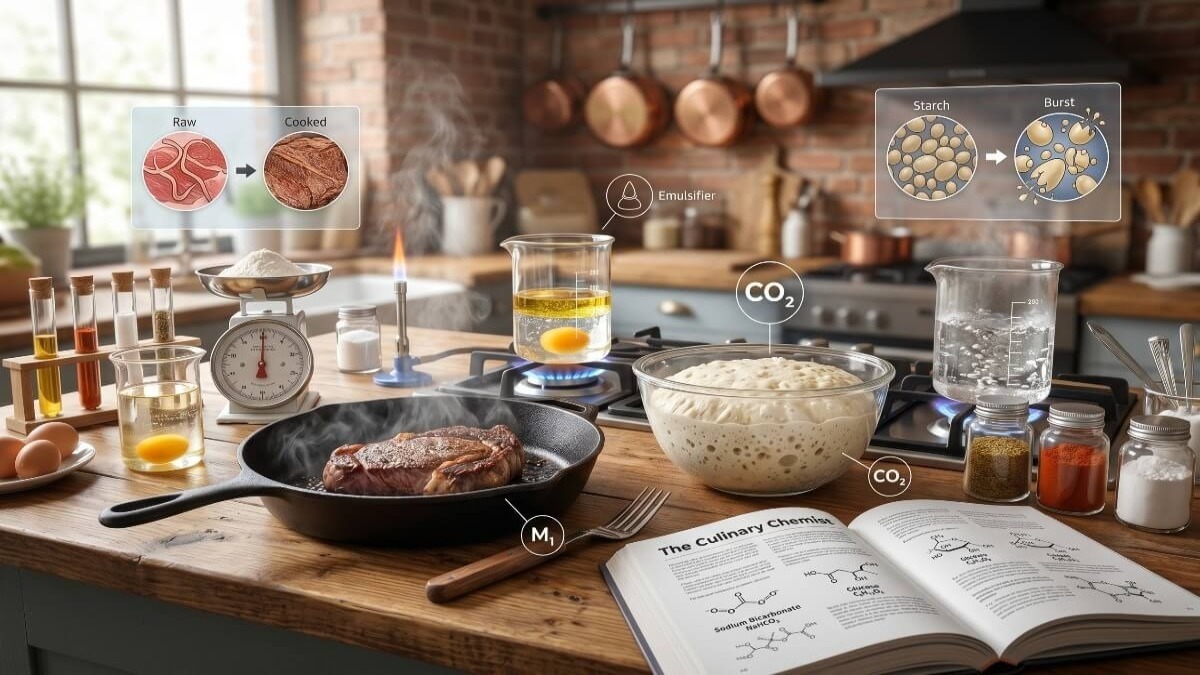
For example, when starchy foods like rice or potatoes are boiled in water, the starch molecules absorb water and swell. Once they reach a certain temperature, these molecules burst open and form a thick, gel-like structure. This is called starch gelatinization. Because of this chemical change, hard rice becomes soft, delicious cooked rice.
Through chemical reactions, not only does the food’s structure change, but its taste, smell, and nutritional value also undergo significant transformations. Some reactions increase the nutritional value of the food and make it easier to digest. On the other hand, excessive heat can sometimes destroy essential vitamins. Therefore, controlling chemical transformations during cooking is absolutely crucial.
Basic Food Components
Proteins and Their Role in Cooking
Protein is one of the main macronutrients in our diet. It is basically a complex molecule made of long chains of amino acids. Meat, fish, eggs, lentils, and dairy products are rich in protein. The role of protein in cooking is extremely important because it determines the food’s structure and moisture.
In their normal state, protein molecules are coiled into a specific three-dimensional structure. When heat, acid, or mechanical force (like beating an egg) is applied to these molecules, these coils begin to unwind. This process is called protein denaturation. After denaturation, the free protein chains form new bonds with one another and solidify into clumps, a process known as coagulation.
The way the liquid egg white becomes firm and opaque when poaching an egg is the simplest example of this protein transformation. The role of protein is also immense when cooking meat. The main proteins in meat, such as myosin and actin, shrink when exposed to heat. This determines whether the meat will be tough or tender.
Carbohydrates and Starch Explained
Carbohydrates are the main source of energy for our body. They can range from simple sugars (like glucose and fructose) to complex starches and cellulose. Rice, bread, potatoes, corn, and Sugar are the main sources of carbohydrates. The behavior of carbohydrates in cooking largely depends on whether they are simple sugars or complex starches.
Starch is a long chain of countless glucose molecules. In their raw state, starch granules do not dissolve in water and remain quite hard. But when they are heated with water, the hydrogen bonds inside the starch loosen, allowing water to enter. As a result, the granules swell, and eventually, the entire mixture thickens. This process is used to thicken soups or make custard.
Simple sugars, on the other hand, behave completely differently under heat. When Sugar is heated to high temperatures without water, it melts and its color changes from golden to dark brown. This is Sugar’s own chemical transformation that brings a perfect blend of sweet and bitter flavors to the food.
Fats and Oils in Food Preparation
Fats and oils belong to the lipid family. We call them oils if they are liquid at room temperature and fats if they are solid or semi-solid. The role of fat in cooking is multifaceted. It is not just a cooking medium; it is a key ingredient in improving the taste and mouthfeel of food.
Fats can reach much higher temperatures than water. While water starts boiling and turning into vapor at 100 degrees Celsius, oil or fat can easily be heated to 200 degrees Celsius or more. Due to this high temperature, the surface of the food can be fried or made crispy very quickly. Fat creates a coating around the food, preventing internal moisture from escaping and keeping the food juicy.
Additionally, many flavor compounds and vitamins (like vitamins A, D, E, and K) are fat-soluble. So, using fat or oil allows the true flavors of spices to blend well with the food. However, every oil has a specific ‘smoke point’. Heating the oil above this temperature causes it to break down, producing harmful smoke and bitter-tasting compounds that are detrimental to health.
Vitamins, Minerals, and Water
Vitamins and minerals are known as micronutrients for our bodies. While they do not play a major role in the physical structure of food, their stability and presence during the cooking process are very important. Some vitamins, like vitamin C and B-complex, are water-soluble and heat-sensitive. Boiling vegetables in water for a long time causes these vitamins to be washed away or destroyed.
Mineral components (like iron, calcium, potassium), on the other hand, are not easily destroyed by heat, but they can also dissolve in the boiling water. Therefore, reusing the cooking water instead of throwing it away is a smart choice. Minerals also often help maintain the color and texture of food. For instance, calcium helps keep the pectin inside vegetables firm so they do not turn completely mushy.
Water is the most universal medium and ingredient in cooking. The amount of water inside the food determines how quickly it will cook or what its texture will be. Water is an excellent solvent and heat conductor. The rate at which water evaporates during cooking dictates whether the food will be crispy or soft.
How Heat Changes Food
Physical vs. Chemical Changes During Cooking
Two types of changes happen in food during cooking: physical and chemical. A physical change refers to a change in the external appearance or state of a substance, while its basic chemical structure remains the same. Examples include ice from the freezer melting into water, or solid butter at room temperature melting in a pan. These are physical changes because even though the butter is liquid, the fat molecules inside remain unchanged.
Conversely, a chemical change is a process in which the original molecules of the ingredients break down to form entirely new substances. These changes are usually irreversible, meaning they cannot be reversed. For instance, after frying a raw egg, it is impossible to turn it back into a raw egg. The heat has created new chemical bonds in the egg’s protein chain.
Most processes in the kitchen are actually a complex mix of physical and chemical changes. When we bake bread, the water inside evaporates (a physical change), while the surface burns slightly under the heat, becoming brown and aromatic (a chemical change). The right balance of these two types of changes makes a dish perfect.
Why Temperature Matters in Food Preparation
Temperature is the most powerful driving force in cooking. Without the right temperature, the desired chemical reactions will never occur. For example, it takes at least 60 to 70 degrees Celsius and quite a bit of time for the tough connective tissues in meat, called collagen, to break down into soft gelatin. If you cook meat rapidly at very high temperatures, the proteins will toughen before the collagen can melt, making the meat hard to chew.
Research from the renowned Harvard T.H. Chan School of Public Health shows that cooking temperatures play the biggest role in destroying harmful bacteria and ensuring food safety. Bacteria multiply rapidly within a certain temperature range (usually 5 to 60 degrees Celsius, known as the danger zone). Therefore, food should be cooked and stored at temperatures outside this range.
| Ingredient / Process | Ideal Temperature (Celsius) | Scientific Result |
| Starch Gelatinization | 60° – 85° | Starch absorbs water, swells, and softens |
| Protein Coagulation | 60° – 80° | Liquid proteins become firm and structured |
| Maillard Reaction | 140° – 165° | Food browns and develops intense, savory aromas |
| Caramelization | 160°+ | Sugar breaks down to create golden caramel |
Even a slight fluctuation in temperature can ruin the taste and texture of an entire dish. Therefore, precisely controlling the stove heat or oven temperature during cooking is crucial.
The Maillard Reaction: The Secret Behind Flavor
What is the Maillard Reaction?
The Maillard reaction is one of the most famous and important chemical reactions in cooking science. French chemist Louis-Camille Maillard first discovered this reaction in 1912. This wonderful phenomenon occurs when amino acids (from proteins) and reducing sugars (from carbohydrates) react in the presence of heat.
This reaction generally requires temperatures between 140 and 165 degrees Celsius. It requires no enzymes or catalysts; it is a purely thermal chemical process. If there is a lot of water in the food, the temperature cannot rise above 100 degrees Celsius because water absorbs a lot of energy to evaporate. Thus, the Maillard reaction usually works best during dry heat or oil-based cooking.
Why Browning Enhances Food Flavor
The most visible result of the Maillard reaction is the beautiful brown color on the surface of the food. However, this is not just an external color change. This reaction produces hundreds of new flavor compounds that were completely absent in the raw food. These compounds include furans, pyrazines, and thiophenes, which create amazingly complex aromas and flavors.
These newly formed molecules strongly stimulate our taste buds and olfactory senses. It is scientifically proven that humans have a natural attraction to browned foods because, through evolution, we have learned that such foods are generally tastier and easier to digest. The compounds generated through the Maillard reaction elevate the flavor of food from ordinary to extraordinary.
Common Foods That Undergo the Maillard Reaction
The flavors of many foods we eat every day rely heavily on this Maillard reaction. Here are some familiar examples:
-
Toasted Bread: When we toast white bread in a toaster or on a pan, the top part becomes brown and crispy.
-
Fried Meat or Steak: When a piece of meat is placed in a hot pan, its exterior quickly browns, creating a delicious crust.
-
Fried Onions: Frying onions for a long time causes the proteins and sugars inside to combine, creating dark brown, sweet-and-bitter fried onions.
-
Coffee Bean Roasting: Raw coffee beans have no pleasant smell. Only after roasting at high heat does the true aroma of coffee emerge through the Maillard reaction.
Whenever you see the color of food turning brown under heat and spreading a beautiful aroma, you can be sure that Maillard chemistry is working its magic.
Caramelization and the Development of Sweetness
The Transformation of Sugar Under Heat
Caramelization is an entirely different process that many people confuse with the Maillard reaction. Caramelization is the pyrolysis or thermal oxidation of pure carbohydrates or sugars. This process does not require any proteins or amino acids. When Sugar is heated above its melting point, it begins to melt and chemically break down.
Under high heat, sugar molecules (like sucrose) first break down into glucose and fructose. Then, by losing water, they form new compounds like caramelan, caramelen, and caramelin. As a result of this process, the Sugar’s sweetness slightly decreases, giving rise to a lightly bitter, buttery, and beautifully aromatic, complex flavor. The caramelization temperature varies by sugar type, but for common table sugar, it is around 160 degrees Celsius.
The Difference Between Caramelization and Browning
Although both caramelization and the Maillard reaction result in food turning brown, there are fundamental scientific differences between them. The following table highlights these differences:
| Feature | Maillard Reaction | Caramelization |
| Required Elements | Protein (Amino Acids) + Sugar | Only Sugar (Carbohydrates) |
| Minimum Temperature | Usually 140° Celsius | Usually 160° Celsius or higher |
| Main Examples | Seared meat, toasted bread, fried onions | Caramel pudding, candy, caramel sauce |
| Nature of Flavor | Meaty, savory, and complex aroma | Sweet, bitter, and buttery aroma |
In simple terms, the browning of meat or bread is the Maillard reaction, while the melting of Sugar into a reddish-brown sauce is caramelization.
Proteins and Cooking
Why Eggs Change When Heated
The egg is one of the most versatile ingredients in the kitchen. About 90 percent of a raw egg is water, and the rest is mostly protein and fat. In the egg white, different types of proteins, including ovalbumin, float precisely within the water. In this state, the proteins remain separate, which is why raw eggs appear liquid and transparent.
When we heat an egg, its protein molecules start vibrating rapidly. As the temperature rises, the weak bonds between them break, and the coiled protein chains straighten out. These unfolded chains then tangle with one another to form a mesh or network, trapping water inside the egg. This is exactly why the egg white turns completely solid and opaque from a liquid state. The same thing happens with the yolk, though the presence of fat makes its temperature and texture slightly different.
A Simple Explanation of Protein Denaturation
You can compare protein denaturation to a ball of yarn. Imagine a woolen thread neatly wound up into a ball. This is the normal (Native) state of the protein. Now, if you pull one end of that ball, the entire thread will unravel and lengthen. Heat does exactly this during cooking.
Heat is not the only way to denature proteins. If you add strong lemon juice or vinegar (an acid) to an egg, or vigorously whisk the egg with a spoon (mechanical force), the proteins can also denature. Once proteins denature, they cannot return to their original state. This process gives our food its specific shape and chewable texture.
How Cooking Affects Meat Texture
Meat is primarily composed of muscle fibers, which are highly complex protein structures. Meat primarily consists of three components: water, protein (myosin, actin, collagen), and fat. The texture of meat changes drastically depending on the cooking temperature.
Starting at 40 degrees Celsius, the myosin proteins in the meat begin to denature, and by 50 degrees Celsius, the meat starts to firm up. When the temperature exceeds 60 degrees Celsius, the meat cells shrink and squeeze out their internal moisture or juices. This is why overcooking makes meat dry and tough.
However, another protein in meat is collagen, which forms tough connective tissues. It takes a long time and a temperature of about 70 degrees Celsius for this to soften. When cooked slowly over low heat, this tough collagen melts into soft gelatin, giving the meat a melt-in-your-mouth texture.
The Science of Baking
How Yeast Makes Bread Rise
Baking is entirely a game of measurement and chemical reactions. A slight mistake here can ruin the entire recipe. When making bread, a single-celled fungus called yeast plays an incredibly important role. Yeast is a living microorganism that consumes the sugars and starches in flour.
When the yeast consumes the sugars in the flour, it starts a biological process called fermentation. During this process, the yeast produces carbon dioxide ($CO_2$) gas and alcohol as byproducts. This carbon dioxide gas accumulates as tiny bubbles inside the dough. Under the heat of the oven, this gas expands further and puffs up the bread beautifully, creating soft, sponge-like holes inside.
The Role of Baking Soda and Baking Powder
When making cakes or biscuits, we usually use baking soda or baking powder instead of yeast. These are called chemical leavening agents. Their job is also to produce carbon dioxide gas, but their process is entirely chemical.
Baking soda is pure sodium bicarbonate ($NaHCO_3$), which is an alkaline substance. For it to work, it needs an acidic ingredient (like yogurt, lemon juice, or buttermilk) and moisture. As soon as it comes into contact with the acid, the baking soda reacts rapidly, releasing carbon dioxide gas.
Baking powder, on the other hand, is a mixture of baking soda and a dry acid (like cream of tartar). A little starch is added to keep the ingredients dry. Because baking powder contains both an acid and a base, it does not need a separate acidic ingredient to activate; just adding water or liquid starts the reaction. Markets usually sell ‘double-acting’ baking powder, which produces gas first when it touches liquid and again in the heat of the oven, helping the food rise perfectly.
Understanding Gluten Formation
The structural foundation of bread or cake is gluten. Gluten is not a single protein; it is essentially a combination of two proteins, gliadin and glutenin, which occur naturally in wheat and flour. In dry flour, these proteins remain scattered and inactive.
When we add water to the flour and begin to knead it by hand, these two proteins link together with the help of water molecules to form a sticky, elastic network. This is called the gluten network. This web traps the carbon dioxide gas produced by yeast or baking powder, much like a balloon holds air. The more you knead the dough, the stronger the gluten becomes. Bread requires strong gluten, but cakes or pastries need a soft texture, which is why low-gluten flour is used for cakes, and they are not overmixed.
Acids and Bases in Cooking
How Acidity Affects Flavor and Texture
The presence of acids is very common in our kitchens. Lemon juice, vinegar, tamarind juice, tomatoes, and yogurt are major sources of acid. In chemical terms, their pH value is below 7. The use of acid in cooking is not just to enhance sourness; it also plays a vital role in balancing the overall flavor and texture of the food.
Acid cuts through the heavy or excessively fatty taste of food, bringing a refreshing sensation. It also helps partially break down meat proteins, which is why lemon or yogurt is used when marinating meat. Acid also affects the texture of vegetables. For instance, potatoes or other vegetables boiled in acidic water do not turn mushy easily because the acid helps keep the pectin in the vegetable cell walls firm.
Common Acidic and Alkaline Ingredients
Although there are fewer alkaline or basic ingredients in the kitchen compared to acids, their impact is immense. Alkalines have a pH value greater than 7. The most common alkaline ingredient in the kitchen is baking soda. Egg whites also tend to be slightly alkaline in nature.
Adding an alkaline substance when cooking vegetables quickly softens the cellulose, causing the vegetables to turn mushy very fast. However, excessive alkali can destroy the natural color of vegetables and degrade vitamin C. On the other hand, acidic ingredients help retain the food’s color. For example, adding a little vinegar when cooking red cabbage maintains its bright red color; otherwise, it might turn dark blue.
Emulsions and Food Structure
How Mayonnaise and Salad Dressings Work
Have you ever tried mixing oil and water together? No matter how much you shake them, the oil and water eventually separate into two distinct layers. This is because oil is a non-polar compound and water is a polar compound, which naturally do not mix. But if you look at beloved foods like mayonnaise, salad dressing, butter, or milk, you will see that oil and water are wonderfully blended together. In science, this is called an emulsion.
An emulsion is a mixture in which tiny droplets of one liquid are evenly dispersed throughout another immiscible liquid. In the case of mayonnaise, a large amount of vegetable oil is mixed with a tiny bit of water and egg yolk to create a thick, smooth, cream-like texture. This does not happen by magic; there is a special ingredient at work called an emulsifier.
The Science Behind Mixing Oil and Water
To create a stable emulsion, we need a molecule with one end attracted to water (hydrophilic) and the other to oil (hydrophobic). This special substance is called a surfactant or an emulsifier.
Egg yolks contain a natural emulsifier called lecithin. When we slowly add oil to egg yolks to make mayonnaise and whisk vigorously, the oil-attracting end of the lecithin surrounds the tiny oil droplets. At the same time, its water-attracting end forms hydrogen bonds with surrounding water molecules. As a result, the oil droplets can no longer coalesce into larger pools, and the entire mixture takes on a stable, permanent form. Milk is also nature’s wonderful emulsion, where milk proteins (casein) act as emulsifiers to keep the fat floating in the water.
Food Preservation and Chemistry
The Role of Salt, Sugar, and Vinegar
Food preservation is one of the main tools for the survival of human civilization. Since ancient times, humans have been using salt, Sugar, and vinegar to preserve food for long periods. Complete chemical and biological science works behind this preservation. The main principle is to destroy the environment in which harmful microorganisms, such as bacteria, survive.
Salt and sugar work primarily through osmosis. When we add a large amount of salt or Sugar to food, the external environment becomes much denser than the internal cells of the food. As a result, all the water from the cells of bacteria or fungi is drawn out through osmosis, and the microorganisms die from dehydration. Salt in pickling and Sugar in making jams and jellies work on this exact principle.
Vinegar, on the other hand, lowers the pH, or acidity, of the food. Most spoilage bacteria cannot survive in highly acidic environments. The acetic acid in vinegar destroys bacterial enzymes, thereby protecting the food from rotting.
Refrigeration and Freezing Explained
Why does food stay fresh in the fridge? The simple answer is temperature. The low temperature inside the fridge (usually around 4 degrees Celsius) drastically slows down the growth rate of bacteria and other microorganisms. It also slows down the rate of chemical reactions. For every 10-degree Celsius drop in temperature, the rate of most chemical and enzymatic reactions is halved.
Freezing, or the process of cooling food below zero degrees Celsius to turn it into ice, takes this one step further. It not only stops microbial growth but also turns the free water inside the food into ice. Bacteria need liquid water to survive and grow. When water turns into ice, the bacteria have no water to use, rendering them completely inactive. Keep in mind, however, that freezing does not destroy bacteria; it simply puts them into a deep, dormant state for a long time.
Preventing Spoilage Through Science
Two main factors are responsible for food spoilage: microbial attacks and the activity of the food’s own enzymes. For example, when a banana slowly ripens and turns black, its internal enzymes are at work even in the absence of bacteria. Controlling these two processes through science is the main goal of food preservation.
According to guidelines from the U.S. Food and Drug Administration (FDA), properly processing and storing food in airtight containers keeps it safe for a long time. Through vacuum packing, we remove oxygen from around the food. Without oxygen, oxidation cannot occur, and aerobic bacteria cannot multiply. By utilizing modern chemistry in this way, we have been able to multiply the shelf life of food many times over.
Flavor, Aroma, and Taste Chemistry
How Taste Buds Detect Flavors
When we put food in our mouths, we often say it tastes delicious or has a great flavor. But science says ‘taste’ and ‘flavor’ are not the same thing. We have thousands of tiny taste buds on our tongues. These taste buds can primarily detect chemical compounds dissolved in liquids.
The human tongue is capable of detecting five basic tastes:
-
Sweet: Indicates the presence of glucose or sugars.
-
Salty: Signals the presence of sodium and other mineral salts.
-
Sour: Detects the presence of hydrogen ions or acids.
-
Bitter: Warns the body against potentially harmful or toxic alkaloids.
-
Umami: A Japanese word meaning savory or meaty. It primarily detects the presence of the amino acid glutamate, which is abundant in monosodium glutamate (MSG), tomatoes, or mushrooms.
The Role of Aroma in Food Enjoyment
Our taste buds can only detect these five basic tastes. So how do we distinguish between thousands of different flavors like mango, lychee, or biryani? This is where aroma comes in. Almost 80 percent of our flavor experience comes through our nose or olfactory system.
When we chew food, the volatile aroma molecules inside the food evaporate and reach our nasal cavity through the back of our throat. This is called retronasal olfaction. We have millions of olfactory receptors in our noses that detect these thousands of different aroma molecules and send signals to the brain. The brain then combines the signals from the five tastes on the tongue and these aromas from the nose to create a complete sensation of ‘flavor’. This is why when we have a cold, and our nose is blocked, all food seems tasteless or bland.
Why Certain Foods Taste Better Together
There are some timeless pairings in the food world, like tomatoes and basil, chocolate and vanilla, or meat and potatoes. There is a scientific theory behind why eating these foods together feels so good: ‘flavor pairing’.
Chemists have found that foods sharing similar or common volatile compounds at the molecular level are perceived very positively by the human brain when cooked or eaten together. For example, cheese and tomatoes both contain high levels of natural glutamate, so mixing them together enhances the umami taste. Modern chefs are utilizing this flavor-pairing chemistry to create completely new and bizarre food combinations that surprise our taste buds.
Everyday Cooking Chemistry
Boiling, Frying, and Grilling Explained
Every method we use in the kitchen daily, such as boiling, frying, or grilling, has a different effect on the food’s molecules. The main difference between these methods is the medium of heat transfer and the temperature used.
When boiling, the medium for heat transfer is water. Under normal pressure, the maximum temperature of water cannot exceed 100 degrees Celsius. At this temperature, proteins coagulate and starches soften, but the Maillard reaction cannot occur. Therefore, boiled food is usually soft and pale or light in color.
On the other hand, during frying and grilling, oil and direct heat or air act as heat-transfer media, respectively. In these methods, temperatures can easily reach 150-250 °C. Due to this high heat, the water on the surface of the food evaporates quickly, and the Maillard reaction and caramelization take place. This creates a crispy, delicious, brown crust on the outside of the food.
Why Different Cooking Methods Yield Different Results
The same ingredient can completely change its taste and texture just by altering the cooking method. Let’s consider a potato. When you boil a potato in water, the starch granules absorb water and turn into soft, fluffy mashed potatoes. No new flavor compounds are created here; you only get the natural taste of the potato.
But when you cut that same potato thinly and deep-fry it (French Fries), the high oil temperature causes the starch and a small amount of surface protein to undergo the Maillard reaction. As a result, the outside of the potato becomes crispy and golden, creating a fantastic chip flavor. Furthermore, if the potato is roasted over coals or grilled, the sugars inside caramelize slightly, and the smoky aroma of the fire mixes in to create a wonderful smoky flavor. Cooking is all about controlling this interplay of temperatures at your will.
Food Chemistry and Nutrition
How Cooking Affects Nutritional Content
Many people believe that cooking reduces the nutritional value of food. While this idea is partially true, it is not entirely correct. While cooking does destroy some nutrients, it also greatly increases the bioavailability (absorption capacity) of many other nutrients in our bodies.
Heat-sensitive vitamins, especially vitamin C and folic acid, break down when cooked at high temperatures for long periods. Also, water-soluble vitamins can leach out into the cooking water when boiling vegetables. However, fat-soluble vitamins like vitamins A, D, E, and K are not easily destroyed by heat. Cooking breaks down the tough cell walls or cellulose of food, allowing our digestive system to easily absorb the nutrients locked inside.
Maximizing Nutrition Through Preparation
By understanding the principles of science, we can maximize nutrient retention while cooking. For example, tomatoes contain a very powerful antioxidant called ‘lycopene’, which helps prevent cancer. Our bodies can absorb much more lycopene from tomatoes cooked with a little oil than from raw tomatoes because oil helps dissolve the lycopene and heat loosens its bonds.
Similarly, the beta-carotene in carrots becomes more beneficial to the body when slightly cooked. An excellent method for preserving the vitamins in vegetables is ‘blanching’. Plunging vegetables into boiling water for just 1-2 minutes and immediately shocking them in ice water destroys harmful enzymes while keeping their bright colors and vitamins intact. Therefore, knowing how to cook a specific food is a big part of nutritional science.
Common Misconceptions About Cooking Science
Does Searing Meat Seal in the Juices?
A very common and popular belief in the culinary world is that searing or quickly frying a piece of meat in a hot pan “seals” the exterior, trapping internal juices and making the meat tender. This theory was advanced by the famous 19th-century German chemist Justus von Liebig, and even today many great chefs still believe it.
However, modern food science has proven this concept to be a complete myth. Famous science writer Harold McGee, in his book On Food and Cooking, has shown that the browned crust around seared meat is not a waterproof wall or seal. In fact, searing meat at high temperatures causes the muscle fibers to shrink even more, pushing more juices out than from raw meat. The real reason for searing meat is not to seal it, but to multiply its taste and aroma hundreds of times over through the Maillard reaction. The real way to keep meat juicy is to maintain the correct internal temperature and let the meat rest for a while before cutting it.
Separating Food Facts from Kitchen Fiction
There are many other misconceptions in the kitchen that we follow blindly. For example, many people think that adding salt to water will make it boil faster. The scientific truth is that the tiny amount of salt we use in cooking has virtually no visible effect on the boiling point of water. To raise the boiling point by even half a degree requires a massive amount of salt, which would make the food inedible. We add salt primarily for flavor, not to speed up boiling.
Another misconception is that keeping the pot covered while boiling green vegetables keeps their color bright. In reality, some natural acids evaporate from vegetables while they cook. If the pot is covered, those acids fall back into the water and alter the green chlorophyll into a dark, grayish-green color. So, leaving the pot uncovered while cooking green vegetables allows steam to escape, helping maintain their bright green color.
Modern Innovations in Food Science
Molecular Gastronomy Explained
Towards the end of the 20th century, the merging of cooking and science created an entirely new discipline called molecular gastronomy. French scientist Hervé This and Oxford physics professor Nicholas Kurti first coined this term. It studies the physical and chemical processes underlying traditional cooking methods and gives them an entirely new form.
Thanks to molecular gastronomy, we now see the use of scientific ingredients such as liquid nitrogen, calcium chloride, and sodium alginate in the kitchen. Using these technologies, liquids are turned into tiny bubbles or capsules that pop in your mouth, a process called spherification. Sauces or fruit juices are fashioned into caviar-like beads to elevate the visual appeal of dishes. It is a modern attempt to give cooking the flawless form of a laboratory experiment.
Future Trends in Food Technology
Future food technology is poised to completely revolutionize our eating habits. Due to global population growth and climate change, scientists are now creating artificial meat or ‘cultured meat’ in labs, where nutritious meat can be produced simply by culturing animal cells without killing them.
Moreover, ‘plant-based meats’ that mimic the exact taste and texture of real meat using plant proteins have already become highly popular in the market. Using 3D food printing technology, food is created from computer-generated designs while maintaining precise nutritional measurements. The food chemistry of the future will not be limited to taste alone; it will play a major role in protecting our planet’s environment and ensuring sustainable food security.
Frequently Asked Questions (FAQs)
What is food chemistry?
Food chemistry is a branch of science that deals with the chemical structure, transformation, and interactions of all biological and non-biological components of food (such as carbohydrates, proteins, lipids, vitamins, and water) during processing. It helps us understand the taste, shelf-life, and nutritional value of our food.
Why does food change color when cooked?
When cooking, heat causes chemical changes in the food’s internal pigments and other ingredients. For instance, the myoglobin in meat breaks down and turns brown when heated; the chlorophyll in vegetables changes color when exposed to acid or heat; and food takes on a golden or brown hue due to the Maillard reaction and the caramelization of sugars.
Why does bread rise?
The main reason bread rises is the production and trapping of gas. The yeast or baking powder in the dough produces carbon dioxide ($CO_2$) gas through chemical or biological processes. The elastic gluten network formed by kneading the dough traps this gas inside, preventing it from escaping. When this gas expands under the oven’s heat, the bread rises.
How does heat affect food?
Heat essentially increases the kinetic energy of food molecules, causing old chemical bonds to break and new ones to form. Heat causes proteins to denature and coagulate (like an egg turning solid), starches to absorb water and soften (like cooking rice), harmful bacteria to be destroyed, and new chemical compounds to form, creating the food’s flavor and aroma.
Why is the Maillard reaction important?
The Maillard reaction is extremely important in cooking because it creates the true savory flavor and wonderful aromas of food. The reaction between amino acids and sugars in the presence of heat produces hundreds of new flavor compounds (such as pyrazines), bringing that familiar, mouth-watering flavor to roasted meat, toasted bread, or coffee.
Conclusion
Key Takeaways on Cooking and Food Chemistry
From this extensive discussion, we can understand that the kitchen is no ordinary place; it is a living laboratory. Every food we prepare daily, whether it is a simple boiled egg or a complex baked good, has an undeniable scientific logic behind every step. Processes such as protein denaturation, starch gelatinization, oil emulsion, and the Maillard reaction determine how delicious and visually appealing the food on our plate will be.
Science teaches us that cooking is not about rote memorization. When we understand the underlying chemistry of ingredient behavior, we can easily avoid many kitchen mistakes. Knowing how to properly control temperature, acidity, and moisture, rather than blindly following a recipe, is the true mark of a skilled cook.
Understanding the Science Behind Better Cooking
When the light of this science enters your kitchen, your perspective on cooking will change completely. You will understand why the pan needs to be very hot before searing meat, why the amount of baking powder must be perfect for a cake, or how a little lemon juice can instantly liven up a bland curry.
This knowledge of chemistry will make you much more confident and creative in the kitchen. So, the next time you turn on the stove, don’t just follow a recipe; remind yourself that you are about to create a wonderful harmony between nature and science. Happy cooking!