The Future of Education: 7 Revolutionary Trends
How Education is Rapidly Transforming in the Digital Age
The world around us is changing very fast. Along with it, the way we learn is also evolving. There was a time when education simply meant the pages of a book and the four walls of a classroom. Today, that concept has completely shifted.
Incredible technological advancements have reshaped the education system. The digital age has made our learning opportunities virtually limitless. You no longer have to rely on a specific place or time to gain knowledge.
The easy availability of the internet is the biggest driver of this transformation. Smartphones, laptops, and high-speed internet connections have turned every home into a school. Anyone can now learn from the best teachers across the globe.
This transformation in education is not just technological. It is a massive shift in mindset. Previously, the focus was heavily on rote memorization. Now, the emphasis is placed heavily on creativity and practical skills.
In today’s blog post, we will discuss 7 revolutionary trends shaping the future of education that everyone needs to know about. These trends are not only changing the present state of learning but also laying the foundation for a bright future.
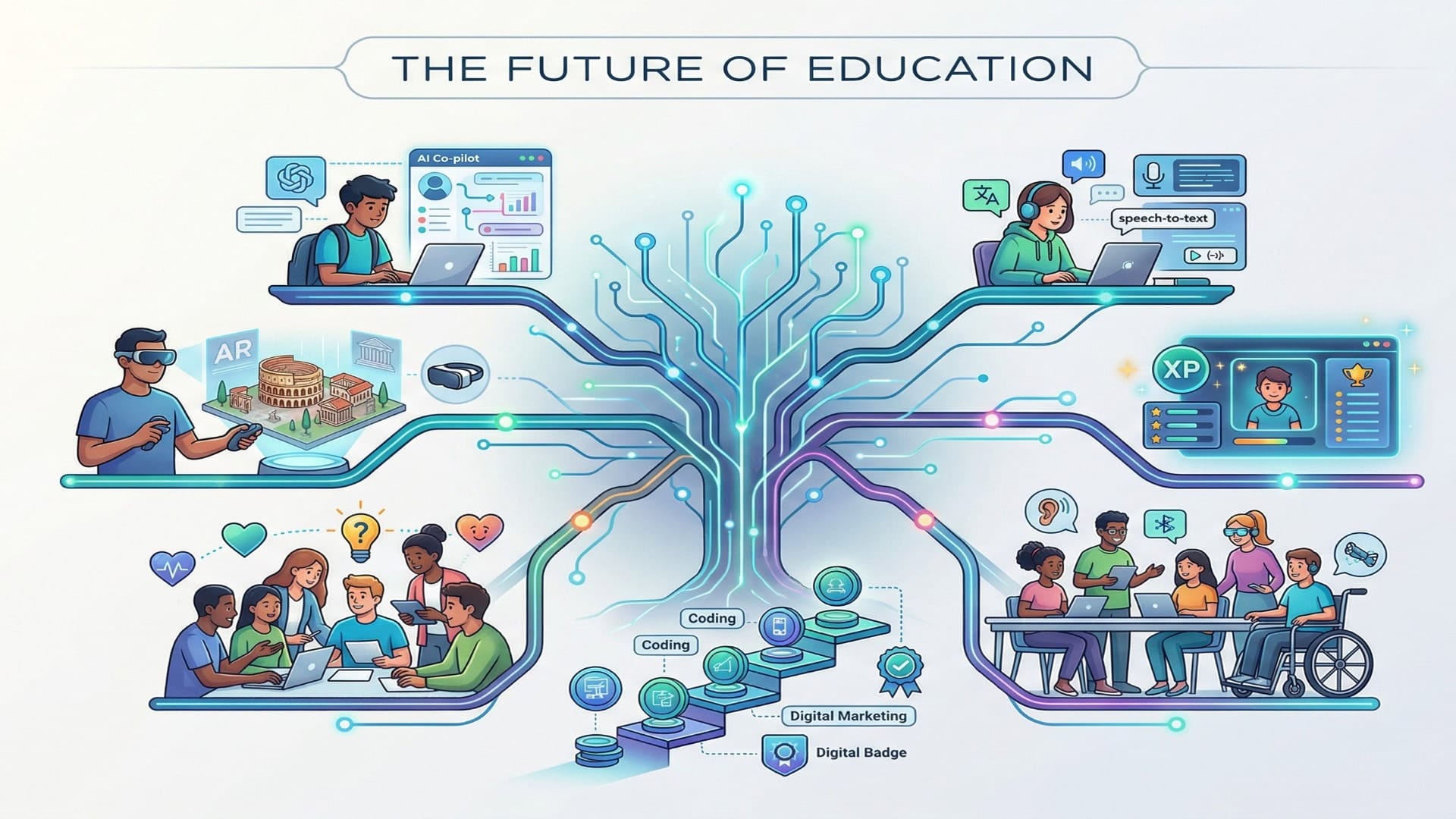
1. Artificial Intelligence in Education: Personalized Learning at Scale
Artificial intelligence, or AI, is no longer a matter of science fiction. It has become an inseparable part of our daily lives. The impact of AI in the education sector is perhaps the most revolutionary of all.
Not every student has the same learning capacity or style. Some learn quickly, while others take a bit more time to grasp a specific concept. AI has brought a wonderful solution to this problem.
With AI technology, it is now possible to create separate, personalized learning paths for every student. The system can identify exactly where a student is struggling and provide content tailored to those specific needs.
According to various World Economic Forum studies, AI-driven educational systems can significantly increase students’ learning speed. This helps overcome one of the biggest limitations of the traditional education system.
How AI Tutors are Changing Student Support Systems
AI tutors have opened a new horizon in education. They can provide services 24 hours a day without human emotions or fatigue. Whenever a student faces a problem, they can immediately seek help from an AI tutor.
These virtual tutors analyze each student’s learning patterns. They figure out which method will best help a particular student understand a topic. Then, they explain the subject using that exact method.
As a result, students’ self-confidence grows. Even if they hesitate to ask questions in a physical classroom, they can ask an AI tutor anything. This creates a highly positive environment for learning.
Benefits and Challenges of AI-Powered Classrooms
The benefits of AI-powered classrooms are immense. For teachers, it is a huge blessing. AI can easily handle routine tasks like checking papers and grading. Consequently, teachers get more time for direct interaction with their students.
However, there are some challenges too. The biggest hurdle is the technological infrastructure and cost. Not all schools or educational institutions can adopt advanced AI technology right away.
Additionally, there are serious concerns regarding data privacy. It is absolutely crucial to ensure how students’ personal information will be stored and used. Therefore, a specific set of guidelines is necessary for the proper use of AI.
2. The Rise of Online and Hybrid Learning Models
The concept of online learning or e-learning is not new. But its popularity has multiplied manifold in recent years. Especially since the global pandemic, online education has become a normal part of our lives.
It is not just fully online models that are thriving. The hybrid learning model is equally popular. A hybrid model is an excellent blend of traditional classroom education and online learning.
In this model, students attend some classes directly at a school or university. They complete the rest of their classes online at their convenience. This offers students a great deal of freedom.
Why Hybrid Education is Becoming the New Normal
Flexibility is the greatest advantage of the hybrid education system. Students can create a learning routine that fits their own time and opportunities. For those who work or have other responsibilities alongside their studies, this is a fantastic opportunity.
In this system, the infrastructural costs for educational institutions also drop significantly. They do not need massive classrooms or excessive facilities. As a result, the cost of education remains somewhat controlled.
Moreover, this method makes students more technologically proficient. They learn to use various online tools and platforms. These skills are highly beneficial for their future careers.
Comparing Traditional vs. Digital Learning Experiences
Traditional education has the major advantage of direct communication. Face-to-face discussions between teachers and students often help in understanding complex topics. The classroom environment also builds a mindset for teamwork.
On the other hand, digital education has no geographical boundaries. A student from a rural area can easily take online classes from top teachers in cities or abroad.
In digital education, the content is usually recorded. If a student has trouble understanding something, they can rewind and watch the video repeatedly. This is almost impossible in traditional education. Therefore, it is safe to say both methods have their own unique benefits.
3. Virtual Reality (VR) and Augmented Reality (AR) in the Classroom
Nothing compares to VR and AR technologies for making education more engaging and realistic. These technologies take students beyond the pages of their textbooks.
Reading about a historical place or a scientific experiment in a book is one thing. Putting on a VR headset and physically feeling like you are in that environment is a completely different experience.
VR and AR transform education from boring to fascinating. Complex subjects easily appear right before your eyes. As a result, students can learn much faster and more effectively.
Immersive Learning Experiences for Better Understanding
Immersive learning is a method in which the student fully integrates into the learning environment. Through VR technology, students can enter a 3D environment and see various concepts firsthand.
Imagine a biology class teaching about the human circulatory system. Using VR, students can literally travel inside the human body alongside a blood cell.
Experiences like this become deeply embedded in the brain. What might take weeks to understand from a standard textbook becomes crystal clear in just a few minutes with immersive learning.
Real-World Applications of VR/AR in Education
The application of VR and AR in complex fields such as medicine, engineering, and space science is highly effective. Medical students can now practice surgeries on virtual patients rather than on living ones.
This completely eliminates the fear of making mistakes or causing harm. They can practice repeatedly without fear to hone their skills. This multiplies the quality of education.
Its application in history or geography classes is also brilliant. Students can stand virtually in front of ancient Rome or the pyramids of Egypt to learn history. It turns learning into a magical experience.
4. Microlearning and Bite-Sized Educational Content
In today’s busy world, people’s attention spans have decreased significantly. We can no longer focus on one topic for long periods. Microlearning was born as a solution to this exact problem.
Microlearning involves creating educational content in very small or bite-sized chunks. This could be a short 2 to 5-minute video, an infographic, or a quick quiz.
The main goal of this method is to provide a specific, clear concept in a short time. Students can learn something new from these short pieces of content while sitting on a bus or during a tea break.
Why Short-Form Learning Helps Retention
According to psychologists, our brains can process small pieces of information very quickly and easily. Providing too much information at once tires the brain out, making it hard to remember everything.
In microlearning, the focus is on a single topic at a time. This reduces cognitive overload or mental stress. Students can easily remember what they learn for a long time.
Additionally, completing a short piece of content creates a sense of achievement in students. This encourages them to learn more. These continuous small achievements sustain their interest in education.
Popular Platforms Utilizing Microlearning Strategies
Many popular platforms currently use microlearning methods. The language-learning app Duolingo is one of the best examples. They teach languages through short games and quizzes.
Platforms like Coursera and LinkedIn Learning are also breaking their large courses down into smaller modules. This ensures students can complete them with ease.
Platforms like YouTube Shorts and TikTok are also widely used today to create educational micro-content. Teachers are explaining complex scientific facts very simply in 1-minute videos.
5. Skill-Based and Career-Centric Education over Traditional Degrees
It was once believed that a degree from a good university guaranteed a successful career. But the current job market tells a completely different story. Today, much more emphasis is placed on a candidate’s skills than their degree.
Many of the world’s leading tech companies, such as Google and Apple, have removed the requirement for university degrees in their hiring processes. They want to see if the candidate has the practical ability to do the work.
Because of this shift, the education system is being completely redesigned. Instead of just theoretical knowledge, students are being taught skills they can use directly in the workplace.
The Shift from Theory to Practical Skills
Book knowledge is certainly important, but it has no value if you cannot apply it. Modern educational institutions are now focusing heavily on project-based or hands-on learning.
Students are given real-world problems to solve. They are acquiring specific skills like coding, graphic design, digital marketing, or data analysis.
These practical skills boost their self-confidence. They understand exactly how to operate in a real workplace environment. Consequently, they become ready for the job market even before finishing their studies.
Industry Demand for Job-Ready Graduates
Industries today need employees who can start working from day one. Companies no longer have the time or money to retrain new hires from scratch.
Therefore, a close relationship is forming between educational institutions and industries. Companies communicate what kinds of skills they need. Educational institutions then update their curricula accordingly.
This skill-based education is protecting students from unemployment. They can easily join their preferred professions and contribute to the country’s economy.
6. Gamification in Education: Making Learning More Engaging
Who does not love playing games? And what if the joy of playing could be combined with studying? Gamification does exactly this. It makes learning fun and incredibly engaging.
Gamification does not mean simply playing video games. It means applying game elements, such as points, badges, leaderboards, and leveling up, to educational activities.
When a student finishes a chapter and earns points, it creates a competitive mindset. They automatically focus more on their studies to perform better.
How Game Mechanics Boost Student Motivation
It is a natural human instinct to want rewards and to stay ahead of others. Game mechanics work perfectly with this psychology. When a student sees their name at the top of a leaderboard, their confidence skyrockets.
Just as a game gives you the chance to try again if you fail, gamification in education offers the exact same opportunity. Students are encouraged to try repeatedly without fearing failure.
This removes boredom from the learning process. Even difficult or tedious subjects can be taught easily and joyfully through gamification.
Examples of Successful Game-Based Learning Platforms
Kahoot! is a fantastic platform for game-based learning. Teachers can create quizzes here, and students can participate using a pin. The presence of points and a timer makes it highly thrilling.
There are many more fun apps available for primary or kindergarten children. Through these apps, they learn basic math or language concepts in a playful way.
Platforms like Codecademy and HackerRank use gamification to teach coding. They award badges and ranks for solving coding problems, which strongly appeals to young learners.
7. Lifelong Learning and Continuous Skill Development
There was a time when passing school or college meant the end of education. After that, it was just work. But in the 21st century, this idea no longer exists.
We now live in a world where new technologies are invented every single day. A skill that is highly necessary today might hold no value 5 years from now.
Therefore, to keep up with the times, there is no alternative to continuous learning. Lifelong learning is no longer a hobby; it is an absolute necessity.
Why Learning Doesn’t Stop After Graduation
To survive and thrive in your career, you must constantly update yourself. Whether you are a doctor, engineer, or businessperson, you need to be aware of the latest advancements in your field.
Furthermore, many people want to change professions midway through their careers. Entering a new profession requires acquiring new skills.
This continuous learning mindset enriches people not just professionally, but personally as well. It keeps the brain active and enhances the ability to think in new ways.
The Role of Online Certification and Upskilling Platforms
Various online learning platforms are the biggest helpers in this journey of lifelong learning. Sites like Udemy, Coursera, or edX offer thousands of courses on countless subjects.
Professionals can take these courses during their free time to boost their skills. Adding professional certificates from these platforms to a LinkedIn profile or CV increases value in the job market.
Additionally, massive companies like Google and Microsoft have launched their own certification programs. Through these, anyone can achieve globally recognized skills right from their home.
Future Prospects: What Education Will Look Like in the Next Decade
In the coming decade, the education system is expected to become even more technology-driven and humane. AI and machine learning will advance further. This will make it possible to create a perfect, unique curriculum for every student.
Virtual reality will likely become a common tool in every school. Students will be able to wander through virtual campuses around the world from the comfort of their homes.
Most importantly, education will not remain confined to a specific group of people. With the spread of the internet, delivering world-class education to marginalized communities will become possible. Achieving inclusive education for all, as targeted by UNESCO, will become much easier.
Conclusion: Preparing for the Future of Education Today
The future of education is incredibly bright and full of potential. However, to keep pace with these changes, the most urgent requirement is a shift in our mindset.
Students, teachers, parents, and policymakers must all embrace the positive aspects of technology with an open mind. Simply having technology is not enough; ensuring its proper use is equally vital.
Now is the perfect time to build a mindset for lifelong learning. We must always be ready to acquire new skills to face the challenges of the future. Remember, there is no better investment than education, and its rewards are always sweet.
Frequently Asked Questions (FAQ)
1. What is the main role of AI or Artificial Intelligence in education?
The main role of AI in education is to create personalized curricula based on each student’s learning style. It automates routine tasks for teachers and serves as a 24/7 virtual tutor to help students.
2. What is meant by microlearning?
Microlearning refers to very small and brief educational content. This usually takes the form of 2 to 5-minute videos, quizzes, or infographics. It helps students understand and remember specific topics quickly and easily.
3. Why is the hybrid learning model becoming so popular?
The main reason for the popularity of the hybrid learning model is its flexibility. It allows students to enjoy the benefits of both traditional classrooms and online education. As a result, they can learn at their own convenience and on their own schedule.
4. How does gamification improve learning?
Gamification integrates game elements like points, badges, and leaderboards into education. It fosters healthy competition among students and encourages them to learn even difficult subjects with joy. Consequently, their focus and interest in learning increase.
5. Why is skill-based education becoming more important than degrees?
In the current job market, companies place more emphasis on practical skills than on theoretical knowledge. Skill-based education prepares students directly for the workplace. Therefore, acquiring specific skills alongside a traditional degree is now extremely crucial.
6. Why is lifelong learning necessary for everyone?
Due to rapid technological change, you must continually learn to survive in the workforce. Continuing your education after graduation is essential for acquiring new skills and professional development. It helps people stay relevant to the times.