
The Ultimate Guide to Strategic Planning for Long-Term Growth
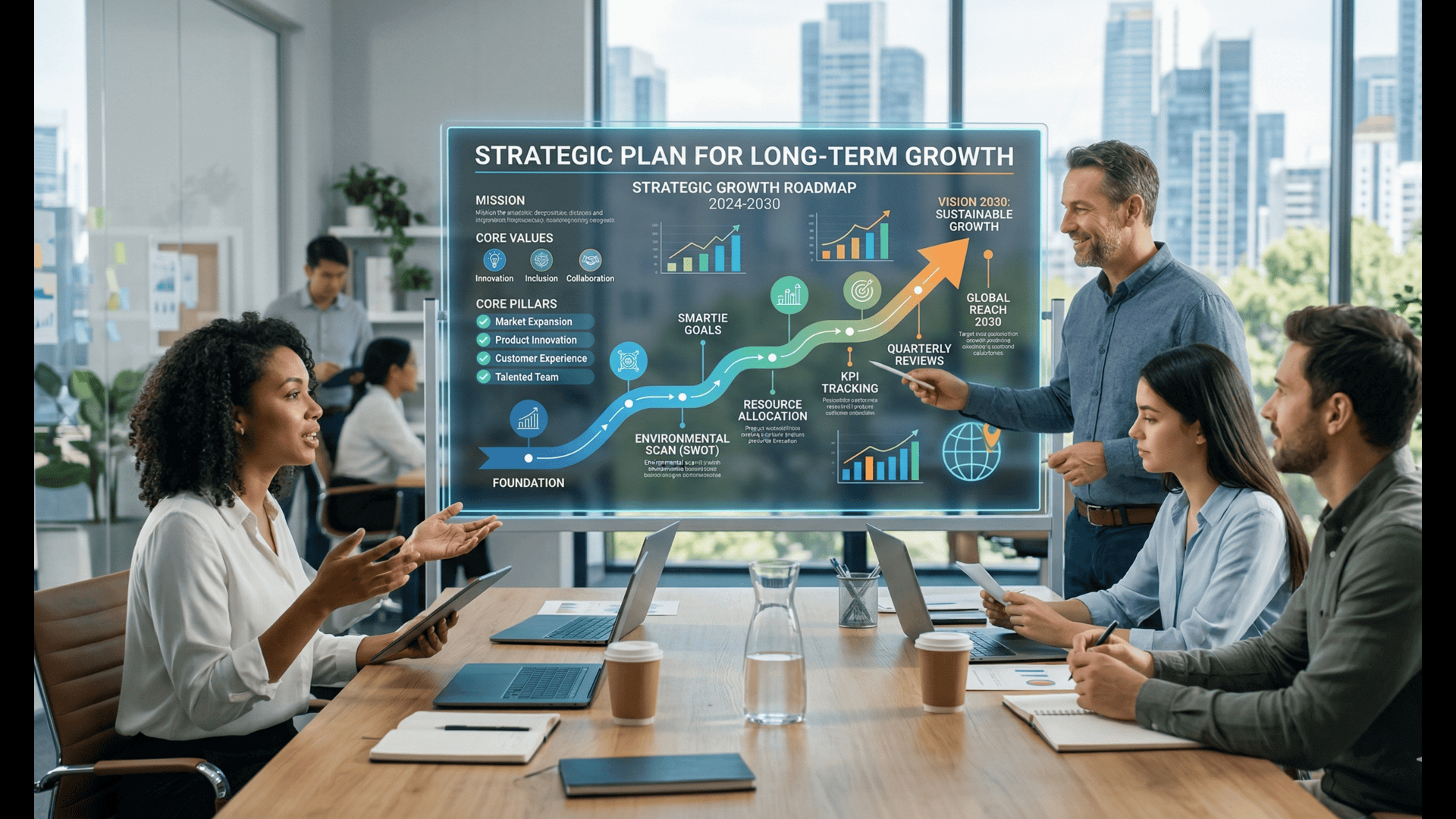
The foundation of long-term success for any business is a strong strategic plan. It is not just a simple document. It is a clear roadmap for the future of your business. Surviving in today’s rapidly changing business world without direction is nearly impossible. Strategic planning provides you with that essential direction.
Many entrepreneurs get so caught up in the daily grind that they forget to think about the future. As a result, the business gets stuck in one place and fails to achieve its desired growth. A proper plan pulls you out of the daily chaos and helps you focus on the bigger picture.
In this guide, we will discuss step by step how to create an effective strategic plan. If you want to take your business to new heights, this guide is for you. Let us get started and learn how the right strategy can lead your business on the path to long-term success.
What is Strategic Planning in Business?
Strategic planning is the process by which an organization defines its future goals and takes the necessary steps to achieve them. Simply put, it is a clear outline of where you are, where you want to go, and how you will get there.
It is a process that inspires all departments of a business to work toward a common goal. According to Investopedia’s definition of strategic management, it involves the continuous planning, monitoring, and assessment of all necessities an organization needs to meet its goals and objectives. Through this, the overall effectiveness of the business increases.
The Difference Between Strategy, Planning, and Execution
Although these three words are often used together, their meanings are quite different. Understanding the distinction between them is crucial.
Strategy is the broader concept or the path to reach your ultimate destination. It determines how you will survive in the competition and how you will stand out from the rest. It is a reflection of long-term thinking.
Planning is the list of specific steps or actions needed to put that strategy into effect. It breaks the strategy down into smaller, manageable parts. This is where you decide who will do what and when.
Execution is the act of starting the work based on the plan. Even the best strategy or plan can fail if it is not executed properly. This is the practical process of getting things done on the ground.
Core Benefits of Long-Term Strategic Planning
A strategic plan brings numerous benefits to a business. First, it guides the entire team toward a common goal. When everyone knows exactly what they need to achieve, the pace of work increases significantly.
Second, it helps with resource allocation. Ensuring the proper use of your time, money, and manpower is critical. It makes it possible to reduce unnecessary expenses.
Third, it helps mitigate risks. By thinking about the future, you can identify potential obstacles in advance. This makes it much easier to deal with unexpected problems when they arise.
Step 1: Define Your Vision, Mission, and Core Values
The first step in any plan is to clarify your identity and purpose. Your vision, mission, and values form the foundation of your business. Without these, no plan can be sustainable.
Creating a Clear Long-Term Vision
The vision is the future picture of your business. Where you want to see your business ten or twenty years from now is your vision. It should be highly inspirational and ambitious.
A good vision statement motivates employees and gives their work a greater purpose. It should be short and easy to remember. The vision ultimately points to your final destination.
Aligning the Mission with Business Objectives
The mission statement is a description of your current work. What you do, who you do it for, and how you do it are all expressed through the mission. It is the first practical step toward achieving your vision.
The mission should always be realistic. It is directly related to your daily operations. All the decisions and actions of your business need to align with your mission. This helps customers understand the core purpose of your brand.
Establishing Core Values that Guide Decisions
Core values are the principles that determine your business culture. They act as your organizational code of conduct. Concepts like honesty, innovation, or exceptional customer service fall under this category.
These values help your team members make the right decisions. When a difficult situation arises, these values act as a guiding light. They strengthen your brand identity and help build deep trust with your customers.
Step 2: Conduct a Detailed Business Analysis
Before you start planning, you need a clear understanding of your current position. A detailed analysis will help you understand the strengths and weaknesses of your business.
SWOT Analysis (Strengths, Weaknesses, Opportunities, Threats)
SWOT analysis is the most popular tool for strategic planning. It helps you evaluate both the internal and external conditions of your business comprehensively.
Strengths and weaknesses are internal factors of your business. For example, your skilled team might be your strength, while a lack of capital might be your weakness. Opportunities and threats are external factors, such as emerging market possibilities or aggressive new competitors.
This analysis helps you craft strategies that leverage your strengths while minimizing your weaknesses.
Market and Industry Analysis
Your business does not operate in a vacuum. Therefore, understanding the overall market and industry conditions is extremely important. You must analyze how customer demands are shifting over time.
Collect data on market size, growth rates, and emerging trends. Keep a close eye on how technological changes are impacting your industry. This analysis will help you prepare for the future market landscape.
Assessing the Competitive Landscape
Knowing your competitors deeply is essential. Find out what they are doing well and where they are falling short. Analyze their products, pricing models, and marketing strategies in detail.
Their weaknesses can easily create opportunities for you. Think about how you can provide better services or products than they do. This evaluation will help you build a unique competitive advantage.
Step 3: Set Long-Term Goals and Objectives
After completing the analysis, you must pinpoint your destination. Strategic planning cannot succeed without specific goals. Goals should be very clear and measurable.
Setting 3 to 5 Year Business Goals
Long-term goals are typically set for three to five years. They serve as the stepping stones to turning your grand vision into reality. Goals need to be highly realistic and achievable.
For example, a goal could be increasing market share by 20 percent over the next five years or expanding operations into three new countries. When goals are specific, everyone on the team understands exactly what they need to work on.
Breaking Down Goals into Measurable Objectives
It is crucial to break large goals down into small, measurable objectives. This makes it much easier to track your progress. Objectives should always follow the SMART framework (Specific, Measurable, Achievable, Relevant, Time-bound).
For instance, to increase market share, an objective for the first year could be acquiring 5,000 new customers. Once these smaller objectives are achieved, reaching the final goal becomes much simpler.
Aligning Goals with Market Trends
When setting goals, it is vital to keep current and future market trends in mind. If the market is becoming highly technology-driven, the use of technology should be reflected in your goals.
Align your goals with the changing tastes and demands of your customers. If the market is leaning toward eco-friendly products, you should incorporate sustainable initiatives into your long-term plan.
Step 4: Develop Strategic Initiatives
After setting your goals, you need to develop strategies on how to achieve them. This stage requires your creativity and business intelligence the most.
Identifying High-Impact Growth Strategies
Not all initiatives yield the same results. Therefore, identify the strategies that will have the most significant impact on your business. These are generally referred to as high-impact strategies.
Exploring new markets, improving product quality, or adopting new technologies can all be included here. These strategies will rapidly accelerate the growth of your business. You should focus most of your attention on these areas.
Prioritizing Results-Driven Projects
You might have many brilliant ideas on the table. However, it is impossible to execute all ideas at the exact same time. Therefore, prioritize projects based on their potential outcomes.
Start with the projects that will bring in the most profit at the lowest cost or those that will help achieve goals the fastest. Selecting the right projects while keeping resource limitations in mind is a massive part of strategic planning.
Balancing Innovation and Stability
Innovation is absolutely essential for long-term growth. However, taking on too much risk can destroy the stability of the business. So, while trying new things, you must also keep your current successful operations running smoothly.
Pay close attention to your primary sources of income. Invest in new markets or new products while keeping the core business fully secure. This balance will keep your business safe in the long run.
Step 5: Create an Effective Implementation Plan
Now it is time to turn your strategy into reality. No matter how good the plan is, it holds zero value without proper execution.
Steps to Translate Strategy into Action
Divide your overarching strategy into small, daily tasks or action items. There must be specific and clear instructions for every single task. Ensure that the tasks are very easy to understand.
For example, if your strategy is to boost digital marketing, the action items could be building a new website or running specific social media campaigns. These clear steps make the path to implementation much smoother.
Assigning Responsibilities and Deadlines
A major part of plan execution is the proper distribution of responsibilities. Assign a specific person to take charge of each task. This will ensure strict accountability across the board.
Along with that, set a specific deadline for every single task. Without a timeline, work almost never gets finished on schedule. Deadlines help the entire team work within a highly structured framework.
Allocating Resources Effectively
Proper allocation of budgets, personnel, and technology is required for execution. Make sure your team has enough resources available to complete their assigned work.
Cut down on unnecessary expenses and increase investments in critical areas. The correct use of resources makes the execution of the plan much faster and more accurate. According to an article published by Harvard Business Review, successful companies are extremely strategic about how they allocate their resources.
Step 6: Build a Performance Measurement System
Once the implementation begins, it is necessary to verify whether the plan is actually working. You must have an effective measurement system in place for this.
Defining Key Performance Indicators (KPIs)
Key Performance Indicators (KPIs) are the specific ways you measure your progress. Selecting the right KPIs that perfectly align with your goals is incredibly important.
For example, if your goal is to increase sales, monthly sales growth or customer acquisition cost could be your KPIs. The right metrics will clearly tell you whether you are on the right track or not.
Monitoring Progress Regularly
Merely setting KPIs is not enough at all. They require regular and consistent monitoring. Review the progress of your work through weekly or monthly meetings.
This routine check-in will help you understand in real time whether the plan is working. If you fall behind on a specific task, you will have the immediate opportunity to take corrective action.
Using Data for Decision Making
Making decisions based purely on guesswork can be highly damaging to a business. Always rely heavily on data and concrete information. Analyze the data you collect to determine your exact next steps.
Data will give you an accurate picture of customer behavior and the real state of the market. Decisions based on hard facts are always more successful and effective. This is a fundamental key to long-term growth.
Step 7: Aligning Teams and Leadership
An excellent strategic plan only succeeds when the entire organization works together flawlessly. Complete alignment between leadership and the team is mandatory.
Ensuring Organizational Alignment
Every single department in your organization needs to have a crystal clear understanding of the strategic plan. Marketing, sales, HR, and finance departments must all be steered toward the exact same goal.
Ensuring this alignment is the primary responsibility of leadership. Everyone must be made to understand why this specific plan is important and what their personal and institutional benefits are.
Improving Communication Across Departments
A severe lack of communication ruins many brilliant plans. The exchange of information between different departments must be simple, open, and fast. No department should ever work in total isolation.
Regular cross-departmental meetings and effective project management tools like Asana or Trello can be used. A strong communication system vastly increases the speed of work and eliminates costly misunderstandings.
Fostering a Culture of Accountability
Every member of the team must be held accountable for the direct results of their work. A culture of accountability builds a strong sense of responsibility among all employees. This is never about blaming anyone, but rather about improving the overall quality of work.
Recognize great work openly and create safe opportunities to learn from mistakes. When everyone carries out their duties correctly, the execution of the strategic plan becomes incredibly smooth.
Step 8: Risk Management and Scenario Planning
The future is always filled with uncertainty. Therefore, risk management should take up a massive portion of your long-term planning. Being prepared in advance for any situation is a very smart move.
Identifying Potential Risks Early
List all the specific risks that could negatively impact your business. These could be economic downturns, strict new government policies, natural disasters, or sudden cyber attacks.
If these risks can be identified early, the amount of potential damage can be reduced significantly. Sit down with your core team and openly discuss all possible negative scenarios.
Creating Contingency Plans
Create contingency plans or backup plans for all identified risks. In other words, always have a “Plan B” completely ready to go. You should decide in advance exactly what you will do if the main plan suddenly fails.
This alternative plan will help you stay perfectly calm during moments of crisis and make rapid decisions. It is extremely important for maintaining the overall stability of the business.
Preparing for Market Uncertainty
Market changes happen incredibly fast. New cutting-edge technology or aggressive moves by competitors can completely change the landscape at any moment. Therefore, you must keep your business operations highly flexible.
Build enough flexibility into your plan so that rapid changes can be made precisely as needed. The ability to adapt to sudden changes is what keeps a business alive in the long run.
Step 9: Continuous Review and Strategic Adjustment
Strategic planning is never a one-time job. It is a continuous, living process. Evaluating and refining the plan over time is absolutely necessary.
Conducting Regular Strategic Reviews
Review your entire strategic plan thoroughly on a quarterly or bi-annual basis. Accurately measure exactly how much of your designated goals have been achieved.
If a particular strategy is not yielding the expected results, discuss it openly. These review meetings provide the perfect direction for the future.
Adapting to Market Changes
Since the market is constantly changing, your core strategy should be adaptable as well. If there is a massive shift in customer demand, be sure to incorporate that shift into your plan immediately.
Do not rely too heavily on past successes. What worked flawlessly last year might not work at all this year. Always adapt yourself to new information and evolving situations.
Refining the Long-Term Plan
Never be afraid to change your primary goals or strategies if necessary. Treat your strategic plan as a completely living document.
Update the plan instantly when major new opportunities arise or severe new obstacles appear. This process of continuous refinement is exactly what will lead your business toward massive long-term growth.
Real-World Examples of Successful Strategic Planning
Many large organizations have achieved extraordinary success through proper strategic planning. Take Apple, for example. In the early 2000s, they adopted a strategy to transform themselves from a simple computer company into a massive mobile and digital lifestyle brand. The execution of this plan turned them into the most valuable company in the world.
Another great example is Netflix. They bravely pivoted away from their highly profitable DVD rental business to focus entirely on streaming services. It was a very bold strategic decision. They were able to accurately predict the future trends of the market ahead of time.
These examples clearly prove that with the right vision and planning, any business can elevate itself to entirely new heights.
Common Strategic Planning Mistakes (And How to Avoid Them)
Many organizations make a few common mistakes when crafting their strategic plans. The first major mistake is overcomplicating the plan. Setting far too many goals can easily confuse employees. Keep your targets limited, focused, and crystal clear.
The second mistake is creating a plan and then leaving it sitting in a file cabinet. It absolutely must be integrated into daily operations. Failing to pay adequate attention to actual implementation is the biggest cause of failure.
The third mistake is completely ignoring the opinions of employees. Those who work on the front lines hold highly valuable information. Accepting their feedback during the planning phase makes execution much easier.
Tools and Frameworks for Strategic Planning
There are several proven frameworks and tools available to formulate and manage strategic planning correctly. These make the entire workflow much more organized.
Balanced Scorecard
The Balanced Scorecard is an incredibly popular business framework. It evaluates the business strictly from four distinct perspectives. These are financial results, customer satisfaction, internal business processes, and learning and growth.
Instead of looking only at financial profits, it strongly emphasizes overall, holistic development. It is a highly effective measurement system for securing long-term success.
OKRs (Objectives and Key Results)
The OKR (Objectives and Key Results) method is utilized heavily by tech giants like Google and Intel. It is an extremely simple but incredibly powerful framework.
Here, one major Objective is set, and 3 to 5 measurable Key Results are established to achieve it. It brilliantly helps everyone in the organization maintain strict focus on highly specific goals.
PESTLE Analysis
PESTLE analysis is a vital tool for thoroughly evaluating the external environment. The acronym stands for Political, Economic, Social, Technological, Legal, and Environmental factors.
It is used to understand exactly how these six crucial elements might impact your business operations. PESTLE analysis is especially essential before entering entirely new markets or for conducting long-term risk evaluations.
Frequently Asked Questions About Strategic Planning
Many people have various questions regarding strategic planning. Below are the answers to some of the most common questions.
How often should a strategic plan be updated?
A strategic plan should be completely reviewed at least once a year. However, in fast-changing industries, quarterly reviews yield much better results. Minor adjustments need to be made regularly based on market conditions, technological changes, and internal performance. This keeps the plan completely relevant at all times.
What is the ideal timeframe for a long-term plan?
Typically, 3 to 5 years is considered the ideal timeframe for long-term business planning. In the technology or startup sectors, this timeframe might be shortened to 2 to 3 years. This is because these sectors evolve incredibly rapidly. However, the grand vision or ultimate goal can easily be set for 10 to 20 years into the future.
Who should be involved in strategic planning?
Primarily, top management or the leadership team leads the creation of this plan. However, to craft a truly successful plan, it is vital to take input from employees at all levels. Department heads, experienced staff, and even key customers can be included in some cases. This makes the final plan much more realistic, grounded, and effective.
What makes a strategic plan successful?
A strategic plan is successful only when it is perfectly clear, realistic, and highly measurable. The absolute most important factor is flawless execution. The unwavering commitment of the leadership team, the spontaneous participation of all employees, and a routine review process drive a plan toward ultimate success. Additionally, flexibility acts as a massive determining factor.
Conclusion: Translating Strategy into Sustainable Long-Term Growth
Strategic planning is never an optional task for long-term growth; it is absolutely essential. In this guide, we have discussed in detail all the steps, from setting a vision to execution and measurement. Every single step is deeply connected to the others.
Setting clear goals through proper analysis, taking highly effective initiatives, and executing them flawlessly can take your business to the pinnacle of success. Remember, a plan will never work if it remains confined to the pages of a document. You must make it an active part of your daily routine.
Involve everyone on your team deeply in this process. Make them realize that this plan is not just for the company, but it is deeply tied to the bright future of everyone involved. A highly united team is capable of turning any powerful plan into a stunning reality.
Final Thoughts: Building a Business That Lasts for Decades
At the end of the day, your goal is not just to make profits for one or two years. Your goal is to build a massive brand and a solid business that will survive and thrive for generations. Sustainable growth absolutely never happens in a single day. It requires immense patience, correct guidance, and relentless hard work.
Start actively working on your strategic plan today. Small, consistent steps will turn into massive success tomorrow. Keep yourself thoroughly updated with the times and turn the dream of taking your business to exciting new heights into a reality.