The Ultimate Guide to Meditation for Beginners
In today’s fast-paced, busy lives, our minds often become exhausted. Work pressure, personal problems, and the noise around us take away our peace of mind. In this situation, taking some time out for yourself is incredibly important.
Meditation can be an excellent way to regain that lost peace. Many people think meditation is a very difficult task. But truthfully, it is a very simple and natural process.
If you are completely new to meditation, this guide is just for you. Here we will discuss everything in simple terms, from the basic concepts of meditation to step-by-step practice methods.
What is Meditation?
Meditation is an ancient practice of deep focus and mind calming. It is a process through which we learn to become fully aware of the present moment around us.
Many people think meditation means completely clearing the mind of all thoughts. But this is a common misconception. The true purpose of meditation is not to force the mind to be empty. Rather, it is about simply observing the thoughts that come to your mind without any judgment.
In simple words, meditation is a way to get familiar with your own mind. It teaches us how to handle any situation calmly without being driven by emotions. Regular practice increases our brain’s functional capacity.
Why Start Practicing Meditation?
In modern life, almost all of us suffer from some form of mental stress. Throughout the day, our minds regret the past or worry about the future. We almost forget the joy of living in the present moment.
Meditation helps us return to the present moment. The main reason to start is to achieve mental peace. When you set aside time for yourself every day, a wonderful sense of self-confidence builds within you.
Moreover, for those who suffer from excessive anger or depression, meditation works like magic. It makes your thought process clearer. As a result, you can make better decisions in your personal and professional life.
Types of Meditation Practices for Beginners
There is no single rule for meditating. There are various types of meditation methods practiced around the world. As a beginner, it is important to find out which one works best for you. Below are a few popular methods discussed.
Mindfulness Meditation
Mindfulness meditation is currently the most popular method. It originates primarily from Buddhist philosophy. In this meditation, you have to pay full attention to the present moment around you.
When you do this meditation, various thoughts will come to your mind. You just have to observe those thoughts from a distance. ..You must not get entangled with them.
You can do this meditation while walking, eating, or sitting. It greatly helps increase awareness in daily life.
Breath Awareness Meditation
For beginners, this is probably the easiest and most effective method. In this method, your entire focus is kept solely on your own breathing.
Sit with your eyes closed and notice how the air enters your lungs through your nose and goes out again. Whenever your mind wanders off, calmly bring your focus back to the breath.
This helps calm your mind very quickly. Especially when you are very nervous or worried, this method comes in very handy.
Guided Meditation
Guided meditation is a method where you meditate by listening to someone else’s instructions. This is an excellent option for beginners.
Here, an instructor will tell you step by step what to do. They explain where to focus and how to relax the body.
You can do this type of meditation through YouTube videos, audio podcasts, or various apps. It helps break the monotony of meditating alone.
Body Scan Meditation
Body scan meditation is the practice of paying attention to every part of your body. It is usually done while lying down.
Starting from the toes, you slowly move your focus up to the crown of the head. You need to notice any pain or discomfort in any part of the body.
It is highly effective in curing sleep problems. Doing this meditation before bed relaxes the body quickly.
Loving-Kindness Meditation
Loving-kindness meditation is the practice of cultivating love and compassion towards oneself and others. It keeps our minds positive.
In this meditation, you first send some positive words or blessings to yourself. For example, “May I be happy, may I be at peace.”
Then gradually, you send these good wishes to your loved ones, acquaintances, and even people you dislike. It helps reduce anger and resentment.
How Meditation Works for the Mind and Body
Meditation is not just a spiritual matter. It is a scientifically proven process that brings positive changes to our brain and body.
The Role of Focus and Awareness
Our brain is constantly busy processing various information. During meditation, when we focus on a specific subject, the brain’s distractibility decreases.
As a result of regular meditation, the prefrontal cortex becomes stronger. This part is responsible for our decision-making and for holding attention.
This increases our concentration on daily tasks. We can do any work faster and more accurately.
How Meditation Reduces Mental Stress
When we are under mental stress, our body secretes a hormone called cortisol. High levels of this hormone in the body are harmful.
Meditation directly works on our nervous system. It calms the sympathetic nervous system and activates the parasympathetic nervous system.
As a result, our heart rate normalizes, blood pressure drops, and the body deeply relaxes. Cortisol levels also decrease significantly.
Impact on Focus and Mental Health
Meditation is like a natural medicine for our mental health. It helps us break out of the cycle of negative thoughts.
Practicing meditation long-term reduces the size of the amygdala in the brain. The amygdala is our center for fear and anxiety.
Therefore, those who meditate regularly do not easily suffer from depression. Their ability to control emotions is much higher.
Health Benefits of Meditation
The physical and mental benefits of meditation are endless. Medical science has also now acknowledged the various benefits of meditation. According to Harvard Medical School, meditation helps alleviate mental depression.
Reduces Stress and Anxiety
This is the most well-known benefit of meditation. Just a few minutes of meditation can remove your day’s fatigue and calm your mind.
For those suffering from excessive anxiety or anxiety disorders, meditation is a powerful tool. It also helps prevent panic attacks.
Increases Focus and Concentration
Nowadays, due to smartphones and social media, our attention span has decreased significantly. Meditation works to solve this problem.
It trains our brains to focus on one task for a long time. It is highly beneficial for students to increase concentration in their studies.
Aids in Better Sleep
Insomnia is a major problem today. Meditating before bed completely relaxes the body.
It wipes away all the day’s worries from our minds. As a result, sleep comes very quickly, and sleep quality also improves immensely.
Enhances Mental Well-being
Regular meditation creates a positive outlook on our lives. It increases our self-awareness.
We can better understand our strengths and weaknesses. This increases self-confidence, and we feel much happier.
May Aid Physical Health
Meditation takes care of not just the mind but also the body. It helps lower high blood pressure and reduces the risk of heart disease.
Besides, it strengthens our body’s immune system. Those who meditate regularly get sick relatively less often.
How to Start Practicing Meditation as a Beginner
Starting meditation can seem a bit challenging at first. But with the right preparation, it will easily become part of your daily life.
Choosing a Quiet Place
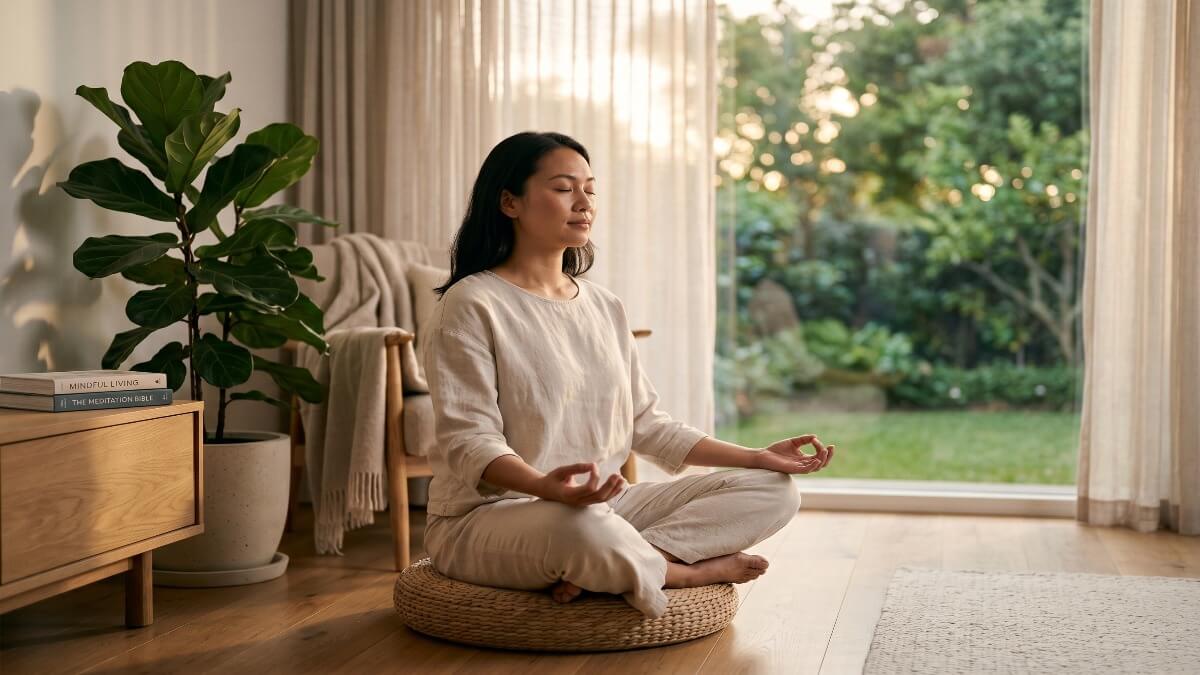
Choose a place for meditation where there is no noise. A specific corner of your room might be the best place.
Try to keep the place clean and tidy. Too many things around can distract the mind. If you want, you can arrange a small plant or soft lighting.
Finding a Comfortable Sitting Posture
There is no rule that you must sit in the lotus position for meditation. You can also meditate sitting on a chair, sofa, or bed.
The most important thing is to keep your spine straight. Keep your shoulders relaxed and rest your hands comfortably on your lap.
Setting a Time Limit (Start Small)
Do not try to meditate for 20 or 30 minutes right at the beginning. You might get frustrated.
Start with just 5 minutes every day at first. When these 5 minutes feel easy, gradually increase the duration to 10 or 15 minutes.
Focusing on Breath Awareness
After sitting for meditation, breathe normally. While inhaling, notice how your stomach expands.
Again, while exhaling, notice how your stomach contracts. There is no need to forcefully take deep breaths. Let the breathing continue just as your body wants.
Step-by-Step Meditation Guide for Beginners
If you want to start meditating today, follow these 5 simple steps below.
Step 1: Sit Comfortably and Settle Down
Sit in your designated quiet place. Set a timer so you do not have to keep looking at the clock. Gently close your eyes.
If there is any tension in any muscle of the body, relax it. Keep your facial, neck, and shoulder muscles completely in a comfortable state.
Step 2: Focus on Your Breathing
Now bring your full attention to your breathing. You can focus on the tip of the nose or the rise and fall of the stomach.
Feel the process of every inhale and exhale. If you want, you can also practice counting breaths mentally.
Step 3: Notice Thoughts Without Judgment
After a while, you will notice your mind has wandered to some other thought. This is very normal.
When you realize the mind has wandered, do not get annoyed with yourself. Just try to understand what you were thinking.
Step 4: Gently Bring the Focus Back to the Breath
After noticing the thoughts, very calmly bring the focus back to the breath. It is like a gentle process.
The mind will get distracted repeatedly, and you will have to bring the focus back repeatedly. This is essentially the core work of meditation.
Step 5: Finish Slowly and Reflect
When the timer goes off, do not open your eyes immediately. Sit with your eyes closed for a few more seconds.
Notice the sounds around you. Observe the sensations of the body. Then slowly open your eyes and smile gently.
Common Obstacles for Beginners and How to Overcome Them
It is normal to face some obstacles when starting something new. In the case of meditation, too, some common problems are seen.
Distracted Thoughts
The biggest complaint of beginners is “My mind just will not calm down.” Remember, calming the mind is not possible in a single day.
Distracted thoughts are not the enemy of meditation; they are part of the practice. Just as clouds float in the sky, let thoughts float in the sky of the mind. Do not try to force them to stop.
Restlessness and Discomfort
Sitting in one place continuously can be difficult for many. You might get back pain, or your legs might go to sleep.
If there is too much discomfort, you can move and adjust your sitting position. However, try to calmly observe these physical discomforts as well.
Lack of Consistency
After meditating enthusiastically for the first few days, many cannot maintain consistency. This is a big challenge.
To avoid this problem, make meditation a daily habit, like brushing your teeth. Try to sit at the same time every day.
Expectations vs. Reality
Many think that meditating will magically solve all problems overnight or lead to a magical experience.
If you have such unrealistic expectations, you will be disappointed. Meditation is a slow and continuous journey. It takes time to get its results.
Best Time and Duration for Meditation Practice
There is no fixed time for meditation. You can meditate whenever it is convenient for you.
However, the morning after waking up is considered the best time for meditation. At this time, the environment is quiet, and the mind is fresh.
Many also prefer to meditate before bed. It removes the day’s fatigue and helps you sleep well. As for duration, practicing for 10 to 15 minutes a day is sufficient.
Tips for Building a Daily Meditation Habit
Building any new habit requires discipline. You can use some strategies to maintain the meditation habit.
Link meditation with one of the tasks in your daily routine. For example, meditate for 5 minutes before having your morning tea.
You can set a reminder on your phone or in your calendar every day. Meditating together with another family member provides inspiration.
Guided Meditation vs. Self-Practice: Which is Better?
There is no specific answer to this question. It completely depends on your personal preference.
In guided meditation, a guide’s voice makes it easier to maintain focus. This is very helpful, especially for beginners.
On the other hand, in self-practice, you can go deep into your mind. This is the best way to spend time completely with yourself without any external noise. You can also mix and practice both if you want.
Meditation Apps and Tools for Beginners
Currently, technology has made our meditation practice much easier. Using various apps on smartphones, you can easily learn meditation.
Headspace, Calm, and Insight Timer are some of the most popular meditation apps in the world. These apps have special courses and guided meditations for beginners.
Additionally, you can use a comfortable meditation cushion or a yoga mat. Gentle instrumental music can also be played in the background.
Meditation Techniques for Stress and Anxiety Relief
There are some special meditation techniques for reducing mental stress that work very quickly. Institutions like the Mayo Clinic support these methods for dealing with stress.
Box Breathing Technique
This is a highly effective breathing exercise. It is also called four-square breathing.
Here you have to inhale for 4 seconds, hold the breath for 4 seconds, exhale for 4 seconds, and pause again for 4 seconds. Repeating this cycle a few times calms the mind.
5-Minute Mindfulness Practice
You can do this even during work breaks or sitting in the office. Close your eyes and try to listen to 5 sounds around you.
Feel the touch of air on your body. Be fully consciously aware of whatever is happening around you in the present moment.
Progressive Relaxation Method
This is essentially a method to relax muscles. Lying down or sitting, start from the toes and slowly tense each muscle, and then release it.
Focus on every part of the body this way. It works like magic, removing all physical fatigue and mental stress.
Meditation Safety and Misconceptions
Meditation is a completely safe practice. It has no harmful side effects.
Many think meditation is associated with a specific religion. This is a big misconception. Meditation is a universal practice that people of any background can do.
However, those who suffer from severe mental illnesses like schizophrenia or trauma should consult a specialist doctor before starting meditation.
How Long Does It Take to See Results?
The answer to this varies from person to person. You might feel a sense of mental peace on the very first day.
However, for long-term benefits of meditation, like memory enhancement or stress reduction, you have to be patient. Research shows that meditating every day for 8 weeks begins to bring positive changes to the brain.
The main point is, you must continue the regular practice. Meditating for a short time every day is much more effective than suddenly meditating for a long time on one day.
Frequently Asked Questions About Meditation
Beginners have many questions about meditation. Answers to some common questions are given below.
Do I need experience to start meditating?
Not at all. Anyone, at any age and in any condition, can start meditating.
No special qualifications or prior experience are required for this. You can start it with just the desire and some time.
Can meditation be a substitute for sleep?
Meditation gives deep rest to our body and mind, but it is never a substitute for a normal night’s sleep.
Getting 7 to 8 hours of sleep a day is essential for keeping the body healthy. However, meditation certainly helps improve your sleep quality.
What if I cannot stop thinking during meditation?
As mentioned earlier, stopping thoughts is not the goal of meditation. The human mind will naturally think.
Your job is just to notice those thoughts. Bringing the focus back to the breath repeatedly, without chasing thoughts, is the key to successful meditation.
Final Thoughts on Starting a Meditation Practice
Meditation is a wonderful journey that brings you closer to yourself. It is not something difficult, but rather a highly enjoyable experience.
Key Takeaways for Beginners
Give yourself time when starting meditation. Do not get frustrated if the mind is distracted for the first few days. Let your body and mind adapt to this new habit.
The most important thing is to be kind to yourself. Do not criticize yourself during meditation.
Building Consistency Over Perfection
Your meditation will not always be perfect. Some days the mind will be very calm, and on other days it might feel very restless.
Both are very normal. Sitting for meditation regularly every day is more important than meditating perfectly.
Making Meditation a Lifelong Habit
Meditation is not a temporary fix. It is a lifestyle that will help you stay healthy and calm throughout your life.
Sit in a quiet place for 5 minutes today and feel your breathing. That beautiful and peaceful world inside you is waiting for you. Best wishes for your meditation journey.