Chemical Reactions: Powering Your Body & Environment
Introduction
The world around us is a wonderful and dynamic place. Have you ever wondered how we get the energy to do our daily tasks? Or how a tiny seed grows into a massive tree? Chemistry is at the root of all these things.
Every single moment, countless chemical changes are happening around us and inside us without us even realizing it. These changes are essentially what keep us alive and maintain the balance of our environment. In today’s post, we will discuss how chemical reactions power our bodies and our environment.
Why Chemical Reactions Are Essential for Life
Life as we know it is basically a combination of countless complex processes. Everything from taking a breath to digesting food involves chemical changes. If these processes did not happen, it would be impossible for any living creature to survive.
Every cell in our body acts like a tiny factory. Various components are constantly being built up and broken down there. Through this cycle of building and breaking, we get the energy to walk, think, and work. Therefore, it is safe to say that these reactions are the greatest tools for sustaining life.
The Hidden Chemistry Behind Everything Around You
From brushing your teeth in the morning to turning on a light bulb at night, chemistry is hidden everywhere. When you make a cup of tea, the mixture formed by hot water and tea leaves is also the result of a chemical process.
Even rain falling from clouds in the sky or rust forming on an iron window grille are nature’s own chemical games. If we look closely at our surroundings, we will see that our entire life is bound by the rules of chemistry.
What Are Chemical Reactions?
Many of us have read this term in science books. But what does it actually mean in real life? Let us try to understand this concept in a very simple way.
A Simple Definition of Chemical Reactions
In simple terms, a chemical reaction is a process in which one or more substances change into a completely new substance. The properties or characteristics of this new substance are entirely different from the original substances.
For example, when we light a fire in a stove, wood burns, producing ash and smoke. Here, wood was the original substance, and ash is the new substance. The properties of wood and ash are not the same. This is fundamentally a chemical change. To learn more in detail, you can visit Wikipedia’s page on chemical reactions.
Reactants and Products Explained
There are two main parts to any reaction. The first is the “reactant” and the second is the “product.” The substances that participate in the reaction are called reactants.
The new substance formed by the reaction is called the product. For example, oxygen and hydrogen gas combine together to form water. Here, oxygen and hydrogen are the reactants, and water is the product.
Types of Chemical Reactions
There are thousands of different reactions in the world of science. However, they can be divided into a few main categories based on their nature. The four main types of reactions are discussed below.
Combination Reactions
Combination simply means joining together. When two or more substances combine to form a new, larger substance, it is called a combination reaction.
As an example, we can mention water again. Two hydrogen atoms and one oxygen atom combine to form a water molecule. This type of reaction is also widely used in industrial factories to produce plastics or polythene.
Decomposition Reactions
This is the exact opposite of the combination process. When a large or complex substance breaks down into multiple smaller and simpler substances, it is called a decomposition reaction.
Usually, outside heat, light, or electricity is required for this type of process. For instance, when limestone is subjected to intense heat, it breaks down into lime and carbon dioxide gas.
Displacement Reactions
Displacement means taking over someone else’s place. In this reaction, one element displaces another element from a compound and takes its place.
Imagine you leave an iron nail submerged in a blue copper sulfate solution. After a while, you will see a reddish-brown coating on the nail. Here, the iron has essentially displaced the copper and taken its place.
Combustion Reactions
Combustion means burning. When a substance burns in the presence of oxygen to produce heat and light, it is called a combustion reaction. This is a highly familiar process in our daily lives.
Lighting a gas stove, running a car engine, and even lighting a candle are excellent examples of combustion reactions. Without this reaction, our modern civilization could not run for a single moment.
Chemical Reactions in the Human Body
Our body is like an automated laboratory. Thousands of chemical changes are happening here constantly. Let us see how these work inside our bodies.
Digestion and the Breakdown of Food
We eat rice, fish, meat, or vegetables every day. But our bodies cannot absorb these foods directly. After eating, the food mixes with various acids and juices in our stomach and intestines.
These juices break down large food particles into very small, simple components. For example, carbohydrates are broken down into glucose. This breakdown process is entirely a chemical reaction.
Cellular Respiration and Energy Production
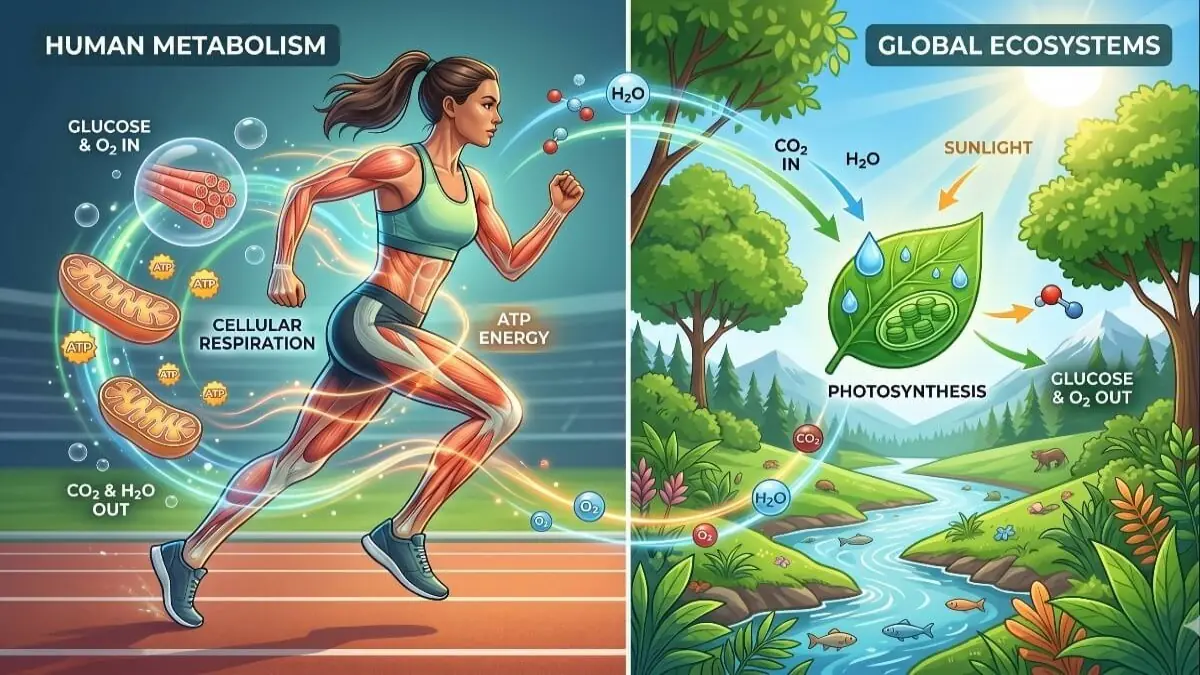
The glucose created after digesting food reaches every cell through our bloodstream. Then the oxygen we inhale burns the glucose inside the cells to produce energy.
This process is called cellular respiration. As a result, our body gets the energy to function, and a gas called carbon dioxide is produced as a byproduct, which we exhale. You can find some excellent lessons on cellular respiration in Khan Academy’s biology section.
Metabolism and Biological Processes
Metabolism is a general term for all the chemical processes happening inside the body. It helps in our body’s growth, cell repair, and body temperature regulation.
Old cells dying and new cells being created in our body are also part of metabolism. People with a high metabolic rate have more energy and do not get tired easily.
How Enzymes Control Chemical Reactions in the Body
The reactions inside the body naturally happen very slowly. A special type of protein works to speed up this process. Let us learn about them.
What Are Enzymes?
Enzymes are special types of proteins that multiply the speed of the chemical reactions inside our bodies. They are also known as biological catalysts.
An enzyme does not participate in the reaction itself or get used up; it helps the reaction proceed quickly. There are enzymes in our saliva, in our stomach, and in every cell of our body.
Why Enzymes Are Essential for Life
If we did not have enzymes in our bodies, it would take several years to digest a single dinner. If processes worked that slowly, no living creature could survive.
Enzymes help complete reactions in fractions of a second. Therefore, the role of enzymes in our healthy survival is truly indescribable.
Chemical Reactions in Everyday Life
Chemistry is not just found in books or laboratories. It is spread across every corner of our homes. Some familiar examples are given below.
Cooking Food and the Browning Reaction
Have you ever wondered why a beautiful aroma comes out, and the color turns brown when baking bread or frying onions? This happens due to a chemical process called the “Maillard reaction.”
This wonderful change occurs when amino acids and sugars in the food mix together under high heat. This enhances both the taste and smell of the food.
Cleaning Products and Household Chemistry
We use soap or detergent to wash clothes. These are basically chemical substances. One end of the soap molecules is attracted to water, and the other end is attracted to dirt or oil.
Because of this property, soap can remove dirt from our clothes. Similarly, floor cleaners, toilet cleaners, or dishwashing liquids all work according to the principles of chemical reactions.
Rusting of Metals
This is a very common sight. If a new iron object is left outside for a few days, a reddish coating forms over it. This is what we call rust.
When iron combines with oxygen and water vapor in the air, it creates iron oxide. This is a slow chemical reaction. Rust reduces the durability of iron.
Burning Fuel for Energy
When LPG gas or natural gas used for cooking in our homes is burned, methane or butane gas reacts with oxygen.
This produces a large amount of heat energy that we use to cook. Similarly, burning oil in generators or car engines also falls under this same type of chemical process.
Chemical Reactions in the Environment
Nature constantly uses chemistry to maintain its balance. Let us learn about a few of nature’s magical reactions.
Photosynthesis in Plants
The biggest reason life exists on Earth is photosynthesis. Plants create their own food using sunlight, carbon dioxide taken from the air, and water taken from the soil.
In this process, plants produce glucose (sugar) and release a large amount of oxygen into the air. Other animals, including us, survive by inhaling this oxygen.
The Carbon Cycle and Climate Balance
The exchange of carbon dioxide in nature happens through a cycle. We release carbon when we exhale, and plants absorb it. Carbon is also released when dead animals or plants rot and mix with the soil.
This entire cycle runs through various chemical reactions. When the balance of this cycle is disrupted, problems such as climate change and global warming arise.
Chemical Processes of Water and Soil
Various mineral elements in the soil mix with rainwater to become usable for plants. This is also a type of chemical change.
In addition, ocean water is constantly absorbing carbon dioxide from the air. This creates a kind of mild acid in the water that is closely linked to the life cycles of marine animals.
Energy Changes in Chemical Reactions
Some form of energy change always occurs when any reaction takes place. Based on this energy change, reactions can be divided into two categories.
Exothermic vs. Endothermic Reactions
Reactions that produce a lot of heat and warm the surroundings are called exothermic reactions. Lighting a fire is the best example of this.
On the other hand, reactions in which heat is absorbed from the surroundings and the surroundings become cold are called endothermic reactions. For example, mixing glucose or urea fertilizer in water makes the glass cold.
How Energy is Released or Absorbed
There is a kind of chemical bond between the molecules inside substances. Energy is required to break these bonds, and energy is released when new bonds are formed.
When more energy is released in creating new bonds than is used in breaking old ones, we feel heat. If the opposite happens, we feel our surroundings become cold.
Real-Life Examples of Chemical Reactions
There are many tasks in our daily lives that we perform without noticing the science behind them.
Burning Wood or Gas
The wood we burn to warm ourselves on a winter night is a wonderful chemical process. The cellulose in the wood mixes with the oxygen in the air to produce carbon dioxide, water vapor, and heat.
Similarly, methane gas in the kitchen gas stove burns when it comes into contact with oxygen, producing a blue flame. Our daily life would come to a halt without these.
Digesting Food in Your Stomach
There is strong hydrochloric acid in the stomach. It helps break down the food we eat and kills harmful bacteria that come with it.
An enzyme called pepsin breaks down the protein in food. This entire process is a powerful chemical factory inside our body.
Baking a Cake and Cooking Bread
A chemical change occurs when baking powder or yeast is used to make cakes or bread. Baking powder melts at high temperatures and produces carbon dioxide gas.
As this gas escapes through the dough, it creates tiny holes. As a result, the cake or bread swells up and becomes soft.
Generating Electricity with Batteries
How is the mobile phone in your hand running? The lithium-ion battery inside it is a chemical chamber.
The chemical energy stored in the battery is converted into electrical energy through chemical reactions. When we charge the phone, the exact opposite occurs: energy is stored again.
Chemical Reactions in Technology
Chemistry makes a massive contribution to modern technology and industrialization. Let us look at its use in a few areas of technology.
Batteries and Energy Storage Systems
From electric cars to solar power panels, high-quality batteries are needed everywhere. Scientists are constantly looking for new types of chemical components to build even more powerful batteries.
These storage systems use chemical reactions to store energy for long periods.
Industrial Manufacturing Processes
Everything from cement, glass, plastics, and paints to agricultural fertilizers is produced through chemical processes in industrial factories.
Raw materials obtained from nature are transformed into usable products for us through various chemical processes. These industries are the main driving forces of the modern economy.
Medicine and Drug Development
The reason we have such easy access to treatments for various diseases today is due to the tireless efforts of chemical scientists.
Everything from a paracetamol tablet to an expensive cancer drug is a mixture of chemical compounds. New life-saving drugs are discovered through various chemical experiments in laboratories.
The Role of Chemistry in Sustainable Development
There is a global emphasis right now on protecting the environment. Chemical science is also working towards this sustainable future.
Green Chemistry and Eco-Friendly Solutions
Green chemistry is a branch of chemistry that attempts to reduce the use of substances harmful to the environment.
Scientists are developing methods that produce less harmful waste during factory manufacturing, ensuring maximum utilization of raw materials.
Reducing Pollution Through Chemical Innovation
Everything from technology that absorbs carbon dioxide from the air to the creation of biodegradable plastics as an alternative to polythene is a product of chemical innovation.
These technologies are helping to reduce pollution around us. Methods for chemically purifying polluted water to make it drinkable again are also increasingly popular.
Common Misconceptions About Chemical Reactions
We often hold unnecessary fears or misconceptions about chemistry. Let us clear those up.
Not All Reactions Are Dangerous or Explosive
Many people think chemical reactions strictly mean explosions or smoke in a laboratory. It is often shown this way in movies or on television.
But in reality, most reactions are very slow and peaceful. Food digesting in your body or tree leaves turning yellow are also chemical reactions, which are not dangerous at all.
Chemical Changes vs. Physical Changes
Ice melting into water or water boiling into steam is not a chemical change. These are called physical changes. This is because ice, water, and steam are all essentially the same substance (H2O).
A chemical change will only occur when the internal structure of a substance completely changes to create something new. Making yogurt from milk is a good example.
Why Chemical Reactions Matter in Daily Life
Coming to this stage of our discussion, we can safely say that we cannot go a single day without chemistry.
Supporting Life and Biological Functions
We are breathing, eating, working, and even sleeping at night. Chemical coordination in the body is needed for every task to be completed smoothly.
Even our thoughts and feelings are influenced by specific chemical substances in the brain. These are called neurotransmitters.
Powering Modern Technology and Industry
All the gadgets, vehicles, and infrastructure behind our comfortable modern life depend on chemistry.
By creating new and sustainable materials, chemical engineering is constantly pushing our civilization forward.
The Future of Chemical Science
New branches of chemical science are opening up to make the future world more beautiful and habitable.
Advances in Biotechnology
Biotechnology has been built on the integration of chemistry and biology. Through this, high-yielding crops are being created by making genetic changes.
The role of biotechnology is also increasing day by day in creating artificial organs or treating complex diseases.
Clean Energy and Sustainable Chemistry
Fossil fuel reserves are running out. That is why scientists are working on clean energy sources such as hydrogen fuel cells and advanced solar panels.
In the future, we might see chemical technologies that meet our energy needs without harming the environment.
Frequently Asked Questions (FAQs)
What is a chemical reaction in simple words?
In simple terms, a chemical reaction is an event in which old substances mix or break down to create an entirely new substance with new properties. Examples include iron rusting or milk turning into yogurt.
How do chemical reactions happen in the body?
Chemical reactions in the body usually happen inside the cells. The food we eat and the oxygen we breathe react inside the cells with the help of enzymes to produce the energy we need to work.
What are examples of chemical reactions in daily life?
There are many examples in daily life. Notable ones include cooking with gas on a stove, cleaning dirt with laundry soap, running a clock or a remote with batteries, and making bread or cakes rise.
Why are chemical reactions important for the living world?
The fundamental processes of survival in the living world are photosynthesis and respiration. Plants make their own food, and animals produce energy through chemical reactions. It is impossible to sustain life on Earth without them.
What is the difference between physical and chemical changes?
In a physical change, only the outer shape or state of a substance changes, but nothing new is created. Ice melting into water is an example. But in a chemical change, a completely new substance is created, like paper burning to ashes.
Conclusion
The world of chemistry is as vast as it is fascinating. Through this article, we have tried to explain how the play of tiny atoms and molecules controls our massive planet.
Key Lessons on Chemical Reactions in Life and Nature
We have learned that chemical reactions are not just a matter for the laboratory. They are deeply connected to our breathing, our digestion, and every element of our environment. Plants, animals, and inanimate objects are all dependent on these rules.
Understanding the Chemistry That Drives Everything Around You
When you start to find science in the ordinary things around you, the world will seem even more beautiful. Hopefully, this article has helped you recognize and understand the hidden chemistry in your surroundings in a new way. May your curiosity about science remain alive, and may this joyful journey of learning continue.