AI vs Human Intelligence: Knowledge & the Path to the Future
Introduction to AI and Human Intelligence
In today’s digital age, technology has entered every aspect of our lives. From the moment you wake up in the morning until you go to sleep at night, we rely on technology in countless ways. Among all these advancements, the most discussed and groundbreaking topic is artificial intelligence, or AI. Nowadays, “AI vs Human Intelligence” is a regular topic of discussion in newspapers, on social media, and in casual conversations. Many wonder if AI will completely take over human roles. Or will it simply serve as a helpful tool for our daily tasks?
In this blog post, we will explore these two distinct yet incredibly powerful types of intelligence in depth. We will look at how AI operates at unimaginable speeds through its mathematical and data-driven capabilities, and how human intelligence makes the world a better place through emotion, creativity, and common sense. Our main goal is to prove that AI and human intelligence are not competitors; rather, they complement each other. When these two forces work together, we move towards a future where knowledge, innovation, and collaboration have no boundaries. Let us dive deep into this fascinating and timely topic.
Understanding Artificial Intelligence in the Modern World
Artificial intelligence is not a magic wand; it is essentially an extraordinary combination of computer science and mathematics. Simply put, AI is a technology that enables machines or computers to think and make decisions like humans. In the modern world, AI is no longer limited to robots. It is integrated into our smartphone voice assistants, website chatbots, and even the algorithms that recommend what we should buy online. According to the Stanford University AI Index report, AI technology is now an integral part of daily life.
In the modern world, AI analyzes massive amounts of data. For example, when you build a website and optimize its SEO, AI tools can analyze thousands of search results in moments to give you ideas for the best keywords or meta descriptions. Even modern web hosting and security networks like Cloudflare use AI to detect cyberattacks and improve website speed. This vast potential of AI has not only made our work easier but has also multiplied its quality. However, AI cannot do anything on its own. Its effectiveness depends entirely on the instructions and data provided by humans.
What is Human Intelligence?
Human intelligence is a wonderful marvel of nature. It is not limited to memorizing facts or solving mathematical equations. Human intelligence is the ability to understand situations, the curiosity to learn new things, and an innate instinct to adapt to the surrounding environment. The human brain contains billions of neurons that control our thoughts, memories, and emotions. When we face a problem, we do not rely solely on logic. Our past experiences, emotions, and sense of morality also play a crucial role in making that decision.
One of the main characteristics of human intelligence is its flexibility. We can make large, complex decisions based on very little information, which is almost impossible for a machine to do. For instance, when a person visits a new city, they can quickly grasp the local people’s behavior, language, and culture. Additionally, empathy and creativity are deeply intertwined with human intelligence. We can write poetry, paint pictures, and feel the pain of others. These are the qualities that make human intelligence fundamentally different from artificial intelligence.
Artificial Intelligence vs Human Intelligence: Core Differences Explained
When comparing the thought processes of AI and humans, several fundamental differences stand out. These differences are discussed in detail below.
Learning and Adaptability
Humans can easily adapt to new environments. When we are young, we learn many things just by looking at a few examples. This is called cognitive flexibility. On the other hand, teaching an AI requires feeding it thousands or millions of examples and data points. A machine learning model needs to see thousands of pictures of cats to recognize one, but a human child can identify a cat after seeing just one or two. However, once an AI learns something, it never forgets and can perform the same task repeatedly with perfect accuracy.
Creativity and Innovation
Creativity is an exclusive human right. Humans can generate new ideas from scratch. When an author writes a novel, their imagination has no limits. Although AI can currently draw pictures or write poetry, these are primarily based on pre-existing data. AI can combine different pieces of information to create something new, but it lacks the true originality or “out of the box” thinking of a human. AI creativity is basically an advanced form of pattern recognition.
Emotional Intelligence and Empathy
Emotions and empathy are completely beyond the reach of AI. A human can understand another person’s state of mind by reading their eyes, body language, and tone of voice. This empathy is absolutely essential in fields such as healthcare and customer service. An AI chatbot might be able to give you the correct answer to your question, but it can never feel your frustration or joy. Because of this lack of emotional intelligence, AI cannot fully replace humans.
Problem-Solving Abilities
When solving problems, AI and humans use different methods. AI views any problem as a mathematical equation and finds the fastest possible solution. It is phenomenal at solving problems within a specific parameter. Conversely, humans use logic and common sense to solve problems. If an unexpected situation arises for which the AI has no data, the system can become confused. But humans can use their presence of mind to handle those unexpected scenarios.
Memory and Data Processing
AI is light-years ahead of humans in data retention and processing. A supercomputer or a cloud server can analyze trillions of bytes of data in an instant, something the human brain cannot do. AI memory is permanent and accurate. Human memory, on the other hand, is often variable and influenced by emotions. We sometimes forget important things, but an AI system never forgets the information stored in its memory.
Decision Making and Judgment
When a human makes a decision, they do not just calculate profit and loss. Their decisions are guided by morality, social values, and considerations of long-term impacts. AI, however, makes decisions solely based on its algorithms and the data provided. If the AI’s data is biased, its decisions will also be biased. Therefore, in critical areas such as legal judgments or complex medical decisions, human judgment is indispensable.
How Artificial Intelligence Works
To understand how AI works, it is necessary to have a basic understanding of its technical internals. AI is essentially a combination of several complex technologies.
Machine Learning and Deep Learning
Machine learning is a branch of AI in which computers are trained to learn from data rather than being directly programmed. You provide it with massive amounts of data, and it finds patterns within that data on its own. Deep learning is an even more advanced form of machine learning, modeled after the neural networks of the human brain. It is used to perform highly complex tasks, such as autonomous driving or voice recognition.
Natural Language Processing (NLP)
NLP, or Natural Language Processing, is the part of AI that helps computers understand, analyze, and generate human language. Tools like ChatGPT can talk to us so naturally because they use NLP. It analyzes a sentence’s grammar, meaning, and context to provide an appropriate answer. It has brought a revolutionary change in content creation, translation, and customer service.
Neural Networks and Cognitive Computing
Artificial neural networks are built to mimic the functioning of the human brain. Countless artificial neurons are arranged in layers to exchange information. Through cognitive computing, computers attempt to think, understand language, and solve complex problems, just as humans do. Together, these technologies have given AI its incredible modern form. To learn more in detail, you can read the IBM Cognitive Computing Guide.
Strengths of Artificial Intelligence
Artificial intelligence possesses some extraordinary strengths that are fundamentally changing the world today.
Speed and Efficiency
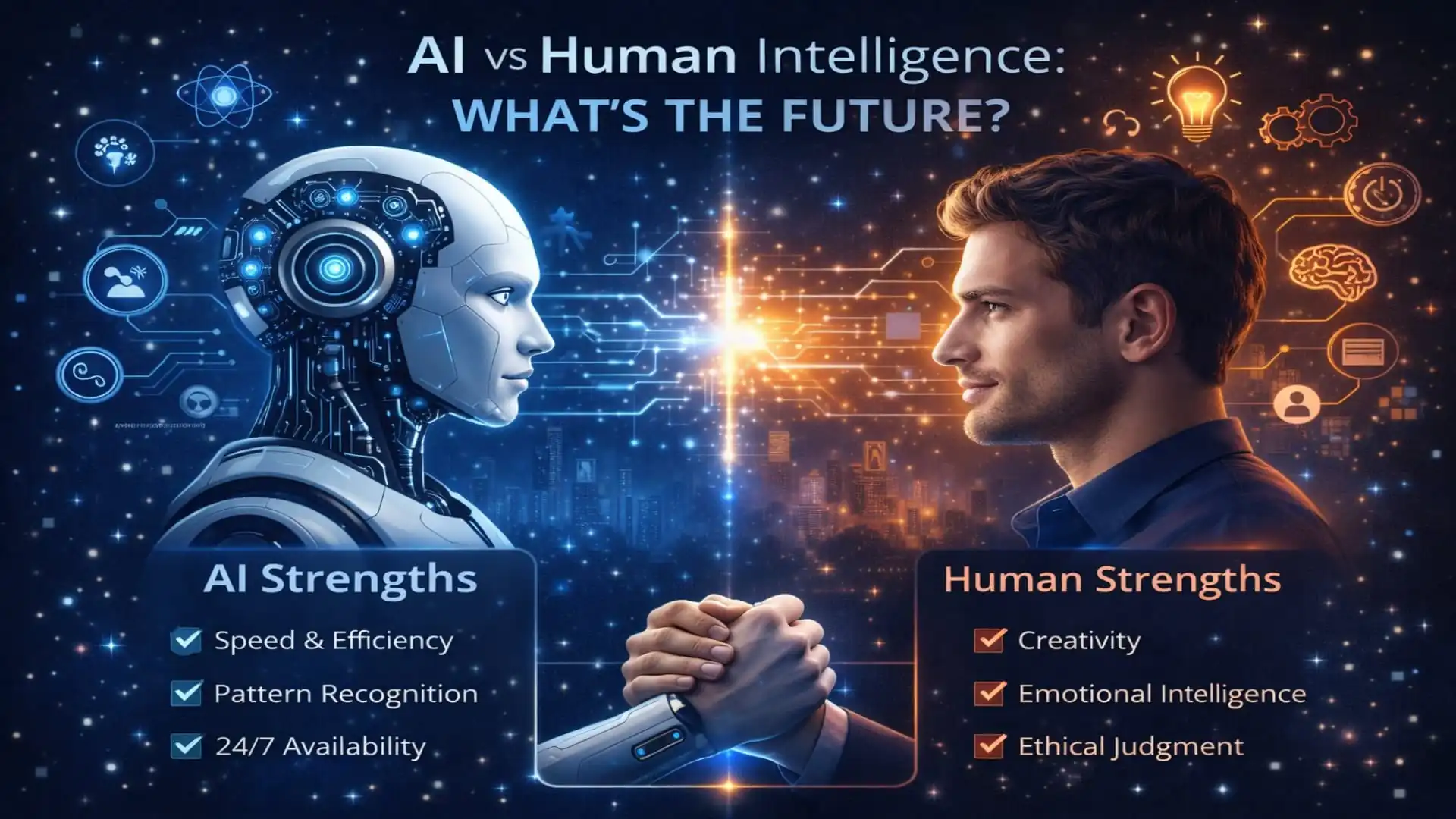
AI can work millions of times faster than humans. Mathematical calculations that would take a human years to complete can be solved by an AI system in seconds. Because of this speed, AI is widely used in space research, weather forecasting, and stock market analysis.
Automation and Repetitive Tasks
Doing the same task over and over again causes human fatigue and increases the chances of errors. But AI can perform the same task flawlessly 24 hours a day without any exhaustion. Tasks like manufacturing products in factories, backing up website data, or automating email are highly efficient when handled by AI.
Big Data Analysis
Data is the most valuable asset today. However, humans can’t analyze the millions of gigabytes of data generated every day. AI can extract critical insights or patterns from this massive wealth of information through big data analytics. This is extremely effective in everything from business decision-making to scientific research.
Accuracy and Predictive Insights
Given the right algorithms and good data, AI’s accuracy can approach 100%. Moreover, AI is unparalleled in predicting future trends by analyzing past data. In healthcare, AI can easily predict whether a patient is likely to develop a specific disease by analyzing their previous medical records.
Strengths of Human Intelligence
No matter how advanced AI becomes, humans have unique strengths that machines will never match.
Critical Thinking and Common Sense
Humans can judge any situation from a critical perspective. We can understand the truth, context, and underlying meaning of any information. Even a child has common sense that the world’s most advanced AI lacks. We know that the street gets wet when it rains; we do not need an algorithm for that.
Emotional Perception
The ability to understand others’ feelings and react accordingly is one of humanity’s greatest traits. Joy, sorrow, anger, affection; these are what make humans alive. This emotional perception is crucial in the workplace for leadership, motivation, or teamwork.
Ethical and Moral Reasoning
Only humans can differentiate between right and wrong. We have certain rules and moral standards in our society that we follow. When making a decision, we judge it from a moral standpoint to see whether it will harm anyone. AI has no morality of its own; it merely follows the instructions given to it.
Imagination and Creativity
Humans can dream and forge new paths to turn those dreams into reality. Einstein’s theory of relativity or Shakespeare’s literary works are not the products of data analysis; they are the result of infinite human imagination. This limitless power of creativity is what makes humans the greatest beings on earth.
AI and Human Collaboration in the Workplace
The relationship between AI and humans in the workplace should be viewed as a partnership rather than a competition. AI is not here to take our jobs; rather, it is here to make our work easier and more productive. When a web developer writes code, AI can point out coding errors or help write code faster. This saves the developer time, allowing them to focus more on creative tasks like website design or user experience.
Similarly, a content creator can use AI tools to gather information quickly, then add their own creativity and experience to enrich the content. When a human’s creative vision is combined with AI’s high-speed data-processing capabilities, the quality of any work increases manifold.
How Artificial Intelligence is Transforming Industries Worldwide
Every major industry worldwide is now being transformed by AI technology.
- Healthcare: AI algorithms are being used to analyze X-ray or MRI reports incredibly fast and accurately. AI is making unimaginable contributions to the discovery of new drugs and to complex research in nutritional science.
- Education: Based on students’ intelligence and learning speed, AI is creating personalized learning methods.
- Finance and Banking: The banking sector has become heavily reliant on AI for fraud detection, risk management, and customer service.
- Technology and Web Management: Platforms like Cloudflare are using state-of-the-art AI to ensure the security of major websites and handle massive traffic.
Can Artificial Intelligence Replace Human Intelligence?
This is the most debated question of our time. The simple answer is “No.” AI can do much better than humans in certain tasks, especially those that are data-driven and repetitive. But in tasks that require empathy, creativity, common sense, and complex decision-making, humans are unparalleled. AI is merely a tool. Just as an advanced calculator did not eliminate the need for mathematicians, AI will not eliminate the need for humans. Instead, those who know how to use AI will advance much further in their careers.
The Future of Human-AI Collaboration
The future world will be a wonderful example of synergy between humans and machines. We are moving towards a time when AI will work as our colleague. In complex scientific research, such as astronomy or quantum physics, AI will analyze massive datasets, and scientists will discover new theories from them. In this collaborative environment, the human role will be to provide direction and to use the results ethically and creatively.
Ethical Concerns in AI Development
With the widespread use of AI, some serious ethical questions have also emerged. The biggest concern is data privacy. Massive amounts of personal data are used to run AI models, making it absolutely crucial to keep personal information secure. Currently, work is underway on advanced technologies such as Zero-Knowledge Proofs and Fully Homomorphic Encryption, enabling AI to perform its tasks while keeping data completely confidential. Additionally, eliminating bias in AI algorithms is a major challenge, as it is essential to ensuring they treat all people equally and neutrally.
Risks and Obstacles of Artificial Intelligence
Like any new technology, AI also carries certain risks. Sometimes AI presents completely false information with absolute confidence, which is known as AI hallucination. Over-reliance on this technology can diminish human independent thinking and problem-solving abilities. Furthermore, cybercriminals can use advanced AI to launch more complex cyber attacks. Therefore, ensuring the correct and controlled use of AI is of utmost importance.
AI in Education, Healthcare, and Business
The impact of AI is most visible in these three sectors. In the education sector, AI chatbots are helping students with their studies at any time of the day. ..In healthcare, it is used to predict complex diseases and help doctors choose the right treatment methods.In business, AI is automating market analysis, customer segmentation, and inventory management to reduce costs and increase profits. Those who work with health, science, and nutrition blogs can easily use AI to quickly analyze reliable research papers and present the findings to readers in simple language.
The Role of Humans in an AI-Driven Future
In the future, when many basic tasks become automated, the human role will primarily be supervision and innovation. Humans will need to focus more on soft skills and human-centric abilities, such as leadership, communication, and emotional intelligence. Our main job will be to design AI systems effectively, ensure their ethical use, and develop new concepts beyond the reach of machines.
How AI and Humans Can Work Together Effectively
To ensure effective collaboration between AI and humans, certain steps are necessary:
- Training and Awareness: Employees must be trained on how to use AI tools properly.
- Defining Clear Boundaries: It must be clearly defined which tasks will be done by humans and which will be handled by AI.
- Ethical Guidelines: Strict privacy policies and ethical guidelines must be followed when using AI.
- Continuous Evaluation: AI output must be regularly verified by humans to ensure it is free of errors and biases.
Future Trends in Cognitive Technology
The AI of the future will be even more advanced and secure. The use of Edge Computing and Decentralized AI will increase, enabling faster, safer data processing. The interface between humans and machines will become easier; perhaps in the future, we will be able to control computers solely with brainwaves. Keeping oneself updated regarding this massive technological progress is the need of the hour. You can learn about the latest AI advancements from reliable sources like the MIT Technology Review.
Common Misconceptions About AI and Human Intelligence
Many people think AI can think like a human or have its own emotions. This is completely false. AI works solely based on mathematics and data. Another misconception is that AI will destroy the world on its own (like in the movie Terminator). In reality, AI has no personal motives or desires. It simply operates according to the programs created by humans.
Frequently Asked Questions About AI vs Human Intelligence
Is AI smarter than humans?
No, AI is not smarter than humans. It is only faster and more accurate than humans in specific tasks, such as massive data analysis or mathematical calculations. But in terms of overall intelligence, common sense, and creativity, AI is far behind humans.
Can AI think like a human?
AI does not think like a human. It provides answers by identifying patterns using its algorithms and predefined data. AI lacks human emotions, consciousness, or the ability to think independently.
What can humans do better than AI?
Humans are exceptionally better than AI at expressing empathy, handling complex and unexpected situations, making ethical decisions, and creating entirely new and creative ideas. In the fields of art, literature, and human connection, there is no alternative to humans.
Will AI completely take over human jobs?
It will not completely take them over, but it will change the nature of work. Repetitive, routine tasks will be automated by AI. In exchange, new types of employment will be created that require AI management and human skills.
How can humans benefit from AI?
Humans can use AI to make their daily tasks easier and faster. Through new discoveries in medical science, business growth, the addition of new dimensions to education, and complex data analysis, AI can significantly improve the quality of human life.
Conclusion: Balancing Innovation and Humanity in the Era of AI
In conclusion, “AI vs Human Intelligence” is not a battle; it is the dawn of a new era. Artificial intelligence is an extraordinary creation of human intelligence itself. If we can combine the speed and accuracy of AI with human creativity and emotion, we can build a much more prosperous and secure future. In this technological journey, we must remember that AI was created to help us, not to control us. Maintaining the right balance between humanity and innovation will be our greatest success in the days to come.