
Are You Studying Wrong? 5 Mistakes & Solutions
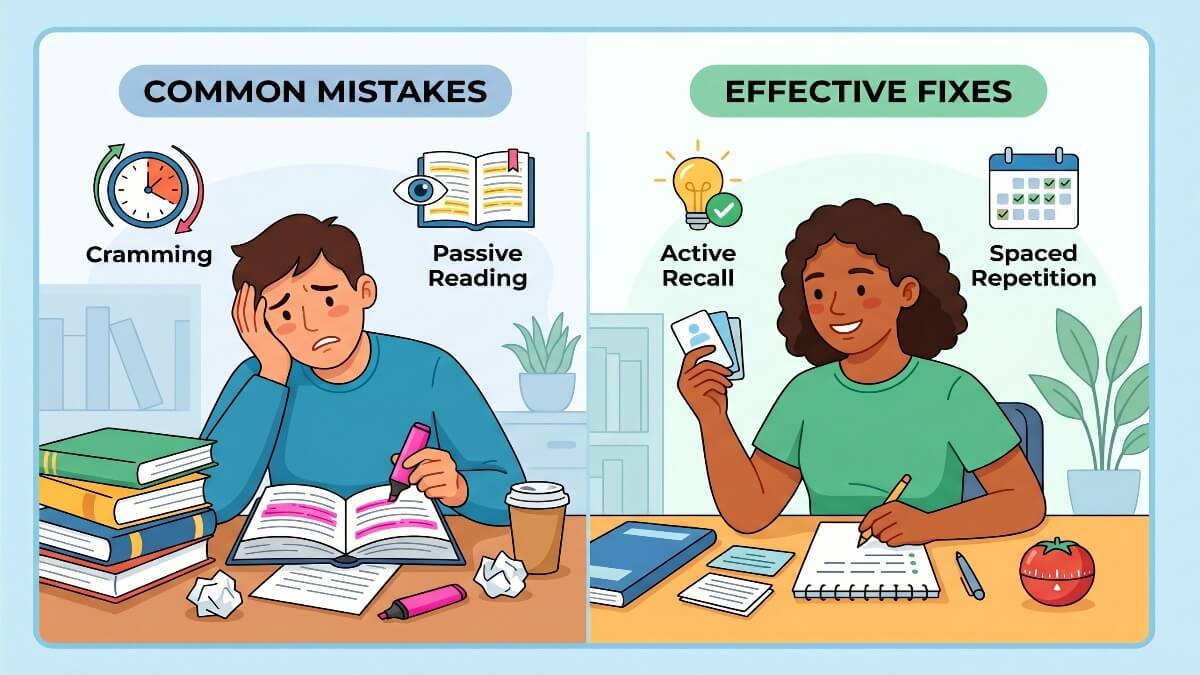
We are all familiar with this situation. You have spent days sitting in front of your books before an exam. You have read every chapter and made countless notes. However, you feel disappointed after receiving your test results. Why did you not get the results you wanted despite working so hard? This question frustrates many students.
Truthfully, simply sitting with a book for hours does not guarantee good results. We often study using the wrong methods without even realizing it. We tend to think that studying for long periods is the main key to success. Science and psychology tell us a different story. When it comes to learning, quality is much more important than quantity.
Working hard is commendable, but it is not always effective. If you try to cut down a tree using the wrong tools, you will waste a lot of time and energy. The exact same concept applies to studying. Without the right methods and strategies, all your hard work can go to waste. In this article, we will discuss 5 common mistakes that are slowing down your learning progress. We will also learn how to correct these mistakes using scientifically proven methods.
The Difference Between Effective and Ineffective Study Habits
There is a huge difference between effective and ineffective studying. Ineffective studying is a process in which you absorb information passively. For example, repeatedly reading a textbook or passively listening to a teacher’s lecture. Your brain does not work very hard during this process. As a result, the information quickly fades from your memory.
On the other hand, effective studying is an active process. Here, you engage directly with the information. You ask questions and try to explain concepts in your own words. You challenge your brain during effective studying. Information learned this way lasts longer and is easier to remember in the exam hall. Your goal should be to abandon ineffective habits and adopt active learning strategies.
How Small Mistakes Can Harm Your Studies
Small mistakes often do not seem very harmful to us at first glance. Over time, these mistakes have a massive impact. Let us say you are constantly checking your mobile phone while studying. Every single notification destroys your concentration. You might think you only looked at your phone for a few seconds. However, your brain has to spend a significant amount of time getting back to its previous level of focus.
Minor interruptions like this slow down your reading speed. Small decisions, like getting inadequate sleep or studying at the wrong times, also reduce your retention capacity. This might not be a big problem for a day or two, but it can severely degrade your results in the long run. Therefore, identifying and correcting these small mistakes is absolutely essential.
How to Identify if Your Study Method is Working
It is necessary to evaluate your current situation before starting a new method. Is your current study pattern actually helping you? Or is it just wasting your time? Knowing the answer to this question is crucial for your success. There are several simple ways to understand if your method is working.
The best way is to be honest with yourself. Are you genuinely understanding the topic when you read? Or are you just trying to memorize it? If you feel like you are forgetting everything, you need to change your approach. Let us discuss some specific signs that indicate your method needs improvement.
Signs Your Current Method Needs Improvement
The first sign is forgetting everything as soon as you enter the exam hall. If you can answer everything while studying at home but cannot recall the answers during the test, there is a flaw in your method. This means you have not been able to store the information in your long-term memory. This is essentially a common result of passive reading.
Another major sign is feeling tired or bored very quickly during study sessions. If you lose focus shortly after sitting down to read, you need to realize there is a problem with your study environment or method. Furthermore, if you cannot explain the core concept to someone else even after reading the same topic repeatedly, it is a clear warning sign. It means you have not understood the subject deeply.
Measuring Learning Progress and Retention
Evaluating yourself regularly is crucial to measuring your progress. Close the book after reading a section. Take a blank piece of paper and try to write down everything you remember. This method is called brain dumping. What you manage to write down is your actual retention capacity. If you see that you can remember very few details, you need to change your study strategy.
You can also try teaching the topic to someone else. This is known as the Feynman Technique. If you can explain a complex topic in simple language to an average person, it proves that your learning is complete. You can easily measure the effectiveness of your studies using these methods.
Mistake #1: Relying on Passive Reading Instead of Active Learning
The most common and damaging mistake among students is passive studying or passive learning. Passive learning involves just flipping through pages of a book, rereading text, or simply glancing over a teacher’s notes. Many students believe that reading a text three or four times will cement it in their brains. This is a completely wrong idea.
An illusion is created in our brain when we read the same thing over and over again. This is called the illusion of competence. Since the text is right in front of our eyes, we feel like we know it very well. Once the book is removed, we remember almost nothing. This is one of the main reasons for wasted time.
Why Just Reading Notes Isn’t Enough
Your brain hardly does any work when you only read notes. Our brains are wired so that they store information only when asked to solve a problem. When you simply read notes, your brain assumes the information is right there, and there is no need to memorize it.
Moreover, we often get lost in other thoughts while just reading notes. Our eyes scan line after line, but nothing enters our minds. It is a mechanical process that does not help you learn at all. Mental exercise, or the attempt to retrieve information from memory, is essential for building long-term memory.
How to Use Active Recall Methods to Improve Memory
Active recall is one of the best scientific methods for studying. In this method, you force your brain to retrieve information from your memory. Close the book instead of repeatedly looking at it while studying. Ask yourself what you just read. Try to answer this question in your mind or write it down in a notebook.
There are many ways to apply this strategy. You can solve the questions at the end of the chapter. You can create small questions for yourself while reading and answer them later. This might seem quite difficult and exhausting at first. However, this mental effort creates strong neural connections in your brain that help you remember information for a long time.
Mistake #2: Cramming the Night Before the Exam
A favorite habit of many students is trying to finish studying everything the night right before an exam. This is called cramming. Neglecting studies for months and then trying to shove a massive amount of information into the brain at the last minute is terribly harmful. It might occasionally help you pass a test, but it is entirely useless in the long run.
Our brains are already under pressure the night before an exam. Processing such a huge volume of information in a short time is impossible for the brain. As a result, most of what you read is stored in your short-term memory. You forget everything just a few hours after the exam is over.
The Problems with Last-Minute Studying
The biggest problem with last-minute studying or cramming is the mental stress it causes. When you see a mountain of topics left to study, your body releases a stress hormone called cortisol. This hormone hinders your logical thinking and memory. Consequently, even simple topics start to seem difficult.
Cramming also disrupts your sleep. Many students try to stay awake all night, drinking coffee. The brain cannot store new information without sleep. The brain organizes everything you read during the night while you are sleeping. Going to the exam hall without adequate sleep means entering a battle with a disorganized brain. This severely damages your final grade.
Using Spaced Repetition for More Effective Learning
The best alternative to cramming is spaced repetition. Science states that we start forgetting things over time after learning them. This is known as the Ebbinghaus forgetting curve. The only way to prevent this forgetting is to review the material at specific intervals.
In spaced repetition, you review what you read today again tomorrow. You review it again three days later, then a week later, and finally a month later. Reading repeatedly in this manner embeds the information permanently in your long-term memory. If you follow this method, you will no longer have to take the pressure of reading a mountain of books the night before the exam. You will be able to participate in the exam feeling completely relaxed.
Mistake #3: Multitasking While Studying
Many people in the modern era consider multitasking or doing multiple things at once to be a skill. It is a terrible mistake when it comes to studying. Listening to music, chatting with friends, or checking social media every few minutes completely destroys your concentration.
According to scientists, the human brain cannot do two deep-thinking tasks simultaneously. When you look at your mobile phone while studying, your brain essentially switches from one task to another. A lot of brain energy is consumed due to this rapid switching, and you get tired very quickly.
How Distractions Reduce Focus and Productivity
Distractions destroy the depth of your learning. You need your brain’s full focus to understand a complex topic. Your concentration breaks the moment a message tone rings. Research shows that it takes about 23 minutes to return to deep focus after being distracted.
This means if you check your phone three times in an hour, your actual study time drops to almost zero. Distractions slow down your reading speed and increase the number of mistakes you make. You might be sitting at your desk for two hours, but your effective reading time might only be 20 minutes. This is the biggest enemy of your productivity.
Strategies for Creating a Distraction-Free Study Environment
Creating a proper study environment is extremely important for maintaining focus. First, leave your mobile phone in another room or hide it in a drawer on silent mode. If the phone is right in front of your eyes, your hand will subconsciously reach for it. Keeping it out of sight is the most effective solution.
Keep your study table neat and clean. Remove unnecessary books, papers, or anything else that might steal your attention. If you study on a laptop or computer, you can use focus apps that block social media sites. A quiet and organized environment keeps your mind calm and helps you immerse yourself deeply in your studies.
Mistake #4: Ignoring Practice Tests and Self-Assessment
Many believe that simply reading books and making notes is the final step of studying. They do not participate in any mock tests or practice exams to evaluate themselves. This is a big mistake. No matter how much you read, it is difficult to get a good result if you do not know how to answer questions in the exam hall.
Practice tests help you identify your weaknesses. You might have thought you understood a math chapter perfectly. However, while taking a test, you might realize you cannot apply the formulas. Having this realization before the main exam is extremely critical. Otherwise, you will regret it in the actual exam hall.
Why Testing Yourself Improves Learning
Testing yourself or using the testing effect is one of the most powerful learning tools. Your brain has to work much harder when you try to answer a question. Your neural networks become stronger during this process. When you give a wrong answer and then learn the correct one, it sticks in your memory much more deeply.
Testing yourself also reduces exam fear or exam anxiety. You get used to the exam environment by taking mock tests repeatedly. As a result, you do not feel nervous on the day of the main exam. You remain much more confident and calm, which multiplies your performance.
Effective Ways to Use Mock Exams and Quizzes
You need to recreate a realistic exam environment to use mock tests effectively. Close the door to your room, set a timer on your clock, and put away all your books. Take the mock test exactly as you would in a real exam hall. Do not try to open the book if you cannot answer a question.
Carefully evaluate your answer sheet after the test. Do not just get happy or sad looking at the score. Analyze why you made those mistakes. Did you not understand the question? Did you forget the formula? This analysis will help you determine which topics you need to focus on more during your next study session. You can participate in free online quizzes from educational websites like Coursera.
Mistake #5: Studying for Long Periods Without Breaks
Many students think they learn best if they sit at a table for 3 to 4 hours straight. This is a dangerous misconception. The human brain has a limited capacity to maintain focus. Mental fatigue sets in when you study continuously for a long time, and your ability to absorb new information drops to zero.
You might be forcing yourself to stare at the book, but your mind is wandering somewhere else. This state is called burnout. The quality of your studying drops drastically if you study without breaks, and you might lose interest in studying altogether. The brain needs rest just like your physical muscles do.
The Impact of Mental Fatigue on Learning
Our cognitive skills decline due to mental fatigue. Consequently, we fail to understand even simple things, and our decision-making ability is hampered. Mental fatigue makes us irritable and easily frustrated.
Research has shown that a tired brain cannot convert new information into memory. If you study for three hours straight, you will remember almost nothing of what you read in the last hour. Putting extra pressure on your brain is unwise. You will only waste your time and energy by doing this.
Using the Pomodoro Technique to Stay Productive
The Pomodoro technique is a magical way to eliminate the fatigue of studying for long periods. This is a world-famous time management method. In this method, you study continuously for 25 minutes, then take a short 5-minute break. These 25 minutes are called a Pomodoro.
You can take a longer break of 15 to 20 minutes after completing four Pomodoros or two hours of studying. Walk around a bit, drink water, or rest with your eyes closed during these breaks instead of looking at your mobile phone. These short breaks refresh your brain and give you new energy for the next 25 minutes. You will be able to maintain your focus for a long time without any fatigue using this method.
Additional Studying Mistakes Students Often Ignore
There are a few other small mistakes students often make, in addition to the five major ones mentioned above. These mistakes might seem very ordinary at first, but they can create major obstacles in the learning process. Let us discuss three such ignored mistakes in detail.
These mistakes are usually blended into our habits. That is why we cannot catch them easily. However, you need to pay attention to these subtle details if you truly want to improve the quality of your studying. These habits can only be changed through awareness.
Highlighting Too Much Information
Using a marker or highlighter while reading is a favorite habit for many. They think coloring important lines will make it easier to read later. The problem is that many people end up highlighting more than half the page. When everything is highlighted, nothing is actually important anymore.
Excessive highlighting is a passive learning strategy. It gives you an illusion of learning. A better way is to read the entire paragraph once first. Close the book and think about the main point of that paragraph. Then highlight only that core message or an important keyword. This will make your brain work actively and make revising much easier.
Focusing Only on Easy Topics
It is a natural human tendency to always want to do easy tasks first. Many students repeatedly read only their favorite and easy subjects while studying. They pile up or avoid the difficult and boring topics. As a result, they do well in the easy subjects but fall extremely behind in the difficult ones.
You can apply the “eat that frog” strategy, which means tackling the hardest task first, to overcome this tendency. Sit down to read the most difficult topic during the freshest and most productive time of your day. A massive sense of accomplishment will wash over you when you successfully complete the difficult subject. This confidence will help you quickly finish the rest of the day’s easy reading.
Ignoring Sleep, Nutrition, and Exercise
Many students think studying is only a brain activity and has nothing to do with the body. This is a massive mistake. Imagining a healthy brain without a healthy body is impossible. The stress placed on the body by staying awake at night before exams and not eating properly severely reduces your learning capacity.
Adequate sleep is essential for memory formation. The brain converts everything you learn throughout the day into permanent memories during sleep. Nutritious food also provides the energy your brain needs. Exercising lightly for 20 to 30 minutes every day increases blood circulation in the brain, which improves your focus and thinking ability. Taking care of your health is equally as important as following a study routine.
Proven Strategies to Study Smarter, Not Just Harder
Working smart is always more fruitful than just working hard. You can achieve much better results in less time than before by integrating scientific strategies into your daily routine. In this section, we will discuss three proven smart strategies.
These strategies will not work like magic overnight. You will need some time and patience to master them. However, once you get used to them, you will notice an amazing transformation in your study style. Studying will no longer feel like a burden to you.
Combining Active Recall and Spaced Repetition
We have already learned about active recall and spaced repetition. Combining these two techniques turns them into an unstoppable studying weapon. This method works exactly like this: you first read a topic and try to recall it from your memory.
After that, you revise the topic repeatedly according to a specific schedule. On the first day, third day, seventh day, and thirtieth day, you ask yourself questions about the topic and try to answer without looking. This powerful combination brings your chances of forgetting information down to almost zero. It is the most popular method among students studying difficult subjects like medicine or engineering.
Creating a Consistent Study Schedule
Motivation is temporary, but discipline is permanent. Studying only right before exams or when you feel like it is not a good habit. Successful students sit down to study at a specific time every day. It becomes a habit for them, just like brushing our teeth or eating every day.
Create a realistic routine. Make a 3 or 4-hour routine that you can follow every day instead of an unrealistic 10-hour study plan. Set aside specific times for rest, entertainment, and sleep alongside your study hours in the routine. This consistency signals your brain that it needs to achieve maximum focus at a specific time.
Setting Clear Learning Goals
Your goals should be clear before you sit down to study. “I will study science for three hours today” is a vague goal. Instead, your goal should be, “I will solve the math problems in chapter three of physics over the next hour.” This clear goal helps you maintain your focus.
You can use the SMART method when setting goals. Your goals should be Specific, Measurable, Achievable, Relevant, and Time-bound. When you have a specific task in front of you, your brain accepts it as a challenge and gets motivated to finish it quickly. You will experience a sense of satisfaction once the goal is achieved at the end of the study session.
How to Build Better Study Habits for Long-Term Success
Changing your study habits is a long-term process. Correcting all mistakes in a single day is impossible. You have to build new habits gradually through small steps. There are no shortcuts to success. You must be patient and believe in yourself.
The first step in building a new habit is awareness. You will be ready for change only when you realize there are problems with your current method. After that, you must practice your new strategies regularly. Even if it feels difficult for the first few days, you cannot give up.
Tracking Progress and Adjusting Your Method
It is crucial to track your progress after you start using a new method. You can use a study journal or diary. Write down what you read, which strategies you used, and how you felt every day. Analyze the diary after a week.
Do not hesitate to change a strategy if you see it is not working for you. Everyone’s learning style is different. Some people love to read while writing, and others prefer reading out loud. You have to figure out what works best for you. Keep your routine and methods flexible based on your needs.
Staying Motivated Throughout the Academic Year
Maintaining motivation to study throughout the entire year is genuinely very tough. Sometimes you might feel like giving up on everything. Remembering your “why” or purpose is extremely vital during these times. Why are you studying? What is your life goal? The answers to these questions will give you renewed energy.
Another way to maintain motivation is by rewarding yourself. Give yourself a small reward when you successfully meet your weekly study target. It could be watching your favorite movie, hanging out with friends, or eating your favorite food. These small rewards release dopamine in your brain, which encourages you to work even harder.
Tools and Resources That Can Improve Your Study Efficiency
In this age of technology, we have many tools and apps at our fingertips that can make our studying much easier and more effective. You can save your time and multiply your productivity by using the right tools. However, you must ensure these tools do not become the reason you waste time.
There are countless resources spread across the internet. We will mention some of the most reliable and well-tested tools here. These tools will help bring structure to your daily study routine.
Productivity and Focus Apps
You can use an app called Forest to maintain your focus. A virtual tree keeps growing when you set a specific timer for studying in this app. The tree dies if you unlock your phone and use other apps. This is an excellent gamified method for maintaining concentration.
Moreover, if you feel bored studying alone, you can use a platform like Focusmate. Here, you can connect via video call with someone from anywhere in the world and study together in silence. This virtual companion will keep you focused on your work and prevent you from slacking off.
Digital Flashcards and Learning Platforms
Anki is a world-famous, completely free software program used to apply active recall and spaced repetition. You can create digital flashcards for your study topics here. Anki uses its own algorithm to show you the cards at the exact moment you start forgetting them. You can download it from Anki Web.
The platform called Quizlet is also incredibly popular for learning through flashcards and games. You can revise your studies while on your way home or sitting on a bus using these kinds of digital tools. This will help you make the most of your free time.
Conclusion: Change Your Study Habits and Achieve Better Results
We have discussed common studying mistakes and scientific ways to solve them in detail so far. Avoiding passive learning, avoiding cramming, quitting multitasking, and applying strategies like testing yourself regularly can completely change your learning trajectory. Remember, studying is not a painful task if you know how to use the right methods.
Try bringing these changes into your study routine starting today. There is no need to start everything at once. Start with the Pomodoro technique or active recall first. Move on to the next one once a habit is formed. These smart habits built little by little will lead you toward your desired success. Achieving good results in any difficult exam is possible if you have the right guidance and perseverance.
Frequently Asked Questions (FAQs)
What is the most common mistake students make when studying?
The most common mistake students make is passive studying. This means repeatedly rereading pages of a book or just highlighting notes. Since the brain does not actively process information here, the information quickly fades from memory. Instead, active methods, such as creating questions to test yourself, should be used.
Why is last-minute cramming ineffective for long-term learning?
A massive amount of information is crammed into short-term memory all at once when studying in a rush the night before an exam. The brain needs time and adequate sleep to organize new information. Cramming increases mental stress and does not create long-lasting memories, causing you to forget everything right after the test.
How can I improve my concentration while reading?
To improve concentration, first move your mobile phone and other distractions far away from your study area. Use the Pomodoro technique while studying (25 minutes of reading and a 5-minute break). Studying in a clean, quiet environment with a specific goal in mind increases focus.
Which study strategies are backed by research?
Active recall and spaced repetition are the most scientifically proven and effective study strategies. Additionally, the Feynman Technique (explaining concepts to others) and regular participation in mock tests or practice exams are strongly supported by research.
How long should an effective study session last?
According to research, the human brain’s capacity to maintain peak focus usually lasts between 25 and 50 minutes. Therefore, an effective study session should last 25 to 45 minutes. Taking a short 5 to 10-minute break afterward helps refresh the brain and prepare it for the next session.