Tech & Human Connections: Communication in the Digital Age
Introduction
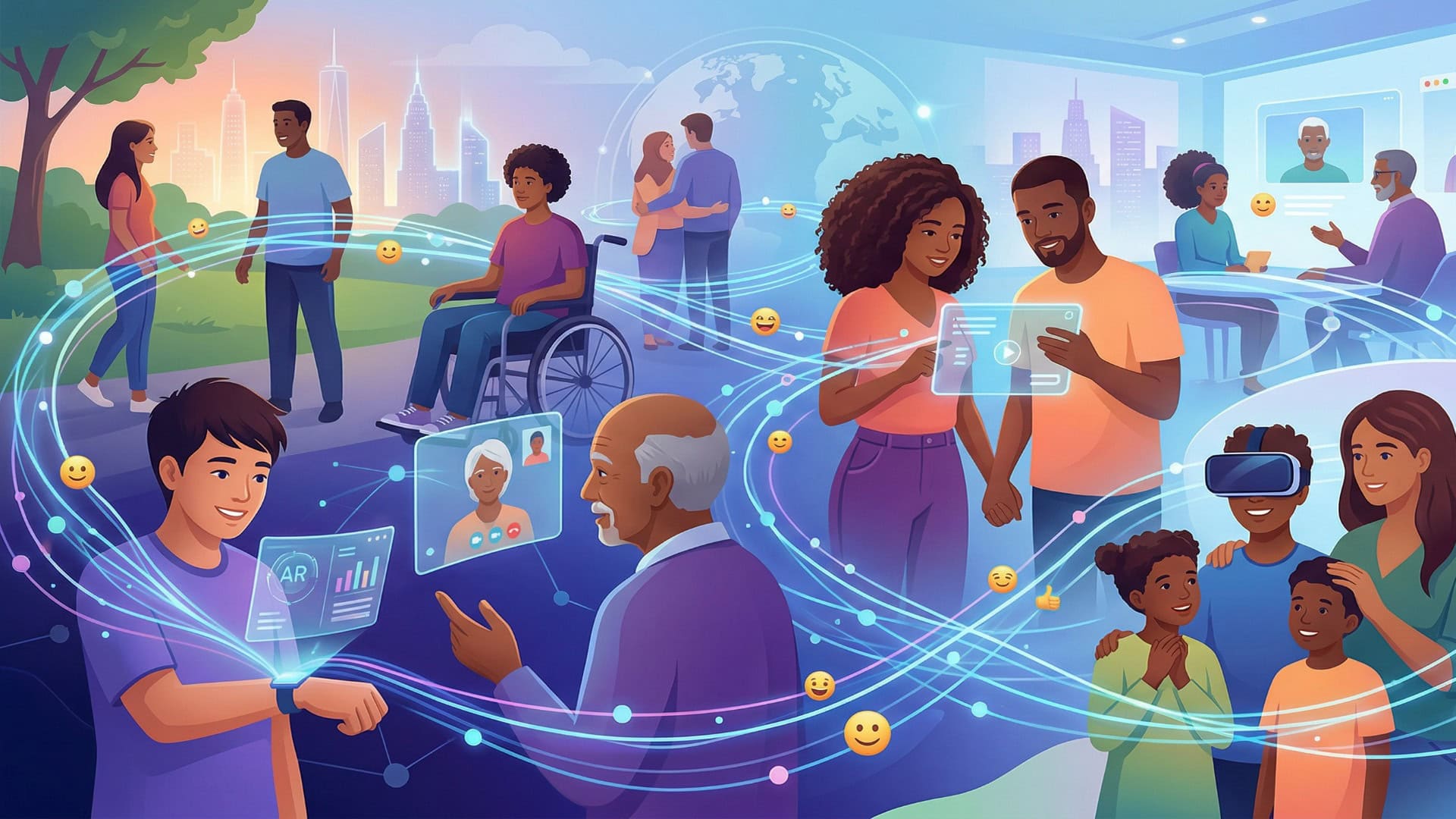
In the modern era, we live within a vast “digital tapestry.” Every thread in this tapestry represents our daily communications, emotions, and relationships. Technology has not just made our lives easier. It has completely reshaped the way we connect with one another.
Sending a message or making a video call has become a common part of our daily routine today. But have we ever wondered how deeply these technologies impact our relationships? In this blog, we will explore these fascinating aspects of technology and human interaction.
We will look at how this digital age creates new opportunities for us. At the same time, we will bring to the forefront the challenges it presents. Let us enter this new chapter of human communication together.
Understanding the Evolution of Human Communication
From the beginning of human civilization, methods of communication have been constantly changing. In ancient times, people expressed their thoughts through cave paintings and signals. The invention of language then allowed humans to express their thoughts more deeply.
Later, letters and the telegraph brought a massive revolution to communication. People realized that distance no longer required breaking ties. But these methods were quite time-consuming. One had to wait days for a reply to a message.
The invention of the telephone and the internet ended this waiting period. Hearing the voice of a loved one on the other side of the world became possible in an instant. This evolution is not just about technology. It is a wonderful example of the indomitable human desire to come closer to one another.
The Growing Impact of Digital Technology on Relationships
Digital technology has deeply penetrated every level of our lives. Maintaining communication with friends or family members is now easier than ever before. We can share the big and small joys of our lives with them whenever we want.
However, this accessibility also has a flip side. Sometimes we get so busy online that we forget to pay attention to the person sitting right next to us. While technology connects us with many people, it can also create a sense of loneliness.
Research suggests that excessive reliance on technology can affect human mental health. According to the American Psychological Association, maintaining healthy relationships in the digital age requires conscious awareness. We need to understand when to look away from the screen and focus on real life.
The Digital Revolution and Human Connection
The digital revolution has completely changed the concept of human connection. It has multiplied both the speed and scope of our communication. Distance is no longer a barrier.
We are now residents of a global village. We can connect with people from anywhere in the world in an instant. This has broadened our thoughts and perspectives.
This revolution did not just bring new technology. It has also redefined our social norms and relationship patterns. Let us dive deeper into this.
From Face-to-Face Conversations to Digital Communication
A decade ago, the primary medium of human communication was face-to-face conversation. Chatting at a tea stall or having evening conversations with family formed the foundation of relationships. During that time, physical presence and eye contact were highly important.
Digital communication has now largely taken over that space. We now express our emotions using text messages, voice notes, or emojis. While this speeds up communication, it often reduces its depth.
In face-to-face conversations, we can understand people’s physical gestures and the tone of their voice. These subtle details often get lost in digital media. As a result, misunderstandings can arise.
How Technology Has Changed Our Methods of Connection
Technology has not only made our communication methods faster. It has made them multifaceted. We can now maintain communication with multiple people simultaneously.
Social media, email, and messaging apps provide us with various communication channels. We can choose any medium according to our needs. Emails for work and messaging apps for chatting with friends are now our top choices.
However, due to this multifaceted communication, our attention often gets divided. We cannot fully concentrate on a single conversation. This can sometimes lower the quality of a relationship.
The Rise of Social Media and Online Communities
Social media has become one of the primary mediums of human communication over the past decade. Platforms like Facebook, Instagram, or X (formerly Twitter) are integral parts of our daily lives. They allow us to connect not only with acquaintances but also with strangers.
Online communities play a vital role in bringing together like-minded people. People can now easily join groups or forums based on hobbies, professions, or interests. This has expanded our social circles unimaginably.
However, the rise of social media has made sociologists ponder. They are working on both its positive and negative aspects. Let us learn about the pros and cons of these platforms.
Building Global Networks Through Digital Platforms
Digital platforms have created a global network for us. Now we can get acquainted with people from all over the world while sitting at home. This gives us the chance to learn about new cultures and perspectives.
These networks are also incredibly effective for professional development. With platforms like LinkedIn, people can now easily find international job opportunities. Exchanging ideas with professionals is now much easier than before.
This global network helps make our thinking more open-minded. We can connect with people from different countries and develop into global citizens. It has opened up a new horizon.
Pros and Cons of Social Media Interactions
The biggest advantage of social media is that it helps us stay connected with old friends. We can easily get updates on their lives and share our own updates. It helps keep relationships alive despite the distance.
Furthermore, social media is highly effective for sharing information and raising public awareness during emergencies. Through various social movements, people are now gathering online to effect massive change. It is a powerful medium for expressing opinions.
On the flip side, the disadvantages are quite significant. People usually share the best moments of their lives on social media. Seeing this, many might suffer from an inferiority complex and become dissatisfied with their own lives.
Instant Communication in the Digital Age
One of the key features of the digital age is instant communication. We are no longer willing to wait long periods for a reply. We want quick and real-time responses.
Due to this instant communication, the pace of our lives has increased significantly. Its impact is noticeable everywhere, from business to personal relationships. It has made our work much easier.
But because of this speed, our patience has decreased significantly. We expect instant results for everything. This can cause us mental stress.
Messaging Apps, Video Calls, and Real-Time Connections
Apps like WhatsApp or Messenger have become our primary modes of communication. Through these, we can easily share texts, pictures, or videos. This makes our conversations much more vibrant.
Video calling technology has taken our communication experience to a new height. Through Zoom or Google Meet, we can now speak face-to-face even with people far away. It has made distance almost invisible.
Because of real-time connections, we can stand by each other during emergencies. We can quickly ask for help and get solutions whenever needed. This increases our sense of security.
Technology Overcoming Geographical Barriers
Today, technology has completely erased geographical boundaries. In the past, talking to a relative or friend living in another country was highly expensive and difficult. Now it is right at our fingertips.
According to the Pew Research Center, digital technology is playing a massive role in keeping families connected globally. Students studying abroad or migrant workers can now easily stay in touch with their families.
This does not just apply to personal relationships. It has also removed geographical barriers in business. Working with a client from anywhere in the world is now easy.
How Technology is Altering Personal Relationships
Technology is redefining the dynamics of our personal relationships. It has changed the way we express love and maintain relationships.
Many argue that technology is creating an artificial wall within relationships. Yet many others believe it helps strengthen relationships. Its impact is multifaceted and complex.
We must understand that technology itself is neither good nor bad. Everything depends on how we are using it.
Strengthening Remote Connections
Technology is a blessing for those whose loved ones live far away. Maintaining a long-distance relationship was very difficult in the past. Now, video calls and messaging have made it much easier.
Couples can now watch movies virtually or play games together. This helps create a wonderful understanding between them despite the distance. They can become a part of each other’s daily lives.
The same applies to friends. Even if school or college friends scatter to different places for life’s demands, they stay connected through social media. This keeps old memories alive.
Balancing Online and Offline Communication
The biggest challenge of technology is maintaining a balance between online and offline lives. We often spend so much time in the virtual world that real-life relationships get neglected.
Many people use their mobile phones even while sitting at the dining table with their families. This can create distance in relationships. We need to be conscious of this issue.
An article in Forbes magazine argues that creating tech-free zones is crucial for healthy relationships. We should avoid all devices for at least part of the day. This time must be exclusively given to our loved ones.
The Impact of Technology on Workplace Communication
Alongside personal life, technology’s impact on the workplace is extensive. Modern offices are no longer confined to brick-and-mortar buildings. Technology has completely changed the concept of a workplace.
New media of communication have made office work more dynamic and straightforward. Coordination among team members can now be done much faster. This helps increase productivity.
However, there are some challenges too. The line between office hours and personal time often blurs. This can create mental stress among employees.
Remote Work and Virtual Collaboration
During the COVID-19 pandemic, we witnessed the true power of remote work. People successfully completed all their office tasks while sitting at home. This is a new revolution in the workplace.
Tools like Slack and Microsoft Teams have become widely used for virtual collaboration. Through these, team members can discuss projects in real-time. File sharing and tracking are now much easier.
Due to remote work, employees are saving time on commutes. They can give more time to their families. This has created an ideal work environment for many.
How Digital Tools Boost Team Productivity
Digital tools have multiplied team productivity many times. Through project management software, work progress can be easily tracked. It becomes clear who is working on which task.
Thanks to cloud storage, it is possible to access necessary files from anywhere. As a result, the pace of work is never hindered. Information exchange is now much faster and more secure.
These tools create transparency among team members. Everyone stays aware of their responsibilities. As a result, the quality of work and the team’s overall performance improve.
The Role of Artificial Intelligence in Human Interaction
Artificial Intelligence, or AI, is no longer just a subject of science fiction. It is a real part of our daily lives. AI is also playing a major role in communication.
AI can understand our behaviors and preferences. Accordingly, it provides us with suitable information and services. It is making our digital experiences much more personalized.
However, there are some ethical questions regarding the use of AI. Can a machine ever be a substitute for human emotion? This question is currently being widely discussed.
AI-Driven Chatbots and Virtual Assistants
When we visit the website of any large company, we now encounter chatbots. These AI-driven chatbots can instantly answer any customer queries. This has greatly improved the quality of customer service.
Virtual assistants like Siri, Alexa, or Google Assistant are making our daily tasks easier. We can get them to do various tasks using voice commands. They give us reminders and help us find information.
These technologies are automating the minor communication tasks of our daily lives. As a result, we can focus more on other important work.
Personalized Digital Experiences Through AI
AI analyzes our data to understand our likes and dislikes. Based on the type of videos you watch on YouTube or Netflix, AI suggests new content for you.
In communication, AI offers features such as smart replies and email drafting. It can understand our writing style and suggest words or sentences accordingly. This saves our time and improves our writing.
However, due to this personalization, we often get stuck in a filter bubble. We only see the information that we like. This can act as an obstacle to exploring new perspectives.
Technology and Cultural Exchange
Technology has built a bridge between different cultures of the world. We can now easily learn about the art, literature, and lifestyle of other countries. This is enriching our cultural knowledge.
Technology is also playing an important role in breaking language barriers. Using tools like Google Translate, we can speak with people of any language. This is a new horizon for communication.
Through cultural exchange, we learn to be respectful of one another. This helps build a tolerant and peaceful world.
Connecting Diverse Communities Worldwide
Online platforms give people from diverse communities the chance to come together. Those who feel like a minority or feel lonely in their local societies can find like-minded people online.
This builds confidence in them. They can share their problems and support one another. It creates a strong social bond.
Through these connections, people can learn new skills and get new ideas. This is beneficial in both personal and professional contexts.
Fostering Global Understanding Through Digital Platforms
When we speak directly to people from different cultures, many of our misconceptions are broken. We realize that despite external differences, our fundamental emotions as human beings are the same.
Digital platforms act as catalysts for fostering this global understanding. We can learn about the festivals or traditions of different countries online. This helps us grow as global citizens.
This understanding is also extremely crucial for world peace. The more we know each other, the less likely it is that conflicts will arise among us.
Obstacles of Tech-Driven Communication
Alongside these benefits, technology also presents significant challenges. These problems are negatively impacting our physical and mental health. There is no way to ignore them.
We must understand that technology is merely a tool. It is not supposed to control our lives. But in many cases, we are becoming slaves to technology.
Identifying these obstacles and finding solutions for them is extremely important. Otherwise, we might fall into a deep crisis.
Digital Fatigue and Information Overload
We are facing a massive amount of information every day. We are constantly flooded with news feeds, emails, and messages. This information overload is exhausting our brains.
Digital fatigue is a common problem now. Constantly looking at screens tires our eyes and nerves. As a result, our focus at work and decision-making capabilities decline.
To overcome this fatigue, we need a digital detox or a break from technology. Occasionally, staying away from the internet helps refresh our brains.
Issues of Privacy, Security, and Online Trust
The security of our personal information online is a major concern. Incidents of hacking and data theft are increasing day by day. This is creating a lack of trust among people regarding online platforms.
In communication, we often become victims of cyberbullying or fake news. Trusting anyone blindly online is very difficult. Traps of deception are spread everywhere.
For safe communication, we must use strong passwords and remain cautious when sharing personal information. General knowledge of cybersecurity is now mandatory for everyone.
The Impact of Screen Time on Social Well-being
Excessive screen time is negatively impacting our social skills. Especially if children become heavily addicted to screens from a young age, their social development is hindered.
They become scared to mingle with people in real life and turn self-centered. For adults, too, excessive mobile use creates distance among family members. Even while sitting together, we all remain lost in our own virtual worlds.
Controlling screen time is extremely important to maintain social well-being. We must place greater importance on our real-life relationships.
The Psychology of Digital Communication
Digital communication is leaving a deep impact on our psychology. How we think and how we react are being influenced by technology. This is a new dimension of human behavior.
Online, we often exhibit behaviors we would never exhibit in real life. The safety behind the screen can make us much more aggressive or reckless.
Understanding these psychological changes is a major subject of research for sociologists and psychologists. Let us discuss some of its aspects.
How Technology Influences Human Behavior
The like, comment, and share buttons on social media release dopamine in our brains. This creates a sort of addiction within us. We constantly crave recognition from others.
This is changing our behavioral patterns. We now focus more on taking pictures of a beautiful moment and posting them online rather than actually enjoying it. It feels as if the value of our lives depends on likes and views.
Additionally, seeing the perfect lives of others online makes us depressed about our own lives. This creates a competitive mindset within us, which is not healthy at all.
The Emotional Toll of Online Communication
Expressing emotion through texts or messages is highly difficult. We might laugh or cry with emojis, but they can never match real emotions.
Misunderstandings often occur because we cannot grasp the tone of a text. Someone might interpret a simple message negatively. As a result, severe disagreements can arise over minor issues.
Online, we talk to people, but we do not feel their presence. Consequently, in the long run, this can create feelings of loneliness and emptiness.
Emerging Technologies Shaping Future Interactions
The progress of technology has not stopped. In the coming days, technologies are arriving that will completely change our concept of communication. We stand on the threshold of a new digital era.
These new technologies will make our communication much more vibrant and interactive. They will blur the boundary between distance and reality.
We should have an idea about these future technologies right now. They will have a massive impact on our lifestyles.
Virtual Reality and Immersive Social Experiences
Virtual Reality, or VR, is creating an entirely new world for our communication. Concepts like the metaverse let us literally step into the internet.
Wearing a VR headset, we will be able to sit in the same virtual room and hang out with friends located anywhere in the world. This will be an immersive experience. It will feel as if we are genuinely sitting next to each other.
This technology will also bring revolutionary changes in education and healthcare. It will take our methods of social interaction to a unique level.
Augmented Reality and Enhanced Communication
Augmented Reality (AR) integrates digital elements with the real world. We will be able to see digital information overlaid on our physical environment through smartphones or smart glasses.
AR can be highly effective in communication. Imagine talking to someone who speaks a different language, and, through AR glasses, seeing their words as subtitles in your own language. Just think about how amazing that could be.
AR will make our daily tasks easier and more informative. It will enhance our interaction with the world around us.
The Future of AI-Mediated Conversations
In the future, AI will play a more active role in our conversations. We might be able to talk to our personal AI assistants as naturally as we do with humans.
AI will be able to understand emotions and respond accordingly. It could act as a friend or therapist to cure our loneliness.
However, this is also a scary thought. If machines take over the role of human-to-human relationships, many are worried about what shape society will take.
Building Meaningful Connections in a Digital World
Despite all these technologies, our primary goal should be to establish meaningful, deep connections. The real issue is how we can use technology to make our relationships more beautiful.
We must remember that technology is only a medium. Relationships are built through human emotions and feelings.
To establish healthy and meaningful connections, we need to follow some rules. These will help improve the quality of our digital lives.
Cultivating Healthy Digital Habits
Cultivating healthy digital habits in our daily lives is extremely important. First, we need to determine how much time we will spend on social media each day. Turning off unnecessary notifications helps increase focus.
Try to avoid all digital devices for at least an hour before bed. This will improve the quality of your sleep and bring mental peace.
Keep your mobile phone away when spending time with family. Pay attention to their words and make eye contact while speaking. These small habits can bring about massive positive changes in relationships.
Maintaining Authentic Relationships Online
To maintain authentic relationships online, being honest is very important. Refrain from the false effort of presenting yourself perfectly. Present your real self to everyone.
Be empathetic towards others. Try to understand the situation before judging anyone online. A positive comment or message can make someone’s day better.
Try meeting your online friends in person occasionally. Giving virtual relationships a realistic shape makes the bond even stronger.
The Future of Human Interaction in a Connected Society
We are moving towards a society completely interconnected by technology. There is much speculation about what the future of human interaction will look like in this society.
Some believe we will become completely machine-dependent. Conversely, many are optimistic that technology will help us become even more human.
Whatever the future may be, we must be prepared. The ability to adapt to change is the greatest strength of the human race.
Trends Defining Next-Generation Communication
Next-generation communication will be much more visual and real-time-based. The use of video and voice messages will increase more than text.
The issue of privacy will gain even more importance in the coming days. People will want to use platforms where their data remains secure.
Additionally, the use of eco-friendly and sustainable technologies will increase. It is expected that people will use technology much more consciously.
Opportunities and Challenges Ahead
Future digital communication will bring us massive opportunities. A new era of global collaboration and education will begin. We will witness an unprecedented exchange of knowledge and skills.
However, the biggest challenge will be balancing technology and humanity. We must ensure that human emotions do not get lost in the crowd of machines.
Furthermore, eliminating the digital divide is also a major challenge. We must ensure that people from every corner of the world can enjoy the benefits of technology.
Frequently Asked Questions (FAQs)
How has technology changed human interaction?
Technology has made human interaction much faster and more accessible. Where it used to take days of waiting to communicate, you can now connect with any part of the world in an instant. It has erased geographical distances and created multifaceted communication mediums. However, in many cases, it has reduced direct, face-to-face communication.
What are the benefits of digital communication?
The biggest benefit of digital communication is its speed and accessibility. Through this, we can stay connected with distant loved ones. Also, rapid information sharing during emergencies is possible. Remote work and virtual collaboration in the workplace have become easier thanks to digital communication.
Does technology improve or harm relationships?
This entirely depends on how it is used. If technology is used in moderation to stay in touch with distant loved ones, it can improve relationships. But it can cause severe harm to relationships due to excessive screen addiction and not giving time to people in real life. Maintaining balance is the key here.
How does social media affect human behavior?
Social media has fostered a tendency toward rapid reactions. It’s like a comment system increases people’s desire to gain recognition from others. Excessive use of social media can often lead to a comparative mindset, inferiority complexes, and loneliness.
Which technologies will shape future communication?
Artificial Intelligence (AI), Virtual Reality (VR), and Augmented Reality (AR) will play a major role in shaping the future communication system. These technologies will make digital communication much more realistic and immersive.
Conclusion
This digital tapestry is an integral part of our modern lives. We cannot imagine life without it. Technology has given us a lot. It has enriched our lives and brought the world into the palms of our hands.
However, we must not blindly drift away on this tide of technology. We have to remember that technology was created to serve us. We must keep a close watch so that we do not become slaves to technology.
Ultimately, our goal should be to build a world where technology and humanity walk hand in hand.
Key Takeaways on Tech and Human Interaction
From this discussion, we realize that technology is a powerful tool for human communication. Just as it can build networks worldwide, misusing it can cause fractures in personal relationships.
The biggest takeaway is to increase our awareness. We need to understand when to turn the screen on and when to turn it off to look at the real world.
It is crucial to ensure that our digital habits do not destroy our mental peace. There is no substitute for physical presence and sincerity to establish meaningful connections.
Navigating Towards a More Connected Digital Future
The journey ahead will be even more technology-dependent. But we must prepare for that future with human values by our side.
We need to teach the new generation how to use technology correctly. We must explain to them that real-life friends are far more important than likes or comments in the virtual world.
Let us build a digital future that is inclusive, safe, and humane. A place where every digital connection will give birth to a beautiful relationship.