10 Full-Body Workouts You Can Do at Home with Zero Equipment
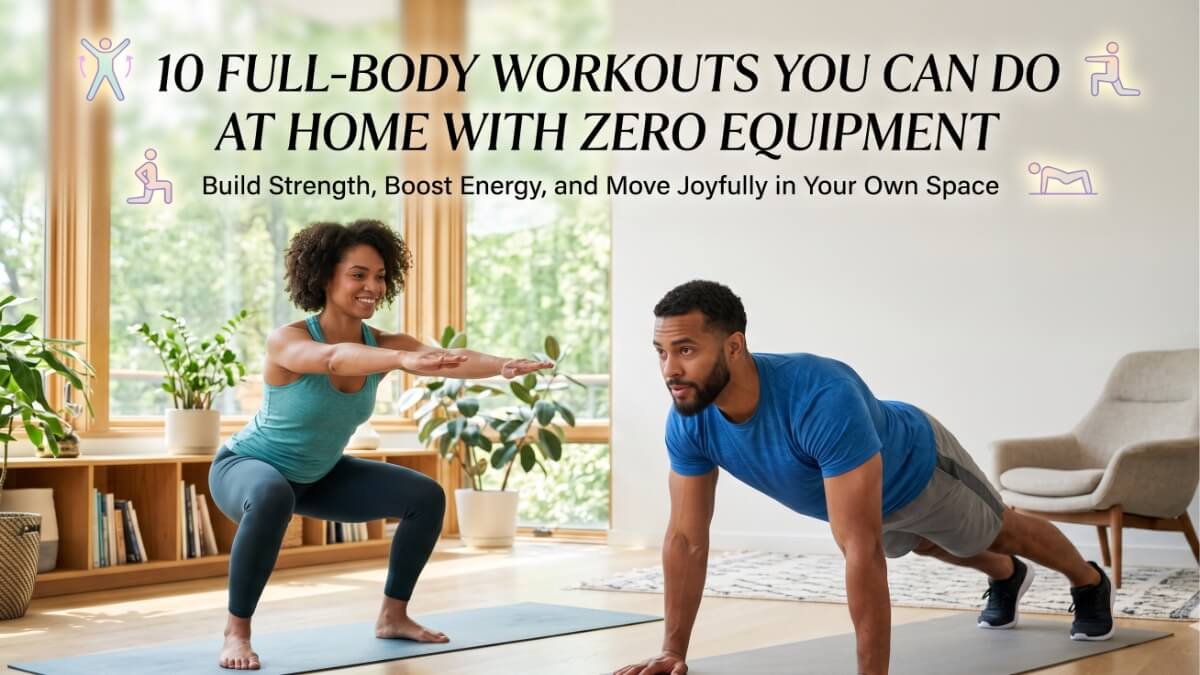
Finding time to take care of your body can be difficult in today’s busy world. Many people think they need an expensive gym membership or costly equipment to stay fit. That idea is completely wrong. You can achieve excellent results by using your own body weight.
Bodyweight training is one of the oldest and most effective methods in the fitness world. Your body becomes your gym with this method. You can do these exercises anywhere and at any time. This approach forces your muscles to work naturally.
Research shows that proper bodyweight exercises build muscle just like lifting heavy weights. According to Harvard Health Publishing, bodyweight exercises greatly improve balance and flexibility. These equipment-free exercises will provide the best foundation if you want to start a new fitness journey.
Benefits of Full-Body Workouts at Home
Exercising regularly at home offers many advantages. You do not have to leave your house to ensure full-body fitness.
Building Strength and Endurance
Bodyweight exercises activate the major muscles in your body. Your physical strength gradually increases when you do these exercises regularly. Your muscle endurance improves as you get used to carrying your own body weight. You will no longer feel tired while doing everyday tasks.
Improving Cardiovascular Fitness
Most people think cardio only means running or cycling. Certain bodyweight exercises at home can quickly raise your heart rate. This improves your cardiovascular fitness. According to the American Heart Association, this type of exercise is highly effective in reducing the risk of heart disease.
Burning Calories Effectively
Burning calories is essential for losing weight or keeping it under control. A full-body workout engages multiple muscles at the same time. This burns a lot of calories in a very short time. Your body even continues to burn calories after the workout through the afterburn effect.
Saving Time and Money
Traveling to and from the gym wastes a lot of time. Monthly gym fees can also be quite expensive. Exercising at home saves your travel time. You also save a lot of money because you do not need any special equipment.
How to Prepare Before You Start
Proper preparation is very important before starting any workout routine. Exercising without preparation increases the risk of injury.
Warm Up for 5 to 10 Minutes
Warming up is mandatory to prepare your body before you start exercising. A warm-up increases blood circulation and helps your muscles become more flexible. You can do simple walking, arm circles, or light stretching for 5 to 10 minutes. This will prepare your joints for the workout.
Create a Safe Space for Your Workout
Choose a place with enough light and air for your exercise. Make sure there are no unnecessary items on the floor. Ensure you have enough space to spread your arms and legs. You can spread a yoga mat on the floor if you want.
Focus on Proper Form Over Speed
Beginners often want to finish their exercises quickly. This is a big mistake. Exercising with proper posture is much more important than exercising quickly. Exercising with incorrect posture can cause muscle strains. Try to do every exercise slowly and follow the right rules.
Workout 1: Bodyweight Squats
The squat is one of the best exercises for strengthening the lower body. It is an essential part of any full-body workout.
Muscles Worked
Squats primarily work the front muscles of your thighs (quadriceps), the back muscles (hamstrings), and the buttocks (glutes). It also activates your abdominal muscles, or core, to maintain balance.
Correct Exercise Technique
Stand straight with your feet shoulder-width apart. Keep your chest up and your spine straight. Lower your hips down as if you are sitting in a chair. Inhale as you bend your knees and go down. Go down until your thighs are parallel to the floor. Press through your heels to return to the starting straight position and exhale.
Variations for Beginners and Advanced Levels
You can do a chair squat with a chair placed behind you if you find regular squats difficult. Lightly touch the chair and stand back up. You can do jump squats to make it harder. Jump forcefully upwards after going down and land back in the squat position.
Workout 2: Push-Ups
The push-up is a classic exercise for increasing upper-body strength. It engages many muscles of the body simultaneously.
Proper Push-Up Technique
Place your hands slightly wider than your shoulders on the floor. Extend your legs straight backward. Keep your body in a straight line from your head to your heels. Bend your elbows and bring your chest close to the floor. Inhale as you go down. Push your body back up using your palms and exhale.
Easy Modifications for Beginners
Doing push-ups on your toes can be difficult at first. You can do knee push-ups by keeping your knees on the floor. You can also start with wall push-ups by standing in front of a wall. This will put less pressure on your arms.
Advanced Push-Up Variations
You can do decline push-ups if regular push-ups feel easy. Place your feet on a chair or bed and do the push-up. You can also do diamond push-ups by keeping your hands very close to your chest. This will have a greater impact on your triceps muscles.
Workout 3: Walking Lunges
Walking lunges are highly effective for increasing leg and glute strength. It is a dynamic exercise, similar to walking, that improves balance.
Lower Body Strength Benefits
This exercise primarily strengthens your quadriceps and glutes. Regular lunges increase your ability to run and climb stairs. It maintains muscle balance by removing weakness on one side of your body.
Common Mistakes to Avoid
Many people bring their front knee far past their toes during lunges. This is harmful to the knee. Always make sure your front knee is directly above your heel. Also, be careful that your back knee does not hit the floor hard.
Tips for Improvement
Stand straight and take one step forward with your right leg. Lower your body by bending both knees to 90 degrees. Keep your back knee just above the floor. Stand up by putting your weight on your right leg and do the same with your left leg, stepping forward. Keep your back straight the entire time and do not lean forward.
Workout 4: Plank Hold
The plank is a static exercise, yet it is a wonderful test for your entire body. It helps reduce belly fat and strengthens the core.
Why the Plank Strengthens Your Entire Core
The plank targets your back and lower back muscles, as well as your front abdominal muscles. A strong core helps maintain proper body posture. It also helps reduce lower back pain.
Proper Plank Posture
Lie face down on the floor. Lift your body off the floor using your elbows and toes. Keep your elbows right under your shoulders. Keep your body completely straight like a line from your head to your heels. Hold your stomach tight and breathe normally. Try to stay like this for 30 to 60 seconds.
Side Plank and Dynamic Methods
The side plank is great for the core’s side muscles. Keep your body straight by resting on one elbow and the side of your foot. You can do plank jacks to make it harder. Jump on your toes from the plank position, spread your legs apart, then jump again to bring them together.
Workout 5: Glute Bridges
The glute bridge is an excellent exercise primarily for the buttocks and lower back. It helps reduce the harmful effects of prolonged sitting.
Activating Glutes and Hamstrings
This exercise directly targets your gluteus maximus, or the main muscle of the buttocks. It also activates your hamstrings and abdominal muscles. This is highly beneficial for people who work sitting at a desk.
Step-by-Step Instructions
Lie on your back flat on the floor. Bend your knees and place your feet flat on the floor. Keep your feet close to your buttocks. Press through your heels and lift your hips off the floor. This will create a straight line from your shoulders to your knees. Hold this position for one second and slowly lower your hips back to the floor.
Ways to Increase Difficulty
You can do a single-leg glute bridge if the regular glute bridge feels too easy. Keep one leg straight up in the air while doing the exercise, and lift your hips using the heel of the other leg. This will put more pressure on your muscles and increase balance.
Workout 6: Mountain Climbers
Mountain climbers are a great combination of cardio and strength building. This exercise raises your heart rate very quickly.
Combining Cardio and Core Training
This exercise targets your stomach, chest, shoulders, and legs simultaneously. Doing it at a fast pace turns it into an excellent cardio workout for burning calories.
Proper Technique
Start in a regular push-up or high plank position. Keep your arms straight and your body in a straight line. Pull your right knee toward your chest. Bring your left knee to your chest as you take your right leg back. Move exactly as if you are running on the floor. Keep your breathing normal.
Speed vs Control
Start the exercise slowly as a beginner. Maintaining proper body posture is the most important thing. You can increase your leg speed slowly as you get used to it. Make sure your hips do not rise too high while trying to go fast.
Workout 7: Burpees
Fitness enthusiasts call burpees the king of full-body workouts. It is quite difficult, but its benefits are unmatched.
Full-Body Conditioning Benefits
Burpees push your legs, chest, core, and arm muscles to the limit. It improves your physical strength, endurance, and agility all at once. Burpees are highly popular for fat loss and quick fitness gains.
Easy Burpee Method for Beginners
Stand straight first. Sit down and place your hands on the floor. Jump both feet back into a push-up position. Jump both feet forward near your hands, stand straight, and jump in the air. You can step your feet back one at a time instead of jumping if this feels too hard. You can also skip the jump at the end.
Tips for Better Results
Do not let your body relax while doing burpees. Keep your abdominal muscles tight during the entire process. You can take a few seconds of rest in between if you feel tired. Pay close attention to ensure your form does not change.
Workout 8: Superman Exercise
The Superman exercise is highly beneficial for your back and spine. It eliminates weakness in the back part of your body.
Strengthening the Lower Back
People often do more abdominal exercises but forget back exercises. The Superman strengthens your lower back and the muscles around your spine. It works wonderfully to prevent back pain or lower back aches.
Improving Posture
Lie face down on the floor. Stretch both arms straight forward. Keep your legs straight back as well. Lift your chest, arms, and both legs upward from the floor at the same time. You will look like a flying Superman in this position. Hold it for 2 to 3 seconds and lower it slowly.
Common Mistakes to Avoid
Do not bend your head upward too much, as this can cause neck pain. Keep looking at the floor to keep your neck in a neutral position. Do not do the exercise very fast. Feel the muscle contraction and raise and lower your body slowly.
Workout 9: Jumping Jacks
Jumping jacks are a familiar childhood exercise. It works great to remove physical stiffness at any time.
A Simple Cardio Warm-Up
This is basically an aerobic or cardio exercise. People widely use it at the start of a workout routine to warm up their bodies. It mobilizes your arm, leg, and shoulder joints.
Improving Heart Health
Stand straight with your feet together and keep your hands on your sides. Jump to spread your legs wide and simultaneously raise both hands above your head to clap. Jump again to return to the previous position. This exercise increases your heart rate quickly and improves blood circulation.
Low-Impact Alternative
People with knee or joint pain can avoid jumping. You can do step jacks instead. Step your right leg to the right side and raise your arms instead of jumping. Bring it back together and step your left leg to the left side. This will not put any pressure on your joints.
Workout 10: Bear Crawl
The bear crawl is an excellent functional exercise. It challenges your entire body.
Increasing Functional Full-Body Strength
Your shoulders, chest, stomach, and leg muscles work intensely in this exercise. It increases your body’s stability and movement skills. It is unique, especially for strengthening the shoulders and core.
Improving Coordination and Stability
Sit on the floor resting on your hands and knees. Lift your knees a few inches off the floor. Keep your back completely flat. Move your right hand and left leg slightly forward together. Then move your left hand and right leg forward. Walk forward slowly like a bear in this manner.
Variations for Different Fitness Levels
Beginners can cross a very short distance and take a rest. You can make the exercise more fun and difficult by walking backward or moving side to side while walking forward. Do not forget to keep your abdominal muscles tight the entire time.
A Sample 20-Minute Full-Body Home Workout Routine
You can create an excellent home routine with these 10 exercises. Below is an example of a 20-minute circuit routine. Do each exercise for 40 seconds, then take a 20-second rest between exercises.
Round One (10 Minutes):
-
Jumping Jacks (40 seconds work, 20 seconds rest)
-
Bodyweight Squats
-
Push-Ups
-
Walking Lunges
-
Plank Hold
Take a 1-minute break and drink some water in the middle.
Round Two (9 Minutes):
6. Mountain Climbers
7. Glute Bridges
8. Superman Exercise
9. Bear Crawl
10. Burpees
You can slightly adjust this routine to suit your ability.
How Often Should You Do a Full-Body Workout?
The number of days you exercise per week depends on your fitness goals. Doing a full-body workout 3 to 4 days a week is usually the best approach.
Rest is equally important alongside exercise for muscle growth. Muscle fibers break down when you exercise. They become stronger than before through repair during rest periods. It is best not to do heavy exercises for the same muscles two days in a row. Take at least a 48-hour break between two full-body workouts.
Tips for Regular Exercising at Home
The biggest challenge of exercising at home is maintaining consistency. Going to the gym creates an obligation that you do not have at home.
Set a specific time to exercise regularly. Build a habit of exercising at the same time every morning or afternoon. Plan your workout routine in advance. You can exercise with a friend or family member if you want. This keeps the enthusiasm alive.
Common Mistakes to Avoid During Bodyweight Training
You must avoid certain mistakes to get the best results from your exercises. Correcting these mistakes will make your fitness journey much easier.
Skipping the Warm-Up
Many people start heavy exercise routines directly because of a lack of time. This is a fatal mistake. Exercising without a warm-up increases the risk of muscle strains or major injuries. Set aside at least 5 minutes to warm up.
Ignoring Rest Days
Doing excessive exercise every day in hopes of getting fast results is wrong. You must give your body time to heal and rebuild muscles. Insufficient sleep and rest can hinder your progress.
Using Incorrect Posture
Doing 10 squats with correct posture is much more effective than doing 100 squats with incorrect posture. You can stand in front of a mirror to check if the form of each exercise is correct. You can also record a video to find your mistakes.
Doing Too Much Too Soon
Beginners try to do very difficult exercises on the first day. This will make your body overly exhausted. Start with simple exercises and gradually increase the exercise time and difficulty.
Frequently Asked Questions About No-Equipment Workouts
Can you build muscle without weights?
Yes, it is entirely possible to build muscle without weights. You can create enough pressure or resistance on the muscles using your body weight. You can increase muscle mass by regularly doing harder variations of exercises over time.
Are home workouts effective for weight loss?
Absolutely. Full-body exercises burn a lot of calories. You must also eat healthy, controlled meals alongside exercise to lose weight effectively.
How long should a full-body workout last?
Generally, 20 to 45 minutes is the ideal time for a full-body workout. You can achieve excellent results in just 20 minutes if you exercise at high intensity.
Can beginners start with these exercises?
Yes, every exercise has an easy alternative. Beginners can start with those simple methods. You can try advanced methods gradually as your body adapts.
Conclusion: Get Stronger Without a Gym
You do not need any heavy equipment to stay healthy and fit. You can start your fitness journey right from home today.
Final Words: Your Body Is the Only Equipment You Need
Bodyweight training teaches us how to control our own bodies. These exercises not only increase physical strength but also build mental toughness. You can turn your body into a powerful machine through consistency and proper routines.
Actionable Steps to Start Your First Full-Body Workout Today
Do not delay any longer. Put on your comfortable clothes right now. Choose a clear spot on the floor and start with a light warm-up. Take your first step toward wellness today by doing at least 5 bodyweight squats and 5 push-ups. Your body will thank you later.