Transformative Impact of Technology in Education Guide
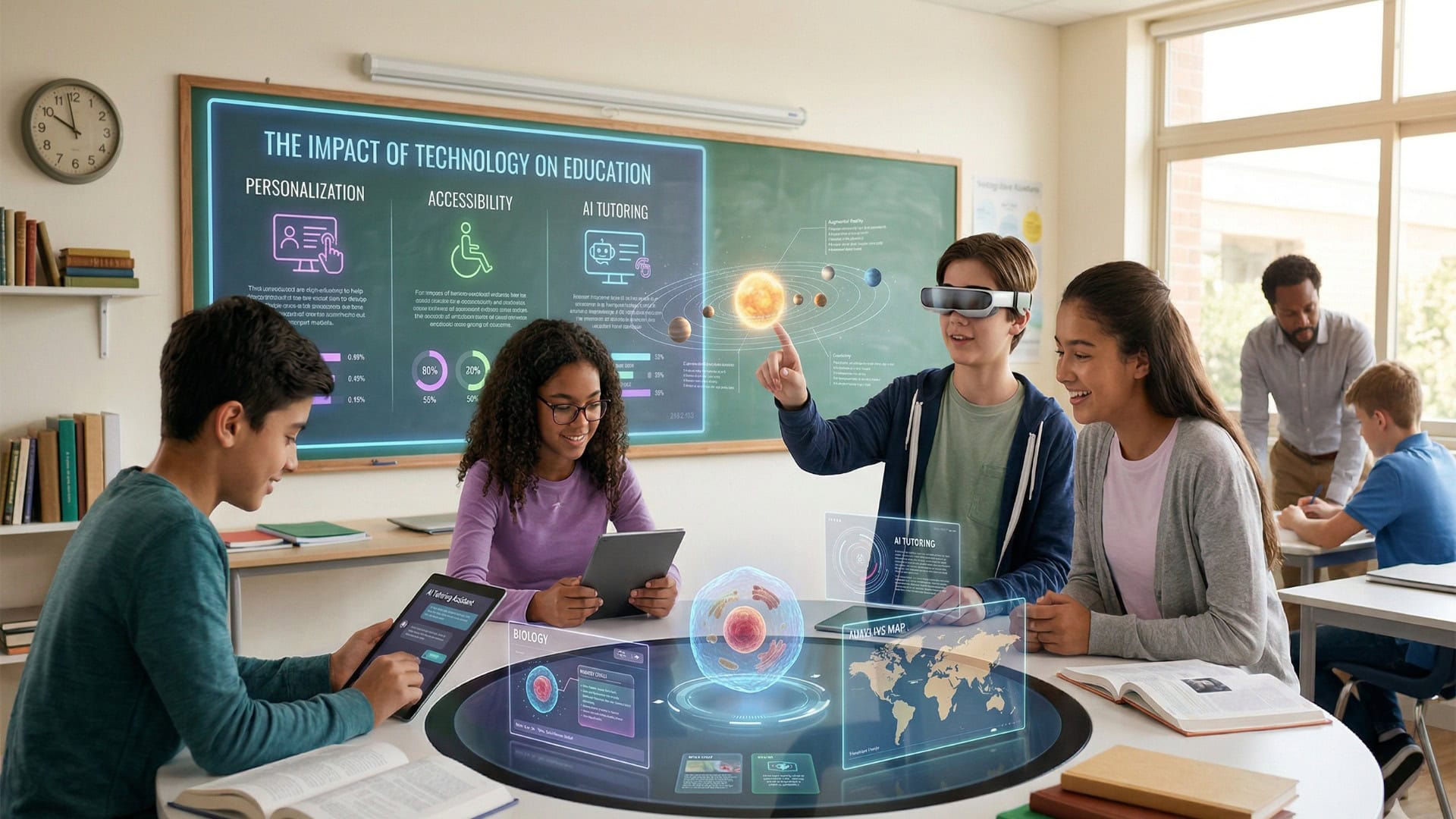
The integration of technology into the education system has brought about a groundbreaking transformation. In the past, education was strictly confined to textbooks and the four walls of a classroom. Today, it has spread globally. Technology has fundamentally changed the way we learn. It has made education much more accessible, rapid, and truly enjoyable.
This transformative impact is not limited to cities or developed nations. Thanks to the internet and smartphones, students in the most remote areas can now access world-class educational resources. Teachers are also utilizing new methods to capture and maintain student attention more effectively than ever before.
Adapting to this changing world requires embracing technology-based education. It is preparing students for the future. In this comprehensive guide, we will discuss the profound impact of technology on education and explore what the future holds.
The Evolution of Education in the Digital Age
Since the dawn of the digital age, the education system has undergone massive shifts. The availability of computers and the internet served as the primary driving force behind this evolution. Students are no longer solely dependent on physical libraries.
Anyone can instantly access a vast ocean of information through the internet. Platforms like Google and Wikipedia have opened up an entire world of knowledge. This has multiplied the speed at which students can learn and research.
This evolution in the digital age goes far beyond just searching for facts. Through online forums, educational videos, and interactive content, the learning process has become incredibly vibrant. Students can now learn in ways that suit their individual preferences.
Why Technology Matters in Modern Education
The importance of technology in modern education cannot be overstated. It has made learning highly practical and effective. Complex subjects that were once difficult to grasp can now be presented simply through technological tools.
When students see a concept visually and practice it interactively, it stays in their memory much longer. Interactive learning makes this possible. It actively helps students develop critical thinking skills.
Furthermore, students need to be familiar with modern technology to keep pace with the times. In the future workforce, almost every job will rely on technology to some extent. Therefore, the use of technology in modern education is absolutely essential.
Understanding Educational Technology (EdTech)
Educational technology, commonly known as EdTech, is a highly discussed topic today. It represents a brilliant fusion of education and technology. EdTech primarily refers to the software, hardware, and modern methodologies used for teaching and learning.
The main goal of these technologies is to make the learning process easier and more effective. EdTech helps students learn not just inside the classroom, but outside of it as well. It has truly opened up a new horizon in the education sector.
EdTech companies are constantly introducing new innovations. These innovations can be customized according to the specific needs and learning styles of students. As a result, teaching methods have become far more precise than ever before.
What is Educational Technology?
Educational technology is the application of modern technological tools to the educational process. This includes various learning management systems, educational applications, and digital content. It acts as a vital support medium for both teachers and students.
By using EdTech, teachers can make their teaching methods much more engaging. They can easily track their students’ progress. This allows them to pay special attention to students who might be struggling.
On the other hand, students can pursue education from anywhere and at any time. EdTech has turned learning into a continuous, lifelong process. It has completely transformed the traditional concept of education.
The Rise of Digital Learning Tools and Platforms
In recent years, we have witnessed an incredible boom in digital learning tools and platforms. Platforms like Zoom, Google Meet, and Microsoft Teams have turned remote learning into a reality. It is hard to imagine the current education system without them.
Additionally, various online course platforms, such as Coursera and Udemy, offer students the opportunity to acquire new skills. These platforms offer courses from some of the best universities in the world. They serve as an excellent medium for skill development.
Website management and content creation platforms also play a massive role. Many educators create their own educational blogs or portals to share knowledge. Systems like WordPress have made this task incredibly simple for creators everywhere.
The History and Evolution of Technology in Education
The use of technology in education did not start overnight. It is the result of a long and continuous evolution. From the slates and chalk of ancient times to the smartboards of today, every step features a touch of technology.
In the early days, educational programs were broadcast via radio and television. This was an early form of distance learning. Later, the arrival of computers brought massive changes to this trend.
The invention of the internet triggered the biggest revolution in education. It connected information from all over the world into a single network. This is when the journey of truly modern digital education began.
From Chalkboards to Smart Classrooms
There was a time when a classroom simply meant a blackboard and a teacher holding a piece of chalk. This was the most common medium of instruction. However, this scenario began to change over time.
Whiteboards and markers slowly replaced chalkboards. Then came overhead projectors, which allowed teachers to display images and slides. This was highly effective at capturing the class’s attention.
Today, modern smartboards and interactive displays have taken their place. These screens allow touch interaction, video playback, and direct internet browsing. The journey from the chalkboard to the smart classroom is truly remarkable.
Major Milestones in Educational Innovation
The history of educational technology features several crucial milestones. The first among these was the introduction of the Personal Computer (PC). It introduced students to the digital world for the very first time.
The second major milestone was the expansion of the World Wide Web. Through the internet, students gained access to information from any corner of the globe. This made research work unbelievably easy.
The latest and arguably most influential milestone is the rise of smartphones and mobile learning. It has quite literally brought education to the palm of our hands. Now, you do not need a specific time or place to learn something new.
Major Technologies Transforming Education Today
Currently, several cutting-edge technologies are completely reshaping the education system. These technologies are making education more interactive, personalized, and effective. They are the primary tools for preparing students for the future.
Among these, artificial intelligence, cloud computing, and virtual reality stand out the most. These technologies do not just provide information; they provide students with a realistic experience. This makes the learning process highly engaging.
These technologies are also reducing teachers’ workload. They can analyze student data to make better instructional decisions. Let us explore in detail some of the main technologies transforming education today.
Artificial Intelligence and Personalized Learning
Artificial Intelligence (AI) has sparked a new revolution in education. It can analyze each student’s learning capacity and style. Based on this, AI creates a personalized learning path for each individual.
Not all students learn at the same pace. AI-driven systems provide simpler lessons for struggling students and more challenging ones for gifted students. This helps students learn without feeling frustrated or left behind.
Moreover, AI chatbots can answer student queries at any time, day or night. As a result, students can continue their studies even in the absence of a teacher. AI acts as a constant, 24/7 guide.
Virtual Reality (VR) and Augmented Reality (AR) in Education
Virtual Reality (VR) and Augmented Reality (AR) have added a new dimension to learning. With VR technology, students can take virtual tours of places around the world from their classroom. They can experience historical sites or outer space in a realistic way.
On the other hand, AR technology overlays digital information onto the real environment. For example, pointing a mobile phone at a page of a book might bring a 3D animal to life. This is incredibly helpful for understanding subjects like science and history.
These technologies are fantastic for grasping complex scientific processes or human anatomy. Students can conduct various experiments in a virtual lab without any physical risks. It multiplies the joy of discovery.
Cloud Computing and Digital Collaboration Tools
Cloud computing has revolutionized how educational institutions store data. There is no longer a need to hoard information on massive physical hard drives. All data can be securely stored on cloud servers with ease.
Students with an internet connection can access their study materials from any device. This has freed them from the hassle of carrying heavy books and notebooks. Platforms like Google Drive and Dropbox are excellent examples of this.
Additionally, digital collaboration tools like Google Docs or Slides allow students to work on a project together simultaneously. They can stay connected with each other right from their homes. This significantly boosts teamwork skills.
Mobile Learning and Educational Apps
Mobile learning has made education universal. Because smartphones are so accessible, learning is now possible from anywhere. Even while commuting on a bus or train, students can easily continue their coursework.
Today, countless educational apps teach a wide variety of subjects. Everything is right at our fingertips, from language learning apps to math solvers. Duolingo and Khan Academy serve as prime examples.
These apps frequently feature game-like elements. Earning points or badges encourages students to keep learning. Mobile learning has successfully turned education into an enjoyable daily habit.
The Benefits of Technology in Education
The benefits of technology in education are vast and multifaceted. It helps not only students but also teachers and parents in numerous ways. Technology has successfully eliminated many old barriers within the education system.
The biggest advantage is that it has drastically improved the quality of education. Using modern visual and audio tools, complex topics can be explained with ease. Consequently, students’ tendency to rely on rote memorization is decreasing.
Furthermore, technology has made education much more cost-effective. There are thousands of free courses and study materials available online. This has opened the doors to quality education for underprivileged students as well.
Improving Access to Learning Opportunities
The greatest contribution of technology is delivering educational opportunities to everyone. In the past, students in remote areas fell behind due to a lack of good teachers or libraries. Now, through the internet, they enjoy the exact same opportunities as urban students.
Online education platforms have erased geographical boundaries. A student sitting in a village can attend classes taught by professors from Harvard or Oxford. This has created a truly global educational landscape.
For students with physical disabilities or illnesses who cannot attend traditional schools, technology is a blessing. They can attend regular classes from home just like anyone else. Technology has made education genuinely inclusive.
Increasing Student Engagement and Motivation
In traditional methods, students often feel bored during class. However, the use of technology makes classes highly engaging. Teaching through videos, animations, and interactive games naturally increases student engagement.
When students gain practical, visual experience with a topic, their interest in learning skyrockets. Technology helps satisfy their curiosity. It inspires them to discover new things independently.
Additionally, gamification methods such as digital badges and leaderboards foster healthy competition among students. They become more attentive to achieve better results. This cultivates a positive attitude toward studying.
Supporting Personalized and Self-Paced Learning
Technology plays a massive role in self-paced learning. In a physical classroom, a teacher usually teaches at a set pace, which might not suit everyone. But online, students can learn at a speed that feels comfortable for them.
If a student does not understand a topic, they can replay a video as many times as they need. Conversely, if someone learns quickly, they can easily skip ahead to the next lesson. This saves both time and effort.
This type of personalized education boosts student confidence. They can focus on their own improvement without constantly comparing themselves to others. It is highly effective for long-term knowledge retention.
Fostering Collaboration and Communication
Technology has built a strong bridge of communication between teachers, students, and parents. Through various apps and messaging platforms, they can stay connected around the clock. This fosters a highly collaborative environment in education.
Students can connect with peers from different countries to share their opinions. This broadens their perspectives and teaches them to respect different cultures. Online forums and communities play a huge role in this cultural exchange.
Teachers can also easily share lesson plans and ideas with other educators globally. This elevates the overall standard of teaching. Effective communication is the master key to any successful education system.
The Role of Online Education and Virtual Classrooms
Online education and virtual classrooms are the most discussed topics of our time. Their importance was realized most deeply during the global pandemic. Without them, educational activities would have come to a complete halt.
Virtual classrooms offer almost all the benefits of real-world classrooms. Teachers can deliver live lectures, students can ask questions in real-time, and presentations can be shared via screen sharing. It is the modern face of distance learning.
Online education is not just for emergencies; it is becoming a permanent model for the future. It saves students both time and commuting costs. It stands as an incredibly flexible educational system.
The Development of E-Learning Platforms
Over the past decade, e-learning platforms have seen massive growth. These platforms function like complete digital schools or universities. Everything from enrollment to taking exams and receiving certificates happens entirely online.
Teachers upload their course videos, PDF notes, and quizzes to these platforms. Students can complete these modules at their own convenience. This also creates great opportunities for professionals to learn new skills while working.
YouTube and other video-sharing sites also act as informal e-learning platforms. You can find countless free tutorials on almost any subject imaginable there. It is an endless repository for self-education.
Benefits of Hybrid and Remote Learning Models
The hybrid learning model is a brilliant combination of online and offline education. Here, students attend physical schools on certain days and take online classes from home on others. It provides the best benefits of both methods.
The remote learning model eliminates geographical barriers entirely. It gives students the chance to spend more time with their families. At the same time, they acquire the essential skill of working independently.
These models significantly reduce the pressure on educational institutions. It becomes possible to educate more students using fewer physical classrooms and infrastructure. It is a cost-effective and highly modern approach to education.
The Future of Virtual Education
The future of virtual education is incredibly bright. With advancements in AI and VR technologies, virtual classrooms will become even more realistic. Students will be able to attend classes together using 3D avatars.
In the future, the need for physical campuses or school buildings might drastically decrease. The entire education system could shift into a metaverse or virtual world. This will make learning far more interactive and fun.
However, this will require robust internet connections and advanced devices. If we can overcome these challenges, virtual education will trigger a worldwide revolution. It will completely rewrite the definition of learning.
How Technology Empowers Teachers and Educators
Technology empowers not just students, but teachers as well. It has made their daily tasks significantly easier and faster. With the help of technology, educators can now work much more smartly and efficiently.
Teachers can now gather the world’s best educational materials right from the internet. They can constantly update their teaching methodologies to reflect current trends. This plays a massive role in their ongoing professional development.
Furthermore, as manual administrative tasks decrease, teachers can dedicate more one-on-one time to their students. They can better understand the unique needs of every learner. This greatly strengthens the teacher-student bond.
Simplifying Administrative Tasks
Alongside teaching, educators must handle a mountain of administrative work. This includes taking attendance, grading exam papers, and preparing report cards. Technology has essentially automated these tedious tasks.
Using specific software, teachers can generate results for the entire class with a single click. Automated multiple-choice grading systems save teachers hours. They can invest the time saved in research and lesson improvement.
School management systems have simplified everything from collecting student fees to creating class routines. This makes the operations of educational institutions much more transparent and dynamic. Technology has drastically reduced administrative headaches.
Enhancing Lesson Planning and Content Delivery
Previously, teachers had to handwrite lesson plans for every single class. Now, they can easily create engaging lesson plans using various digital tools. They can craft well-structured, multimedia-rich content to reach even more students effectively.
Using tools like PowerPoint or Canva, teachers can design stunning visual content. These materials are highly effective at holding students’ attention. The better the presentation of the content, the higher the learning retention rate.
Teachers can now supplement textbooks with videos, podcasts, and online articles. This ensures that classes never feel monotonous. Technology has given teachers a broad canvas to express their creativity.
Using Data Analytics to Improve Student Outcomes
Data analytics has added a completely new dimension to education. EdTech platforms collect data with every click a student makes. By analyzing this data, teachers can pinpoint exactly which students are struggling with which topics.
If data shows that the majority of the class did not understand a specific math problem, the teacher can review that topic again. Data analytics provides teachers with real-time feedback. It helps them make data-driven decisions rather than relying on guesswork.
By analyzing past student performance, it is possible to predict their future potential. As a result, teachers can intervene early and provide necessary support to struggling students. This helps improve the overall academic outcomes of the entire class.
Artificial Intelligence and the Future of Education
Experts believe that Artificial Intelligence (AI) will completely dominate the education system in the coming decade. It will no longer be just a tool; it will become an inseparable part of education. AI will make learning highly intelligent and responsive.
From language translation to automated essay writing, the use of AI is expanding across many domains. It has dramatically accelerated research work for students. AI functions as a massive, intelligent knowledge base.
However, AI is not a replacement for teachers. It will act as a powerful support tool for educators. The combined efforts of AI and human teachers are about to usher in a brand-new era in education.
AI-Powered Tutoring Systems
AI-powered tutoring systems function much like personal home tutors. They are ready to assist students twenty-four hours a day. Whether it is solving a tough math equation or understanding a grammar rule, these systems provide step-by-step guidance.
These systems point out students’ mistakes and suggest ways to correct them. They adapt themselves to match the student’s unique learning style. This greatly encourages students to learn independently.
Such tutoring systems are particularly beneficial for students who are too shy to ask questions in a crowded class. They can clarify all their doubts with the AI without any hesitation. It fosters an incredibly friendly and low-pressure learning environment.
Adaptive Learning Technologies
Adaptive learning technology alters the educational content based on the learner’s abilities. It is a highly dynamic process. If a student performs well, the subsequent questions automatically become more challenging.
If a student gets stuck on a particular step, the system attempts to explain the concept using simpler examples. It is very similar to leveling up in a video game. It provides students with the perfect level of challenge to keep them engaged.
Adaptive learning ensures that no student falls behind. It guarantees a successful learning journey for every single individual. It completely dismantles the traditional “one size fits all” approach to education.
Ethical Considerations of AI in Education
There are several ethical aspects to using AI in education that simply cannot be ignored. If AI does all the work for students, their own critical thinking abilities might decline. Therefore, ensuring the appropriate and measured use of AI is vital.
There must be absolute transparency regarding how student data is being used or stored. Care must be taken to ensure that AI algorithms do not show bias toward any specific group or language. Technology mustn’t create new forms of discrimination.
Teachers and students must be trained on the ethical use of AI. They need to understand that AI is a supportive tool, not a substitute for their own intellect. We can reap its full benefits only with proper rules and regulations.
The Impact of Technology on Developing Student Skills
Acquiring textbook knowledge alone is no longer enough to prepare for the future. To succeed in the 21st century, students must acquire specific soft skills. Technology plays a direct role in developing these crucial competencies.
Communication, collaboration, and technological literacy are the most highly desired skills in today’s world. By working in a digital environment, students acquire these skills naturally. This builds a rock-solid foundation for their future careers.
Technology teaches students to be independent and self-reliant. They learn to find solutions to their own problems. This significantly boosts their self-confidence and decision-making capabilities.
Building Digital Literacy
In current times, digital literacy is just as important as knowing how to read and write. Digital literacy does not just mean knowing how to operate a computer. It is the ability to find accurate information online and verify its authenticity.
The internet is full of misinformation and fake news. Students must learn how to gather data from reliable sources. By becoming accustomed to technology, they can easily master this essential skill.
Additionally, writing emails, presenting online, and following digital etiquette are all parts of digital literacy. Using technology at a school level teaches students these necessary skills. It shapes them into responsible digital citizens.
Enhancing Critical Thinking and Problem-Solving Skills
Technology teaches students to think outside the boundaries of rote memorization. Learning to code or program dramatically increases logical and analytical skills. Students learn to break down massive problems into smaller, manageable pieces to solve them.
Various simulation and strategy games help students make quick decisions. They learn to evaluate the potential outcomes before taking a step. This significantly enhances their critical thinking abilities.
While working on online projects, students often face various technical glitches. By solving these issues, they acquire real-world problem-solving skills. This directly fosters the development of innovative thinking.
Preparing Students for Future Careers
In the next decade, many traditional jobs will become obsolete, and new technology-driven professions will emerge. Fields like robotics, data science, and cybersecurity will create massive employment opportunities. Technological education prepares students directly for these future careers.
When students are familiar with technology from a young age, adapting to new tools becomes second nature. They can quickly pick up new skills on the fly. This adaptability is absolutely crucial in the modern workplace.
Furthermore, opportunities for freelancing and remote jobs are increasing daily. If students have digital tools and online communication skills, they can work with companies worldwide. Technology opens up a vast horizon of career possibilities for them.
Challenges and Risks of Technology in Education
While technology in education has many benefits, it also carries several challenges and risks. If we fail to address these challenges, technology could become a curse rather than a blessing for education. Therefore, it is extremely important to remain aware of these issues.
Due to technology, students sometimes lose their socialization or face-to-face communication skills. They remain constantly glued to screens. This can have adverse effects on both their physical and mental health.
Additionally, new problems like cyberbullying and online harassment have emerged. Ensuring a safe digital environment for students is a major challenge. Striking the right balance when using technology is absolutely necessary.
The Digital Divide and Accessibility Issues
The biggest challenge of technology is the digital divide. Students in developed countries or cities easily gain access to modern tech. However, students in poor or rural areas are often deprived of these opportunities.
Not everyone has access to a good internet connection or a smart device. As a result, technology often widens the educational gap between the rich and the poor. Ensuring equal opportunity for everyone is a massive responsibility for governments and institutions.
To address this issue, initiatives such as creating free Wi-Fi zones or distributing low-cost laptops can be undertaken. We must ensure that the benefits of technology reach people in all strata of society. Otherwise, technological progress will remain incomplete.
Privacy, Security, and Data Protection Concerns
In the digital education system, an enormous amount of students’ personal data is stored online. Ensuring the security of this data is a significant challenge. Students’ privacy can be compromised due to hacking or data theft.
Online educational platforms need to have a proper privacy policy. The protection of student records can be ensured using state-of-the-art encryption methods. Care must be taken to ensure that no institution uses student data for commercial purposes.
Students and parents also need to be educated about online security. Simple rules, such as using strong passwords and avoiding suspicious links, must be followed. Cybersecurity should be a core component of the modern education system.
Managing Screen Time and Digital Distractions
Due to excessive technology use, students’ screen time has increased dramatically. Staring at screens for long periods can cause eye damage and sleep disorders. This is certainly not good for their physical health.
Furthermore, the internet is full of distracting elements. While trying to study, students often end up watching social media or YouTube videos instead. This pulls them away from their main goals and wastes valuable time.
Parents and teachers need to be highly vigilant about this. Specific time limits should be set for technology use. Students must also be actively encouraged to engage in offline sports and read physical books.
Technology and Inclusive Education
Technology plays a magical role in ensuring inclusive education. Many people in society are isolated from mainstream education due to physical or social reasons. Technology has created the opportunity to bring them all under one umbrella.
For students who are hard of hearing or visually impaired, special software is available. Technology has removed educational barriers for them. It is helping to turn education into a fundamental right for absolutely everyone.
If we can reduce the disparity in access to technology, the true purpose of inclusive education will be achieved. It plays a vital role in establishing equality and justice in society.
Supporting Students with Disabilities
The contribution of technology to students with physical or intellectual disabilities is outstanding. Text-to-speech software can read books aloud for visually impaired students. Conversely, using speech-to-text technology, they can type just by speaking.
For the hearing impaired, live captions and subtitles are available during video classes. There are many specialized keyboards and mice that students with motor skill challenges can easily use. These assistive technologies help them learn independently.
Using VR, students with autism are trained to face various social situations in a controlled environment. This enhances their social skills. Technology truly teaches disabled students to be self-reliant.
Expanding Educational Access for Marginalized Communities
In many parts of the world, children cannot attend school due to extreme poverty or war. To deliver education to these underprivileged children, satellite internet and solar-powered tablets are being utilized. Various international organizations are assisting in these efforts.
For instance, UNICEF and other institutions have launched several digital learning programs. As a result, even children in refugee camps can receive education in their native languages. Technology has successfully transcended geographical and political barriers.
Additionally, elderly or working adults who cannot attend traditional schools can continue their studies through e-learning. Technology has opened up a massive avenue for lifelong education.
Emerging Trends Shaping the Future of Education
With the rapid advancement of technology, new trends are continually being integrated into the education system. These trends dictate exactly what the future of education will look like. In the coming days, education will be much more modern, concise, and enjoyable.
We are no longer in an era where learning happens strictly by reading textbooks. The new generation of students wants something that entertains them while they learn. Education is rapidly transforming into a highly interactive experience.
Let us look closely at a few important emerging trends that are shaping the future of education. These will soon become core components of our mainstream educational systems.
Gamification and Interactive Learning
Gamification refers to adding game-like elements to the learning process. Examples include earning points for completing specific tasks, leveling up, or acquiring badges. This makes students intensely interested in learning.
Students naturally love playing games. If education can be presented like a game, they no longer need to be forced to study. They learn eagerly on their own. This makes it much easier to remember difficult concepts.
Through interactive learning, students are not just passive listeners; they become active participants in the process. They learn through various drag-and-drop activities or puzzle-solving challenges. This brings the learning process to life.
Blockchain Credentials and Digital Certification
Blockchain technology is no longer limited to cryptocurrency. It is bringing massive changes to the certification methods in the education sector. By using blockchain, students can be issued highly secure digital certificates.
These digital certificates can never be forged or altered. Employers can easily verify a candidate’s educational qualifications using the blockchain network. This makes the verification process incredibly simple and fast.
Students can store their entire life’s educational records in a secure digital wallet. There is no longer any need for physical paper documents. It is an eco-friendly and highly modern approach.
The Rise of Lifelong and Microlearning Opportunities
Because technology changes so rapidly, finishing a degree once is no longer enough. We must continuously learn new skills. This is known as lifelong learning. Online courses have made this continuous learning possible for everyone.
Microlearning is another massively popular trend. Instead of taking a long, exhausting course, subjects are taught in small, bite-sized modules. Examples include a 3 to 5-minute video or a short, focused article.
As people’s lives get busier, the time available for long study sessions is decreasing. Through microlearning, it is possible to learn something new while commuting or during short breaks at work. It is a fast and highly effective learning method.
Best Practices for Integrating Technology in Education
Simply introducing technology into education is not enough; we must ensure its proper and effective use. If not integrated correctly, the true purpose of technology is entirely defeated. To prevent this, certain specific rules or best practices must be followed.
Technology can never be a substitute for a teacher; rather, it is a medium to make the teacher’s work more effective. This concept must be crystal clear to everyone. Care must be taken to ensure that technology is not used aimlessly.
Educational institutions must create a well-planned roadmap before implementing any new tech. Proper training must be arranged for both teachers and students. Let us look at some of the best practices.
Selecting the Right Educational Materials
Currently, the market is flooded with countless EdTech tools and apps. Selecting the right tool based on the students’ age and learning objectives is crucial. Not all tools are equally effective for everyone.
When selecting a tool, one must evaluate how easy it is to use. If an app is too complex, both teachers and students will be discouraged from using it. A simple user interface is highly desirable.
Additionally, it must be verified how relevant the selected tools are to the curriculum. A technology should not be used just because it looks modern. Its educational value is the most important factor to consider.
Balancing Technology with Traditional Teaching Methods
Using technology does not mean discarding all traditional methods. Traditional practices like reading physical books, handwriting, and group discussions each hold unique importance. A beautiful balance must be maintained between these and modern tech.
For instance, after telling the story of a historical event in class, VR technology can be used to show the students that exact location. This enriches the traditional method. Technology should be used as a supplement to traditional education.
Care must be taken to ensure that students do not become overly dependent on technology. They must be given ample opportunities to use their own imagination and creativity. A blended approach always yields the best results.
Promoting Responsible Digital Citizenship
It is not enough to simply teach students how to use technology; they must be taught how to behave responsibly on the internet. This is known as digital citizenship. It is an absolutely essential topic in today’s world.
They need to understand how crucial it is to speak respectfully to others online. They must be taught that sharing personal photos or information without permission is a serious offense. We must raise their awareness to actively prevent cyberbullying.
Furthermore, they must be taught to establish a healthy routine for their time spent online. Responsible digital citizenship helps students maintain a safe, positive, and productive online environment.
Real-World Examples of How Technology is Transforming Education
Technology is not just a theoretical discussion; we can see its practical applications all around us. Schools and universities around the world are achieving incredible success by leveraging technology. These examples serve as powerful inspiration for other institutions.
During the COVID pandemic, we witnessed firsthand how technology kept the entire educational system running. Furthermore, through various innovative projects, we constantly see how education can be made highly practical.
Let us explore some real-world examples and success stories that prove technology is indeed transforming education.
Success Stories from Schools and Universities
Top-tier American universities like Stanford and MIT have made many of their courses available online for free. As a result, brilliant students from third-world countries are getting the opportunity to study there. This is a massive revolution in higher education.
The impact is also highly noticeable in developing nations like Bangladesh. Many public and private schools now feature multimedia classrooms. Teachers use projectors to show animated videos, explaining complex scientific concepts effortlessly.
Moreover, various EdTech startups are providing quality education to thousands of students at very low costs. These institutions are helping many students who previously fell behind due to a lack of proper guidance succeed.
Innovative Educational Models Around the World
The education system in Finland is considered one of the best in the world. They use technology to create a completely stress-free learning environment for students. Instead of rote memorization, they emphasize project-based or phenomenon-based learning.
Under the “Smart Nation” initiative, the Singaporean government has ensured the use of modern technology in all its schools. Students are learning subjects like coding and robotics from a very young age. This prepares them directly for global competition.
In Africa, many innovative models have been created using mobile learning. In areas where physical school buildings do not exist, students are studying directly on their mobile phones. These models prove that technology can conquer all educational limitations.
The Future of Education in a Technology-Driven World
We are entering a world where technological evolution will never stop. Experts are constantly researching what the educational landscape will look like in this technology-driven world. Future education will be incredibly dynamic and adaptable.
The value of practical skills will far outweigh traditional degrees or certificates. Educational institutions will not just provide theoretical knowledge but will prepare students directly for the workforce. The learning process will become entirely personalized.
The role of teachers will also shift. They will no longer just be sources of information; instead, they will act as guides or mentors. They will illuminate the right path for their students.
Predictions for the Next Decade of Education
In the coming decade, AI will become a staple in almost every classroom. Every student will have a personal AI tutor assisting them around the clock. Smart tablets and VR headsets will completely replace physical textbooks.
Educational institutions will no longer be restricted to specific buildings. Through the metaverse, students worldwide will connect in a massive virtual campus. They will be able to interact seamlessly with each other there.
The importance of micro-credentials and small skill certifications will rise. Instead of spending four years pursuing a single degree, people will take three-month short courses and immediately join the workforce. Learning and working will happen simultaneously.
Preparing Students for the Changing Digital Landscape
To keep pace with this rapidly changing world, students must be mentally prepared. They need to be taught how to adapt quickly to new situations and technologies. Adaptability will be their greatest weapon in the future.
A mindset of lifelong learning must be instilled in students. They need to understand that learning never truly ends. Because technology is always changing, they must continuously update their skills.
To facilitate this preparation, changes in the education system are urgently needed. The curriculum must be designed to enhance students’ creativity and critical thinking. Only then will they be able to face any challenge the future might hold.
Conclusion: Leveraging Technology to Elevate Education
Ultimately, the transformative impact of technology in education is undeniable. It has multiplied the quality, accessibility, and effectiveness of learning severalfold. Hand in hand with technology, we are moving toward a highly modern and global educational system.
However, we must remain vigilant regarding the use of technology. We need to avoid its harmful aspects and ensure its proper, ethical application. Through the combined efforts of teachers, students, parents, and policymakers, this technological revolution can be a massive success.
The primary purpose of education is to enlighten humanity. Technology is merely a medium to make that light shine brighter and reach further. Let us build a beautiful future for our education system through the responsible use of technology.
Frequently Asked Questions (FAQs)
How has technology changed education?
Technology has taken education out of the four walls of the classroom and spread it globally. It has made learning much more interactive, personalized, and accessible. Today, it is possible to receive high-quality education from anywhere simply by using the internet.
What are the main benefits of technology in education?
The primary benefits of technology in education include a massive expansion of learning opportunities, increased student engagement, and the ability to learn at one’s own pace. It helps clarify complex subjects easily and simplifies communication with people from any corner of the world.
What are the barriers to using technology in education?
The main barrier is the digital divide. Not everyone has access to good internet or smart devices. Additionally, issues such as data security risks, excessive screen time, and loss of attention pose significant obstacles to implementing technology in education.
How is artificial intelligence impacting education?
Artificial Intelligence (AI) is creating personalized learning paths for individual students. It provides special tutoring arrangements for struggling learners and automates administrative tasks for teachers, saving them valuable time. It is making the entire education system incredibly smart.
What does the future of technology in education look like?
The future of education will see a massive increase in the use of VR, AR, and AI. Virtual classrooms or the metaverse will serve as the schools of tomorrow. The importance of micro-credentials and practical skills will far outweigh that of traditional degrees, making education entirely student-centric.