
The Cosmic Journey: The Life Cycle of Stars Explained
When we look up at a clear night sky, we see countless twinkling lights. These lights are actually massive stars located millions of kilometers away from us.
Stars are not just beautiful decorations in the night sky. They have a specific and fascinating life cycle. Just like humans, stars are born, they grow over time, and they eventually die.
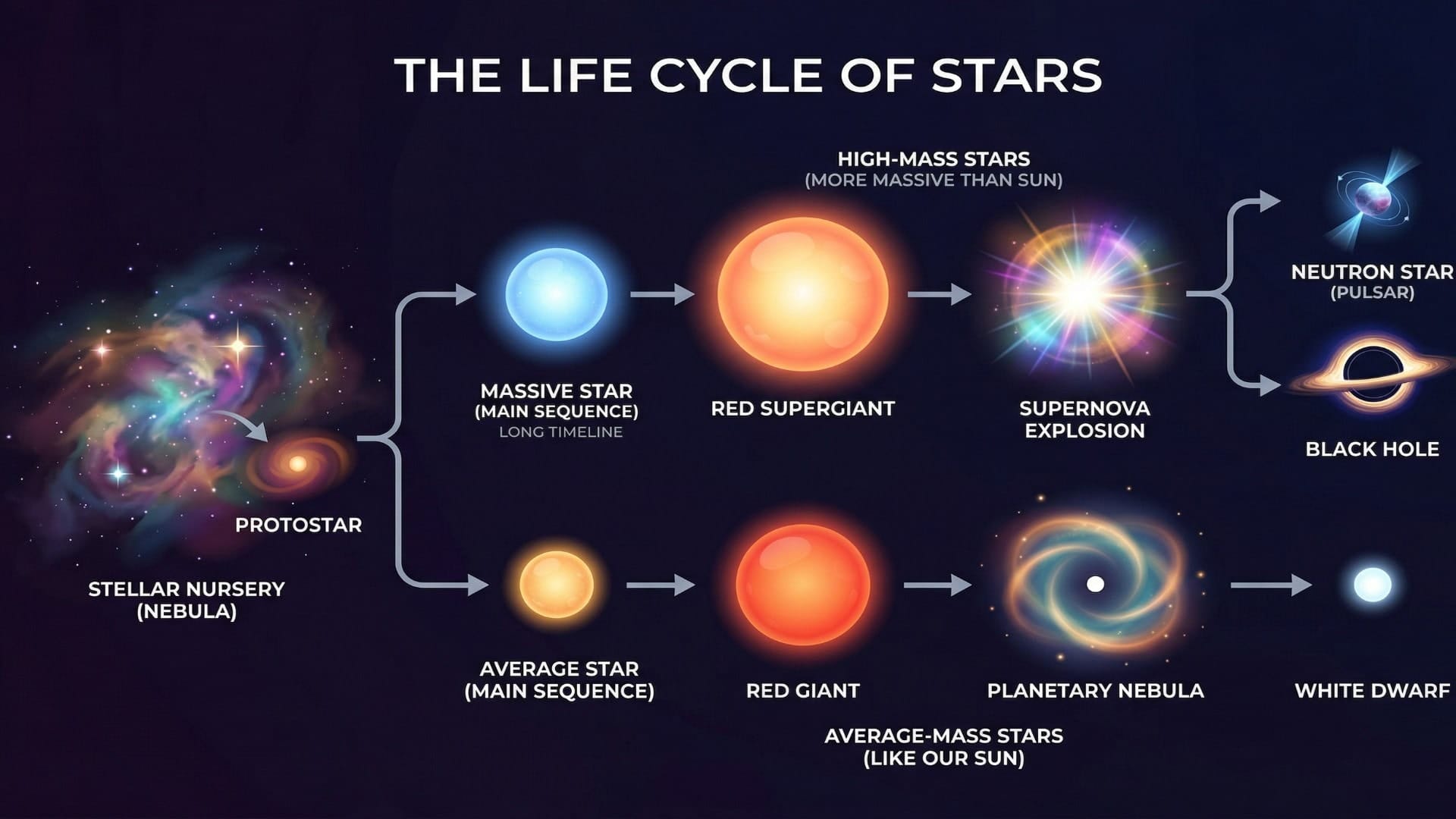
This journey of stars on the grand stage of the universe is incredibly thrilling. We call this journey stellar evolution. In today’s blog post, we will explore the cosmic journey of a star in detail.
Why Understanding Stars Matters
Knowing about stars is essential for understanding our very own existence. Every single atom in our bodies was forged inside a star at some point in cosmic history.
According to scientists, stars are the ultimate factories of the universe. Everything from carbon and oxygen to iron and gold is manufactured deep within the cores of stars.
If we can understand the life cycle of stars, we can unlock the mysteries of how the universe was created. This knowledge helps us understand how simple gases can eventually form complex planets and living organisms.
Importance of Stellar Evolution in Astronomy
Stellar evolution is the fundamental pillar of astronomy. Whenever scientists study deep space, stars serve as their primary guides.
By studying the life cycle of stars, researchers can determine the age of entire galaxies. The history of a galaxy is revealed by counting how many new or old stars it contains.
Stars also play a major role in helping us understand complex topics like the expansion of the universe and dark energy. Scientists measure the light from distant supernova explosions to calculate exactly how fast our universe is expanding.
What is a Star?
A star is essentially a massive glowing sphere of gas floating in space. They exist primarily as plasma and radiate their own light and heat.
Our closest star is the Sun. We can get a good idea of general stellar characteristics just by looking at how the Sun behaves. However, there are stars in the universe that are much larger and much smaller than our own.
Stars maintain their structure through the force of gravity. Their massive weight creates an intense gravitational pull that holds all the internal gases together perfectly.
Definition and Basic Traits of a Star
In scientific terms, a star is a cosmic body that generates energy through nuclear reactions within its core. This continuous energy production is exactly what keeps a star shining so brightly.
The primary ingredients of any star are hydrogen and helium gas. At the time of a star’s birth, its mass usually consists of about 74 percent hydrogen and 24 percent helium. The remaining fraction is made up of traces of other heavier elements.
The temperature of a star is extraordinarily high. Their surface temperatures can range from a few thousand degrees Celsius to several hundred thousand degrees. The distinct color of a star is directly determined by its surface temperature.
How Stars Produce Light and Energy
The process by which a star emits light is an incredibly fascinating subject. The light we get from stars is not caused by a simple chemical fire like the ones we see on Earth.
There is extreme pressure and unbelievable heat at the core of a star. Under these extreme conditions, hydrogen atomic nuclei smash together and fuse to create helium. This intense process is known as nuclear fusion.
During this fusion process, a tiny fraction of the mass is converted directly into pure energy. Following Albert Einstein’s famous equation $E = mc^2$, this tiny bit of missing mass produces a massive amount of power. This energy then travels through space as the heat and light we eventually see.
The Birth of a Star
The birth of a star is not a sudden event. It is a long, complex, and beautiful process. Stars are born from massive clouds of cosmic dust and gas floating in deep space.
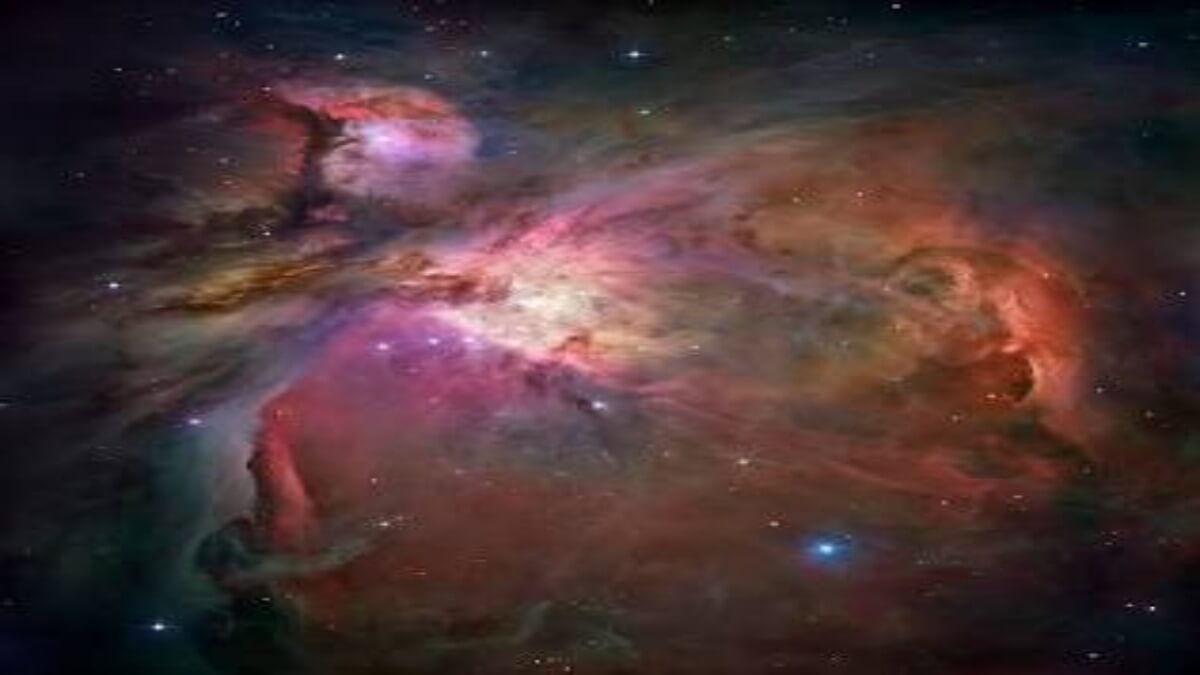
These massive clouds are called nebulae. Nebulae are scattered across various regions of the universe and act as cosmic nurseries for baby stars.
It can take anywhere from a few hundred thousand to several million years for a single star to fully form. Let us look at how a star is born step by step.
Giant Molecular Clouds and Stellar Nurseries
The massive expanses of gas and dust clouds in space are known as giant molecular clouds. These regions are exceptionally cold and very dark.
The size of these clouds can be so massive that light takes several dozen years just to travel from one end to the other. The raw materials needed to build new stars are stored safely inside these cold clouds.
Sometimes a shockwave from a nearby supernova explosion will disturb a part of this cloud. When this happens, the gases begin to clump together in one specific area.
From Nebula to Protostar
As gas and dust particles clump together under gravity, the density of that region increases rapidly. As the density increases, it starts pulling even more surrounding cosmic material toward itself.
This tightly packed ball of gas slowly begins to spin and heat up. This early stage of star formation is called a protostar. A protostar is not yet a true star because nuclear fusion has not started in its core.
Protostars are usually hidden behind thick blankets of cosmic dust. Because of this, they cannot be seen with ordinary optical telescopes. Scientists use specialized infrared telescopes to peer through the dust and observe these baby stars.
The Role of Gravity in Star Formation
Gravity acts as the master builder during star formation. Without the persistent force of gravity, the gases would never come together in the first place.
Gravity continuously pulls the outer layers of gas toward the protostar’s center. As a result, the pressure and temperature at the core begin to rise at an unbelievable rate.
A breakthrough event happens when the core temperature reaches roughly 15 million degrees Celsius. At this extreme heat, the hydrogen atoms can no longer remain apart, and they begin to fuse. At that exact moment, a brand new star is born.
The Main Sequence Phase
After a star is born, it enters the most stable period of its entire life. This lengthy period is known as the main sequence phase.
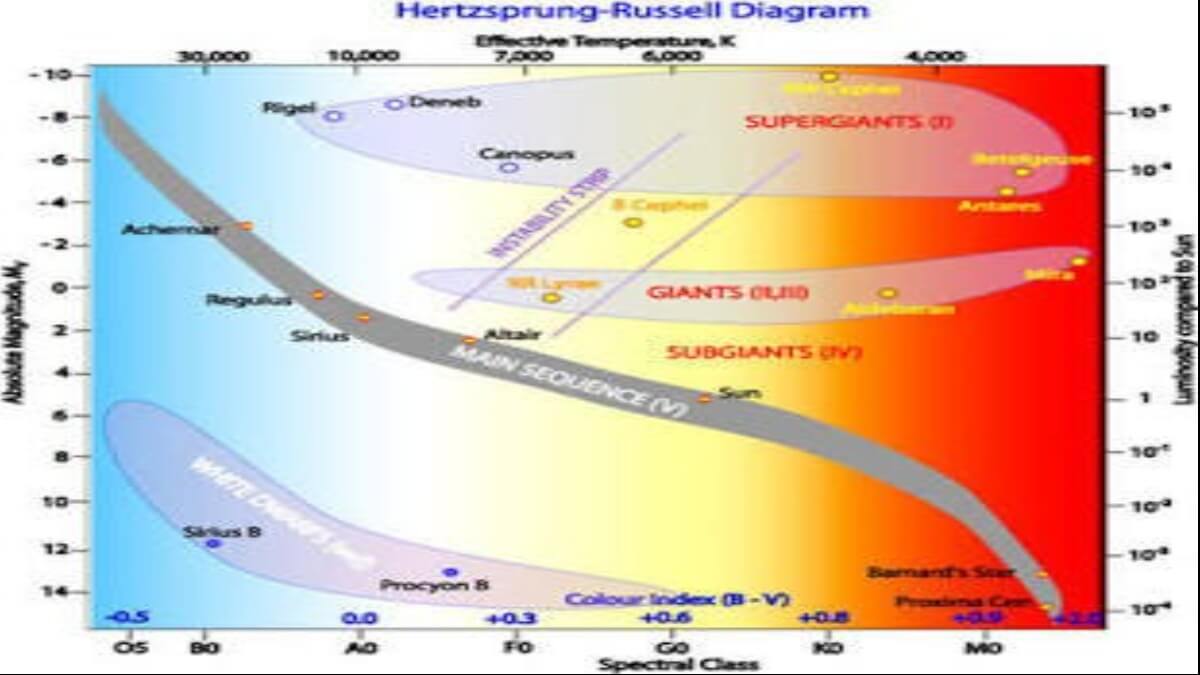
Our Sun is currently in the main-sequence phase. A typical star will spend almost 90 percent of its entire lifetime in this exact stage.
During this time, the star radiates a very consistent amount of heat and light. You will not see any drastic changes in its size or temperature while it remains here.
How Nuclear Fusion Powers a Star
The primary job of a star during the main sequence phase is to burn hydrogen to create helium. This nuclear fusion continues flawlessly and uninterrupted at the core.
Millions of tons of hydrogen gas undergo fusion every single second. The immense energy created by this process generates a massive outward pressure from the core.
This outward pressure naturally tends to expand the star. It works very much like blowing air into a balloon to keep it inflated.
Why Stars Spend Most of Their Lives on the Main Sequence
There is an elegant scientific balance that explains why stars remain peaceful for so long. This delicate state is called hydrostatic equilibrium.
On one side, the star’s sheer mass creates a powerful gravitational force that tends to crush it inward. On the exact opposite side, the thermal pressure from nuclear fusion pushes outward to expand the star.
When these two opposing forces become perfectly equal, the star achieves absolute stability. As long as there is enough hydrogen in the core, this balance holds strong, and the star remains firmly on the main sequence.
Examples of Main Sequence Stars Including the Sun
Most of the stars we observe in the night sky are main-sequence stars. Our very own Sun is the most famous and familiar example of this group.
The Sun has been in this phase for roughly 4.6 billion years. Scientists estimate that it will remain comfortably on the main sequence for about another 5 billion years.
The brightest star in our night sky is Sirius, which is also a main-sequence star. Furthermore, Alpha Centauri A and Alpha Centauri B are excellent examples of main-sequence stars located very close to our solar system.
Factors That Determine a Star’s Fate
Not every star follows the exact same life cycle. How long a star lives and how it eventually dies depend on a few very specific factors.
The characteristics a star inherits at birth basically write the script for its entire life. The single most important factor among these traits is the star’s total mass.
Additionally, a star’s physical size and chemical makeup will influence its evolution. However, mass is always the primary deciding force for a star’s destiny.
The Importance of Stellar Mass
When a star forms from a protostar, the total amount of gas it manages to gather becomes its mass. If the mass is high, the internal gravitational pull of the star is incredibly strong.
High-mass stars are forced to burn their hydrogen supplies very aggressively to maintain their internal balance against this heavy gravity. Consequently, they run out of their nuclear fuel very quickly.
On the other hand, low-mass stars have much weaker gravity. Because of this, they burn their fuel very slowly and live for an incredibly long time. The rule is simple: the heavier the star, the shorter its lifespan.
How Size Affects Stellar Evolution
A star’s mass directly dictates its physical size. High-mass stars grow to be extremely large and possess blazing hot surface temperatures.
These massive stars usually appear blue or brilliant white. Their internal structure and energy flow operate quite differently from those of their smaller counterparts.
Smaller stars like red dwarfs evolve at a remarkably slow pace. The gases inside them mix thoroughly from the core to the surface. This allows them to use up nearly 100 percent of their available hydrogen highly efficiently.
Evolution of Low-Mass Stars
Medium-sized stars like our Sun and stars with even lower mass follow a very predictable evolutionary path. Their lifespans can stretch out for billions of years.
When low-mass stars finally exhaust all the hydrogen in their cores, dramatic changes begin. The quiet life of the main sequence ends, and the preparation for death begins.
This process does not happen through a sudden, violent explosion. Instead, it unfolds gradually over several distinct phases. Let us look at this process step by step.
Transition to a Red Giant
When the hydrogen in the core runs out, the fusion reaction temporarily stops. Without fusion, the outward thermal pressure drops significantly.
Gravity then takes over, forcing the core to shrink inward. As the core compresses, its temperature skyrockets. This intense new heat causes a thin shell of hydrogen just outside the core to ignite and start burning.
This burst of new energy causes the outer layers of the star to swell up massively. Because the star expands so much, its surface cools and turns a deep red. This huge, swollen star is known as a red giant.
Formation of a Planetary Nebula
During the red giant phase, the inside of the star becomes highly unstable. The core temperature eventually rises high enough for helium to begin fusing into carbon and oxygen.
However, low-mass stars do not have enough gravity to force carbon to fuse. Eventually, all nuclear reactions in the core come to a complete halt.
The star then gently ejects its outer gaseous layers deep into space. This beautiful, expanding shell of glowing gas that surrounds the dying star is called a planetary nebula.
The Birth of a White Dwarf
After the outer layers drift away as a planetary nebula, only the incredibly hot and dense core of the star remains behind. This dead, glowing core is called a white dwarf.
A white dwarf is roughly the size of the Earth but contains the mass of an entire star. This means its density is unimaginably high. A single spoonful of material from a white dwarf would weigh as much as an elephant here on Earth.
No new energy is generated inside a white dwarf. It simply radiates its leftover heat into space. Over billions of years of gradual cooling, it will eventually become completely dark and cold.
Evolution of High-Mass Stars
Stars that are eight times more massive than our Sun experience a fast and highly destructive life cycle. Their extreme weight guarantees a violent end.
Massive stars live for only a few million to a few tens of millions of years. They are the brightest and hottest objects in the stellar universe.
Their deaths create some of the most powerful and spectacular cosmic events ever witnessed. Their evolutionary path is completely different from that of ordinary stars like our Sun.
Transition to a Red Supergiant
When massive stars run out of core hydrogen, they also swell up considerably. However, they grow to thousands of times the size of a standard red giant. These colossal objects are called red supergiants.
Their gravity is so overwhelming that they can fuse not only helium but also heavier elements such as carbon, neon, oxygen, and silicon. The inside of the star starts to look like an onion, with different elements fusing in distinct layers.
Eventually, iron begins to build up at the absolute center of the star. Fusing iron does not release any energy. Instead, it actively absorbs energy, sealing the star’s doom.
Supernova Explosion
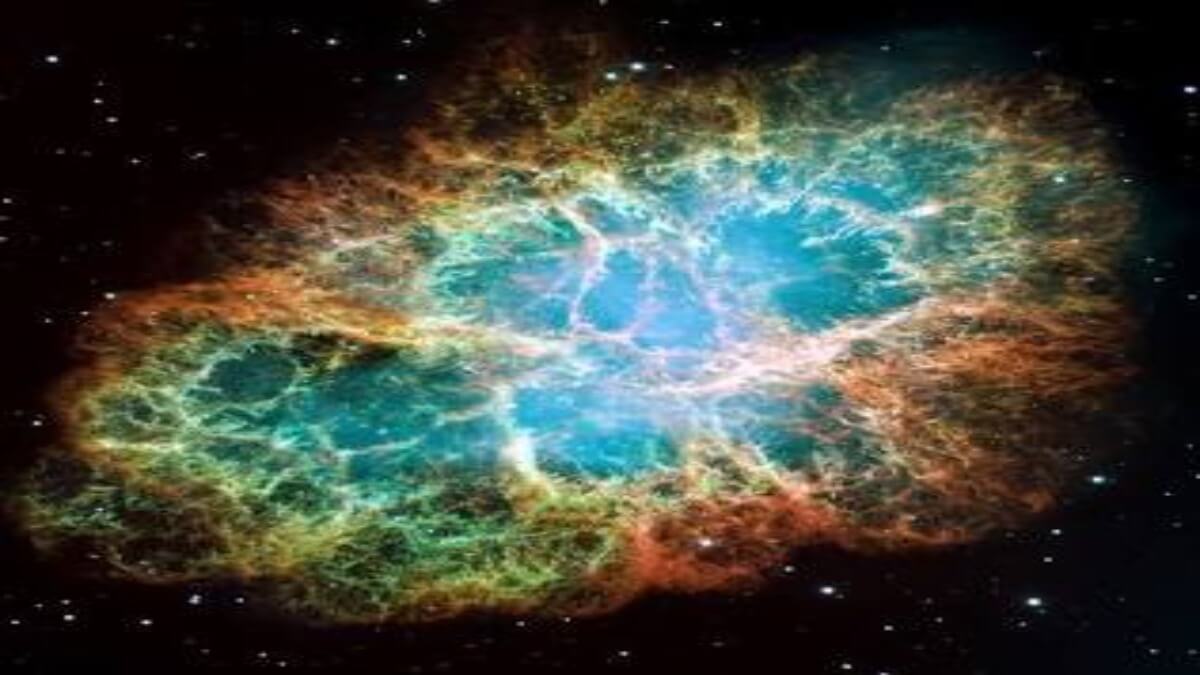
Once the iron core becomes too heavy, the star can no longer support its own weight. In a fraction of a second, the outer layers of the massive star collapse inward at incredible speeds.
These collapsing layers slam into the ultra-dense iron core and bounce off with unimaginable force. This violent cosmic explosion is known as a supernova.
The light from a single supernova explosion is so intensely bright that it can easily outshine an entire galaxy of billions of stars. It is during this extreme explosion that superheavy elements such as gold and uranium are forged and blasted into space.
Creation of Neutron Stars and Black Holes
After the violent supernova explosion tears the star apart, only the very center survives. Depending on how much mass remains in this core, it will become one of two things.
If the leftover core has a mass between 1.4 and 3 times that of our Sun, the extreme pressure forces electrons and protons to merge into neutrons. This creates an incredibly small, ultra-dense object known as a neutron star.
If the remaining core is larger than 3 solar masses, gravity wins completely. Nothing in the universe can stop it from collapsing inward. It shrinks down to an infinitely small point, creating a black hole.
Death of Stars and Cosmic Recycling
Nothing in the universe ever truly goes to waste. The death of a star does not mean the story is over. A dying star actually paves the way for new life.
When stars die, they scatter all the precious elements they created deep into space. This process alters the chemistry of the universe, making it significantly richer.
We can call this process cosmic recycling. Stars sacrifice themselves to provide the exact raw materials needed to build the next generation of celestial bodies.
How Dying Stars Enrich the Universe
Throughout their active lives, stars use nuclear fusion to convert simple hydrogen and helium into essential elements such as carbon, oxygen, and nitrogen. These elements are the strict requirements for biological life.
When a planetary nebula or a supernova explosion occurs, these elements are thrown violently into the interstellar medium. This scattered dust and gas eventually mix with the giant molecular clouds floating in space.
In this way, every single dying star fertilizes the cosmic clouds with heavy elements. The very first generation of stars contained only hydrogen and helium, but modern stars are rich in complex elements thanks to this recycling.
Formation of New Stars and Planets
These newly enriched molecular clouds eventually collapse to form a brand new generation of stars. When these new stars are born, they inherit all the heavy elements left behind by their ancestors.
It is not just stars that form here. The swirling disk of leftover gas around a new star eventually clumps together to form planets, moons, and asteroids.
Because modern cosmic clouds contain plenty of iron, silicon, and carbon, rocky planets like ours can finally form. Our Earth and the entire solar system were built from the scattered ashes of ancient, long-dead stars.
Types of Stellar Remnants
The corpses left behind after a star dies are of great fascination to astrophysicists. Depending on the original star’s mass, these remnants fall into three main categories.
These remnants are white dwarfs, neutron stars, and black holes. These objects do not obey the normal rules of matter. They operate under the most extreme and bizarre laws of physics imaginable.
These stellar remnants are among the densest and most gravitationally powerful objects in the entire universe. Let us explore each of them in greater detail.
Explaining White Dwarf Stars
A white dwarf is the final resting state of small to medium-mass stars. Stars like our Sun will eventually take on this exact form at the end of their lives.
The density of matter inside a white dwarf is staggering. The electrons inside are crushed into a bizarre state called electron degeneracy. It is the outward pressure of these tightly packed electrons that stops gravity from crushing the white dwarf any further.
White dwarfs start their new lives incredibly hot, with temperatures reaching up to 100,000 degrees Celsius. However, because they no longer produce fresh energy, they slowly radiate their heat away over billions of years.
Neutron Stars and Pulsars
A neutron star is the ultra-dense core that survives a catastrophic supernova explosion. As the name suggests, it is composed almost entirely of tightly packed neutron particles.
A neutron star might be the size of a small city with a diameter of roughly 20 kilometers, yet it weighs more than the Sun. Its gravity is so intense that escaping its surface requires traveling at a significant fraction of the speed of light.
Some neutron stars spin at dizzying speeds while shooting powerful beams of radiation from their magnetic poles. As they rotate, these beams sweep across Earth like a cosmic lighthouse. We call these fast-spinning neutron stars pulsars.
Black Holes: The Ultimate Fate of a Star
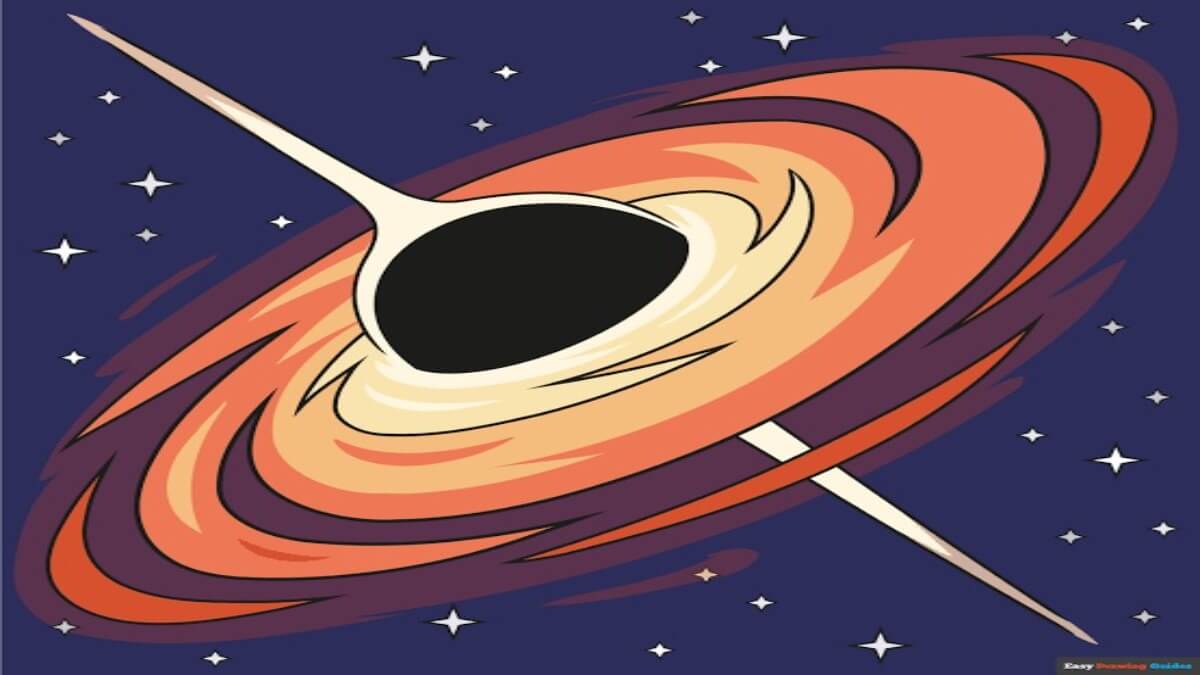
When the remnant of a massive star is so heavy that not even neutron pressure can stop gravity, it collapses entirely and becomes a black hole. This is the most mysterious and extreme fate a star can suffer.
At the very center of a black hole, the density of matter becomes infinite. This central point is known as the singularity. Surrounding this point is an invisible boundary known as the event horizon.
The gravitational pull inside the event horizon is so fierce that not even light can escape its grip. Because no light escapes, we cannot see black holes directly. However, through NASA’s black hole research, we have learned a great deal about how they influence the surrounding space.
Life Cycle of the Sun
The Sun is our most important cosmic neighbor. It is the ultimate source of all energy and life on Earth. Therefore, understanding the Sun’s life cycle is incredibly relevant to us.
The Sun is classified as a typical G-type main-sequence star or a yellow dwarf. It was formed about 4.6 billion years ago when a fragment of a giant molecular cloud collapsed under its own gravity.
The Sun’s life will follow the standard rules of the universe. It will not shine forever. Our beloved star has a definitive beginning and a definitive end.
The Sun’s Current Phase
The Sun is currently in its most stable stage of life on the main sequence. You can think of it as being perfectly in its middle age.
Every second, the Sun fuses roughly 600 million tons of hydrogen into helium. During this violent process, about 4 million tons of actual mass is converted into the pure energy that warms our planet.
Scientists estimate that the Sun has used up about half of the hydrogen fuel stored in its core. That puts our star exactly halfway through its stable main-sequence life.
What Will Happen to the Sun in the Future?
In about 5 billion years, the hydrogen fuel in the Sun’s core will finally run out. When that happens, the Sun will leave the main sequence and enter its red giant phase.
The Sun’s outer surface will swell so drastically that it will swallow Mercury, Venus, and likely our Earth as well. By that point, the oceans will have boiled away, and life on Earth will be impossible.
Once the red giant phase ends, the Sun will gently puff away its outer layers to create a stunning planetary nebula. All that will be left is a tiny, incredibly dense white dwarf that will float quietly in space forever.
How Scientists Study Stellar Evolution
Human life spans merely a few decades, yet stars live for billions of years. So how exactly did scientists figure out the entire life cycle of a star from birth to death?
The answer lies in mass observation. Astronomers observe billions of different stars scattered across the sky. They actively look for newly born stars, dying stars, and the ancient remnants of dead stars simultaneously.
By piecing together data from stars at different stages of life, they build a complete picture of stellar evolution. It is very similar to walking into a forest and understanding a tree’s life cycle by observing a seed, a sapling, a mature tree, and a fallen log all at once.
Telescopes and Space Observatories
The primary tools for studying stars are highly advanced telescopes. Telescopes based both on Earth and floating in space capture the faint light emitted by distant stellar objects.
Instruments like the Hubble Space Telescope and the James Webb Space Telescope allow scientists to observe infrared, ultraviolet, and X-ray light. These special wavelengths let them peer straight through thick dust clouds to watch protostars being born.
Organizations like the European Space Agency are actively mapping the precise positions and movements of over a billion stars. This massive collection of data is revolutionizing our understanding of stellar evolution.
Computer Simulations and Modern Astronomy
Telescopes can only show us the outside of a star. To understand what is happening deep inside the core, scientists rely on powerful supercomputers.
They use complex laws of physics to build digital models of the heat, pressure, and nuclear reactions inside a star. These simulations allow researchers to confidently predict what will happen to a star millions of years into the future.
Modern astronomy has also been transformed by the detection of gravitational waves. Ripples in space-time caused by colliding black holes or neutron stars provide entirely new ways to study the universe after a star’s death.
Fascinating Facts About Stars
The universe is wonderfully diverse, and stars are the greatest proof of that diversity. Every point of light we see in the night sky has its own unique story and characteristics.
There are stellar facts that completely defy common sense. In terms of sheer scale and raw power, stars are the most mind-bending objects in existence.
Let us look at a few fascinating facts about stars that will truly leave you amazed.
Largest and Smallest Known Stars
One of the largest stars ever discovered is named UY Scuti. It is a massive red supergiant star. Its physical size is so incredibly huge that you could comfortably fit about 5 billion of our Suns inside it.
On the flip side, the smallest known stars in the universe are red dwarfs. They can be just barely larger than the planet Jupiter.
However, to legally qualify as a star, an object must weigh at least 80 times more than Jupiter. If it fails to reach that weight, nuclear fusion cannot start, and it becomes a “failed star” known as a brown dwarf.
Unusual Stellar Phenomena
There are many star systems in space where two stars orbit extremely close to one another. These are known as binary star systems.
Sometimes, one star will aggressively siphon off gas and material from its nearby companion. These greedy objects are nicknamed vampire stars. By stealing fresh hydrogen, these vampire stars actually rejuvenate themselves and shine much brighter than they naturally should.
Another incredible event is a tidal disruption event. This happens when an unlucky star wanders too close to a supermassive black hole, and the black hole violently shreds the star apart before eating it.
Record-Breaking Stars in the Universe
The oldest known star ever documented by science is affectionately called Methuselah. Based on scientific calculations, it is roughly 13.7 billion years old. It formed very shortly after the universe itself was born.
The title for the most luminous star goes to an incredibly massive object named R136a1. It burns so fiercely that it shines millions of times brighter than our Sun.
There are also hypervelocity stars that have been forcefully kicked out of the center of a galaxy by a supermassive black hole. These stars travel at such insane speeds that they will eventually escape the galaxy altogether and wander alone in empty space.
Common Misconceptions About Stars
Humans have always been deeply fascinated by space. However, a lack of clear scientific information has allowed many myths and misconceptions about stars to spread.
Science fiction movies and ancient folklore often contribute to these misunderstandings. It is highly important to evaluate these ideas using scientific and logical methods.
Let us clear up some of the most common misconceptions about stars and uncover the scientific truth behind them.
Are All Stars the Same?
Many people assume that all the stars in the sky are basically identical and output the exact same amount of light. This is completely false.
Stars differ wildly from one another in terms of mass, size, temperature, and color. Some stars are brilliantly blue and unbelievably hot, while others are dim, red, and relatively cool.
Just because a star looks bright in our night sky does not mean it is actually a powerful star. It might just appear bright simply because it happens to be located very close to Earth.
Can Stars Live Forever?
In poetry and romantic songs, stars are often described as eternal or immortal objects. From a strictly scientific perspective, absolutely nothing in the universe lasts forever.
Every single star is born with a finite amount of nuclear fuel. After burning brightly for millions or billions of years, that fuel will eventually run out completely, resulting in the star’s death. Tiny red dwarfs indeed burn their fuel so slowly that they can survive for trillions of years. This easily outlasts the current age of the universe, but even their deaths are mathematically guaranteed eventually.
Do Stars Just Burn Like Fire?
The light from a star is nothing like a campfire or a gas stove burning here on Earth. A very common misconception is that stars are just giant balls of chemical fire.
For a normal fire to burn, it strictly requires the presence of oxygen gas. Space is a vacuum, meaning there is absolutely no oxygen available for a chemical fire to survive.
Stellar light is the direct result of nuclear fusion. Inside a star, atomic nuclei smash together and merge to release monumental amounts of energy, much closer to how a nuclear reactor operates rather than a campfire.
The Role of Stars in the Universe
Without stars, the universe would be an utterly dark, freezing, and completely lifeless void. Their role in shaping the evolution of the cosmos cannot be overstated.
Stars act as the primary engines of energy in the universe. They light up the dark vacuum of space and directly dictate the shape, structure, and behavior of entire galaxies.
From the formation of complex planetary systems to the very spark of biological life, stars are either directly or indirectly responsible for everything.
The Building Blocks of Elements
Stars can be accurately described as the chemical laboratories of the universe. Shortly after the Big Bang, the universe contained only hydrogen, helium, and a tiny trace of lithium.
Every single heavy element we see around us today, like carbon, iron, silicon, and gold, was forged under intense pressure inside a star.
Famous astronomer Carl Sagan once said that we are all made of “star stuff.” The nitrogen in our DNA, the iron in our blood, and the calcium in our teeth were all manufactured in the fiery belly of a dying star.
Influencing Galaxies and Planetary Systems
The immense gravitational pull of stars is what holds entire galaxies together. Billions of stars bound by gravity create the gorgeous spiral and elliptical galaxies we observe through telescopes.
Furthermore, the shockwaves produced by supernova explosions compress nearby gas clouds, thereby triggering the birth of even more stars. The powerful stellar winds blown outward by stars also push away debris to help young planets form safely.
Planets orbit naturally around their parent stars. Our entire solar system depends entirely on the Sun’s gravity to stay organized. It is the steady warmth and light provided by stars that create the perfect conditions for life to flourish on planets.
Frequently Asked Questions (FAQs)
What is the life cycle of a star?
The life cycle of a star is its complete evolutionary journey from birth to death. It starts forming in a cloud of gas and dust, spends most of its life generating energy on the main sequence, and eventually dies, becoming a white dwarf, neutron star, or black hole, depending on its original mass.
How long does a star live?
A star’s lifespan is entirely determined by its mass. Extremely heavy stars live very short lives, burning out in just a few million years. Small, lightweight stars like red dwarfs can easily live for hundreds of billions of years.
What happens when a star dies?
When a star dies, it finally runs out of its nuclear fuel. Smaller stars gently puff away their outer layers, leaving behind a glowing white dwarf. Massive stars explode violently in a supernova, leaving behind either an ultra-dense neutron star or a black hole.
How do black holes form from stars?
When a massive star explodes as a supernova, its iron core is crushed inward by extreme gravity. If the star is heavy enough, the core collapses so violently that it shrinks into an infinitely small point, creating a black hole with gravity so strong that light cannot escape.
What phase is the Sun currently in?
Our Sun is currently in the main-sequence phase of its life cycle. It is in a very stable state, fusing hydrogen into helium at its core. It has been in this comfortable phase for 4.6 billion years and has about 5 billion years left before it becomes a red giant.
Conclusion
Key Takeaways About Stellar Evolution
From our detailed look at the life cycle of stars, it becomes incredibly clear that the universe is constantly changing. From the quiet collapse of gas clouds to the explosive power of a supernova, every step follows elegant scientific rules.
A star’s total mass is the ultimate judge of how it will live its life and how violent its death will be. This entire evolutionary process is the universe’s only method for creating complex heavy elements.
We also learned that a star’s death is not just an ending, but a new beginning. The debris left behind by dead stars serves as the exact building blocks required for new stars and new planets.
Understanding the Cosmic Journey of Stars
Understanding the cosmic journey of stars reminds us of just how vast and highly organized our universe truly is. The twinkling lights in our night sky are actual witnesses to billions of years of cosmic history.
Studying this journey is not just about learning astronomy. It is about discovering our own origins. It was through the birth and explosive death of ancient stars that the spark of life became possible in this universe.
Hopefully, this blog post has given you a clear, fascinating, and easy-to-understand look into stellar evolution. May your curiosity about the endless wonders of deep space continue to grow.