
Position and Importance of Ishmael in World Religions
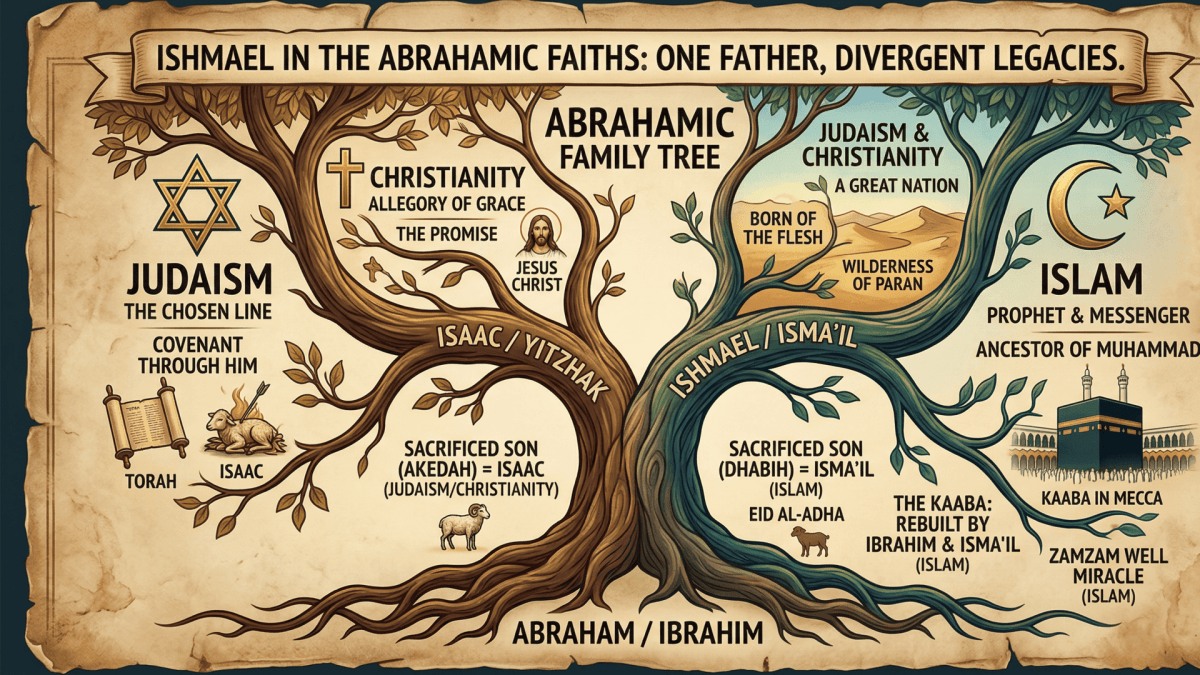
Who is Ishmael?
Ishmael is one of the most ancient and influential figures in human history. He is primarily regarded as a highly important historical and religious figure in the three major monotheistic religions: Judaism, Christianity, and Islam. He was the eldest son of Father Abraham and Mother Hagar. In religious texts, he is depicted as a man blessed by God, whose descendants later formed a vast nation. Although his life story is told from different perspectives in various religions, his historical significance is undeniable everywhere.
Why Ishmael is Important in Multiple Religions
Ishmael was not just an ordinary man, but a living symbol of God’s promise. According to the Abrahamic religions, God carried out part of His grand plan through Ishmael. In Islam, he is recognized as an honored prophet and the patriarch of the Arab people. On the other hand, in Judaism and Christianity, he is revered as Abraham’s firstborn and the founder of an independent nation. For ages, people have found lessons of faith, patience, and reliance on God from his life story. For this reason, Ishmael’s name is still remembered with deep respect in the world’s major religions.
Understanding Religious Perspectives on Ishmael
To truly understand Ishmael, we must look at the specific texts and traditions of different religions. Each religion has interpreted the story of Ishmael from its own theological context. By understanding these perspectives, we not only learn about Ishmael but also more easily grasp the similarities and differences among these religions. Let us try to understand Ishmael deeply from the perspectives of various religions one by one. Reliable sources, such as the Encyclopedia Britannica, also acknowledge his immense historical and religious importance.
Ishmael in Judaism
How Judaism Describes Ishmael
In Judaism, Ishmael is recognized as Abraham’s first child. According to the Hebrew Bible or Tanakh, he was a person blessed by God. Although the primary divine promise or “covenant” in Judaism continues through Isaac, Ishmael is never disregarded. In Rabbinic literature, Ishmael is honored as the father of a strong and independent nation.
Ishmael, the Son of Abraham and Hagar
When Abraham’s wife, Sarah, was childless, she proposed that Abraham take Hagar, an Egyptian maidservant, as a wife. As a result, Ishmael was born. In Jewish texts, Hagar is depicted as a highly devout and God-fearing woman. God promised Hagar that her child’s descendants would be countless. The name Ishmael means “God hears” because God had heard Hagar’s distress. This proves that Ishmael was under God’s special care from birth.
The Role of Ishmael in the Book of Genesis
Detailed accounts of Ishmael’s life are found in the Book of Genesis in the Bible. It states that Ishmael grew up in the wilderness and became known as a skilled archer. When Hagar and Ishmael were exiled into the desert, God protected them and provided them with water. In the Book of Genesis, God explicitly tells Abraham that He will also make a great nation out of Ishmael because he is Abraham’s offspring. This is a major proof of God’s infinite mercy toward Ishmael in Jewish tradition.
The Relationship Between Ishmael and Isaac in Jewish Tradition
The relationship between Ishmael and Isaac is a significant topic of discussion in Jewish tradition. Although there was some psychological distance between them initially, Jewish scriptures mention that after Abraham’s death, both Ishmael and Isaac came together to bury their father. This event is a beautiful example of their brotherhood and reconciliation in later life. Many Jewish scholars believe that Ishmael repented in the latter part of his life and completely surrendered to God’s path.
Ishmael in Christianity
How Christianity Describes Ishmael
In Christianity, Ishmael’s identity is primarily derived from the accounts in the Old Testament. However, in the New Testament, the story of Ishmael takes on a new symbolic dimension. Christians have historically acknowledged Ishmael as Abraham’s son and recognized God’s presence in his life. Yet in Christian theology, Isaac is accorded greater importance as the “child of promise.”
Ishmael in the Old and New Testaments
The story of Ishmael in the Old Testament is basically similar to the Jewish narrative. God’s mercy and the promise that Ishmael’s lineage will multiply are clearly stated there. But in the New Testament, specifically in Paul’s letters (Galatians), the story of Ishmael and Isaac is used differently. Paul highlights a metaphorical meaning alongside the historical events, which form a large part of Christian theology.
Symbolic Interpretation of Ishmael in Christian Theology
In a significant part of Christian theology, Ishmael is seen as a symbol of human effort, whereas Isaac represents God’s promise. According to Paul, Ishmael was born in the ordinary human way, but Isaac was born through God’s miraculous promise. Through this metaphor, Christians are taught to rely on God’s grace rather than on their own capabilities. This metaphor is not used to demean Ishmael but to impart spiritual teachings to Christian believers.
Lessons for Christians from the Story of Ishmael
Christians draw lessons of God’s providence from the life of Ishmael. When Hagar and Ishmael were thirsty and helpless in the desert, God heard their cries and saved their lives. This strengthens the Christian belief that God cares for even the most vulnerable and marginalized people in society. God never forgets anyone, which is one of the greatest Christian lessons to be drawn from the story of Ishmael.
Ishmael in Islam
How Islam Describes Ishmael
In Islam, Ishmael is highly esteemed as a Prophet and Messenger. He is considered the ultimate symbol of sacrifice, patience, and complete submission to God in Islamic tradition. In Islam, Ishmael is not only the son of Abraham, but also the patriarch of the Arab nation and a prominent ancestor of Prophet Muhammad. Information repositories like Wikipedia detail his immense significance in Islam.
Prophet Ishmael in the Quran
The name of Ishmael is mentioned with great respect several times in the Holy Quran. He is described as truthful, a keeper of promises, and a chosen servant of God. The Quran states that he used to instruct his family to perform Salah (prayer) and pay Zakat (charity). This proves that he was not only righteous himself but also played a major role in building an ideal society.
Ishmael’s Role in Building the Kaaba with Abraham
One of the greatest acts of Ishmael in Islamic tradition is the construction of the Holy Kaaba. According to the Quranic narrative, father Abraham and son Ishmael jointly laid the foundations of the Kaaba in Mecca. As they were raising the walls of the Kaaba, they both prayed to God to accept their work and to raise a Muslim Ummah or submissive nation from their descendants. Building the Kaaba was not just about erecting a structure; it was about establishing a great symbol of monotheism on earth.
The Story of Sacrifice in Islamic Tradition
The most notable event in Ishmael’s life in Islam is the story of the sacrifice. According to Islamic belief, God instructed Abraham in a dream to sacrifice his most beloved possession. Abraham realized he was being asked to sacrifice his beloved son Ishmael. When he informed Ishmael of this, Ishmael asked his father very calmly and firmly to carry out God’s command. This supreme readiness for self-sacrifice on the part of Ishmael is still celebrated in Islam today through Eid al-Adha. While Judaism and Christianity consider Isaac as the intended sacrifice, Islam definitely regards Ishmael as that son.
Ishmael as an Ancestor in Arab Genealogy
Ishmael is called “Abu al-Arab,” meaning “father of the Arabs.” He began living with the Jurhum tribe in Mecca and adopted their language and culture. Through his descendants, various tribes of northern Arabia emerged. Most importantly, the Prophet of Islam, Muhammad, is a direct descendant of Ishmael. For this reason, the historical and spiritual status of Ishmael is so massive for Muslims.
Ishmael in Other Traditions
Bahá’í Faith
In the Bahá’í Faith, Ishmael is also viewed with great respect. According to the Bahá’í belief, God has sent many messengers from age to age to guide humanity. Abraham and his family are an important part of that spiritual chain. Bahá’ís believe that God’s blessing was also upon Ishmael and that many of God’s great plans were realized through him. In Bábí and Bahá’í scriptures, the sacrifice of Ishmael and his devotion to God are remembered with praise.
Historical and Comparative Religious Perspectives of Ishmael
Historically, Ishmael’s character serves as a bridge among various ancient Middle Eastern civilizations. Many folktales and historical accounts have been built around him. In comparative theology, Ishmael is a fascinating figure because, although his life story is interpreted differently in various religions, the core essence remains the same. He is a living testament to the existence of God, divine mercy, and the divine orchestration of human history.
Ishmael in Literary and Cultural Traditions
Beyond religious texts, the name Ishmael is widely used in literature and culture. In Western literature, the name “Ishmael” is often used as a metaphor for an exile, a wanderer, or a person alienated from mainstream society. The most famous example of this is Herman Melville’s world-renowned novel Moby-Dick, which begins with the exact sentence “Call me Ishmael.” Here, through the name Ishmael, the author portrays an independent, lonely, and spiritual truth-seeking character.
Comparing Religious Perspectives of Ishmael
Similarities Among Jewish, Christian, and Islamic Accounts
There are some fundamental similarities regarding Ishmael across the three major religions. Firstly, everyone agrees that he is the son of Abraham and Hagar. Secondly, all religions acknowledge that Ishmael was blessed by God and that his descendants grew into a great nation. Thirdly, the saving of Hagar and Ishmael in the desert is remembered with deep emotion in Jewish, Christian, and Islamic traditions alike. It is a wonderful example of God’s universal mercy.
Key Differences in the Narratives of Ishmael
Alongside similarities, there are also several important differences. The biggest difference centers around the event of the sacrifice. Jews and Christians believe that God asked for Isaac to be sacrificed, whereas Muslims believe that the son was Ishmael. Furthermore, in Judaism and Christianity, Isaac is seen as the primary bearer of God’s covenant. In contrast, in Islam, both Ishmael and Isaac are considered prophets of equal dignity, with Ishmael directly associated with Mecca and the Kaaba.
Why Ishmael is a Common Patriarch
Despite the differences, Ishmael serves as a powerful link among the Abrahamic religions. He is a patriarch whose life is intrinsically tied to Jewish history, Christian spiritual metaphors, and Muslim roots. In religious dialogues, the character of Ishmael can be an effective means of fostering mutual respect and understanding.
Family and Legacy of Ishmael
Hagar and Abraham in the Story of Ishmael
Ishmael’s life story is incomplete without his father, Abraham, and his mother, Hagar. Abraham loved Ishmael deeply. When Sarah demanded that Hagar and Ishmael be sent away, Abraham was extremely grieved. Later, upon receiving God’s command, he bid them farewell. On the other hand, Hagar symbolizes ultimate maternal affection and reliance on God. Hagar’s historic running between the hills of Safa and Marwa in search of water in the desert is still commemorated by millions of Muslims during the Hajj pilgrimage.
Ishmael and Isaac: Brotherhood and Conflict
Ishmael and Isaac were half-brothers. There are various interpretations of religious texts regarding their relationship. While there are hints of some conflict during their childhood, they complemented each other in later life. Their uniting after Abraham’s death proves that blood ties and brotherhood ultimately prevailed. This brotherhood can serve as a model for peaceful coexistence among people of different religions in the modern world.
Descendants of Ishmael in Religious Traditions
The twelve sons of Ishmael are mentioned in the Book of Genesis, each of whom became the head of a large tribe. These tribes spread across different regions in Arabia. Historically, they were called “Ishmaelites.” In Islam, this lineage has been preserved with great care because the arrival of Islam on earth happened through this very line. The descendants of Ishmael have expanded their historical influence not only in Arabia but also worldwide.
Historical and Symbolic Perspectives
Was Ishmael a Historical Figure?
There is a long-standing discussion among historians and archaeologists about the historicity of Ishmael. Although it is difficult to prove the existence of Ishmael with direct archaeological evidence, many tribal names found in ancient Middle Eastern documents and inscriptions match those of Ishmael’s descendants mentioned in the Bible and the Quran. Therefore, modern historians believe that there is a very strong historical foundation for the character of Ishmael, preserved in texts and oral traditions for thousands of years.
The Role of Ishmael in Ancient Near Eastern Traditions
The nomadic lifestyle was common in the Ancient Near East. Ishmael’s life in the desert, his skill as an archer, and his relationships with various tribes present a perfect picture of the socio-economic conditions of that era. He was a connecting medium between urban civilization and the nomadic life of the desert.
Symbolic Meanings Associated with Ishmael
In the pages of history, Ishmael is not just a human being; he is a massive symbol. For those who are outcasts from society, those who are helpless, and those struggling in a harsh reality like a desert, Ishmael is their representative. He proves that even if someone falls short in human judgment, everyone is equal in the eyes of God. God’s mercy is not confined to any specific tribe or boundary.
Moral and Spiritual Lessons
Lessons of Faith and Patience from the Story of Ishmael
The story of Ishmael and his mother, Hagar, is a timeless example of patience. Surviving in a desolate desert with little water and food was a massive test for them. They did not despair, but placed their full trust in God. From Ishmael’s life, we learn that no matter how difficult the situation may be, with faith and patience, God will find a way out.
Family Relationships and Divine Promises
Ishmael’s life beautifully highlights the complexities of family relationships. Conflict with a half-brother, separation from a father, and the lonely struggle of a mother all combine to create a realistic family picture. But above all, this was the promise of God. God kept every word of the promise He made to Abraham. This teaches us that human promises may break, but God’s promises never fail.
The Narrative of Faith and Survival in the Desert
The desert symbolizes hardship and isolation. Ishmael’s story of survival in the desert can be compared to the difficult times in our personal lives. There are times in our lives when we feel our surroundings are like a dry desert. Ishmael’s story inspires us that even in that desolate desert, God can hear our call, and a new source of life or a ‘Zamzam’ well can be created there, too.
Frequently Asked Questions (FAQs)
Which religions mention Ishmael?
Primarily, the three large monotheistic religions, Judaism, Christianity, and Islam, contain mentions and detailed accounts of Ishmael. Besides, he holds an honorable position in other faiths, such as the Bahá’í Faith.
Is Ishmael mentioned in the Quran and the Bible?
Yes, Ishmael is clearly mentioned in both the Holy Quran and the Holy Bible. In the Old Testament of the Bible (especially the Book of Genesis) and in various chapters of the Quran, the life of Prophet Ishmael is described with great importance.
What is the difference between Ishmael in Islam and Christianity?
In Christianity, although Ishmael is historically recognized as Abraham’s son, it is believed that God’s main promise came through Isaac. On the other hand, in Islam, Ishmael is honored as a great prophet, the builder of the Kaaba, and an ancestor of Prophet Muhammad. In Islam, Ishmael is believed to be the son whom Abraham intended to sacrifice.
Why is Ishmael important in Islamic tradition?
Ishmael is important in Islamic tradition because he is the ultimate symbol of patience and devotion. His unwavering consent to sacrifice himself upon the command of his father Abraham is a major example of “submission,” the core foundation of Islam. Furthermore, his contribution to the construction of the Holy Kaaba has immortalized him in Islamic history.
What can we learn from the story of Ishmael?
From the story of Ishmael, we learn profound faith in God, patience in the face of extreme danger, and the lesson never to give up under any circumstances. It reminds us that God never abandons the helpless and has a beautiful plan for everyone.
Conclusion
Final Thoughts on Ishmael in Different Religions
The life of Ishmael is an excellent blend of history and theology. Although he is evaluated from different perspectives in Judaism, Christianity, and Islam, everyone agrees on one thing: he was a figure specially favored by God. His life story reminds us of ancient social systems, religious beliefs, and the indomitable human will to survive.
Understanding a Common Religious Tradition Through Ishmael
In this modern world, where divisions are often created in the name of religion, figures like Ishmael can serve as a symbol of unity. When Jews, Christians, and Muslims read the story of Ishmael, they essentially find the same roots. Just as Ishmael and Isaac eventually reunited, the followers of these religions can also unite through mutual respect and love.
Why the Story of Ishmael Continues to Influence Religious Traditions
Although thousands of years have passed, Ishmael’s relevance has not diminished in the least. The stories of sacrifice, hardship, and success, intertwined with his life, touch the eternal aspects of human nature. As long as religion and spirituality exist on earth, Ishmael will live on in people’s hearts as an inspiring patriarch, an ideal son, and a great prophet. His story repeatedly reminds us that the power of faith and love can overcome any obstacle.