
Benefits and Risks of Artificial Intelligence
Introduction to Artificial Intelligence
One of the biggest and most groundbreaking discoveries of the current century is artificial intelligence, or AI. It has brought an unprecedented change to the way we work, communicate, and live our daily lives. From the smartphone alarm that wakes us up in the morning to the social media news feeds we scroll through before going to sleep at night, we rely on AI at every step. As we move forward, all of us need to understand the benefits this technology will bring and the risks it may entail. In this article, we will discuss various aspects of artificial intelligence to give you a clear, realistic idea of this amazing technology.
Understanding the Rapid Growth of AI Technology
The development of AI technology has happened at an unimaginable speed over the last few years. What was limited only to the pages of science fiction a decade ago is now right in the palms of our hands. There are mainly three reasons behind this rapid growth. First, the expansion of the internet is generating massive amounts of data that help train AI models. Second, there has been an incredible improvement in computer processing power and hardware. Third, thanks to cloud computing, anyone can now access powerful computing resources if they want to. For example, organizations like OpenAI and Google have created state-of-the-art large language models that can generate text, write code, and answer complex questions just like humans.
What is Artificial Intelligence and Why is it Important?
In simple terms, artificial intelligence is a technology that enables machines and computers to think, make decisions, and solve problems as humans do. It is designed so that the computer can learn from its past experiences and adapt to new situations.
Its importance is immense. AI is not just a new tool; it is a transformative force. It can multiply our productivity, help find cures for complex diseases, and play a crucial role in tackling global issues like climate change. To survive and thrive in today’s fast-changing world, adopting AI technology is the only viable option.
How Artificial Intelligence Works
Artificial intelligence is not a single technology; it is a combined form of many different branches and technologies. An AI system typically receives vast amounts of data, analyzes patterns within it, and makes predictions or decisions based on those patterns. Its workflow can be divided into a few parts.
Machine Learning and Deep Learning
Machine learning (ML) is a branch of AI in which computers learn from data without being explicitly programmed. It primarily works using algorithms and statistical models. On the other hand, deep learning is an advanced level of machine learning. It uses an “artificial neural network” that mimics the structure of neurons in the human brain. Deep learning is highly effective in analyzing massive amounts of data and identifying extremely complex patterns.
Natural Language Processing (NLP)
Natural language processing, or NLP, helps computers understand, interpret, and generate human language. When you talk to Google Assistant or ChatGPT, it uses NLP to analyze your words and provide the correct answer. It is widely used for tasks such as translation, sentiment analysis, and text summarization.
Computer Vision and Robotics
Computer vision technology enables AI systems to extract meaningful information from images and videos. How a self-driving car identifies traffic signals and pedestrians is an excellent example of computer vision. Combined with robotics, smart machines are being built that can move independently in the physical world and perform various tasks just like humans.
The Evolution of Artificial Intelligence
The history of artificial intelligence is quite old. In the 1950s, British mathematician Alan Turing first raised the question, “Can machines think?” The “oncept of AI essent” ally took institutional form through his “Turing Test.” Then, the term Artificial Intelligence was first officially used at the Dartmouth Conference in 1956. Although its progress was quite slow in the early days, AI caught everyone’s attention anew when IBM’s Deep Blue supercomputer defeated world chess champion Garry Kasparov in 1997. And today, in the era of generative AI, it is pushing beyond the boundaries of our imagination.
Main Types of Artificial Intelligence
Based on capabilities and functionality, artificial intelligence can be generally divided into three main categories.
Narrow AI
Narrow AI or Weak AI is a type of AI designed to do only a specific job or task. All the AI we currently use falls under the category of Narrow AI. Apple’s Siri recommendations on e-commerce websites and weather forecasting algorithms are all examples of this. While they are highly efficient in their respective fields, they cannot work outside their designated boundaries.
General AI
General AI (AGI) or Strong AI is a theoretical stage where an AI system’s intelligence will match that of a human. It will be able to perform any intellectual task with the same skill and logic as a human being. Scientists have not yet achieved this level of AI, but top research institutions worldwide are working towards it. If successful, it would be the biggest discovery in human history.
Superintelligent AI
Superintelligent AI, or ASI, is the extreme stage of AI in which machine intelligence surpasses the collective intelligence of all humanity. It will not only think like a human but will also be far ahead of humans in creativity, common sense, and problem-solving. Although it is still science fiction, many scientists have already begun researching its potential impact.
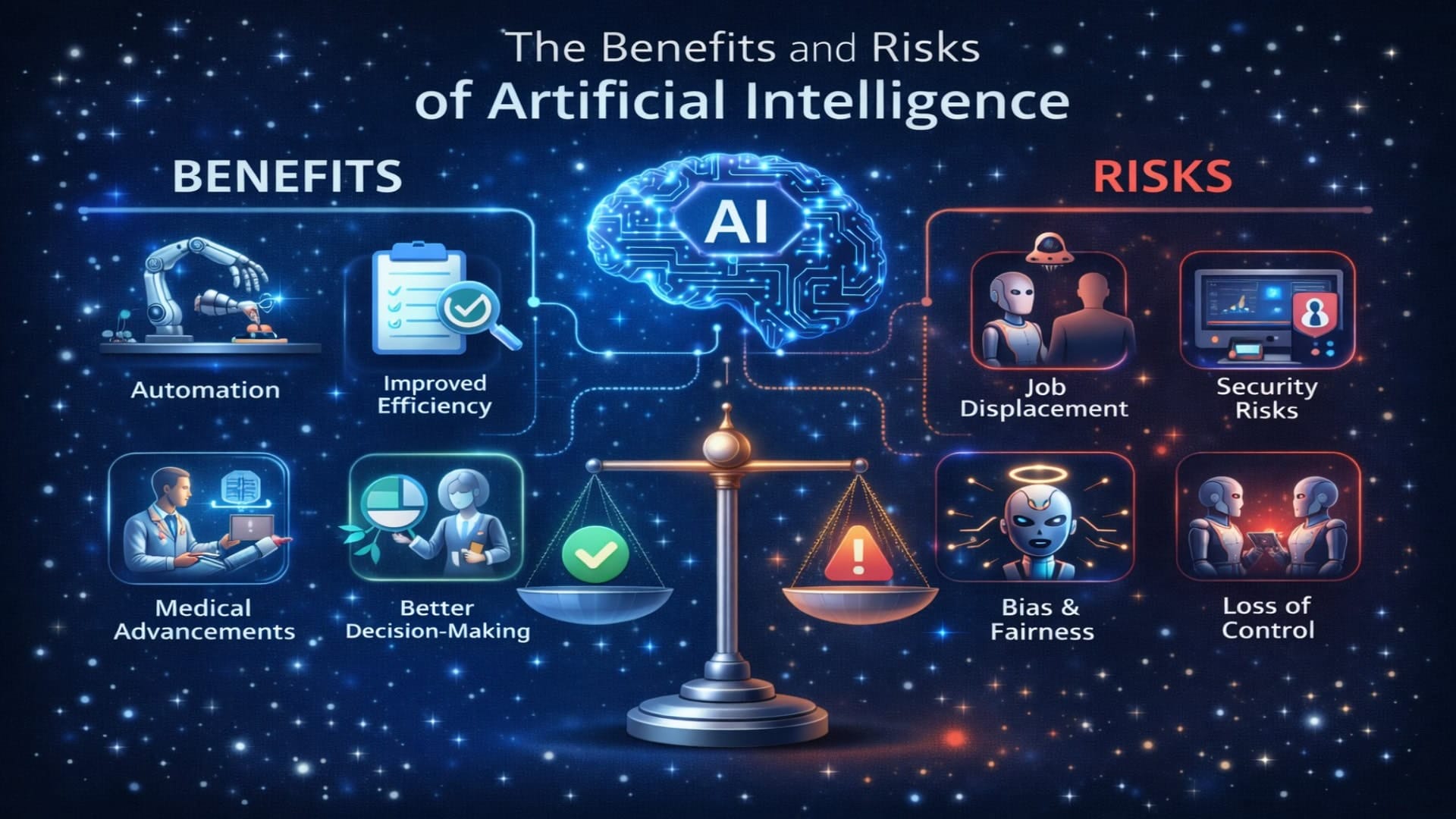
Major Benefits of Artificial Intelligence
AI is making an extraordinary contribution to all sectors, from our personal lives to the global economy. The main benefits are discussed in detail below.
Increased Efficiency and Automation
The biggest advantage of AI is its ability to automate tedious, repetitive tasks. This saves people time and allows them to focus on more creative and important work. From data entry to every stage of product manufacturing in massive factories, AI systems can complete work faster and more accurately than humans.
Improved Decision Making
Accurate information and analysis are required to make the right decisions. AI can analyze terabytes or petabytes of data in a matter of minutes and provide accurate insights. From reducing investment risks in businesses to determining marketing strategies, AI-based decision-making is becoming much more fruitful than before.
Advanced Healthcare and Medical Research
AI is causing a silent revolution in the healthcare sector. According to the World Health Organization and various medical journals, AI can provide even more flawless results than doctors in analyzing MRI and X-ray reports and detecting cancer. In addition, AI models are performing time-consuming tasks, such as discovering new drugs, in a few months rather than years, helping save millions of lives.
AI in Education and Personalized Learning
The learning style and pace of all students are not the same. AI-based educational platforms can analyze each student’s strengths and westudent’sand create fully customized lesson plans. This is making the education system much more inclusive and effective.
Smart Business Operations
The use of AI in supply chain management, inventory tracking, and human resource management is drastically reducing costs for businesses. AI chatbots provide customer service 24 hours a day, increasing customer satisfaction while significantly reducing the company’s operating costs. The company’s transportation and Logistics
Self-driving or autonomous vehicles are on the verge of completely changing the transportation system. With the help of AI, it is becoming possible to reduce traffic jams, lower the accident rate, and save fuel. Logistics companies are using AI to determine the fastest and most cost-effective routes for product delivery.
Improvement of Cybersecurity
Cyber attacks are a major threat in the digital age. AI-powered cybersecurity systems can quickly detect abnormal network behavior and thwart malware or hacking attempts. This helps security teams stay one step ahead of hackers.
Enhanced Customer Experience
When you visit an online shop, AI analyzes your previous shopping history and presents your favorite products to you. Platforms like Netflix or Spotify use AI to give you wonderful movie or song suggestions, making the customer experience truly unique.
Scientific Discovery and Innovation
From space research to ocean-floor exploration, AI is helping scientists make new discoveries everywhere. AI has become an indispensable tool for analyzing vast datasets in complex fields such as genomics, quantum physics, and materials science.
How AI is Transforming Industries Worldwide
The world’s major industrial sectors are undergoing a complete transformation with the touch of AI. In agriculture, farmers are using AI drones to detect crop diseases and apply irrigation at the right time. ..In the finance sector, AI algorithms are trading on the stock market within milliseconds and preventing credit card fraud. In the manufacturing industry, AI-driven robots are controlling product quality. ..In every industry, AI is creating new business models and income sources.
Risks and Challenges of Artificial Intelligence
Like any powerful technology, AI also has some dark sides and risks. If these are not resolved, humanity may have to pay a heavy price in the future.
Job Displacement and Workforce Shifts
Due to AI automation, many people are at risk of losing their jobs. Tasks like data entry, customer service, proofreading, and basic coding are being easily taken over by AI. Although AI is also creating many new jobs, acquiring the necessary skills for those new roles is not easy for everyone. As a result, there is a strong fear of rising unemployment and inequality.
Data Privacy and Security Concerns
Data is the primary food for AI systems. AI companies are collecting everything from your browsing history, location, and shopping habits to your personal photos. If this massive amount of personal data falls into the wrong hands, it can take a terrible turn. Incidents like identity theft, financial fraud, and state surveillance have already become a cause for concern.
Bias and Ethical Issues in AI Systems
AI models are trained using data created by humans. Therefore, various prejudices and biases of human society easily creep into AI. In many cases, AI systems used for recruiting or loan approval have been observed to exhibit bias towards people of specific genders or races. This is extremely harmful socially.
Misinformation and Deepfake Technology
With the help of generative AI, it is now possible to create highly flawless fake images, audio, and videos known as deepfakes. Through this, any reputable person can be made to say things they never actually said. The misuse of this technology to gain political advantage, spread rumors, and ruin people’s reputations is a threat to democracy and society.
Overreliance on Automation
If people become dependent on AI for every minor task, human creativity, problem-solving skills, and critical thinking abilities may slowly decline. If the technology fails or a cyberattack occurs, this excessive dependence could paralyze the entire system.
AI Safety and Regulatory Challenges
The development of AI technology is happening so quickly that governments and regulatory bodies are struggling to keep up. The creators themselves often cannot properly explain how an AI model reaches a decision, a phenomenon known as the “black box” problem. The u”control” use of such technology could invite fatal disasters in the future.
Ethical Considerations in Artificial Intelligence
Ethics should be given the highest priority in the development of AI. It is the moral responsibility of developers to ensure that an AI system does not harm humans, increase discrimination, or violate human rights. Transparency and accountability should be the core foundation of AI design. If an AI makes a mistake in its decision, it is extremely important to clearly determine who will bear responsibility.
The Role of Government and Regulations in Artificial Intelligence
Governments around the world have already begun taking steps to address the negative impacts of AI. For example, the European Union (EU) has passed its historic AI Act, which will bring high-risk AI systems under strict regulation. By strengthening data privacy laws, funding AI research, and imposing bans on harmful AI applications, governments are working to build a safe digital world.
Artificial Intelligence and Human Creativity
It was once thought that creativity was the exclusive right of humans. But AI tools like Midjourney, DALL-E, or ChatGPT have changed that notion. AI can now draw excellent pictures, write poems, and compose music. However, this does not destroy human creativity; rather, with the help of AI, humans can express their imagination more fully. Treating AI as a co-artist instead of a competitor is the need of the hour.
Can Artificial Intelligence Replace Human Intelligence?
This is the most discussed question of our time. The simple answer is that AI will not be able to completely replace human intelligence, at least in the near future. AI can process massive amounts of data and recognize patterns, but AI does not have human-like emotions, empathy, common sense, or moral judgment. No machine has yet become an alternative to humans in building human relationships and making the right decisions in complex social situations.
The Impact of Artificial Intelligence on Society and Daily Life
Our daily lives are now deeply influenced by AI. From controlling the temperature of smart homes to reaching our destinations by avoiding traffic jams via Google Maps, everything is a contribution of AI. However, problems such as social isolation and increased screen time are also emerging as a result of its impact. People are spending more time in the virtual world than socializing with each other, which is hurting mental health.
Future Trends in Artificial Intelligence
In the future, AI will become even more intuitive and blend seamlessly with us. When AI is combined with quantum computing, its processing power will reach incredible levels, potentially bringing solutions to problems like climate change and incurable diseases. Alongside this, “Edge AI” technology will “expand, “with data processed directly on our devices (such as phones and smartwatches) rather than in the cloud. This will further secure data privacy.
How Businesses Can Prepare for an AI-Driven Future
To survive, businesses must quickly adapt to AI technology. Employees need to be trained on using AI tools, a process known as upskilling. Data management systems must be improved, and a clear strategy must be created outlining which areas of the business will benefit from applying AI. Most importantly, a positive and flexible attitude towards change must be maintained.
Tips for Using Artificial Intelligence Responsibly
As general users, we should use AI responsibly. Instead of blindly trusting any AI-generated information, its authenticity should be verified through fact-checking. Refrain from sharing sensitive personal information with AI chatbots or platforms. Besides, it is extremely important to raise awareness to protect yourself and others from the spread of deepfakes and other misinformation.
Common Misconceptions About Artificial Intelligence
People have many misconceptions about AI. Many think that AI has its own thinking power or consciousness, which is not true at all. AI is merely a form of code and mathematical models. Furthermore, the idea that AI will one day destroy the world, as in Hollywood sci-fi movies, is also baseless. According to scientists, through proper rules and human control, it is possible to use AI for the welfare of humanity.
Frequently Asked Questions About Artificial Intelligence
What are the main benefits of artificial intelligence?
The main benefits of artificial intelligence include increased speed and accuracy of work, automation, improved decision-making, and bringing groundbreaking changes in healthcare, education, and business. It can provide fast solutions to extremely complex problems through data analysis.
What are the biggest risks of artificial intelligence?
Job loss or increased unemployment, violations of data privacy, bias in AI systems, and the spread of fake information through deepfake technology are the biggest risks posed by AI.
Is artificial intelligence dangerous?
Artificial intelligence is not dangerous on its own. However, its good or bad sides depend on who is using it, how, and for what purpose. If used with malicious intent and a lack of control, it can be fatally dangerous to society.
How is artificial intelligence changing the future?
AI is fundamentally changing the way we communicate, work, and live. It is improving healthcare, personalizing education, and modernizing industrial factories.
Can artificial intelligence be trusted?
AI systems are not completely flawless and can sometimes give false information or hallucinations. Therefore, when making important decisions, one should not blindly rely on AI; instead, apply human judgment and verify the results.
Final Thoughts on the Future of Artificial Intelligence
Artificial intelligence, or AI, is not a fleeting trend; it is a new chapter in the evolution of human civilization. Just as its endless possibilities open new horizons for us, its risks also send us a message: be careful. If we can ensure the proper use of this technology with clear rules, ethics, and awareness right now, AI will help ensure a safer, more prosperous future for us. Therefore, instead of fearing technology, we should learn to use it properly and stay prepared for the journey ahead.