Emerging Technologies in 2026: Ultimate Guide
Introduction
The world of technology is constantly evolving. As we navigate 2026, technology is redefining how we live and work every day. Things that seemed like pure science fiction just a decade ago are now our everyday reality.
New and advanced technologies are not only improving our quality of life but also making a massive impact on the global economy. In this blog post, we will discuss the most important technologies of 2026. Our goal is to introduce you to this brave new world in a way that is easy to understand and highly actionable.
Why Emerging Technologies Matter in 2026
Keeping up with technology is no longer an optional choice in today’s fast-paced world. It has become an absolute necessity. Emerging technologies are constantly creating new opportunities for all of us.
For businesses, these technologies are the primary tools for survival and growth. Organizations that fail to adopt new tech are quickly falling behind the competition. On the other hand, those who use it correctly are leading their respective industries.
For individuals, these technologies are opening up entirely new career paths. From healthcare to education, they are bringing positive changes to every sector. Therefore, understanding the emerging technologies of 2026 is crucial for everyone.
How Innovation is Shaping the Future of Industries
Every industrial sector is currently being transformed by the touch of technology. Organizations like the World Economic Forum regularly highlight how tech is reshaping the global economy. ..In the healthcare sector, robotic surgeries and AI diagnostics have become standard practices.
In the financial sector, blockchain technology has made transactions infinitely more secure. ..In agriculture, farmers are multiplying their yields by using smart sensors and drones. In the transportation industry, autonomous vehicles or self-driving cars are no longer just in the experimental phase.
These innovations are doing much more than just making work easier. They are creating entirely new business models. As a result, the future of industry is standing on a completely new framework.
What Are Emerging Technologies?
Emerging technologies are new tech innovations that are still developing but have the potential to make a massive impact over the next five to ten years. They have the power to radically change the world as we know it.
Simply put, technologies in their early stages that promise to bring monumental changes in the future are known as emerging technologies.
Understanding the Concept of Next-Generation Tech
Next-generation technology refers to innovations that eliminate the limitations of previous systems. For example, when we transitioned from 4G to 5G, internet speeds multiplied exponentially.
This concept is not limited to speed alone. It fosters the development of new ways of thinking. ..It finds solutions to problems that were previously thought to be impossible to solve. It is a brilliant combination of data, speed, and intelligence.
Next-generation technologies often complement each other. When Artificial Intelligence and the Internet of Things work together, the results are truly unimaginable.
How Emerging Technologies Differ from Existing Innovations
Existing technologies keep our current workflows running smoothly. Emerging technologies, however, completely restructure the entire system. While existing technology improves gradually, emerging technology brings revolutionary change.
Consider the difference between a standard calculator and an AI-powered chatbot. A calculator only computes based on the exact data you input. A chatbot, however, can converse with you, learn from your prompts, and make independent decisions.
Existing innovations enhance our current skills. Emerging technologies can serve as alternatives to human labor or create entirely new possibilities.
1. Artificial Intelligence (AI) and Machine Learning
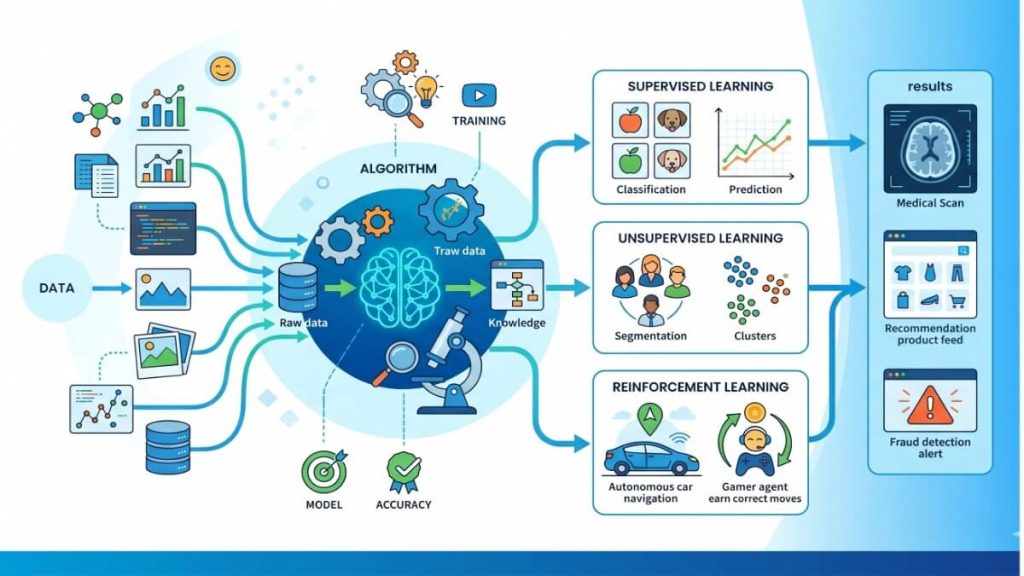
Artificial Intelligence (AI) is no longer a new buzzword. By 2026, it will have become an inseparable part of our lives. AI and machine learning are fundamentally changing the way we think and operate.
AI is the ability of a computer to think and reason like a human being. Machine learning is a branch of AI that enables computers to learn on their own without explicit programming.
How AI is Transforming Industries
The impact of AI on the industrial sector is massive. Manufacturing companies are now using AI to verify product quality. As a result, error rates have dropped to near zero.
AI has caused a revolution in logistics and supply chain management. It can instantly calculate the fastest and most cost-effective routes for transporting goods. According to McKinsey & Company, AI has the potential to add trillions of dollars to the global economy.
In customer service, chatbots and virtual assistants are now working as efficiently as humans. As a result, companies can provide uninterrupted customer support 24 hours a day.
Machine Learning in Everyday Applications
Machine learning is intertwined with our daily lives, often without us even realizing it. When you watch a movie on a streaming platform, the recommendations that follow are generated by machine learning algorithms.
The facial recognition system on your smartphone uses machine learning to identify your face. Its presence is everywhere, from email spam filters to live traffic updates on digital maps.
This technology is constantly learning from our preferences and habits. Consequently, it can provide us with a much more personalized and flawless service experience.
2. Generative AI and Large Language Models
Generative AI is a form of artificial intelligence that can create new text, images, audio, or video. Large Language Models (LLMs) are a prime example of this fascinating technology.
The generative AI we saw in 2023 or 2024 has become vastly more advanced and accurate by 2026. It is now a major collaborator in human creativity.
AI-Driven Content Creation and Automation
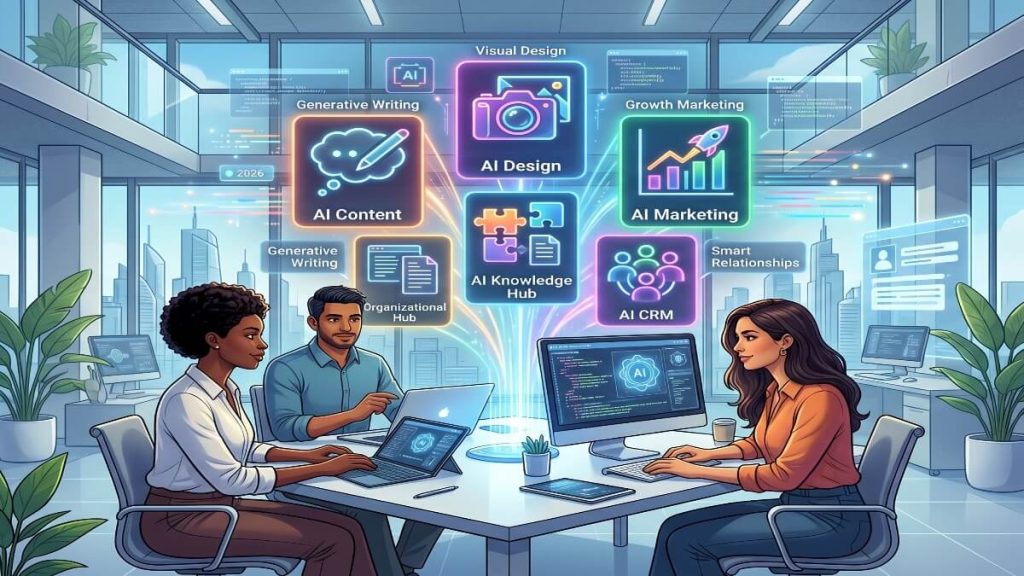
Generative AI has opened up a new horizon in content creation. It no longer takes hours to write a blog post, paint a digital picture, or compose a piece of music.
AI tools can produce high-quality content in a matter of seconds. Everything from marketing campaigns to social media posts can now be fully automated using AI.
However, this does not mean human creativity is obsolete. Instead, humans are now directing AI to produce even higher-quality work.
Real-World Uses of Generative AI
The application of generative AI is no longer limited to just generating text or images. Programmers are actively using this technology to write complex code. As a result, software development time has been cut by more than half.
In the healthcare sector, generative AI is used to design new molecular structures for life-saving drugs. Architects are utilizing it to draft innovative building designs.
Even in game development, generative AI plays a fantastic role in automatically generating new levels, environments, and characters.
3. The Internet of Things (IoT)
The Internet of Things (IoT) is a concept where everyday objects are connected to the internet. Everything from your kitchen refrigerator to your car’s engine can fall under this vast network.
These devices can exchange information with one another and make decisions without any human intervention.
Smart Devices and Connected Ecosystems
We are all somewhat familiar with smartwatches, smart TVs, or smart speakers. But IoT is not limited to just a handful of consumer devices. It creates a massive, fully connected ecosystem.
Your smartphone can instruct your home air conditioner to start cooling the house as you approach your neighborhood. This entire process happens automatically.
This connected ecosystem makes our lives much more comfortable and effortless. It saves us valuable time while also preventing energy waste.
IoT in Homes, Cities, and Industries
Smart homes are no longer a luxury reserved for the wealthy. Smart lighting, security cameras, and automated thermostats have made our homes safer and more energy-efficient.
City management heavily relies on IoT for smart city projects. Tasks such as traffic signal control, waste management, and water supply monitoring are now managed using smart sensors.
In the industrial sector, IoT is used to continuously monitor machine performance. Sensors can send warning alerts before a machine actually breaks down. This significantly reduces the risk of factory production halting.
4. Blockchain and Decentralized Systems
Blockchain technology originally gained popularity through cryptocurrencies like Bitcoin. However, it is strictly not limited to digital currencies. It is fundamentally a decentralized database system.
In this system, data is stored in a way that makes it nearly impossible to alter or hack. It creates a transparent, highly secure network.
Beyond Cryptocurrency: Real-World Applications
Blockchain technology is now being utilized well beyond banking and finance. It is an excellent solution for verifying product origin in a supply chain.
Whether a medicine or a food product is authentic can be easily traced on the blockchain. Additionally, using blockchain in digital voting systems can completely eliminate voter fraud.
Smart contracts are being used to ensure transparency in real estate transactions. These contracts are executed automatically only when specific pre-set conditions are met.
Security and Transparency in Digital Systems
In this age of relentless cyberattacks, data security is a major concern. Blockchain technology can provide a permanent solution to this problem because data is not stored on a single central server.
The data is distributed across the entire network. Therefore, a single hacker can’t compromise the entire system.
Furthermore, everyone on the network can view the record of every transaction or change. This has brought unprecedented transparency to digital systems.
5. 5G and Next-Generation Connectivity
5G, or fifth-generation internet connectivity, has completely changed our communication mediums. It surpasses all previous technologies not only in speed but also in reliability.
In 2026, 5G networks will have become widely available in almost every major city worldwide. It acts as a massive catalyst for the development of other new technologies.
High-Speed Internet and Low-Latency Communication
The biggest feature of the 5G network is its unbelievable speed. Downloading a high-definition movie now takes only a few seconds.
But what is even more important than speed is its low latency. Latency is the time it takes for data to travel from one point to another. In 5G networks, this latency is almost zero.
As a result, video calls, online gaming, and live streaming are now incredibly smooth. We can enjoy real-time experiences without any buffering whatsoever.
Enabling Smart Cities and Autonomous Systems
The 5G network serves as the backbone of smart cities and autonomous systems, such as self-driving cars. An autonomous vehicle has to process enormous amounts of data and make split-second decisions every single moment.
Due to 5 G’s low latency, these vehicles can communicate instantaneously with surrounding cars and traffic signals. This plays a massive role in reducing road accidents.
Additionally, tasks like remote robotic surgeries or drone deliveries are difficult to even imagine without the robust support of a 5G network.
6. Quantum Computing
Quantum computing represents a massive leap in computing. While standard computers use bits (0 or 1) to process data, quantum computers use quantum bits or qubits.
It is hundreds of thousands of times more powerful than a standard supercomputer. It can perform calculations in seconds that would take traditional computers thousands of years to complete.
How Quantum Technology Works
The core foundation of quantum technology is based on the principles of quantum physics. A qubit can exist as both 0 and 1 at the same time, a phenomenon known as superposition.
Because of this unique trait, a quantum computer can analyze countless possibilities simultaneously. It can solve incredibly complex mathematical problems that are entirely beyond the capabilities of conventional computers.
While this technology is not yet fully open for general public use, its progress in laboratories is astonishing. Companies like IBM and Google are at the forefront of this sector.
Potential Breakthroughs in Science and Security
Quantum computing can bring revolutionary changes to science and medicine. Discovering new chemical compounds or analyzing the genetic structure of complex diseases can be done incredibly fast.
However, it also poses a significant challenge to cybersecurity. Current encryption and password systems are extremely weak against the sheer power of quantum computers.
That is why scientists are currently working diligently on creating quantum-safe cryptography. This will keep our digital data secure from future cyberattacks.
7. Augmented Reality (AR) and Virtual Reality (VR)
Augmented Reality (AR) and Virtual Reality (VR) are completely changing how we see and experience the world. VR takes you into a totally new digital environment. AR overlays digital elements onto the real world around you.
Together, these two technologies have created Mixed Reality or Extended Reality (XR), which is one of the main attractions of 2026.
Immersive Experiences in Work and Entertainment
In entertainment, VR games and movies provide us with a newly immersive experience. It feels as though you are physically present inside the game or movie yourself.
But it is not limited to just entertainment. VR and AR are being widely used for office work and virtual meetings. Even when sitting far apart, colleagues feel like they are sharing the same physical conference room.
For training doctors and pilots, VR simulators have proven to be a highly safe and cost-effective medium.
The Future of Mixed Reality Technology
The future of mixed reality technology is extremely bright. Through smart glasses, we will be able to browse the internet or view maps simply by looking at the real world.
The shopping experience is also fundamentally changing. Before buying clothes or glasses, you can see exactly how they will look on you right from your home using AR tech.
It is also bringing massive changes to the education sector. Students are no longer just reading textbooks. They can easily grasp complex subjects by interacting with fully 3D digital models.
8. Robotics and Automation
Robotics and automation are rapidly taking over physical labor tasks. Previously, robots were only used in factories for heavy lifting. Now, they have become an integral part of our daily lives.
Automation has significantly reduced human error and increased overall work speed across the board.
Smart Robots in Industry and Daily Life
Smart or collaborative robots (Cobots) are now being heavily used in manufacturing plants. They can work side by side safely with human workers.
In agriculture, robots are used for planting seeds and harvesting crops. From serving food in restaurants to delivering vital medicines in hospitals, robots are handling it all.
Even in our homes, smart vacuum cleaners and robotic lawnmowers have made daily chores significantly easier to manage.
How Automation is Shifting the Workforce
Many traditional jobs are indeed disappearing because of automation. But at the same time, it is creating completely new types of employment opportunities.
Humans now need skills such as operating, maintaining, and programming robots. The demand for mental and creative work is rising much faster than the demand for physical labor.
Acquiring new skills has become absolutely essential to adapt to this massive shift in the global workforce.
9. Edge Computing and Cloud Evolution
Cloud computing simplified how we store our data. But as the number of devices and the sheer volume of data increased, the pressure on cloud servers skyrocketed. Edge computing emerged as the perfect solution.
Edge computing is a technology where data is processed close to where it is created, at the ‘edge’ of the network, rather than being sent to a distant cloud server.
Processing Data Near the Source
When a self-driving car is moving, its sensors generate gigabytes of data every single second. The car simply does not have the time to send this data to the cloud and wait for instructions to come back.
This is exactly where edge computing steps in. It processes the data right inside the vehicle and helps it make instantaneous, life-saving decisions.
This is highly effective not just for cars, but also for smart factories and IoT devices. It significantly reduces strain on internet bandwidth and dramatically speeds up operations.
The Future of Cloud Infrastructure
The rise of edge computing does not mean cloud computing is dead. Instead, these two technologies are now working seamlessly together.
Critical and time-sensitive data is processed at the edge. Meanwhile, data required for long-term storage or complex historical analysis is sent to the cloud.
This hybrid model will serve as the foundation for future technological infrastructure. It will make data processing much more cost-effective and highly efficient.
10. Green Tech and Sustainable Innovation
Climate change is currently one of the greatest threats to our world. There is no alternative to green technology when it comes to tackling this global crisis.
By 2026, sustainable innovation will no longer be just an empty corporate slogan. It has become the key to business survival and the preservation of our planet.
Eco-Friendly Solutions for a Better Future
Technology companies are actively working to reduce their environmental footprint. Data centers consume massive amounts of electricity and generate intense heat. They are now being cooled using highly eco-friendly methods.
The use of electric vehicles (EVs) has increased dramatically to reduce carbon emissions. The adoption of renewable energy sources, like solar panels and wind turbines, is now far more affordable.
Extensive research is underway to develop fully biodegradable materials that can completely replace harmful plastics.
Renewable Energy and Smart Sustainable Systems
Advanced battery technologies have been developed to efficiently store renewable energy. Smart grid technology has made the distribution of electricity much more effective.
A smart grid can automatically detect where electricity is needed most and distribute it accordingly. This actively prevents the massive waste of electrical power.
These earth-saving technologies are not just protecting the planet. They have also successfully created a massive new global market.
The Benefits of Emerging Technologies
The benefits of new technologies are truly endless. They have made our lives easier, safer, and much more comfortable. Let’s look at a few of the primary advantages.
Increased Efficiency and Productivity
Thanks to automation and AI, the speed of work has multiplied significantly. Humans are finally free from monotonous and highly repetitive tasks.
Robots and software can execute tasks much faster and more flawlessly than humans. Consequently, overall productivity has surged. Companies can now produce more goods or services at a fraction of the cost.
Enhanced Connectivity and Communication
Thanks to 5G and smart devices, the entire world has truly become a global village. Geographical distance is no longer a barrier to human connection.
Thanks to advanced video conferencing and collaboration tools, remote work is now easier and more effective. People can seamlessly communicate and work with anyone, anywhere in the world.
Global Industry Transformation
Agriculture, healthcare, education, and banking are all transforming under the touch of technology. Entirely new business models are being born every day.
Developing nations are utilizing these technologies to rapidly catch up with the developed world. This is playing a significant role in reducing global inequality.
Challenges of Emerging Technologies
Every good thing has its drawbacks. Emerging technologies are no exception. Implementing them comes with several distinct challenges.
Security and Privacy Concerns
As technology expands, the risk of cyberattacks also increases. Our personal information, bank passwords, and health data are all stored digitally.
Hackers are constantly attempting to steal this sensitive information. Furthermore, maintaining personal privacy has become incredibly difficult due to the widespread use of smart cameras and tracking sensors.
There is a genuine fear among the general public regarding exactly how their data is being used.
Ethical and Regulatory Issues
When AI begins making decisions like a human, some serious ethical questions arise. If a self-driving car gets into a fatal accident, who is responsible? The owner of the car, or the programmer who wrote the code?
Additionally, AI systems can easily become biased if trained on flawed data. There is also the potential to cause societal chaos by creating fake audio or videos using Deepfake technology.
Formulating correct laws and ethical guidelines to tackle these issues is urgent. Many governments are still struggling to create laws that can keep pace with the sheer speed of technological advancement.
High Implementation Costs
Adopting brand-new technology is quite expensive. Setting up quantum computers or advanced robotics requires a massive financial investment.
It is very difficult for small or medium-sized businesses to make this kind of investment in the early stages. Consequently, large corporations gain a technological advantage and grow larger, while smaller companies struggle to keep up.
However, experts believe that the costs of these technologies will naturally decrease over time.
How Businesses Can Prepare for Emerging Technologies
To survive the fierce competition of the future, businesses must prepare right now. They need to embrace technology as a friend rather than fear it as a threat.
Investing in Innovation and Research
Companies must invest a portion of their profits directly into Research and Development (R&D). It is essential to continuously analyze exactly how the market is shifting.
They need to foster a workplace mentality that openly welcomes new ideas. New technologies can be safely tested through small, controlled pilot projects.
Upskilling the Workforce
Technology cannot do anything completely on its own. It requires skilled human operators to operate. Therefore, there is absolutely no alternative to continuous employee training.
Employees must be educated about new software, AI tools, and cybersecurity protocols. This upskilling process needs to be a regular, ongoing effort.
The companies that invest in upgrading their employees’ skills will lead the future.
Creating a Tech-Ready Strategy
Businesses must have a clear vision. They need to correctly identify which specific technology is most suitable for their unique operations.
Adopting a technology simply because a rival company is using it is not a smart move. A step-by-step implementation strategy must be created that aligns perfectly with the company’s specific goals and budget.
The Future of Tech Beyond 2026
What we are witnessing up to 2026 is perhaps just a single drop in the vast ocean of technology. In the coming decades, technology will easily surpass our wildest imaginations.
The Synergy of AI, Robotics, and Connectivity
In the future, no technology will operate in isolation. AI, robotics, and the Internet of Things will merge to create a brand new ecosystem known as AIoT.
Your home AI will read your body temperature and realize you are sick. It will automatically book a doctor’s appointment and dispatch a robot taxi to take you safely to the hospital.
This seamless synergy will simplify our lives in ways we can only begin to dream of today.
Predicting the Next Tech Revolution
Experts predict that the next massive technology revolution will be driven by biotechnology and neurotechnology. Scientists are actively working on technology to connect the human brain directly to computers.
Commercial space travel might soon become accessible to the general public. Thanks to clean energy innovations, the earth might finally heal and regain its pristine natural state.
The future is always uncertain. But there is absolutely no doubt that this relentless march of technology is guiding us into a magnificent new era.
Frequently Asked Questions (FAQs)
What are the most important emerging technologies in 2026?
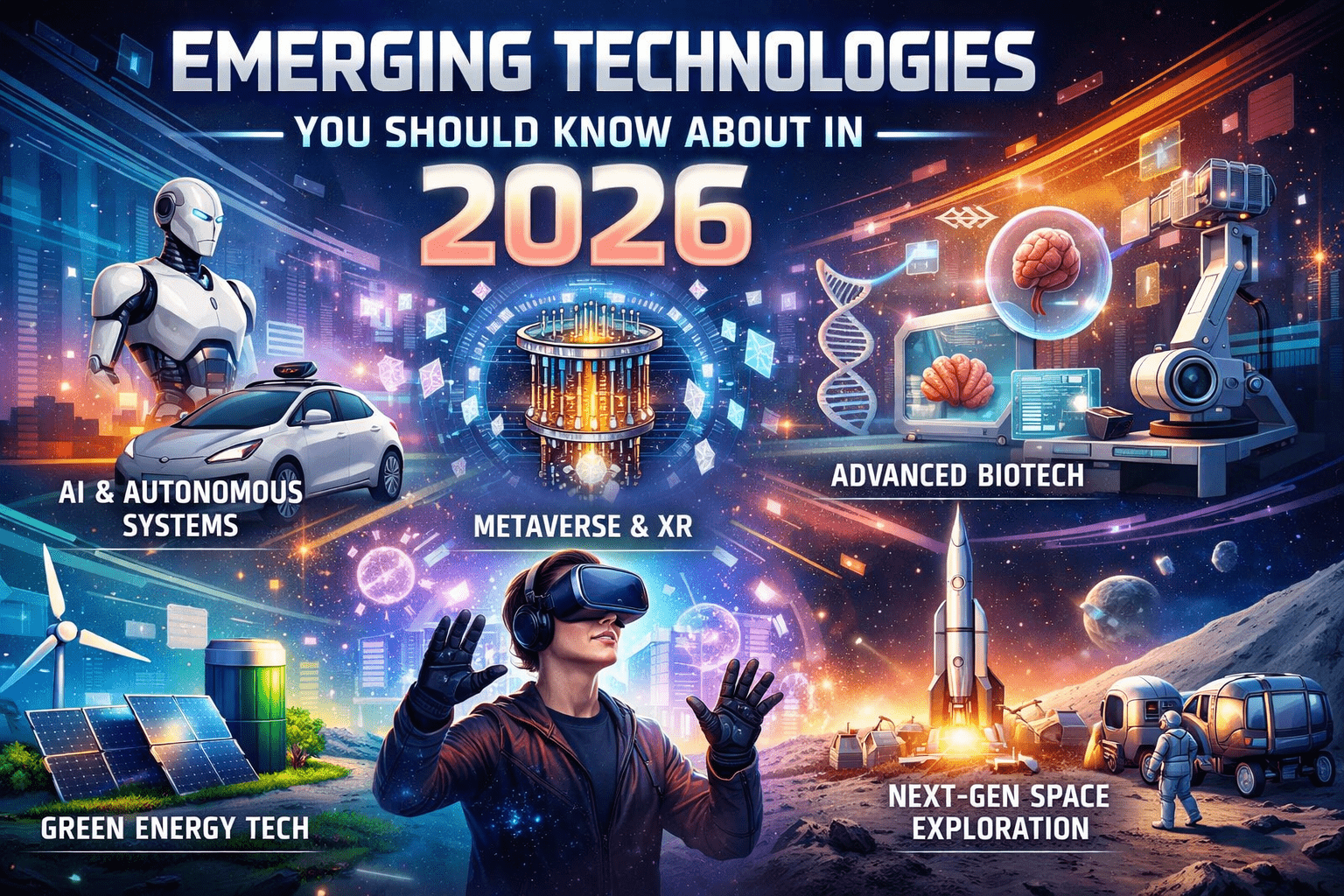
The most critical technologies in 2026 include Artificial Intelligence (AI), Generative AI, 5G internet, Quantum Computing, Blockchain, the Internet of Things (IoT), and Green or Sustainable Technology. Together, these technologies are reshaping our world.
How do emerging technologies affect businesses?
Emerging technologies dramatically speed up business operations and cut down costs. They help leaders make accurate decisions through advanced data analysis. They expand businesses by providing superior customer service. However, they also introduce new challenges, such as the need for robust cybersecurity and continuous employee upskilling.
Is AI the most important technology today?
Yes, AI is currently considered the most influential technology in the world. This is because it has the unique ability to integrate with and enhance almost all other technologies. From healthcare to finance, education, and entertainment, AI is driving monumental changes in every single sector.
What skills are required for tech-related jobs of the future?
Future jobs will require a solid understanding of AI operations, advanced data analysis, cybersecurity protocols, cloud computing, and blockchain mechanics. Alongside these hard skills, problem-solving abilities, creativity, and a strong eagerness to learn quickly are absolutely essential. Mental adaptability is now just as critical as technical proficiency.
How can I stay updated with new technologies?
To stay updated, you can follow tech-focused blogs, podcasts, and digital newsletters. Reading reputable websites, such as MIT Technology Review or Forbes Tech, regularly is highly beneficial. Furthermore, you can follow tech industry experts on LinkedIn or X (formerly Twitter) and take various online courses to master new subjects.
Conclusion
We are living in an incredible era where technology presents us with new miracles every single day. The tech trends of 2026 are not just a collection of random gadgets and software. They are the primary tools we will use to build our future.
Key Takeaways on Emerging Tech
The biggest lesson from this discussion is that we should not fear technology. AI and robots are not here to steal our jobs; they are here to elevate the quality of our work.
However, ensuring the correct and highly ethical use of technology is our collective responsibility. We must move forward by protecting our environment, not by destroying it.
Preparing for a Tech-Driven Future
The world of tomorrow will be entirely driven by technology. To keep pace with this world, we must change our traditional mindsets. We must maintain a burning curiosity to learn new things.
Whether you are a business owner, a student, or a working professional, technological knowledge will always keep you one step ahead of the curve. Let us all work together to prepare ourselves for this beautiful and highly promising future.