The Ultimate Stargazing Guide for Beginners
Introduction
Looking up at the night sky brings a profound sense of wonder and joy. Since ancient times, humans have used the stars to navigate across oceans, create fascinating myths, and try to unlock the deep mysteries of the universe. In the hustle and bustle of our modern mechanical lives, we have often forgotten about this incredible canvas right above our heads.
Stargazing is a beautiful experience that reconnects us with the natural world. It is not just about staring at the sky. It is about becoming part of an endless cosmic journey. This guide will help you take those very first steps into the universe with confidence and excitement.
Why Stargazing is One of the Most Rewarding Hobbies
Stargazing is much more than a simple pastime. It acts as a powerful source of mental peace and relaxation. There is truly nothing better than standing under a quiet, dark sky to wash away the stress and exhaustion of a long day.
Through this hobby, you get to experience science in a very personal way. When you lay eyes on a galaxy or a glowing nebula millions of light-years away, all your everyday worries tend to fade. It teaches us how small yet incredibly unique we are in this vast universe. This hobby builds patience and cultivates a deep respect for the wonders of nature.
How to Start Your Journey in the Night Sky
You do not need to spend a fortune on expensive devices to begin this thrilling journey into space. All you really need is a little curiosity, an open mind, and a bit of patience. Your own two eyes are your first and greatest tools for this adventure.
Start by choosing your roof, a balcony, or an open field where artificial lights are kept to a minimum. When you step outside, resist the urge to look straight up immediately. Give your eyes at least twenty minutes to adapt to the darkness. Slowly but surely, you will see a whole new mysterious world unfold above you.
What is Stargazing?
In simple terms, stargazing is the practice of observing celestial objects in the night sky. You can do this with your naked eyes or with the help of various optical tools. It is one of the oldest sciences in human history, which has now evolved into modern astronomy. Looking at the stars is quite literally looking back in time.
Basic Concepts of Night Sky Observation
Every bright point in the sky holds its own unique story and history. When we look at the night sky, we are not just seeing stars. We are actually looking deep into the past. This happens because the light from those stars has taken thousands or even millions of years to travel across space and reach our eyes.
The fundamental concept of stargazing is learning to identify the main objects in the sky, such as the moon, planets, and prominent stars. As you observe the sky regularly, you will realize that it is never static. It changes constantly and follows a beautiful, predictable rhythm.
Naked Eye vs. Telescope Observation
Many people mistakenly believe that a telescope is absolutely mandatory from day one. The reality is entirely different. Observing the sky with the naked eye brings its own distinct and unparalleled joy. Without any equipment, you get to see the entire massive canvas of the sky all at once, which helps you understand how different constellations connect.
On the other hand, a telescope takes you deep into one specific, tiny point in space. It magnifies the craters on the moon, the rings of Saturn, or distant cosmic clouds. However, the smartest approach for beginners is to first learn the sky with the naked eye before slowly transitioning to a telescope.
Getting Started with Stargazing
To be successful in stargazing, you need some basic preparation and planning. You cannot simply walk outside on a random night and expect to see everything perfectly. Combining the right time with the right environment is crucial.
Choosing the Right Time and Place
The success of your observation depends heavily on picking the right time and location. The days surrounding the new moon offer the best conditions. During this time, the moon’s intense glare is absent, allowing faint stars and galaxies to shine brightly.
When it comes to location, rural areas or mountainous regions far from city limits are ideal. If you live in a city, you can still find a local park or the roof of a high-rise building where direct streetlights cannot reach your eyes. The darker your surroundings, the more spectacular the sky will look.
Avoiding Light Pollution for Clear Skies
One of the biggest obstacles of the modern era is light pollution. Neon signs, sodium streetlamps, and artificial lighting from skyscrapers have hidden the beautiful night sky from most urban dwellers. To get a clear view of the cosmos, you must actively avoid these artificial light sources.
You can easily find dark locations near you by using online resources like Light Pollution Map. These interactive maps show you exactly where the darkest skies are located in your region. Traveling just a short distance outside the city limits can completely transform your view of the heavens.
Understanding Weather and Sky Conditions
Finding a dark spot is only half the battle. Checking the weather forecast is equally important. A cloudy sky will completely block your view of the stars. Furthermore, high humidity, fog, and turbulent atmospheric conditions can severely hinder your observation.
Astronomers refer to these atmospheric conditions as “seeing” and “transparency.” A calm, dry, and completely cloudless night is a stargazer’s absolute best friend. Always check a reliable local weather app or astronomy weather website before heading outside.
Essential Equipment for Stargazing
While you do not need any gear to start, adding a few simple tools over time can greatly enrich your experience. These items will multiply your enjoyment of the night sky.
Do You Need a Telescope?
Never make the mistake of rushing to a store to buy an expensive telescope on your very first day. Setting up a complex telescope as a beginner can take up all your time and leave you feeling frustrated.
Loving space does not require expensive gear. It only requires the right perspective. You should only consider buying a telescope once you can confidently identify the main constellations with your naked eye and feel your curiosity growing.
Using Binoculars for Beginners
Starting with a good pair of binoculars is a much more effective and budget-friendly decision than buying a telescope. Binoculars are small, lightweight, and incredibly easy to carry around. They allow you to scan any part of the sky instantly.
For beginners, a 7×50 or 10×50 pair of binoculars works wonderfully. With these, you can beautifully observe lunar craters, Jupiter’s largest moons, and several bright star clusters. They offer a much wider field of view than a telescope, making it much easier to find objects.
Star Maps, Apps, and Sky Guides
To avoid getting lost in the vastness of space, you need a good map or guidebook. The traditional “planisphere” (a rotating star map) can be your lifelong companion. It requires no batteries and is incredibly simple to use outdoors.
Today, there are also fantastic digital apps available for smartphones. You simply point your phone at the sky, and the app tells you the names and locations of stars in real time. These modern tools make the learning process significantly faster and easier for newcomers.
Understanding the Night Sky
You can imagine the night sky as a massive globe or canvas surrounding the Earth. There are specific rules regarding the positions and movements of the stars on this canvas. Knowing these rules makes navigating the sky quite simple.
How to Identify Stars and Constellations
Finding a specific star among thousands can seem difficult at first. The easiest method is “star hopping,” which involves moving from one familiar star to another nearby.
First, try to identify the brightest stars in the sky, such as Sirius or Vega. Once you recognize a bright star or a familiar pattern, you can use it as a base to easily identify the surrounding constellations.
The Motion of the Sky Over Time
When we look up at night, it feels like the stars are completely still. This is actually an illusion. Because the Earth rotates on its axis, the entire sky appears to rotate from east to west. This is the exact same reason the Sun appears to move during the day.
The North Star (Polaris) in the northern sky is the only star that appears entirely stationary. This is because it sits almost perfectly above the Earth’s axis of rotation. All other stars appear to rotate in circles around the North Star. Understanding this motion helps you predict where stars will be at different times of the night.
Seasonal Changes in the Night Sky
Because the Earth orbits the Sun, we see different parts of the universe at different times of the year. The winter sky looks completely different from the summer sky. This seasonal shift keeps the hobby fresh.
For example, the constellation Orion completely dominates the winter sky. On the other hand, the constellation Scorpius becomes the main attraction during the summer months. This constant changing of the celestial guard makes stargazing an endlessly fascinating activity.
Major Constellations to Look For
There are exactly 88 officially recognized constellations in the sky. However, beginners do not need to memorize all of them. You can start your journey by identifying just a few large and simple patterns.
Orion: The Hunter of the Sky
Orion is one of the most recognizable and famous constellations in the night sky. Since antiquity, people have imagined it in the shape of a mighty hunter. At its center, three bright stars sit in a perfectly straight line, forming “Orion’s Belt.”
This belt makes Orion incredibly easy to spot. At the hunter’s right shoulder sits the red supergiant star Betelgeuse, while the bright blue-white star Rigel marks his left foot. During the winter, this magnificent constellation takes center stage high in the sky.
Ursa Major and the Big Dipper
The most important and historic constellation in the northern sky is Ursa Major (the Great Bear). A large portion of it looks like a giant spoon or ladle, famously known as the Big Dipper. It is formed by seven very bright stars.
The two bright stars at the outer edge of the Dipper’s bowl are called the Pointer Stars. If you draw an imaginary line through them and extend it outward, it points directly to Polaris, the North Star. This made the Big Dipper an essential navigation tool for sailors in ancient times.
Cassiopeia and Other Easy Patterns
Located in the northern sky, directly opposite the Big Dipper, is the constellation Cassiopeia. It is shaped like a distinct ‘W’ or ‘M’ depending on its position. When the Big Dipper dips low near the horizon, Cassiopeia rises high, helping you locate the North Star.
During the summer months, a massive pattern known as the Summer Triangle appears overhead. It is made up of three brilliant stars (Vega, Deneb, and Altair) from three entirely different constellations. Finding these giant patterns is an incredibly rewarding experience for newcomers.
The Moon and Planets
The members of our own solar system are the most dynamic and exciting objects in the night sky. Observing them is both simple and thrilling.
Observing the Different Phases of the Moon
Our only natural satellite, the moon, is the absolute easiest target for stargazers. Watching the moon cycle through its various phases, from the dark new moon to the brilliant full moon, is a wonderful experience.
While a full moon looks beautiful to the naked eye, astronomers usually avoid it because its intense brightness washes out faint stars. The moon’s craters and mountains are actually best viewed during its crescent or quarter phases. During these times, sunlight strikes the lunar surface at an angle, casting long shadows that highlight the rugged terrain.
How to Identify Planets Without a Telescope
Even though they look like regular stars to the naked eye, planets have distinct characteristics that reveal them. The first rule is that stars twinkle because of Earth’s atmosphere, whereas planets shine with a steady, solid light. This happens because planets are much closer to us than distant stars.
Secondly, planets always follow the exact same path across the sky as the Sun and Moon. This imaginary line is called the Ecliptic. If you see a bright, non-twinkling light along this specific path, you are almost certainly looking at a planet.
Explaining Venus, Mars, Jupiter, and Saturn
These four major planets of our solar system are incredibly easy to spot without any equipment. Venus is often called the “Morning Star” or “Evening Star” and is the brightest object in the sky after the Sun and Moon.
Mars stands out easily due to its distinct, fiery reddish hue. Jupiter is a massive and brilliantly bright planet. With just a standard pair of binoculars, you can even see its four largest moons. Saturn has a slightly yellowish tint, and a small beginner telescope will clearly reveal its breathtaking rings.
Deep Sky Objects for Beginners
Deep Sky Objects (DSOs) refer to distant celestial bodies located far beyond our own solar system. This category includes open star clusters, glowing nebulae, and massive galaxies.
Star Clusters and Nebulae
The Pleiades (also known as the Seven Sisters) is a stunning open star cluster that is clearly visible to the naked eye during the winter. It looks like a tiny, sparkling cluster of diamonds shaped somewhat like a miniature dipper.
Below Orion’s Belt, in the area representing the hunter’s sword, lies the Orion Nebula (M42). This is a colossal cloud of interstellar gas and dust where brand new stars are currently being born. Through standard binoculars, it looks like a faint, glowing, grayish cloud.
The Andromeda Galaxy and Nearby Galaxies
The closest galactic neighbor to our Milky Way is the magnificent Andromeda Galaxy (M31). It is located an astonishing 2.5 million light-years away from Earth. On a dark, moonless autumn or winter night, you can spot it with your naked eye as a faint smudge of light.
Andromeda is the most distant object a human being can see without optical aid. When you look at this galaxy through your binoculars, remember that the light hitting your eyes began its journey 2.5 million years ago.
What You Can See with Simple Equipment
Many people assume you need something like the Hubble Space Telescope or the James Webb Space Telescope to see deep-space objects. Surprisingly, a regular pair of binoculars or a small refractor telescope can reveal dozens of famous Messier Objects.
These include the spectacular Hercules Globular Cluster, the glowing Lagoon Nebula, and the beautiful double star Albireo. Using a star map or a digital app to hunt down these hidden treasures is half the fun of the hobby.
How Telescopes Help You Explore the Universe
When you are ready to dig deeper into the cosmos after mastering naked-eye observation, a telescope becomes your primary vehicle. It will bring the universe’s hidden beauty right to your backyard.
Types of Telescopes for Beginners
When you are finally ready to purchase a telescope, you will mainly encounter three distinct types:
-
Refractor: This uses glass lenses to gather light. It is durable, very easy to use, and perfect for getting crisp views of the moon and planets.
-
Reflector: This type uses curved mirrors to collect light. It offers the best value for your money and is excellent for viewing faint deep-sky objects.
-
Cassegrain: This is a hybrid design that uses both lenses and mirrors. It is very compact but packs a lot of power.
For beginners, a small Dobsonian reflector telescope is universally recommended because it is incredibly easy to aim and offers excellent light-gathering power for the price.
How to Use a Telescope Effectively
The golden rule of using a new telescope is to practice setting it up and focusing it during the daytime. Trying to figure out screws, knobs, and lenses in total darkness is a recipe for frustration. Focus on a distant tree or building to learn how the knobs work.
Always start your night by using your lowest-power eyepiece. This gives you the widest field of view, making it much easier to find your target. Once the object is perfectly centered, you can switch to a higher-power eyepiece for a closer look. Always place your telescope on solid, flat ground to prevent shaky views.
Common Mistakes by Beginners
The biggest trap beginners fall into is obsessing over high magnification. The primary job of a telescope is to gather light, not just to magnify objects. Retailers often sell cheap plastic telescopes claiming they magnify “500 times,” but these usually produce dark, blurry images.
Another incredibly common mistake is trying to observe the night sky from indoors through a closed glass window. Window glass distorts incoming light and severely degrades image quality. Always take your equipment outside under the open sky for the best results.
Reading the Night Sky Like a Map
To navigate the sky accurately, professional astronomers use specific imaginary lines and mapping systems. Learning the basics of these systems will help you find objects in any corner of the sky.
Understanding Celestial Coordinates
Just as we use latitude and longitude to pinpoint locations on Earth, the sky has its own imaginary grid system. This system is known as Celestial Coordinates.
The two main components of this system are Declination (which measures north and south positions) and Right Ascension (which measures east and west positions). While this might sound highly technical at first, grasping the basic concept makes reading complex star charts much easier over time.
Navigating Using the Stars
Even without a modern compass or GPS device, you can find your way simply by looking at the stars. In the Northern Hemisphere, the easiest method is locating Polaris, the North Star. This star always sits directly due north.
If you stand facing Polaris, east will be precisely on your right, west will be on your left, and south will be directly behind you. Learning and practicing this ancient survival skill brings a deep sense of satisfaction to any true nature lover.
Mobile Apps and Technology for Stargazing
Modern technology has put the power of a planetarium right in the palm of your hand. You no longer need to carry heavy encyclopedias into the dark.
Best Apps for Identifying Stars and Planets
There are several brilliant, entirely free apps available on both the Google Play Store and the Apple App Store. One of the absolute best is Stellarium, which provides a breathtaking 3D map of the sky.
Other highly user-friendly options include SkyView and Star Walk. If you type the name of a specific planet or galaxy into their search bar, the app displays a clear arrow on your screen, pointing you exactly where to look.
Using Augmented Reality for Sky Observation
Augmented Reality (AR) technology has revolutionized the stargazing experience. When you hold your phone’s camera up to the sky, the app overlays constellation lines, star names, and the locations of invisible deep-sky objects directly onto the real-world view.
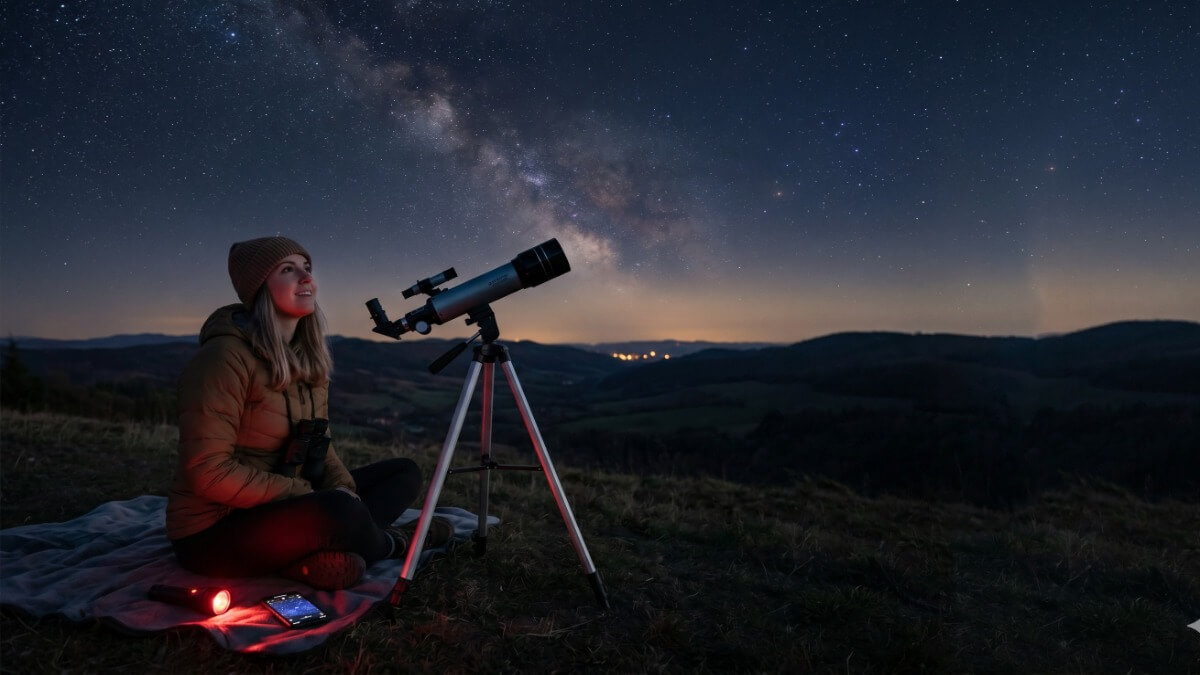
It acts as a live, interactive guidebook right in front of your eyes. However, you must remember to reduce your screen brightness and enable the app’s red-light “Night Mode” to protect your natural night vision.
Astrophotography for Beginners
Many people dream of capturing the breathtaking beauty of the night sky with a camera. This specific art form is called astrophotography, and it is more accessible today than ever before.
Taking Pictures of the Night Sky
You do not need a multi-million-dollar space observatory setup to get started. A sturdy tripod and a modern smartphone or basic DSLR camera are all you need to take impressive night sky photos.
The core technique relies on leaving the camera’s shutter open for a long period. This allows the sensor to gather much more light than the human eye can see. This technique is universally known as long-exposure photography.
Using Smartphones vs. Cameras
Today’s smartphones are packed with incredibly advanced technology. Many high-end phones now feature dedicated “Astrophotography” or “Night” modes. By securing your phone to a tripod and letting it take a 10 to 30-second exposure, you can capture gorgeous starry skies.
However, if you want sharper, more detailed images of deep space, a dedicated DSLR or Mirrorless camera is the better choice. By switching to manual mode, increasing your ISO setting, and opening the aperture fully, you can achieve professional-level results.
Capturing the Milky Way
Photographing the bright, dusty core of our own Milky Way galaxy is a major milestone for any beginner. To achieve this, you absolutely must find a location entirely free of light pollution on a moonless night. The warm summer months are generally the best time to see the galactic core.
Point your camera toward the darkest section of the southern sky. Use a shutter speed of roughly 14 to 20 seconds. If you leave the shutter open any longer, the Earth’s rotation will cause the stars to streak and blur. With just a little bit of light editing afterward, the magical dust lanes of our galaxy will pop right out.
Common Stargazing Mistakes
Making mistakes is a completely normal part of learning any new skill. However, knowing about these common pitfalls in advance can save you a tremendous amount of time and frustration.
Expecting Too Much Too Soon
The biggest disappointment for beginners comes from expecting telescope views to match the colorful, highly processed photos taken by the Hubble Space Telescope. Human eyes simply cannot process faint colors in the dark the way a camera sensor can.
When looking through a telescope, most distant galaxies and nebulae will appear as faint, fuzzy gray smudges. You must accept this reality. The true thrill of visual astronomy lies in knowing you are personally witnessing light that is millions of years old, rather than looking for bright colors.
Ignoring the Impact of Light Pollution
Many eager beginners try to hunt for faint galaxies directly under a glowing street lamp or from a bright city balcony, only to quit the hobby out of sheer frustration. You cannot ignore the devastating effects of light pollution.
Even if you only want to see a moderately starry sky, you must make the effort to escape direct local lighting. The deeper the darkness around you, the more the universe will reveal its secrets. Do not let laziness keep you from finding a proper dark site.
Using Equipment Incorrectly
Buying a brand new telescope and immediately taking it outside at night without reading the manual is a guaranteed recipe for failure. Many beginners struggle with the focus knobs or accidentally use the wrong high-power eyepiece first.
A very common error involves forgetting to align the small “finder scope” with the main telescope tube during the day. If these two are not perfectly aligned, finding anything in the dark sky becomes physically impossible. Always test and align every piece of gear in broad daylight.
Safety Tips for Night Observation
Because the best stargazing requires you to venture into dark, isolated areas, personal safety must always be your top priority.
Staying Safe Outdoors at Night
Never travel alone to an unfamiliar forest, completely deserted field, or remote mountain. Always bring a friend or family member along, and make sure to tell someone else exactly where you are going.
Always carry a basic first-aid kit, a reliable flashlight with a red filter, and a fully charged mobile phone. Be mindful of your surroundings, choose your setup spot carefully, and watch out for local wildlife or insect hazards.
Preparing for Long Observations
Temperatures can drop surprisingly fast under an open night sky. Even in the middle of summer, the early morning hours can become uncomfortably chilly. Always pack extra layers of clothing or a warm jacket.
Stargazing is a slow, methodical process, so bring a comfortable folding chair or a thick blanket to sit on. Packing some light snacks and a thermos full of hot tea or coffee will make your long hours in the dark infinitely more comfortable and enjoyable.
Why Stargazing Matters
Looking at the stars is far more than just a passing hobby or a casual science lesson. It elevates human consciousness and alters how we think about our existence.
Understanding Our Place in the Universe
When we stare into a sky filled with billions of glowing stars, we instantly realize how fragile and tiny our Earth truly is. It looks like a single drop of water in an endless cosmic ocean. This profound realization strips away human arrogance and fosters a deeper sense of empathy for one another.
The late, great astronomer Carl Sagan famously noted that we are all made of “star stuff.” Stargazing reminds us of our ancient, cosmic origins and gives human life a beautiful, humbling meaning.
The Connection Between Science, Wonder, and Exploration
Stargazing naturally nurtures a scientific mindset and a deeply curious soul. It forces us to ask the big questions: Where did we come from? Does the universe have an edge? This exact sense of wonder is what drives humanity to invent, explore, and push boundaries.
When you point out a constellation to a young child, you might unknowingly plant the seed for a future astrophysicist or astronaut. This seamless blend of natural wonder and scientific inquiry is the fundamental driving force behind human progress.
Frequently Asked Questions (FAQs)
What do I need to start stargazing?
To get started, you only need two things: a clear, dark sky and your own eyes. Beyond that, downloading a free astronomy mobile app and wearing warm, comfortable clothing for the night is highly recommended. You absolutely do not need to buy expensive optical equipment right away.
Can I see planets with the naked eye?
Yes, absolutely. Five planets in our solar system (Mercury, Venus, Mars, Jupiter, and Saturn) are brightly visible to the naked eye. They usually appear much brighter than surrounding stars, and their light shines steadily rather than twinkling.
What is the best time for stargazing?
The absolute best time to observe the stars is during the days leading up to and immediately following a new moon, when the sky is completely dark. Seasonally speaking, the crisp, dry air of autumn and winter often provides the clearest and most stable atmospheric conditions for observing.
Do I need a telescope as a beginner?
No, a telescope is not required for beginners. The complex setup and narrow field of view can actually confuse newcomers. Start by learning the sky with your naked eye, and perhaps invest in an affordable pair of binoculars. You should only consider a telescope after you have learned to navigate the major constellations confidently.
How can I find constellations easily?
The easiest way to find constellations is to start with the largest, most famous patterns, such as the Big Dipper or Orion. Once you find these anchors, you can use a free mobile app like Stellarium to guide your eyes outward to neighboring star patterns. This stepping-stone method is known as star hopping.
Conclusion
The night sky is a massive, completely free laboratory and art gallery open to everyone on Earth. It serves as a beautiful reminder that a vast, awe-inspiring universe exists far beyond our daily earthly routines.
Key Takeaways for Beginner Stargazers
The most important lesson from this ultimate guide is that stargazing is never a race. It is a slow, deeply rewarding art form. Escaping artificial city lights, cultivating patience, and reconnecting with nature are the true keys to success. Letting go of the fear of making mistakes and simply enjoying the ancient beauty of the cosmos is the mark of a true stargazer.
Your First Step into the Universe
Let tonight be the start of your cosmic journey. Turn off the artificial lights in your home, step out onto your balcony or into your yard, and look up. The universe is waiting for you with billions of stories written in starlight. This simple first step might just help you discover an entirely new world. Happy stargazing!