
The Ultimate Quantum Mechanics Guide for Beginners
Introduction
Have you ever wondered how the smallest parts of the universe work? This tiny realm is completely different from the world we see every day. The rules of this microscopic world are what we call quantum mechanics.
Many people think quantum mechanics is only for scientists. But it is actually connected to all our lives. In this blog post, we will explore the world of quantum mechanics.
Quantum mechanics is a branch of physics. It deals with the behavior of atoms and subatomic particles. In other words, this branch explains how the smallest building blocks of the universe function.
This is extremely important for us. A large part of our modern technology relies on it. From smartphones to advanced medical equipment, its application is everywhere. The progress of modern science would have been almost impossible without quantum mechanics.
How Quantum Physics Changed Our View of Reality
Scientists once believed the universe ran on fixed rules like a clock. Everything could be measured perfectly using Isaac Newton’s laws. But quantum physics completely changed this idea.
This theory showed us that at the microscopic level, nature relies on probability instead of absolute certainty. Here, a particle can exist in multiple places at once. This has made our understanding of reality much broader and more mysterious.
Understanding Quantum Mechanics
The rules of the quantum world do not match our daily life experiences. So, to understand it, we need to think with an open mind.
Common logic often does not work here. But once you grasp the main concepts, you will find the subject absolutely fascinating.
A Simple Definition of Quantum Mechanics
In simple terms, quantum mechanics is the set of rules for the smallest components of nature. It teaches us how electrons, protons, and photons interact with each other.
The word “quanta” means a specific or discrete amount of energy. Energy flows in small packets or chunks rather than continuously. The science that deals with these energy packets is called quantum mechanics.
How Quantum Physics Differs from Classical Physics
Classical physics is based on Newton’s laws of motion. It perfectly explains the motion of cars, planets, and other large objects in our daily lives.
On the other hand, quantum physics applies only to extremely small particles. In classical physics, everything can be measured with certainty. But in the quantum world, everything depends on probability. It is impossible to say with 100% certainty exactly where a particle is located.
The History of Quantum Mechanics
The history of quantum mechanics is highly thrilling. It is not the discovery of a single scientist. Rather, it is the result of years of research by many brilliant minds.
Toward the end of the 19th century, scientists faced some strange problems. This new science was born out of the search for solutions to those problems.
The Origins of Quantum Theory
German scientist Max Planck first introduced the concept of quantum theory in 1900. He was working on blackbody radiation.
Planck discovered that light or energy is not emitted continuously. Instead, it is emitted in small energy packets. He named these packets “quanta”. This is where the journey of quantum theory began.
Key Discoveries That Revolutionized Physics
Following Planck’s discovery, Albert Einstein explained the photoelectric effect in 1905. He proved that light is actually a stream of small particles. These particles are called photons.
Later, Niels Bohr proposed a new model of the atom. He showed that electrons can orbit the nucleus of an atom only along specific paths. These discoveries changed the course of physics forever.
Famous Scientists Who Shaped Quantum Mechanics
Several scientists played undeniable roles in establishing this new science. Alongside Max Planck and Einstein, Werner Heisenberg and Erwin Schrödinger played the most crucial roles.
Heisenberg is famous for his uncertainty principle. Schrödinger developed a mathematical equation that describes the behavior of waves. Additionally, scientists such as Paul Dirac and Richard Feynman later developed this theory.
Core Elements of the Quantum World
To understand the quantum world, we must know about its core elements. These elements behave very differently from the objects in our familiar world.
Let us learn about the smallest building blocks of the universe.
Atoms, Electrons, and Subatomic Particles
The smallest unit of any matter is the atom. At the center of an atom lies the nucleus. The nucleus is made up of protons and neutrons.
Electrons orbit around this nucleus. Protons, neutrons, and electrons are called subatomic particles. Quantum mechanics primarily researches the strange behavior of these particles.
Understanding Wave-Particle Duality
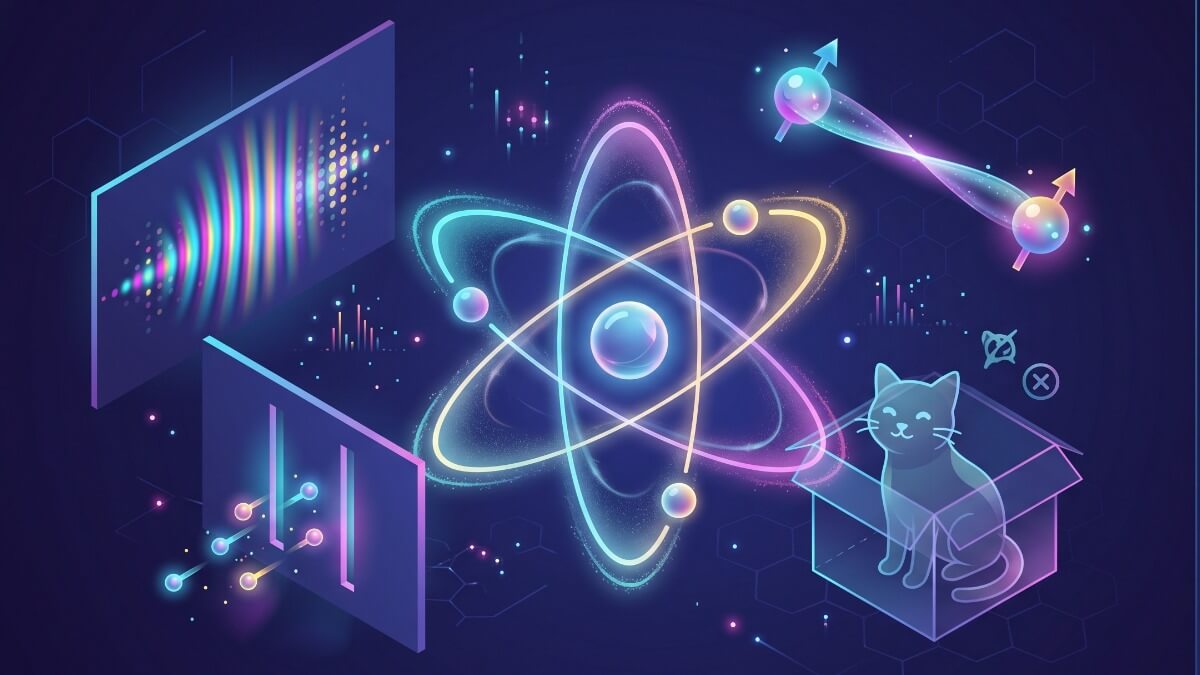
The biggest surprise of the quantum world is wave-particle duality. This means a subatomic particle can behave as both a particle and a wave at the same time.
In normal life, a rock is just a solid object. And an ocean wave is just a wave. But in the quantum realm, light or electrons show the characteristics of both rocks and waves simultaneously.
Why Particles Act Like Waves
Scientists have conducted extensive research into why particles behave like waves. French scientist Louis de Broglie first proposed that all matter has wave properties.
When a particle travels through space or a vacuum, its position is not fixed. It spreads out like a wave of probability. Only when we measure it does it appear in a specific location like a particle.
Core Principles of Quantum Mechanics
Quantum mechanics rests on a few fundamental principles. These principles might seem beyond our common sense.
But nature actually follows these strange rules. Below, we discuss some of the most important principles of the quantum world.
Quantization of Energy
Quantization of energy means there is a specific unit for measuring energy. It does not flow in a continuous stream like water.
This concept can be compared to a staircase. You can step on any stair, but you cannot step in the empty space between two stairs. Similarly, in the quantum world, energy can only be exchanged in specific amounts or steps.
The Superposition Principle
Superposition is a fascinating concept in quantum mechanics. According to this principle, a particle can exist in multiple states at the same time.
As long as you are not observing or measuring the particle, it exists in all possible states simultaneously. The moment you measure it, it settles into one specific state.
Quantum States and Probability
In the quantum world, we cannot predict the future position of anything with 100% certainty. We can only talk about probabilities.
Where an electron might be is expressed using a mathematical equation. This equation gives the probability of finding the electron at a given location. This is the exact opposite of the certainties found in classical physics.
Explaining the Uncertainty Principle
German physicist Werner Heisenberg published a groundbreaking principle in 1927. It is known as Heisenberg’s uncertainty principle.
This principle states that you cannot perfectly measure both the position and momentum (speed) of a particle at the same time. The more accurately you measure one, the more uncertain the other becomes. This is not a flaw in our measuring instruments, but a fundamental rule of nature.
Explaining Wave-Particle Duality
Wave-particle duality is one of the most discussed topics in quantum mechanics. To prove this, one of the most famous experiments in the history of science was conducted.
This experiment forced us to rethink the nature of reality.
The Double-Slit Experiment
This experiment is known as the double-slit experiment. In this test, light or electrons are fired through two small slits in a wall.
When scientists send electrons through the slits, they see a wave-like pattern on the screen behind. This means that every single electron passed through both slits simultaneously and interfered with itself like a wave.
What It Reveals About the Nature of Reality
The strangest thing happens when scientists try to see which slit the electron is going through. Whenever they try to measure it, the wave pattern disappears. Then the electrons behave like ordinary particles.
This proves that the act of observing or measuring can directly change reality. There is a deep relationship between the observer and the object at the quantum level.
Heisenberg’s Uncertainty Principle
The uncertainty principle sets the quantum world apart from all other sciences. It gives us a clear idea about the limitations of nature.
No matter how advanced the instruments scientists build, this principle will always hold true.
Why Position and Momentum Cannot Be Measured Exactly
To measure the position of a tiny particle, you have to shine light or photons on it. When a photon hits the particle, the particle’s path and energy change.
So, whenever you shine light to see where the particle is, its speed will change. As a result, if you know the position, the speed remains unknown. Conversely, if you try to measure the speed, you cannot determine the exact position.
Real-World Implications of Uncertainty
We do not feel this uncertainty in our daily lives. This is because we live in a world of very large objects. For a moving car, this uncertainty is so small as to be negligible.
But in the world of atoms, this uncertainty is massive. Because of this uncertainty, the electrons inside an atom do not crash into the nucleus. This helps keep the entire universe stable.
Quantum Superposition
Superposition is a state in the quantum world that is quite hard to imagine. While it may sound like science fiction, it is a proven truth.
Modern technologies like quantum computers work based on this principle.
How Particles Can Exist in Multiple States
If you toss a coin, it will land on either heads or tails. But if you toss a quantum coin, it remains in a state of both heads and tails at the same time until you look at it.
This is superposition. Subatomic particles can remain simultaneously in multiple spin or energy states.
Understanding Schrödinger’s Cat Thought Experiment
To explain superposition, the scientist Erwin Schrödinger described a famous thought experiment. Imagine a cat inside a closed box. The box contains a mechanism that can release a poisonous gas depending on the state of a quantum particle.
Since the particle exists in two states at once, according to quantum theory, the cat inside the box is also both alive and dead at the same time. The cat remains in this mixed state until we open the box and look. While this is not possible in the macroscopic world, it is completely true for tiny particles.
Quantum Entanglement
Quantum entanglement is the strangest phenomenon in quantum mechanics. Einstein did not like this phenomenon at all.
He called it “spooky action at a distance.”
The “Spooky Action at a Distance” Phenomenon
When two particles become entangled with each other, an invisible connection is formed between them. If you change the state of one particle, the state of the other particle will change instantly.
Even if the two particles are at opposite ends of the universe, this change will happen immediately. Although science tells us that no information can travel faster than the speed of light, entangled particles seem to break that rule.
How Entangled Particles Are Connected
Scientists are still not entirely sure how these particles communicate from afar. However, it has been proven repeatedly in laboratories.
Entangled particles essentially act as a single system. They do not have separate identities. This technology is currently being used to develop the quantum internet and highly secure communication systems.
Quantum Tunneling
Quantum tunneling is a process that defies the laws of classical physics. It works like a magical power.
Its application happens constantly in nature and in our modern devices.
How Particles Pass Through Barriers
Suppose you throw a ball at a wall. Normally, the ball will bounce back. But in the quantum world, particles can pass through the wall or create a tunnel to reach the other side.
Because particles do not have a fixed position, there is a slight probability of them being present on the other side of the wall. Using this probability, particles can overcome solid barriers. This is called quantum tunneling.
Everyday Technology That Uses Quantum Tunneling
Do you know how the sun produces light and heat? Quantum tunneling is behind it. Inside the sun, protons repel each other. But by tunneling, they overcome this barrier, merge, and release massive amounts of energy in the fusion process.
In addition, quantum tunneling technology is used to store data in our computer flash drives or memory cards.
Quantum Mechanics in Everyday Life
Many people think quantum mechanics is confined only to laboratories. But the reality is that many things in our daily lives depend on quantum technology.
Its presence is everywhere, from your smartphone to hospital machines.
Smartphones and Computer Chips
Our smartphones and laptops run on tiny devices called transistors. A modern processor contains billions of transistors.
How these transistors conduct electricity and function strictly follows the rules of quantum mechanics. Without understanding quantum physics, it would have been impossible to create today’s powerful computer chips.
Lasers and Optical Technology
The laser beams used in supermarket barcode scanners or eye surgeries are direct applications of quantum mechanics.
When atoms absorb energy, they become excited, and when they return to a calm state, they emit photons or light. Laser light is created by controlling this exact process.
Medical Imaging and Electronics
MRI scanners used in hospitals can produce clear images of the human body’s internal organs. This machine works by utilizing the quantum spin of the atomic nuclei in the human body.
Furthermore, many modern electronic devices, such as LED lights and solar panels, operate on the principles of quantum theory.
Quantum Computing and the Future
The next big revolution in technology will be quantum computing. It will be many times more powerful than any current supercomputer.
The world’s largest tech companies are investing heavily in building quantum computers.
What Is Quantum Computing?
Quantum computing is a method of processing information using the principles of quantum mechanics. Where a regular computer would take years to complete a task, a quantum computer can provide a solution in seconds.
It uses quantum features like superposition and entanglement to perform calculations at an incredibly fast speed.
Differences Between Quantum Computers and Classical Computers
Classical or regular computers store information in ‘bits’, which can be either 0 or 1. But quantum computers store information in ‘qubits’.
Due to the principle of superposition, a qubit can be in both the 0 and 1 states at the same time. As a result, quantum computers can perform many calculations in parallel, a feat that is impossible for regular computers.
Potential Applications of Quantum Technology
Through quantum technology, discovering new life-saving drugs will be much faster. This is because it can simulate chemical molecular structures very rapidly.
It will also play a groundbreaking role in improving artificial intelligence and providing flawless weather forecasts. Highly secure quantum cryptography is also being developed to prevent hacking.
Common Misconceptions About Quantum Mechanics
There is a lot of confusion and misconception among the general public regarding quantum mechanics. Because of its strange nature, people often mix scientific explanations with fiction.
To understand real science, we must step away from these misconceptions.
Separating Science from Science Fiction
Movies or sci-fi books often use quantum mechanics to tell stories of time travel or parallel universes. While these are highly fascinating, none of them are scientifically proven yet.
The quantum world operates at the atomic level. Directly applying its rules to large objects, such as humans, to explain invisibility or teleportation is currently not scientifically sound.
What Quantum Mechanics Does and Does Not Explain
Quantum mechanics perfectly explains the behavior of subatomic particles. It discusses the chemical properties of matter and its interactions with light.
However, it does not explain human consciousness, the mind, or spirituality. You often see pseudoscience like “quantum healing” or “quantum consciousness” promoted on the internet, which has no connection to actual quantum physics.
Why Quantum Mechanics Matters
Quantum mechanics is not just a theoretical subject. It is one of the sciences that has played the biggest role in the advancement of human civilization.
Without it, we would have been far behind technologically today.
Impact on Modern Technology
Today, we easily find our way using the Global Positioning System (GPS). Atomic clocks are used to keep the time of these GPS satellites accurate. And these atomic clocks are built on quantum principles.
Internet communication, mobile networks, and data storage all have direct or indirect influences from quantum technology.
Contributions to Scientific Progress
Chemistry and modern materials science are paralyzed without quantum mechanics. It is quantum mechanics that has taught us how molecules bond to create new materials.
Quantum theory is also a crucial tool for researching the origin of the universe and black holes.
Obstacles and Unsolved Questions
Although quantum mechanics is an incredibly successful theory, there is still much we do not understand.
Scientists still have several unsolved questions they are trying to answer.
The Measurement Problem
The biggest mystery in the quantum world is the measurement problem. Scientists do not have a clear answer as to why a particle exists in a probabilistic state before measurement and then instantly shifts to a specific state upon measurement.
There is still debate among physicists about how the act of observation affects physical reality.
Different Interpretations of Quantum Mechanics
Scientists have different interpretations of how these strange rules work. The most popular one is the ‘Copenhagen interpretation’, given by Niels Bohr and Werner Heisenberg.
Another popular concept is the ‘Many-Worlds’ theory. According to this theory, every time a quantum measurement is made, the universe splits to create multiple parallel universes. However, it is still not certain which one is 100% correct.
The Search for a Unified Theory
While quantum mechanics perfectly explains everything in the microscopic world, it cannot explain gravity. Einstein’s theory of relativity is used to explain gravity.
But the theory of relativity and quantum mechanics do not work together. The biggest dream of scientists is to combine these two theories to create a ‘Theory of Everything’.
Tips for Beginners Learning Quantum Mechanics
Many people get scared just at the mention of quantum mechanics. But with interest, anyone can learn its core concepts.
With patience and proper guidance, learning it can be very enjoyable.
Concepts to Master First
Do not dive into complex mathematics right at the start. First, get a clear idea about atomic structure, electrons, protons, and the general properties of waves.
Try to visualize theoretical concepts like superposition and entanglement. Knowing how Newton’s laws of classical physics work will make it easier to understand the differences in the quantum world.
Recommended Learning Resources and Methods
There are many excellent and simple explanatory videos on YouTube for beginners. Channels like “Kurzgesagt” or “Veritasium” explain quantum mechanics beautifully through animation.
You can also read books like Carlo Rovelli’s “Seven Brief Lessons on Physics” or Stephen Hawking’s books. Many simple articles for beginners can be found online on NASA or other scientific websites.
Frequently Asked Questions (FAQs)
What is quantum mechanics in simple words?
In simple terms, quantum mechanics is the branch of science that explains how the smallest particles in the universe, such as electrons and photons, behave. It explains the rules of the microscopic world.
Why is quantum mechanics so hard to understand?
The main reason it seems difficult is that its rules do not align with our everyday experiences. Usually, the exact opposite of what we see happens in the quantum world. Moreover, in-depth research into it requires extensive complex mathematics.
What is quantum entanglement?
It is a magical connection between two particles in which a change in one instantly affects the other. This connection remains intact no matter how far apart the two particles are.
How is quantum mechanics used in everyday life?
Our smartphone chips, laser pointers, hospital MRI machines, and computer memory are all built based on the principles of quantum mechanics.
Can beginners learn quantum physics?
Yes, absolutely. By avoiding complex mathematics, it is very easy to understand just the theoretical concepts. Anyone can learn the core concepts of quantum physics by reading books written for the general public and watching educational videos.
Conclusion
Quantum mechanics has unveiled an unforgettable and mysterious realm of the universe before us.
This knowledge has taken us far in terms of technology and is opening new horizons for the future.
Key Takeaways About Quantum Mechanics
We have learned that at the microscopic level, the universe runs on probability rather than fixed rules. Strange phenomena like wave-particle duality, superposition, and entanglement are the true laws of nature.
This theory has shown us that the nature of reality is far more complex and beautiful than what meets the eye.
Your First Step Into the Quantum World
Hopefully, this blog post will help you step into the vast world of quantum mechanics. Science is all about learning new things and asking questions.
Keep your curiosity about quantum mechanics alive and continue reading about new topics. The smallest mysteries of the universe might just completely change how you think.