
Step-by-Step Explanation and Guide to the Scientific Method
Introduction
The world around us is a vast treasure trove of mysteries. Every day we see new things, and various questions arise in our minds. Why does the sky look blue? Why do apples fall to the ground? These types of questions are the main driving force behind the development of human civilization. A curious mind is always looking for answers. But are all answers correct? How can we be sure that what we are learning is true? This is where the magic of science lies.
Science is not just a collection of facts. It is a systematic process of thinking and uncovering the truth. At the center of this process is the scientific method. Whether you are thinking deeply about astronomy or researching daily wellness, you must follow a specific set of rules. In this guide, we will discuss every aspect of the scientific method in detail.
Why the Scientific Method is the Foundation of Modern Science
The scientific method is at the root of the unimaginable heights that modern science has reached today. In ancient times, people thought natural phenomena were the effects of supernatural powers. But over time, people’s ways of thinking changed. They learned to understand that there are logical reasons behind natural events.
A specific framework was needed to find these logical reasons. The scientific method provides that framework. It helps scientists reach conclusions based on evidence rather than speculative ideas. Through this process, there is no room for personal opinions or superstitions. Science becomes objective and universal. Therefore, it can be said that the strong edifice of modern science stands on this method.
How Curiosity Leads to Discovery and Understanding
Humans are naturally curious. When a small child first learns to speak, their questions have no end. This curiosity is the first step in acquiring knowledge. This is equally true in the field of science. From the vastness of space to the microscopic world of atoms and molecules, everything began through the questions of a curious mind.
When we observe the world around us, various questions arise in our minds. The strong desire to find answers to these questions inspires us to do research. We experiment with new things and discover unknown facts. Curiosity not only helps us discover new things but also deepens our understanding of the world around us.
What is the Scientific Method?
Many people think that science just means working in a laboratory, wearing a white apron, and using complex equipment. But science is actually much more than that. Science is a process of knowing. And the scientific method was developed to properly manage this learning process. It is basically a logical way to solve problems.
This method was not created by any single person. It is the result of the thoughts and experiences of many wise people over hundreds of years. Through this, we can better understand the world around us. Let us learn a simple definition of this method.
A Simple Definition of the Scientific Method
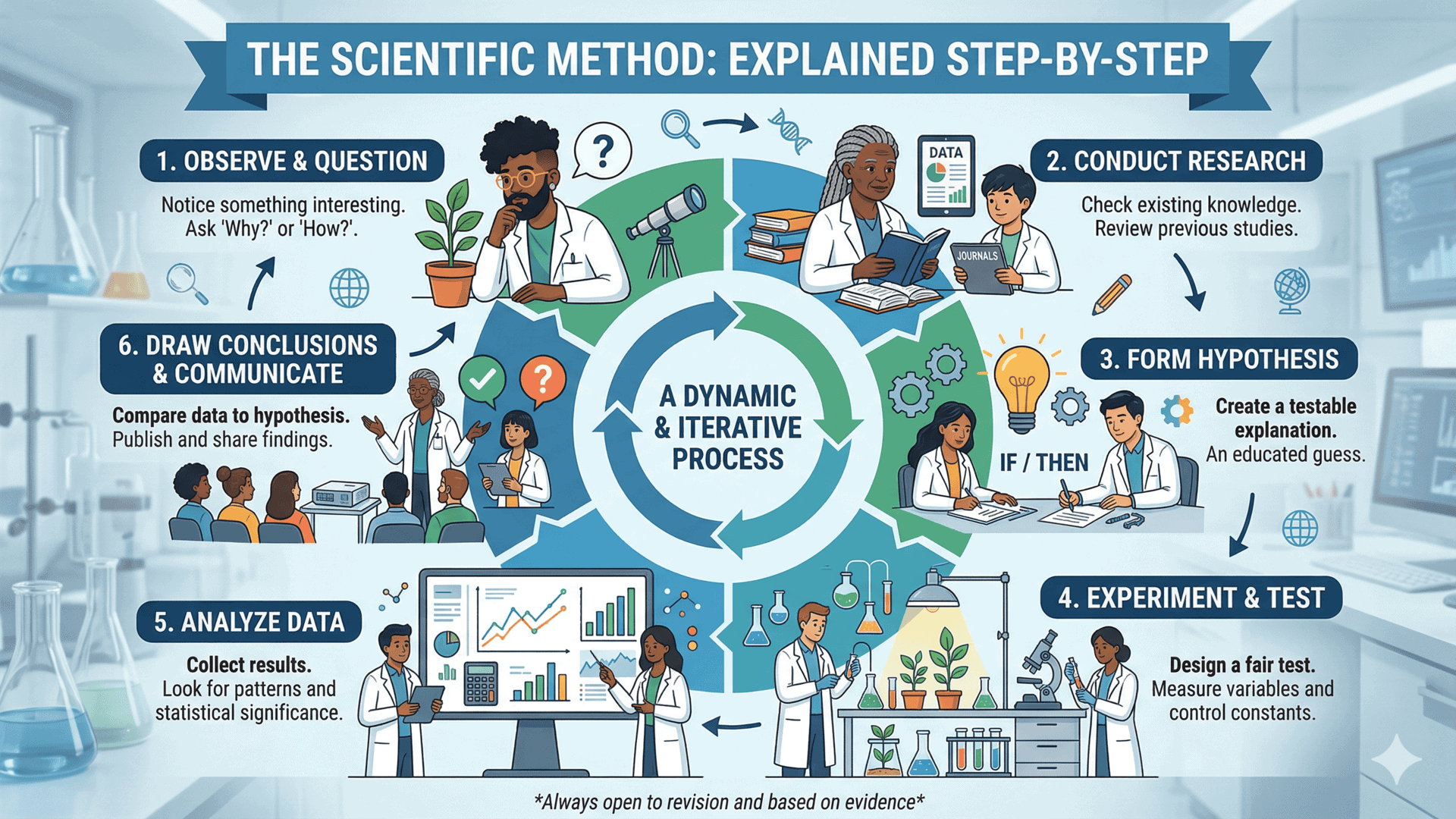
In simple terms, the scientific method is a systematic process of acquiring knowledge. It is a continuous process in which scientists observe natural phenomena, ask questions, formulate hypotheses, and verify those hypotheses through experiments.
If the experiment provides evidence in favor of the hypothesis, it is accepted. If the evidence does not match the hypothesis, the hypothesis is rejected or modified. This entire cycle is the scientific method. It is not blind faith but a tool for finding the truth based on evidence and logic.
Why Scientists Rely on a Systematic Approach
The rules of the universe are very complex. Relying on a random method to understand these complex rules is foolish. If scientists did research according to their own wishes, it would not be possible to reach any accurate and reliable conclusions.
Through a systematic framework, scientists can guide their research on a specific path. This greatly reduces the chances of making mistakes. Moreover, if a systematic method is followed, other scientists can repeat the same experiment. This increases the transparency and acceptability of the research.
The Importance of Evidence-Based Inquiry
There is no place for blind belief in science. Here everything depends on evidence. If you make a claim, you must present evidence in its favor. Evidence-based inquiry is an essential part of the scientific method.
Without evidence, no theory or hypothesis is ever accepted in the scientific community. This keeps science free from superstition and blind faith. When a decision is based on strong evidence, it benefits society. The importance of evidence-based inquiry in fields such as medical science, engineering, and space research is immense.
History of the Scientific Method
The scientific method we use today was not created in a single day. Behind it lies a long and rich history. People have been trying to find the truth since ancient times. In different eras, various scientists and philosophers have enriched this method through their thoughts and work.
The well-structured process of today is the result of the relentless efforts of scientists from the Greek philosophers to the modern era. Knowing the history of this evolution is very important for us because it gives us a clear idea about the progress of science.
Early Roots of Scientific Thought
The seeds of scientific thought were sown in ancient civilizations. Astronomy, mathematics, and medicine were practiced in ancient Egyptian, Babylonian, and Indian civilizations. They observed nature and collected various data. However, their knowledge was mainly practical.
Later, a new era of scientific thought began in ancient Greece. Philosophers such as Aristotle, Plato, and Socrates emphasized logic and reason to understand the laws of nature. Aristotle emphasized observing nature, which is considered an early form of the scientific method.
Contributions of Famous Scientists and Philosophers
In the Middle Ages, Islamic scholars played an important role in the development of the scientific method. Ibn al-Haytham used the experimental method while researching the nature of light. Many consider him one of the pioneers of the modern scientific method.
Then a scientific renaissance occurred in Europe. Scientists such as Galileo Galilei, Johannes Kepler, and Sir Isaac Newton advanced scientific theories grounded in evidence and experiments. Galileo observed space with his telescope and proved that the Earth revolves around the Sun. Sir Francis Bacon introduced the inductive method in scientific research.
Evolution of the Scientific Method Over Time
As human knowledge and technology have advanced over time, the scientific method has also undergone significant changes. The complex experiments of modern laboratories have replaced the simple observations of ancient times.
In the twentieth century, philosophers such as Karl Popper and Thomas Kuhn revisited the theoretical basis of the scientific method. Karl Popper provided the theory of falsification. He stated that a scientific theory must be presented in a way that allows it to be falsified through experiments. This concept is widely appreciated in modern scientific research.
Step 1: Make an Observation
The journey of the scientific method begins with a simple task. And that is observation. Carefully observing the world around us and noticing its various aspects is observation. It could be seeing a tree leaf fall or noticing the position of stars in the night sky.
Observation is not just limited to seeing with the eyes. We can observe using any of our five senses. Every little detail is very important to scientists. A groundbreaking discovery can easily be born from a simple observation.
Identifying Patterns and Phenomena
While observing, scientists try to find similarities or patterns among different events or objects. Many things in nature follow specific rules. Examples include the change of seasons, the day-and-night cycle, and the tides.
Identifying these patterns is very important for science. Through this, scientists can understand that an underlying cause or rule is working behind an event. When you study physics or astrophysics, finding these patterns in the behavior of various objects in the universe becomes the main goal.
The Role of Curiosity in Scientific Inquiry
As mentioned earlier, science is impossible without curiosity. When you observe something, a question should arise in your mind. Questions like “Why is this happening?” or “How is this happening?” will guide you on the path of research.
Curiosity helps scientists think outside the box and discover something new. Indomitable curiosity is needed to uncover the mystery hidden deep within a seemingly ordinary event. Albert Einstein said that he had no special talent but was only passionately curious. This quote beautifully highlights the importance of curiosity in scientific inquiry.
Step 2: Ask a Question
Turning the curiosity that arises in your mind after observation into a specific question is the second step of the scientific method. Although asking questions may seem easy, formulating a correct scientific question is quite difficult.
Your question must be one that can be answered. You cannot research unrealistic or vague questions. The more specific your question is, the easier your research path will be.
Turning Observations into Research Questions
Suppose you noticed that the plants in a specific place in your garden are growing faster than the plants in other places. This is your observation. Now you have to turn this observation into a research question.
You might ask, “Why are these plants growing fast?” But this is a very general question. To make it more specific, you could say, “Does this specific location have better soil quality, or does it receive more sunlight?” These specific questions will give you clear direction.
Characteristics of a Strong Scientific Question
A strong scientific question has some specific characteristics. First, the question must be testable. That means there must be a possibility of finding its answer through experiments.
Second, the question must be clear and specific. There should be no ambiguity in it. Third, the question must be about something that can be measured. For example, “Does God exist?” is a philosophical question, not a scientific one, because it is not possible to test or measure it in a laboratory.
Step 3: Conduct Background Research
The question you want to work on might have been studied by someone else before. So there is no point in reinventing the wheel. Before you start working on your question, you need to see what other scientists think about this topic.
This step is called background research or literature review. Through this, you can build a strong foundation for your research topic, saving you time and effort.
Gathering Existing Knowledge and Evidence
While conducting background research, you need to collect information from various books, scientific journals, and reliable websites. Whatever information you find related to your question must be read and analyzed carefully.
You can find various research papers using platforms like Google Scholar. This information will help you understand the current stage of your research topic and what new things you can add through your own experiments.
Evaluating Reliable Sources of Information
Information is very easy to find in the age of the internet. But not all information is reliable. Especially in scientific research, if you work from incorrect information, the entire study will be ruined. Therefore, evaluating the sources of information is as important as collecting it.
You need to verify which institution published the information. Check whether it is a recognized university or research institution. Also, verify if the research paper is peer-reviewed. Peer-reviewed means that other experts in the same field have verified the research paper before publication. Only information from reliable sources should be used in scientific research.
Step 4: Form a Hypothesis
After completing the background research, you need to think of a possible answer to your question. This possible answer is the hypothesis. It is not a made-up story. You have to create this hypothesis based on your observation and background research.
The hypothesis is a very important part of the scientific method. It will guide your entire research in a specific direction. All your subsequent work will focus on proving or disproving this hypothesis.
What is a Scientific Hypothesis?
A scientific hypothesis refers to a logical and probable explanation proposed as the cause of a natural event or observation. It is basically an educated guess.
But there is a big difference between a general guess and a scientific hypothesis. A scientific hypothesis must be verifiable through experiments. If there is no way to test and disprove a hypothesis, it will not be considered a valid scientific hypothesis.
How to Create a Testable Prediction
A good hypothesis is usually written in the “If… Then…” format. Through this structure, a clear prediction can be made.
For example, “If I add more fertilizer to the plant, then the plant’s growth will be faster.” This is a testable prediction. Here, you clearly state what you will change (adding fertilizer) and the result you expect (faster growth). It is very easy to test this type of prediction.
Examples of Strong and Weak Hypotheses
Not all hypotheses are equally strong. A strong hypothesis is always specific and testable. On the other hand, a weak hypothesis is vague and has no specific direction.
-
Strong hypothesis example: “If the mass of an object increases, the amount of force applied to it must also increase to maintain the same acceleration.” This is a very specific hypothesis based on physics principles.
-
Weak hypothesis example: “Plants are happy when they listen to music.” This is a weak hypothesis because there is no scientific way to measure a plant “being happy.”
Step 5: Design and Conduct an Experiment
The only way to know if your hypothesis is correct is to test it. In this step of the scientific method, you must plan an accurate and precise experiment. The experiment must be designed in such a way that it can directly verify your hypothesis.
From laboratory settings to field research, experimental design must be carefully considered in all cases. A flawed experiment can easily lead you to wrong conclusions.
Planning a Fair and Controlled Experiment
The most important condition for a fair experiment is that it be controlled. A controlled experiment is an experiment in which the researcher deliberately changes only one variable while keeping all other conditions unchanged.
The reason is that if you change many things at once, you will not be able to determine exactly which factor is responsible for the final result. So perfect planning and caution are essential for a fair test.
Understanding Variables and Controls
Understanding variables is very important in the design of an experiment. A variable is anything that can change. A general scientific experiment has three types of variables: independent variables, dependent variables, and controlled variables.
We will discuss variables in more detail in a later section. For now, remember that identifying and controlling these variables correctly is essential for a successful experiment.
Collecting Accurate Data
During the experiment, you must collect data very carefully. There is no room for guesswork in science; everything depends on data. Data can be quantitative (numbers) or qualitative (descriptions).
You must use the most accurate equipment for any type of measurement. Personal likes or dislikes cannot influence data collection. Every piece of collected data must be carefully recorded.
Step 6: Analyze the Results
After the experiment is over, you will have a lot of data. This raw data does not carry any meaning on its own. It has to be analyzed and transformed into usable knowledge.
In this step, scientists mainly rely on mathematics and statistics. Analysis is extremely important for uncovering the truth from a large volume of data.
Organizing and Interpreting Data
The collected data must first be arranged in a clear and organized format. You can use tables for this. If you are involved in website development and understand the importance of a good layout, you will know how easily organized information can be read and understood.
After organizing the data, you must try to interpret it. You have to think deeply about what this information is actually indicating.
Identifying Patterns and Trends
The best way to analyze data is to create graphs or charts. With a graph, it is very easy to see whether there is a hidden pattern or trend in the data.
Suppose you create a graph tracking time and temperature. If you see that the temperature is consistently increasing over time, you will see a clear trend. These patterns will help you reach a final conclusion.
Using Evidence to Gain Insights
At this stage of analysis, you have to see whether your data speaks for or against your initial hypothesis. You must gain new insights or ideas from the obtained evidence.
There is no room for emotion here. You must accept whatever the data says. If the evidence goes against your hypothesis, there is nothing to be disappointed about. Being proven wrong is also a kind of success in science.
Step 7: Reach a Conclusion
After analyzing all the data and identifying patterns, it is time to reach a final decision or conclusion. This conclusion will be the summary of your entire research.
You will provide the answer to the question asked at the beginning of your research in this conclusion. It must be very clear, logical, and entirely dependent on evidence.
Determining Whether the Hypothesis is Supported
The most important part of the conclusion is to clearly state whether your initial hypothesis has been proven correct. Do your test results support your hypothesis?
If the answer is yes, you can say that your hypothesis is highly likely to be correct. And if the answer is no, you must admit that your hypothesis was wrong. Honesty is very important in science.
Understanding the Meaning of the Results
It is not enough to just say whether the hypothesis is right or wrong. You must also explain the actual meaning or significance of your obtained results.
What new information did this research add to the scientific world? Will it be of any use in our daily lives? Answering these types of questions will enrich your conclusion. As a result, readers will clearly understand the importance of your research.
Identifying Limitations and Uncertainties
No scientific research is perfectly flawless. Every study has some limitations. As an honest scientist, you must mention the limitations of your research.
Maybe you did not have enough time, or your equipment was not very advanced. Admitting these limitations does not mean that your research is bad. Rather, it proves that you are fully aware and objective about your work.
Step 8: Communicate the Findings
Science is not secret knowledge. It is for everyone. If you make a groundbreaking discovery but do not share it with anyone, that discovery has very little value.
A highly important step in the scientific method is to share the results of your research with other scientists and the general public. This is how the true expansion of science happens.
Sharing Results with Others
Scientists usually share their research results with the scientific community by publishing articles at scientific conferences, seminars, or in journals. A good research paper documents the background, methods, results, and conclusion in detail.
This ensures anyone else can read it and understand the entire research process. In the current digital age, complex scientific topics are also being presented to ordinary people in simple language through various blogs and websites. This is a highly commendable initiative.
The Importance of Peer Review and Collaboration
Before your research paper is published in an established journal, it goes through a rigorous process called peer review. In this process, other experts in your field of research evaluate your work.
They check if there are any mistakes in your method or if your conclusion is logical. Due to this rigorous evaluation, the quality of scientific research is maintained. Besides, mutual cooperation is very important in scientific research. Many difficult problems can be solved by the combined efforts of multiple scientists.
Contributing to Scientific Knowledge
When the results of your research reach everyone, they add a new piece of knowledge to the repository of human civilization. Your work may serve as the foundation for another scientist’s new research.
This is how scientific knowledge expands from generation to generation. The unimaginable success we see today in astrophysics or medical science is the result of the small contributions of countless scientists over time.
Step 9: Iterate and Refine
Many people think that the scientific method ends by publishing the results. But science is actually an ongoing process. It has no true end. Trying to find the answer to one question often gives birth to ten new questions.
So repetition or replication is very important in science. Just because an experiment is successful once does not mean it is the ultimate truth.
Why Iteration is Essential in Science
An experiment needs to be repeated at different times, in different places, and by different scientists. If the same result is obtained repeatedly, then that result can be trusted.
Sometimes, for unknown reasons or due to a mechanical error, an incorrect result may appear once. It is possible to eliminate these errors through repeated testing. Scientific truth must be universal.
Improving Experiments and Testing New Ideas
When other scientists work with your research, they may see opportunities to make some improvements to your method. They can add a new variable or use more advanced equipment to repeat the experiment.
As a result, the original idea is further refined. This is how science corrects itself over time and becomes more perfect.
Building Reliable Scientific Knowledge
Reliable scientific knowledge is built up little by little through this constant observation, experimentation, analysis, and repetition. Nothing is absolute truth in science. Old theories can be rejected in light of new evidence.
This flexibility of science is its biggest strength. It brings us out of the darkness of blind faith and teaches us to walk in the light of logic.
Understanding Variables in Scientific Experiments
While discussing the testing steps, we learned a little about variables. To make any experiment successful, it is extremely important to have a clear understanding of the variables.
A variable is any characteristic, number, or quantity that can be measured or changed. Let’s learn in detail about the three main variables of a scientific experiment.
Explanation of Independent Variables
An Independent Variable is a variable that a researcher deliberately changes during an experiment. It is the core cause being tested.
For example, if you want to see how a plant’s growth depends on the amount of light, then the amount of light is the independent variable. You can give more light to one plant and less light to another as you wish. A proper experiment usually has only one independent variable.
Explanation of Dependent Variables
A Dependent Variable is a variable that changes as a result of the change in the independent variable. It is the result, which you want to measure.
In the previous example, plant growth is the dependent variable. You are hypothesizing that changing the amount of light (independent variable) will affect plant growth (dependent variable). During the experiment, you have to measure this dependent variable very carefully.
Controlled Variables and Their Importance
Controlled Variables are all those variables that are kept constant or unchanged during the entire experiment.
In the example of plant growth, changing only the amount of light will not do. Both plants must be kept in the same type of soil, with equal amounts of water and at the same temperature. Here, soil, water, and temperature are controlled variables. If you do not control these, you will not be able to prove that light is the only real reason for the plant’s growth changing.
Real-World Examples of the Scientific Method
Hearing the words “scientific method” might make it seem like it is only for scientists to use in laboratories. But the surprising thing is that we use this method in our daily lives without realizing it.
The scientific method is a universal way to solve problems logically. Let’s see how it has been used in real life and in big discoveries.
Solving Everyday Problems Through Scientific Thinking
Suppose you woke up in the morning and put bread in your toaster, but the toaster is not working. This is your observation. The question arose in your mind, “Why is the toaster not working?”
You hypothesized that the plug might not be properly connected. This is your hypothesis. Now you checked by properly connecting the plug. If the toaster works, your hypothesis is correct. And if it does not work, you will make a new hypothesis that maybe the toaster itself is broken. See how easily you used the scientific method to solve an everyday problem.
Scientific Discoveries Made Using the Scientific Method
Many groundbreaking discoveries in the pages of history result from following this strict method. Alexander Fleming’s discovery of penicillin is a great example.
He noticed (observation) that a type of fungus had grown in his bacterial culture plate and the bacteria around the fungus had died. He asked a question and hypothesized that the fungus was producing something that destroyed the bacteria. Then he proved through detailed experiments that his hypothesis was correct. This is how the first antibiotic in human history was discovered.
Its Application in Medicine, Technology, and Environmental Science
Modern medical science today is entirely dependent on the scientific method. Before any new drug or vaccine comes to market, it has to undergo years of clinical trials and tests.
In the field of technology and engineering as well, when creating a new device or software, it is tested step by step to ensure it is error-free. Environmental scientists constantly have to resort to this method to understand complex issues like climate change and find ways to combat them.
Benefits of Using the Scientific Method
The scientific method is not just for scientists. It can be an excellent tool of thought for any conscious person. The habit of this disciplined thought process can bring many positive changes in our personal and professional lives.
There are many advantages to following this method. Some of its main benefits are discussed below.
Encouraging Critical Thinking
The scientific method forbids people from blindly believing everything. It teaches us to question and demand evidence. As a result, critical thinking develops in us.
A society where people can think critically is less victimized by superstitions and misinformation. They can logically judge the pros and cons of any decision before making it.
Reducing Bias and Presumptions
As humans, we all may have our own beliefs or biases. Many times we try to explain an event from our own personal perspective.
But personal feelings have no value in the scientific method. It is entirely dependent on data and evidence. Therefore, using this method greatly reduces human personal bias in any problem or research and uncovers the real truth.
Producing Reliable and Repeatable Results
The biggest advantage of the scientific method is that its results are extremely reliable. Since the whole process is done step by step and very carefully, the likelihood of errors is very low.
The best part is that anyone can test the results obtained using this method again if they want to. This repeatability proves science to be different and superior to other mediums of knowledge practice.
Common Misconceptions About the Scientific Method
There are quite a few misconceptions among ordinary people about this scientific method. While studying in school, many of us memorize the steps of the scientific method very simply. As a result, we have trouble understanding its real-world application.
It is very important to clear up these misconceptions. The real beauty of science is hidden in its flexible rules.
Science is Not Always a Straight Line
The way the scientific method is arranged step by step in books is not so linear in reality. Scientists often jump from one step to another or return to previous steps if necessary.
Maybe during testing, scientists realize that their main question was flawed. Then they create a new question and start working again. Science is like a tangled thread that has to be untangled slowly.
Why Failed Experiments Still Matter
Many of us believe that a scientific experiment is valuable only if it is successful. But there is no such thing as failure in science. Thomas Edison failed a thousand times while inventing the electric light bulb. He famously said, “I have not failed. I’ve just found 10,000 ways that won’t work.”
A proven false hypothesis tells us which path we should no longer walk. It opens new doors for subsequent research. So negative results are equally important in science.
Understanding the Difference Between Hypotheses, Theories, and Laws
To ordinary people, the words hypothesis, scientific theory, and scientific law may seem the same. But in the language of science, there are huge differences between them.
A hypothesis is an initial idea or educated guess. When a hypothesis is repeatedly proven correct through numerous experiments over many years, and scientists accept it unanimously, it becomes a scientific theory (for example, the theory of evolution or the theory of relativity). On the other hand, a scientific law is a rule of nature that always works the same way under specific circumstances (for example, Newton’s law of universal gravitation). A theory explains ‘why’ it happens, and a law describes ‘what’ happens.
How Students Can Apply the Scientific Method
Learning the scientific method is extremely important for students. This is not just for getting good marks in exams, but also necessary to grow up as a rational person in real life.
If this method can be practiced from the beginning of students’ lives, it can completely change the way they think.
Science Fair Projects and Classroom Experiments
Science fairs are an excellent place for students to apply the scientific method in practice. Here they can ask questions about their favorite topics, make hypotheses, and design small experiments.
In addition to reading books in the classroom, teachers can make this topic more enjoyable through small practical experiments. This way, science will no longer seem boring to them.
Developing Research and Analytical Skills
By practicing the scientific method, students build excellent research and analytical skills. They learn how to collect information from various sources, assess its reliability, and analyze complex data to reach a logical conclusion.
These skills will be useful in any profession in their future lives. Especially for those who want to work with web development, data science, or advanced technology in the future, these logical skills are essential.
Cultivating a Love for Lifelong Learning
When a student completes an experiment on their own and discovers an answer, the joy they feel is incomparable. This joy awakens the desire to learn new things in their minds for the rest of their lives.
Science is not a closed pond; it is like a flowing river. The practice of the scientific method teaches people how to swim in the current of this river and constantly search for new knowledge.
Frequently Asked Questions (FAQs)
What is the scientific method in simple terms?
In simple terms, the scientific method is a step-by-step set of rules for solving a problem or acquiring new knowledge. It is a continuous process, starting with observation, leading to asking questions, forming hypotheses, testing, and finally reaching a logical conclusion.
Why is the scientific method important?
It is important because it helps us to know the truth based on evidence rather than our personal emotions, beliefs, or superstitions. The knowledge gained through this is reliable, objective, and acceptable to people from any part of the world.
What are the main steps of the scientific method?
Its main steps are: 1. Making an observation, 2. Asking a question, 3. Doing background research, 4. Forming a hypothesis, 5. Conducting an experiment, 6. Analyzing data, and 7. Reaching a conclusion. In many cases, sharing research results with others is also considered an integral part of it.
How is a hypothesis different from a theory?
A hypothesis is an initial, testable explanation for an event that has not yet been fully proven. On the other hand, when a hypothesis is proven correct after repeated testing by many scientists over many years, it is called a scientific theory.
Can the scientific method be used in everyday life?
Yes, absolutely. We often use it unknowingly. For example, if your internet is not working, you first ask why. Then you hypothesize that there might be a problem with the router and test it by restarting the router. This is an excellent real-life example of the scientific method.
Conclusion
The scientific method is one of the greatest inventions of human civilization. It has made our world of thought disciplined and logic-based. From understanding the vast galaxies of the universe to the structure of a tiny virus, this method is our only reliance.
Key Takeaways About the Scientific Method
We learned from this guide that science is not a static subject. It is an endless journey of curiosity, evidence, and logic. Asking a good question, forming a logical hypothesis, conducting a controlled experiment, and making an honest decision based on the data obtained are the main foundations of this process.
Using Scientific Thinking to Understand the World Better
The widespread application of scientific thinking is necessary not only in laboratories but also in our daily lives. When we learn to distinguish between truth and falsehood among the thousands of pieces of information scattered around us and do not believe anything without evidence, only then can we form a healthy and rational society. So let us be curious, learn to ask questions, and discover the world anew from a scientific perspective.