
The Future of Education: Critical Thinking in Schools
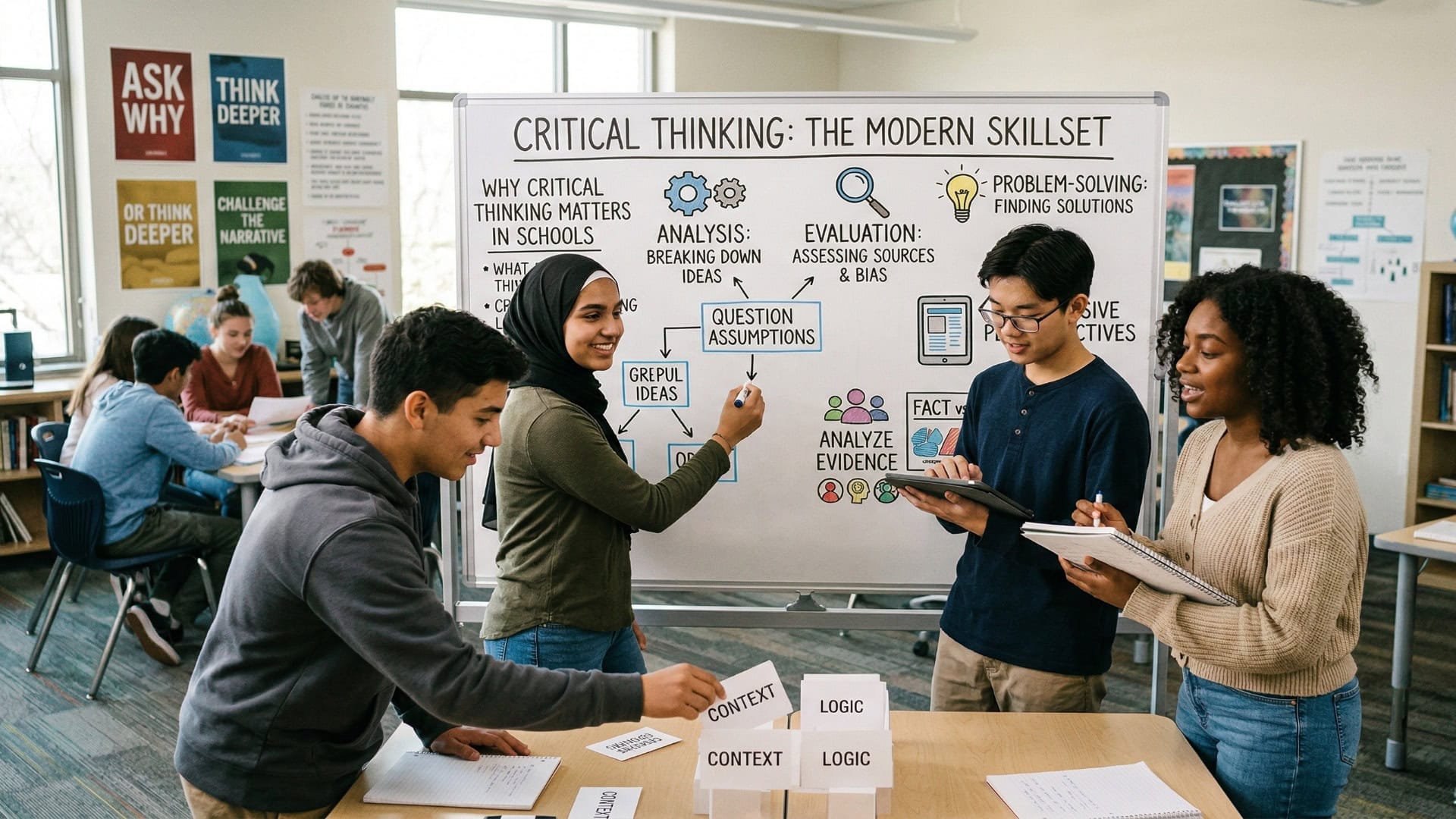
The primary goal of any education system is to prepare students for the future. But the world we live in is changing at a breakneck pace. Because of this rapid evolution, relying solely on textbook knowledge is no longer the ultimate key to success.
Today, we desperately need a generation capable of adapting to completely new situations. At the very core of this adaptability lies critical thinking. This vital skill helps students analyze complex information and make sound decisions under pressure.
Integrating this skill into modern education has become an absolute necessity. Let us explore exactly why bringing this change to our educational institutions is so essential.
The Shift from Rote Memorization to Thinking Skills
For decades, our education systems have relied heavily on rote memorization. Memorizing pages of textbooks to score high marks in exams was the primary objective. However, this approach actively strips away a student’s ability to think independently.
Knowledge gained through blind memorization simply does not last. Students tend to forget the information shortly after their exams are over. When they face real-world problems later in life, this memorized data offers very little practical help.
Thinking skills, on the other hand, allow students to understand subjects on a much deeper level. They stop worrying just about “what” they are reading and start asking “why” and “how” things work. This fundamental shift makes learners far more curious and engaged.
How Education Must Evolve for the Future
Education for the future must be dynamic, flexible, and completely up to date. While completing the academic syllabus is important, schools must place equal emphasis on acquiring practical knowledge.
We need to design learning environments that actively foster student creativity. As technology advances rapidly, artificial intelligence is taking over many routine tasks. Therefore, developing human-centric qualities and advanced cognitive skills is more critical than ever.
Schools must take the lead in this educational evolution. Classrooms should no longer be spaces just for listening to long lectures. They need to become vibrant centers for discussion, debate, and discovery. This is the only way to build a generation truly ready for the challenges ahead.
What is Critical Thinking?
When people hear the term critical thinking, they often assume it just means criticizing someone else’s work. In reality, the meaning is entirely different. It is a highly logical and analytical mental process.
This cognitive skill prevents us from blindly believing information. Instead, it trains our minds to verify facts before accepting them as truth.
In simple terms, it is the ability to ask the right questions and hunt for accurate answers. Let us try to understand this concept even more clearly.
Defining Critical Thinking in Simple Terms
Critical thinking is the ability to analyze a subject or piece of information in depth to reach a logical conclusion. It fundamentally involves being aware of your own thought processes.
Imagine you read a sensational news article online. As a critical thinker, you will not believe the story immediately. You will pause to verify the source of the news and consider if there is a hidden agenda behind the publication.
This is not a talent you have to be born with. It is a highly trainable skill. With regular practice, absolutely anyone can master it. According to Wikipedia, it is the intellectually disciplined process of actively conceptualizing, applying, analyzing, synthesizing, and evaluating information.
Core Components of Critical Thinking Skills
This skill consists of several crucial components. The first is observation. Carefully observing a problem or situation is the vital first step.
The second component is analysis. This involves breaking down collected information into smaller parts and understanding the relationships between them. Following this is inference, which means drawing logical conclusions based on the data you have evaluated.
Finally, we have communication and problem-solving. This means clearly expressing your thoughts to others and applying those ideas to solve real-world issues. All these elements work together seamlessly to create a flawless cognitive process.
Why Critical Thinking is Essential for Students
Students need critical thinking at every single stage of their lives. It not only improves their academic grades; it also prepares them for the harsh realities of the adult world.
This skill makes young learners incredibly confident. They learn to face any situation with courage rather than fear.
Below are some of the most important reasons why this skill is vital for students today.
Improving Problem-Solving Abilities
We all face various problems in every aspect of life. Students are certainly no exception. Critical thinking allows them to view any challenge from multiple unique perspectives.
They quickly learn that a single problem can have several different solutions. They avoid rushing into conclusions out of panic. Instead, they carefully weigh the pros and cons of various options before selecting the best possible route.
From solving complex mathematical equations to resolving arguments between close friends, this skill is universally applicable. It makes them much more innovative, tactful, and resilient.
Enhancing Decision-Making Skills
The ability to make the right choices is one of life’s most important skills. Students make countless decisions every single day. Choosing a major, deciding which sport to play, or figuring out which peers to trust all require solid judgment.
Critical thinking teaches students to evaluate situations logically rather than act purely on emotion. They can pause and consider the long-term consequences of their actions before making a move.
This independence is crucial. They learn to rely on their own judgment rather than be easily swayed by others’ opinions. Consequently, the decisions they make become much more sustainable and accurate.
Fostering Independence in Learning
In traditional education systems, students are heavily dependent on their teachers. But in the modern world, independent learning is absolutely essential for long-term growth.
Critical thinking encourages students to take full responsibility for their own education. They start generating their own questions and actively seek out the answers themselves.
This sense of independence keeps them engaged and eager to learn for the rest of their lives. They learn to gather knowledge from the internet, their environment, and their peers, breaking free from the limits of standard textbooks. It transforms them into genuine lifelong learners.
The Role of Schools in Teaching Critical Thinking
A school is often considered a student’s second home. They spend a massive portion of their formative years there. Therefore, educational institutions play a monumental role in shaping their cognitive development.
Instead of applying intense pressure just to achieve perfect test scores, schools need to focus on expanding the boundaries of student imagination.
Teachers must cultivate an environment where students feel entirely safe expressing their independent opinions.
Moving Beyond Traditional Rote Learning
Schools must first fundamentally change their curricula and evaluation methods. Exam papers need to be designed so that students cannot simply write memorized answers to pass.
Educators need to include creative and analytical questions that actively force students to think deeply about the material.
Instead of demanding that students memorize every line in a book, the focus must shift to grasping core concepts. When this happens, students stop seeing studying as a heavy burden and start enjoying the learning process.
Encouraging Inquiry-Based Learning in Classrooms
Encouraging questions in the classroom is incredibly important. Often, students hesitate to speak up because they fear making mistakes or being scolded by the teacher. This fear must be completely eradicated.
Educators must make it clear that there are no stupid questions. Every single inquiry opens a brand new door to learning.
Teachers should also constantly challenge students with fresh questions; instead of just asking “what is this,” asking “why did this happen” or “what if we did it differently” pushes students to think much more deeply.
How Critical Thinking Prepares Students for the Future
The students in classrooms today are the leaders of tomorrow. When they eventually enter the workforce, many will take on jobs that do not yet exist.
Preparing them for a narrow, specific set of tasks is a huge mistake. We need to equip them with versatile skills that apply to absolutely any situation they might encounter.
Critical thinking is a universal tool. It guarantees they can adapt to whatever massive shifts occur in the world.
Adapting to a Rapidly Changing Job Market
The modern job market is shifting every single day. According to reports from the World Economic Forum, analytical thinking and innovation will be the most sought-after skills in the future workplace.
Routine and repetitive tasks are rapidly being replaced by robots and intelligent software. However, analyzing highly complex human situations and generating original ideas are things machines still cannot do.
To survive and thrive professionally, students must become strong critical thinkers. It allows them to master new technical skills quickly and remain highly relevant in their fields.
Building Skills for the Digital Age
We are firmly planted in the digital age. We are constantly bombarded with an overwhelming amount of information. Accessing the internet instantly exposes us to thousands of news articles, opinions, and claims.
Determining what is true and what is entirely fabricated is incredibly difficult. Fake news is a massive crisis in modern society.
Critical thinking acts as a vital compass in this chaotic sea of data. Students equipped with this skill do not blindly believe everything they read online. They know how to identify credible sources and keep themselves intellectually safe in digital spaces.
Teaching Methods That Foster Critical Thinking
Standard lecturing is simply not enough to teach critical thinking. Educators must adopt specific, modernized teaching methods to make a real impact.
These innovative approaches transform students from passive listeners into highly active participants.
Let us look at some highly effective strategies for the classroom.
Inquiry-Based Learning Approaches
In this specific method, the teacher never gives away the answer directly. Instead, they present a complex problem or thought-provoking question to the class. The students must then research, investigate, and discover the solution on their own.
It is very similar to detective work. Students gather clues, analyze varying pieces of data, and eventually draw their own conclusions.
This approach makes learning highly engaging and skyrockets their natural curiosity. Because they work hard to uncover the answers themselves, the knowledge sticks in their long-term memory permanently.
Group Discussions and Collaborative Learning
Humans are inherently social creatures. Our cognitive abilities expand significantly when we communicate with others. Group work and collaborative study sessions are incredibly beneficial for young learners.
When a diverse group of students discusses a single problem, they hear multiple viewpoints. This dramatically broadens their own perspectives.
They learn to respect dissenting opinions and build logical arguments to defend their own stances. This collaborative atmosphere also naturally builds strong leadership and communication skills.
Project-Based Learning in Modern Classrooms
Project-based learning is a deeply practical educational approach. Students are tasked with completing a long-term project based on a real-world issue.
For example, a class might conduct research on local environmental pollution and be tasked with developing actionable solutions for their city council.
Throughout this process, they plan, gather field data, and finally present their findings publicly. This gives them a fantastic opportunity to apply their critical thinking skills directly to reality.
The Role of Teachers in Shaping Critical Thinkers
Teachers are the true architects of society. They have the most profound impact on a student’s mental development. A truly great teacher can transform an average student into an extraordinary thinker.
To achieve this, teachers must be willing to update their own instructional methods. They need to step away from being strict controllers and step into the role of supportive facilitators.
By gently guiding students, educators can completely reshape how young minds view the world.
Creating an Open and Interactive Learning Environment
The classroom must be a space where every single student feels safe, respected, and heard. Free thinking is absolutely impossible in an environment governed by fear.
Teachers must foster an interactive space where ideas flow constantly between the educator and the learners.
Mistakes should never be treated as failures. Instead, they must be celebrated as valuable learning opportunities. Rather than scolding a student for a wrong answer, a teacher should help them analyze exactly where their logic went off track.
Asking the Right Questions Instead of Giving Answers
One of the most effective ways to build critical thinkers is to answer questions with more questions. This is commonly known as the Socratic method.
When a student asks for help, the teacher avoids giving away the direct answer. Instead, they ask a guiding question that forces the student to think a little harder and find the correct path on their own.
This technique is an excellent exercise for the brain. It helps students realize that knowledge is not just trapped in textbooks; it is waiting to be unlocked within their own minds.
Challenges in Teaching Critical Thinking in Schools
While the theory sounds ideal, implementing these skills in traditional schools is quite difficult in practice. Several major roadblocks are standing in the way.
Unless we dismantle these barriers, our education system will never truly modernize.
Let us discuss the two most significant challenges educators face today.
Exam-Centric Education Systems
The biggest flaw in current global education is its intense obsession with exams and grades. Securing a high GPA has sadly become the sole purpose of learning.
To survive in this high-pressure rat race, both teachers and students rely heavily on rote memorization. Teachers are under massive pressure to finish long syllabi quickly, leaving almost no free time for deep thinking or open debates.
Until this mindset fundamentally changes, practicing critical thinking in regular schools will remain nearly impossible. A massive overhaul of our evaluation systems is urgently required.
Lack of Training and Resources for Teachers
If teachers are not properly trained, they cannot possibly teach complex new skills to their students. Many educators simply lack exposure to modern, interactive teaching methodologies.
Furthermore, overcrowded classrooms and a severe shortage of educational materials pose significant hurdles. It is incredibly difficult for a single teacher to provide personalized, interactive attention to a massive group of students in a short 40-minute period.
Governments and educational authorities must invest heavily in advanced teacher training programs and ensure schools have the physical and digital resources they need to succeed.
How Technology Aids in Developing Critical Thinking
When used correctly, technology can absolutely revolutionize education. While some worry that screens make students lazy, creative application of digital tools can massively boost cognitive skills.
Technology connects students to a global web of information. It makes the learning process infinitely more interactive, visually engaging, and fun.
Here are a few highly positive ways technology impacts learning.
Access to Information and Research Tools
Thanks to the internet, all the world’s knowledge is accessible from a smartphone. Students no longer have to rely on a small school library. They can access global encyclopedias, prestigious research papers, and top-tier educational platforms from their bedrooms.
This endless ocean of data allows students to analyze any given topic from a hundred different angles. They can easily compare conflicting reports and find the truth.
However, they must be taught digital literacy. Learning how to identify a credible, peer-reviewed website versus a biased blog is a massive part of modern critical thinking.
Artificial Intelligence (AI) and Interactive Learning Platforms
Artificial intelligence is currently making massive waves in the education sector. Various AI-driven tools can help students learn at their own personalized pace, breaking down complex topics into digestible pieces.
Interactive platforms use educational games and detailed digital simulations to make hard concepts easy to grasp. Students can conduct dangerous chemistry experiments safely in virtual-reality labs or take stunning 3D tours of historical events.
These highly engaging tools allow students to step outside the bounds of traditional textbooks and gain practical, simulated experience that rapidly builds their analytical power.
Real-World Benefits of Critical Thinking Skills
The incredible benefits of critical thinking do not vanish once a student graduates. These skills positively impact personal, professional, and social lives for decades.
People who can think logically are generally much more successful and content with their lives.
Let us explore some of the highly practical benefits of having a sharp, analytical mind.
Better Academic Outcomes
Students who regularly practice critical thinking almost always see massive improvements in their academic performance. Because they deeply understand the core concepts, they can write well-structured, insightful answers during exams.
They tackle complex, unexpected questions with ease. Because they do not rely on memorizing exact phrases, they do not suffer from the intense test anxiety that plagues many students.
This powerful skill also gives them a massive advantage in higher education, where university degrees rely heavily on independent research and thesis writing.
Stronger Career and Workplace Success
In the modern corporate world, employers highly value staff members who can think creatively to solve unexpected problems. Employees who take the initiative to fix issues rather than waiting for a manager’s instructions are always the first to get promoted.
Strong critical thinkers naturally develop into fantastic leaders. They actively listen to their team’s diverse opinions and make calculated decisions that benefit the entire company.
Furthermore, for aspiring entrepreneurs and business owners, this skill is strictly mandatory for accurately analyzing market trends and assessing financial risks.
Improved Daily Decision Making
This mental framework significantly impacts our daily lives. Everything from managing monthly finances to deciding which local politician to vote for requires heavy logical reasoning.
A person who thinks critically is rarely fooled by flashy marketing campaigns or internet scams. They carefully evaluate the true value and necessity of a product before spending their hard-earned money.
When they see an inflammatory post on social media, they do not react blindly out of anger. They evaluate the situation with a cool head, helping to maintain peace and order in their communities.
The Future of Education Centered Around Critical Thinking
The future of global education is shifting entirely toward skill-based models. Those who only stockpile memorized facts will be left behind, while those who know how to dynamically apply knowledge will lead the way.
Tomorrow’s world will be incredibly complex and intensely data-driven. Critical thinking will not just be a nice bonus; it will be a primary survival tool.
Our educational institutions must adapt to this incoming reality immediately.
Moving Towards a Skill-Based Education System
Globally, there is a massive push toward skill-based education. Developed nations have already made sweeping changes to their standard curricula to reflect this.
Many developing regions are also trying to introduce these vital changes through new curriculum frameworks. The focus is actively shifting from textbook memorization to hands-on, practical application.
If these educational reforms succeed, students worldwide will be perfectly equipped to compete on a global stage. They will become invaluable assets not just to their home countries, but to the entire world.
Preparing Students for Uncertainty and Innovation
Absolutely no one can predict exactly what the future holds. A sudden global pandemic or a revolutionary new piece of technology can flip the world upside down overnight.
There is only one reliable way to prepare students for such extreme uncertainty. We must teach them how to think independently. They need the mental flexibility to adapt to environments they have never seen before.
We must raise them to be innovators. Without continuous, out-of-the-box thinking and fresh innovation, human progress will simply come to a halt.
Conclusion: Building a Better Future Through Critical Thinking Education
Ultimately, teaching critical thinking in schools is not an optional luxury; it is an urgent demand of our current era. Our educational frameworks must step firmly into the 21st century.
Students, teachers, parents, and government policymakers must all work collaboratively to drive this change forward. We must break the heavy chains of rote memorization and finally give students the freedom to think for themselves.
The generation that views the world through a lens of logic and reason is the generation that will build a beautiful, tolerant, and highly advanced society. The true purpose of education will only be achieved when every single student blossoms into a fiercely independent and logical thinker.
Frequently Asked Questions (FAQs)
Why is critical thinking important in education?
It is crucial because it significantly reduces a student’s reliance on rote memorization and helps them understand complex concepts more deeply. It teaches them to think independently, ask the right questions, and find logical solutions to tough problems. Consequently, they become well prepared not just to pass exams but to achieve real-world success.
How can schools teach critical thinking effectively?
Schools can do this by thoroughly updating their curricula. Instead of traditional, one-way lectures, classrooms must actively encourage debates, open discussions, and project-based assignments. Teachers should ask challenging, open-ended questions rather than just handing out answers. Furthermore, creating a fear-free environment where students can safely voice their unique opinions is essential.
What are examples of critical thinking activities in the classroom?
A fantastic example is analyzing real-world case studies in groups. Organizing formal debates where students must argue for or against a specific topic is also highly effective. Other great activities include playing complex problem-solving games or participating in science fairs in which students present and defend their original, innovative ideas.
How does critical thinking help in real life?
In daily life, it actively helps us make smart, calculated decisions. When we read the news or see a shiny advertisement, this skill protects us from being easily manipulated or scammed. It plays a massive role in managing personal finances, navigating stressful workplace situations, and solving daily personal problems with a calm, level head.
Can critical thinking be taught to young students?
Yes, absolutely. This practice should begin at a very early age. When reading a storybook to a child, simply pausing to ask, “What do you think will happen next?” or “Why did the character do that?” jumpstarts their cognitive development. This vital skill can also be easily nurtured through interactive play, building blocks, and solving age-appropriate puzzles.