
The Future of Science: What Lies Ahead for Our World?
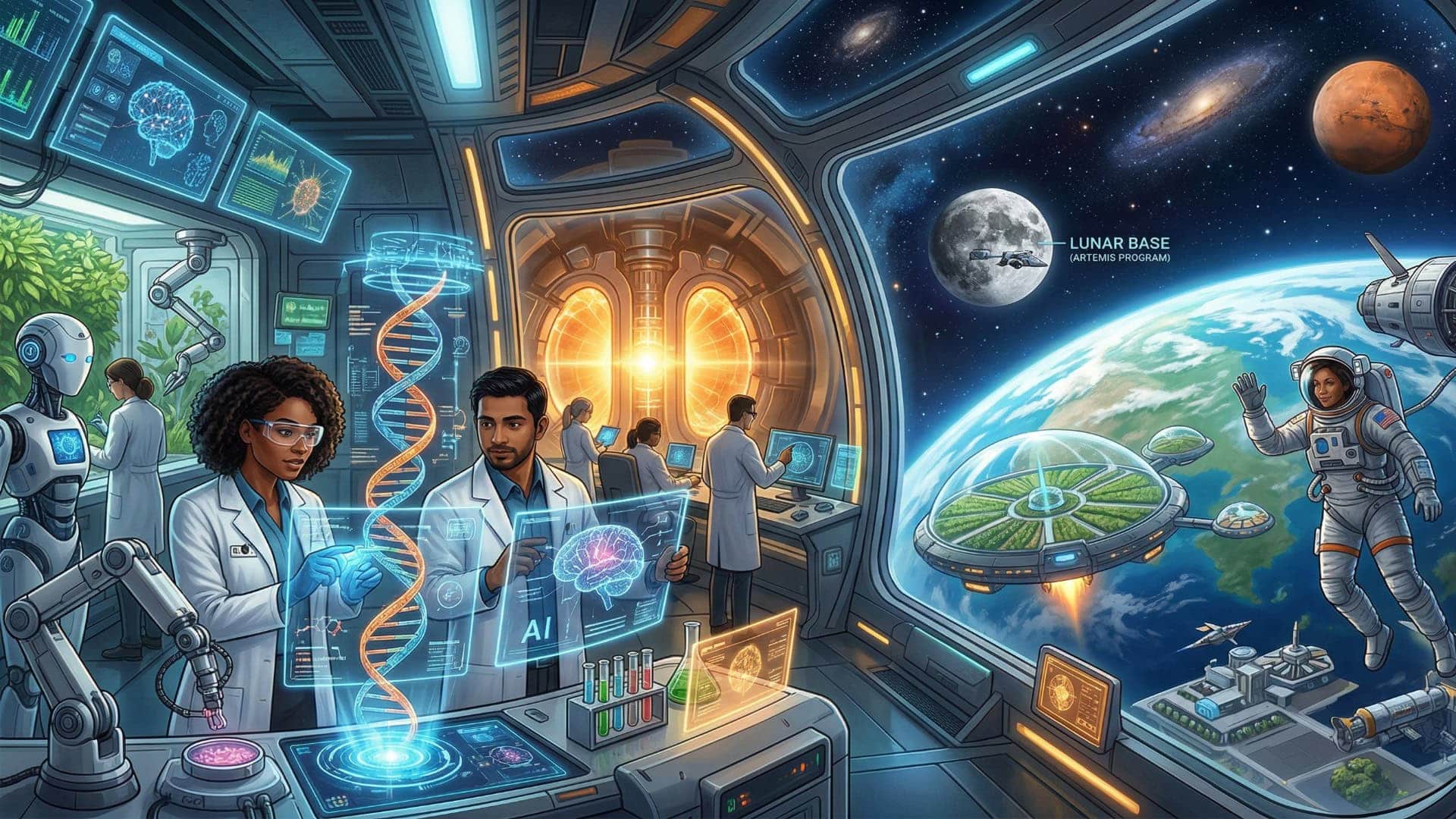
Introduction
Science has always served as the primary driver of human civilization’s progress. From the discovery of fire in ancient times to modern space travel, every step in science has made our lives easier and better. However, we now stand at a crossroads, where the pace of technology and research is faster than ever.
The future of science will not be limited to just understanding the world around us. It will redefine every aspect of our lifestyle. In this blog post, we will discuss the future of science and what awaits us.
We will explore important topics like artificial intelligence, space research, medical science, and climate change in detail. Using simple, fluent language, we will try to make these complex topics understandable to everyone. Let us look toward this exciting future of science together.
Why the Future of Science is More Important Than Ever
The world today faces several complex and unprecedented problems. Climate change, the outbreak of new diseases, and resource limitations have become major threats to our existence. The future progress of science is highly crucial for solving these problems.
Science is not just a means of acquiring knowledge; it is an essential tool for our survival. To gift a safe, habitable world to future generations, we must focus on sustainable scientific solutions now. International organizations such as the World Health Organization (WHO) consistently highlight the importance of scientific research in the health sector.
Moreover, in this era of globalization, a problem in one country can spread to another very quickly. Therefore, there is no alternative to advancing technology and scientific research to tackle global crises. The future of science will help us overcome these collective challenges.
How Scientific Innovation is Shaping the World
Looking at history, it is evident that scientific innovation has always brought massive changes to society and the economy. The invention of the internet and smartphones has completely transformed our communication methods. Today, we can share information instantly from anywhere in the world.
In the medical field, new medicines and surgical procedures have significantly increased average human life expectancy. ..In agriculture, genetically modified crops and modern irrigation systems are increasing food production and making a huge contribution to alleviating global hunger.
In the future, this trend of innovation will accelerate further. Artificial intelligence and robotics will completely automate our industrial production systems. As a result, there will be an unimaginable change in our work patterns and daily routines, shaping the whole world anew.
The Evolution of Science Through the Ages
The history of science is essentially the history of humans’ indomitable curiosity and the effort to know the unknown. People of ancient civilizations planted the seeds of science by unraveling various mysteries of Nature. Over time, science has expanded its scope and given birth to new branches.
This evolution of science did not happen in a straight line. Modern science has achieved its current form through numerous failures and mistakes, and by finding the right path. The small discoveries of the past are acting as the foundation of today’s massive technological successes.
Major Scientific Milestones in Human History
Looking at human history, several groundbreaking scientific milestones stand out. The invention of the wheel brought the first major revolution in communication systems. After that, the invention of the printing press made it easier to preserve and spread human knowledge.
Later, Sir Isaac Newton’s discovery of the law of gravity ushered in a new era in physics. In the nineteenth century, the Industrial Revolution multiplied human production capacity. The invention of the steam engine and electricity radically changed the social system.
At the start of the twentieth century, we saw the discovery of penicillin, which saved millions of lives. After that, the emergence of computers and the development of the internet brought an unprecedented change in information technology. These milestones are the current foundation of human civilization.
How Past Discoveries Influence Future Breakthroughs
Every scientific discovery of the past opens the door to new research. Without Albert Einstein’s theory of relativity, today’s GPS technology could not even be imagined. Similarly, the discovery of the double helix structure of DNA created the foundation of modern genetics.
Scientists build new theories based on the data of previous researchers. The basic concepts of quantum mechanics are now giving rise to groundbreaking technologies such as quantum computing.
So it can be said that science is a continuous process. No knowledge of the past is wasted; rather, it is refined and improved over time. Behind any future great success lies the relentless hard work of countless scientists of the past.
Key Drivers of Future Scientific Progress
Where science will go in the future depends mainly on certain specific drivers. Technological development and global needs determine the course of science. Currently, scientists are working on technologies that will completely change our lifestyle within the next few decades.
These advancements are not happening in isolation. New discoveries are becoming possible through the combination of multiple technologies and the joint efforts of researchers from different parts of the world. Let us see what those key drivers are.
Advancements in Technology and Computing
The incredible increase in computing power is the biggest tool for future scientific progress. Modern supercomputers can calculate trillions of times per second. This has brought speed to every task, from weather forecasting to the creation of new medicines.
In particular, advanced data processing technology has enabled scientists to analyze massive amounts of information. With cloud computing, it is now possible to run complex simulations on powerful servers from anywhere.
In the future, computing technology will become smaller and more powerful. As a result, we will easily be able to solve complex mathematical problems that were unimaginable in previous eras. According to MIT Technology Review, this advancement in computing will impact every branch of science.
Global Collaboration in Scientific Research
The future of science does not depend on any single country or institution. It has now turned into a global effort. Because of the internet and advanced communication systems, scientists from different parts of the world can now easily share information with each other.
For example, thousands of scientists from more than 100 countries are working on CERN‘s Large Hadron Collider project. During the COVID-19 pandemic, we saw how a vaccine could be developed in record time through global collaboration.
This joint effort is accelerating scientific progress. When researchers from different cultures and different backgrounds work together, new ways of solving problems emerge.
The Growing Role of Artificial Intelligence
Artificial Intelligence (AI) has added a new dimension to scientific research. Tasks that scientists previously spent months doing are now being done by AI in minutes.
Artificial intelligence is much more efficient than humans at analyzing information and finding patterns. It is helping scientists to create new hypotheses and predict research results in advance.
In the future, AI will not just remain a helper to scientists; it will lead new scientific discoveries itself. From chemistry to astronomy, the role of AI is increasing day by day in every field.
Artificial Intelligence and the Future of Science
Artificial intelligence is currently one of the most discussed topics in science. It is not just a technological marvel; it is changing the fundamental structure of research. Due to AI, the future of science is becoming much more data-driven and accurate than before.
Machine learning and deep learning algorithms are constantly improving themselves. As a result, artificial intelligence is moving towards matching human intelligence. Its impact is far-reaching at every level of science.
How Artificial Intelligence is Accelerating Research and Discovery
Traditional scientific research requires a lot of time and money. Often, a whole research project has to be restarted due to a small mistake. But artificial intelligence has significantly reduced this risk.
Through simulation and modeling, AI can provide potential outcomes before experiments are run in the real world. In drug discovery, it can analyze the structures of various chemical molecules and identify the most effective one.
AI systems like AlphaFold have accurately predicted the three-dimensional structures of proteins, a groundbreaking achievement in biology. This proves how much AI can accelerate research.
Machine Learning in Scientific Innovation
Machine learning is a branch of artificial intelligence that can learn from data without any specific instructions. ..Machine learning is highly effective in analyzing massive datasets in science.
Astronomers are using machine learning to discover new planets or stars by analyzing thousands of images of space. Climate scientists are using it to understand complex weather patterns and predict future climate changes.
The more data machine learning algorithms receive, the more accurate their results become. Therefore, data collection and machine learning have become complementary in modern science.
Solving Problems with the Help of Artificial Intelligence
The main goal of science is to solve various problems in human life. AI is now helping us find answers to our most complex problems.
AI-driven drones and sensors are being used in agriculture to diagnose crop diseases and increase yield. AI systems are being applied in smart cities to reduce traffic jams and prevent energy waste.
Even in proving complex mathematical theories, artificial intelligence is showing scientists a new path. It is finding ways to solve problems from completely new perspectives by overcoming the limitations of human thought.
The Future of Space Exploration
The human dream of conquering space is very old. The first human footprint on the Moon in 1969 was the greatest achievement of this dream. However, the future of space research is much more exciting and extensive.
With the help of new technologies, we are now preparing to cross the boundaries of our solar system and enter deeper into space. Alongside government space agencies, many private organizations are now investing heavily in this sector.
Missions to the Moon, Mars, and Beyond
One of the main goals of future space missions is to establish permanent human settlements on the Moon and Mars. The goal of NASA‘s Artemis mission is to send humans to the Moon again and create opportunities for long-term research there.
There are plans to use the Moon basically as a base camp for going to Mars. If the human mission to Mars is successful, it will be one of the greatest scientific achievements in human history.
Apart from this, work is underway to send autonomous robots to satellites like Europa or Titan. These missions will help us learn in detail about the environment and structure of other planets in our solar system.
The Search for Extraterrestrial Life
Are we really alone in the universe? This question has made scientists think throughout the ages. A major part of future space research will center on the search for extraterrestrial life.
Scientists are mainly keeping an eye on exoplanets, or planets outside the solar system. They are looking for planets located at a habitable distance from their stars and with the potential for liquid water.
Advanced technology is being used to look for signs of oxygen, methane, or other life in the atmosphere. Although no definitive proof of extraterrestrial life has been found yet, scientists believe we may get an answer to this question within the next few decades.
Next-Generation Space Telescopes and Observatories
Our knowledge about space depends mainly on how far and how clearly we can see. The Hubble Space Telescope has revealed many previously unknown aspects of our universe.
Recently, the James Webb Space Telescope (JWST) has opened a new horizon in space observation. It can capture images of the oldest stars and galaxies in the universe using infrared light.
In the future, more powerful space telescopes will be built that can directly image exoplanets. Modern lenses and sensors are also being installed in observatories on Earth, which will take space research to new heights.
Breakthrough Discoveries in Medicine and Healthcare
Medical science is currently going through a silent revolution. Treatments are now being discovered for diseases that were once considered incurable.
Future healthcare will be much more preventive and technology-driven. By combining genetics, biotechnology, and data science, medical science will reach new heights. Evidence of these groundbreaking changes can be found in various research papers published in Nature.
Personalized and Precision Medicine
In the future, the same type of medicine or treatment method will not be used for everyone. Instead, the era of personalized medicine is about to begin.
Every person’s genetic makeup is different, so their body’s reaction to medicines varies. By analyzing a patient’s DNA, doctors can determine which medication will be most effective for them and which will have fewer side effects.
This precision medicine approach will play a major role in curing complex diseases such as cancer and heart disease. As a result, treatment costs will decrease, and the patient’s recovery rate will increase significantly.
Gene Editing and Biotechnological Innovations
Gene editing technology, especially CRISPR-Cas9, has created unimaginable possibilities in medical science. With this technology, scientists can cut, modify, or replace specific parts of DNA with high precision.
As a result, it will be possible to cure hereditary genetic diseases. Scientists are developing crops that can protect themselves from drought or insect pests.
Research on creating artificial organs using biotechnology is also progressing rapidly. If new organs can be created using the patient’s own cells via 3D bioprinting, the complications of organ transplantation will be largely eliminated.
The Future of Disease Prevention and Treatment
In future healthcare, more emphasis will be placed on preventing disease rather than treating it after it occurs. Wearable sensors and smartwatches will constantly monitor various metrics of our body.
If any abnormal changes are detected in heart rate, blood pressure, or blood sugar levels, these devices will warn us in advance. As a result, it will be possible to consult a doctor before a severe health risk arises.
The concept of using tiny nano-robots to destroy pathogens or cancer cells inside the body, aided by nanotechnology, is also slowly becoming a reality.
Quantum Science and Computing
Quantum mechanics is a highly complex branch of physics that explains the behavior of atoms and sub-atomic particles. A new technology called quantum computing is being built based on this theory.
While an ordinary computer works using binary bits of 0 and 1, a quantum computer uses qubits. A qubit can be in both 0 and 1 states at the same time, which is called quantum superposition.
What Quantum Technology Can Achieve
The calculating power of a quantum computer is billions of times greater than a normal supercomputer. A mathematical problem that would take thousands of years for a normal computer to solve can be done by a quantum computer in just a few seconds.
This infinite power will bring massive changes to the discovery of new medicines and the simulation of various chemical reactions. It will be highly effective in giving accurate weather forecasts and optimizing complex logistics networks.
Moreover, quantum computing can play an incredible role in accelerating the training of artificial intelligence models.
Potential Impact on Communication and Security
Quantum technology will take our digital communication security to a completely new level. The passwords or encryption we currently use online are basically dependent on complex mathematical problems.
Future powerful quantum computers will be able to break this encryption very easily. Therefore, cybersecurity experts have to create quantum-safe encryption or quantum cryptography right now.
Due to a property called quantum entanglement, it will be possible to share information from one end to the other in a way that is physically impossible to hack. This will create the foundation for a secure internet system in the future.
Challenges in Quantum Research
Despite the huge potential of quantum technology, it is still in its early stages. Qubits are extremely sensitive. Their stability is destroyed by even the slightest temperature change in the external environment or electromagnetic effects.
This problem is called quantum decoherence. To keep a quantum computer functional, it has to be kept cold, close to absolute zero temperature, which is a very expensive and complex process.
Besides, completely new types of software engineering knowledge are needed to write quantum algorithms. Scientists are working tirelessly to overcome these technological barriers.
Climate Science and Sustainable Development
One of the biggest crises facing the world today is climate change. Global warming and environmental pollution are severely damaging our planet’s ecosystem.
According to a report by the Intergovernmental Panel on Climate Change (IPCC), if we do not take effective steps now, Earth will become uninhabitable for humans. To tackle this crisis, the development of climate science and sustainable technology is essential.
Tackling Global Environmental Challenges
With the help of science, we are better understanding the harmful effects of climate change. Using satellite imagery and advanced sensors, scientists are continually collecting data on ice melt rates and rising sea levels.
To reduce environmental pollution, technologies for carbon capture, or the absorption of carbon dioxide from the air, are being developed. Besides, emphasis is being placed on introducing eco-friendly production processes in factories to reduce carbon emissions.
To prevent plastic pollution, biodegradable materials are being created that will not harm the environment.
Renewable Energy and Green Technology
Reducing dependence on fossil fuels and increasing the use of renewable energy are key to sustainable development. Solar energy and wind energy technologies have become much more advanced and affordable than before.
Research is ongoing on new materials, such as perovskites, to increase the efficiency of solar panels. New projects are being undertaken to generate electricity by utilizing ocean waves or geothermal energy.
Through green technology, we are working to build an economy that supports human economic development without harming the environment. The expansion of electric vehicles is a big example of this green revolution.
Scientific Solutions for a Sustainable Future
To ensure a sustainable future, we must bring massive changes to our current lifestyle. Science is showing us the path to that change.
With the help of smart grid technology, electricity waste is being reduced, and the equitable distribution of energy is being ensured. In agriculture, methods for growing more crops on less land, such as vertical farming and hydroponics, are becoming popular.
New water purification technologies will help us eliminate the clean-drinking-water crisis. Scientific methods for turning waste materials into reusable resources, based on the concept of a circular economy, will be applied on a large scale in the future.
Robotics and Automation
Machines have long been working as a supplement to human physical labor. But modern robotics and automation are not just performing physical labor; they also perform intellectual work.
In the future, robots will become more automated, intelligent, and better suited to working alongside humans. From industrial factories to our living rooms, the presence of robots will increase everywhere.
Intelligent Machines in Industry and Daily Life
The use of robots in industrial production is nothing new. However, robots are currently being used in factories to learn their work through machine learning.
Big companies like Amazon and Alibaba use thousands of automated robots in their warehouses that perfectly sort and pack products.
In daily life, too, robot vacuum cleaners or smart assistants are making our routine tasks easier. In the future, humanoid robots will be used to look after the elderly or provide care to patients in hospitals.
The Future Relationship Between Humans and Robots in the Universe
The relationship between robots and humans will reach a new dimension in the future. Robots will become humans’ biggest companions in space exploration. Robots will be sent to extreme hostile environments where humans can’t survive.
The Perseverance rover sent to Mars is an excellent example of our robot-dependent space research. In the future, more advanced artificial intelligence robots will build advanced settlements for humans on other planets.
On Earth, the concept of Cobots, or collaborative robots, is becoming popular for humans and robots to work together. They can work completely safely alongside humans in factories.
Opportunities and Challenges of Automation
Automation will multiply our productivity and reduce the production cost of goods. It will free humans from dangerous or monotonous jobs.
However, it also has a negative side. Due to massive automation, many people might lose their traditional jobs. Especially in tasks that require less creativity, robots will easily take over.
Therefore, humans must acquire new skills to adapt to this changing work world. It is highly urgent to formulate automation policies with the understanding that inequality is not created by the social system.
The Future of Energy
The energy demand is increasing day by day. The current fossil fuel-based energy system is harmful to the environment on the one hand and is depleting rapidly on the other.
So, the future world will depend entirely on clean, new energy sources. Scientists are looking for energy that will be endless, cheap, and eco-friendly.
Advancements in Solar, Wind, and Nuclear Energy
The expansion of solar and wind energy has increased at an unimaginable rate over the past decade. Thanks to new technology, the ability to generate electricity even on cloudy days or with low wind has been made possible.
New types of research are also going on regarding nuclear energy. Small Modular Reactors (SMRs) are being built, which are much safer and easier to install than previous large nuclear reactors.
Scientists are working on nuclear fusion. This is exactly the process by which the sun produces energy. If fusion technology succeeds, it could provide humanity with practically infinite, completely clean energy.
Emerging Energy Storage Technologies
The biggest problem with renewable energy is its inconsistency. The sun doesn’t always shine, and the wind doesn’t always blow in the same way. So, storing the generated energy is highly important.
The use of lithium-ion batteries is widespread now, but scientists are searching for more advanced battery technologies. Solid-state batteries will be able to hold more energy and charge faster than current batteries.
Besides, research is underway on new technologies such as pumped hydro storage and large-scale flow batteries for grid-level energy storage. Without a good energy storage system, it is difficult to imagine a sustainable energy future.
The Quest for Clean and Limitless Energy
Scientists are constantly looking for new sources of energy. Green Hydrogen is emerging as an excellent alternative to energy. By using renewable energy to split water, hydrogen gas is produced; when used as fuel, it produces only pure water as a byproduct.
Efforts are also underway to utilize the vast amounts of methane hydrate at the bottom of the ocean or geothermal energy. The goal is one: to build a clean energy world by bringing carbon emissions down to zero.
These endless energy sources will keep our planet pollution-free while ensuring human economic growth.
Neuroscience and Understanding the Human Mind
The human brain is considered the most complex structure in the universe. How this network of billions of neurons gives rise to our thoughts, emotions, and memories is one of science’s biggest mysteries.
Future progress in neuroscience will completely change the way we understand our brains. It will not only help treat mental illnesses but also establish direct communication between humans and computers.
Mapping the Brain and Consciousness
Scientists are trying to create a complete map of the human brain. Like the Human Genome Project, brain projects aim to understand the connections among every neuron in the brain.
Using advanced MRI scanners and optogenetics technology, scientists are observing how specific parts of the brain work. They are looking for the answer to the question of how consciousness is created.
Once this perfect map of the brain is created, it will be possible to find out the real causes of complex neurological diseases like Alzheimer’s or Parkinson’s and cure them permanently.
Brain-Computer Interfaces and Future Applications
A Brain-Computer Interface (BCI) is a technology that enables direct communication between the brain and external devices. Projects like Elon Musk’s Neuralink have already succeeded in exchanging signals with a computer by planting a microchip in the brain.
With this technology, paralyzed individuals will be able to control a robotic arm or a computer mouse simply by thinking. In the future, BCI technology could multiply our learning speed.
Even science fiction concepts like downloading a new language or skill directly into our brains like a computer might become reality one day.
Ethical Questions in Cognitive Science
Research on the brain and the development of BCI technology has given rise to several deep ethical questions. If we can read or change people’s thoughts, what will happen to personal privacy?
If someone hacks and takes control of another person’s brain, it will create a terrifying situation. Moreover, there is debate about how socially acceptable it will be to use advanced technology to erase memories or increase intelligence.
Alongside ongoing progress in this branch of science, it is urgently necessary to formulate strict international guidelines to address its ethical aspects and prevent potential abuse.
Future Scientific Challenges
Science always shows the way to solutions, but new technology often creates new dangers. The biggest challenge for future science is not just making new discoveries but protecting humanity from the negative impacts of those discoveries.
Along with the infinite power of technology, we must equally develop our sense of responsibility. Let us look at what the main obstacles are on the path to future scientific progress.
Ethical Concerns and Responsible Innovation
Powerful technologies like genetic engineering and artificial intelligence are highly susceptible to misuse. If a harmful virus created in a laboratory spreads into the environment, whether accidentally or intentionally, it could destroy human civilization.
The concept of designer babies, or giving birth to a child with desired traits by artificially altering genes, is highly controversial ethically. Such technology could create a new kind of inequality in society.
Therefore, scientists are now focusing more on Responsible Innovation. Before starting research, evaluating its potential social and environmental impacts is being made mandatory.
Managing Technological Risks
When a new technology first comes to the market, scientists cannot be certain about all its flaws or risks. Social media platforms were initially created as a medium for human communication, but later they became a cause for spreading rumors or mental depression.
If future artificial intelligence systems fall out of human control, they could cause a major disaster. The competition to develop autonomous weapon systems, or “killer robots,” poses a global threat.
Governments and scientists in every country must work together to properly manage these technological risks. It is necessary to conduct rigorous security tests before releasing the technology.
Balancing Progress with Human Values
No matter how technologically advanced we become, we must ensure that human values are not lost. Over-reliance on machines can weaken our human relationships.
Ensuring that technology benefits people from all levels of society is a big challenge. Often, the benefits of new technology are enjoyed only by wealthy countries or by upper-class people in society.
Science must be inclusive and universal. Maintaining a proper balance of scientific progress with human values will be the biggest test for the scientists of tomorrow.
How Science Will Transform Daily Life
Future science will not be limited to laboratories only. It will make every task in our daily lives easier, more comfortable, and safer.
From waking up in the morning to going to sleep at night, every moment of ours will be deeply intertwined with technology. The Internet of Things (IoT) will connect all the objects around us to each other.
Smart Homes, Cities, and Transportation Systems
Future smart homes will be able to control their environments to meet our needs. The room temperature, lighting intensity, or entertainment system will change automatically based on our mood.
Smart cities will have almost no traffic jams. Artificial intelligence-controlled signal systems will perfectly manage the road traffic. City waste management and power supply will be highly planned and eco-friendly.
In the transportation system, autonomous or self-driving cars will be widely used. Extremely high-speed transportation systems such as Hyperloop or Maglev trains will greatly reduce travel times between distant cities.
Personalized Education and Healthcare
In the future, the education system will not remain the same for everyone. AI teachers will create a personalized curriculum for every student by analyzing their intellect, interests, and learning speed.
With the help of Virtual Reality (VR) and Augmented Reality (AR), students will be able to study by directly experiencing travel to historical places or into space. This will make education much more enjoyable and realistic.
In healthcare too, consulting a doctor from home or doing a daily health checkup standing in front of a smart mirror will become very common. Medical services will become much more accessible.
Advanced Communication and Connectivity
5G and later 6G networks will make our internet browsing experience unbelievably dynamic. With this high speed, real-time holographic calls without delay will be possible.
Instead of video calls, people will conduct virtual meetings using three-dimensional holograms, where it will feel like everyone is sitting in the same room. Through satellite internet, high-speed internet will reach even the most remote areas of the world.
This advanced communication system will practically erase geographical distances and turn the world into a true global village.
Skills Required for a Science-Driven Future
Since work patterns and the social system are changing rapidly due to technology, people will need to acquire new skills to adapt to this new environment.
Just a traditional degree will not be enough for the future. Alongside understanding technology, human skills will also become equally important.
Critical Thinking and Problem Solving
When there is no lack of information due to the internet and AI, the most important skill will be the ability to verify that information. Critical thinking will help us choose the right information.
The ability to analyze complex situations and find effective solutions will be most valued in future workplaces. Even though robots will do routine tasks, humans will have to make complex decisions.
The ability to solve problems in creative ways will keep humans separate and ahead of machines.
Digital and Scientific Literacy
To survive in the future world, technological knowledge and digital literacy are essential. This does not just mean using a smartphone or computer, but having a basic idea about how they work.
General knowledge of coding or programming, data analysis skills, and awareness of cybersecurity will be considered highly urgent skills.
Similarly, scientific literacy must also be increased. Ordinary people need to understand basic concepts in climate change, the importance of vaccines, and nutritional science so they can make the right decisions in daily life.
Lifelong Learning in a Rapidly Changing World
Previously, it was possible to finish studies once and spend the whole life in a specific profession. But due to rapid changes in science, future professions will disappear quickly, and new ones will emerge.
Therefore, the mentality of lifelong learning must be maintained. Those who are interested in continually learning new technologies and skills will be successful in the future world.
Online courses and virtual training platforms will give people the opportunity to learn new things at any age. Keeping oneself up to date with the times will be the main mantra for survival.
Frequently Asked Questions (FAQs)
What is the future of science?
The future of science is a world where technology and Nature will blend. Fields like artificial intelligence, space exploration, and quantum technology will improve and simplify every aspect of our lives. Its main goal is to build a sustainable, advanced human civilization by solving Earth’s problems.
Which scientific fields will expand the most?
In the coming decades, artificial intelligence, machine learning, genetic engineering, quantum computing, and renewable energy technologies will see the most expansion. At the same time, space science and personalized medicine will also witness unimaginable success.
How will Artificial Intelligence (AI) impact scientific research?
Artificial intelligence will help scientists make new discoveries by rapidly analyzing massive amounts of data. It will reduce time and cost in drug creation, climate modeling, and space observation. AI will essentially expand human thinking capacity and multiply the speed of research.
What are the biggest scientific challenges ahead?
The main scientific challenges of the future include tackling climate change, arranging food and energy for a growing population, and preventing the outbreak of new pandemics. Besides, ensuring the ethical and responsible use of artificial intelligence and genetic engineering is a major challenge.
How can humans prepare for future scientific progress?
Humans must acquire digital knowledge and scientific literacy. Critical thinking and creative problem-solving skills must be increased. The most important thing is to maintain an interest in learning new things in this rapidly changing technological era and build a mindset for lifelong learning.
Conclusion
Key Takeaways About the Future of Science
The future of science is opening the doors to endless possibilities for us. On this journey, we have learned that technological advancement does not remain confined to the laboratory; it determines the fate of society as a whole. From artificial intelligence to quantum computing to space research, every field is challenging our old notions and helping build a new world.
However, we must also remember that as the power of science increases, the responsibility for its proper use increases as well. To tackle challenges like climate change and ethics, we must prioritize human values alongside technology.
Embracing Discovery and Innovation for a Better Future
If we want a secure and prosperous world, we should not fear science and new innovations but embrace them gladly. The mentality of adapting to change will make us more creative and productive.
The future world will be for those who dare to explore the unknown and work for human welfare using new technology. Let us all become partners in this exciting, science-driven future and contribute to building a beautiful Earth.