
What is Machine Learning? A Beginner’s Guide
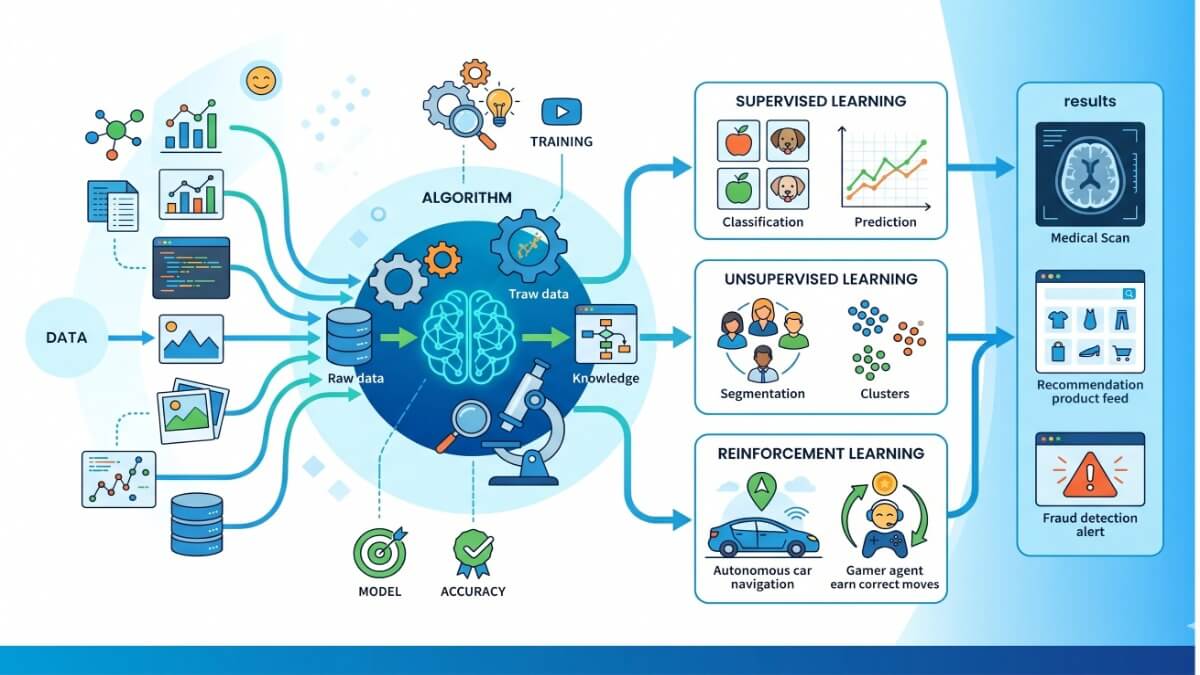
We currently live in a digital age where massive amounts of data are generated every day. When you search for something on Google, watch a video on YouTube, or shop from your favorite e-commerce website, every action creates data. Extracting meaningful information from this massive amount of data is almost impossible for humans. This is exactly where a groundbreaking branch of technology has emerged: Machine Learning.
In today’s blog post, we will discuss what machine learning is, how it works, and why it is so important for our future.
Introduction to Machine Learning
One of the most talked-about topics in the tech world today is machine learning. It is essentially a specialized branch of computer science and statistics. Simply put, it is a technology that enables computers to learn from experience, just like humans. Previously, computers could only do what they were explicitly instructed to do. But now, with the help of machine learning, computers can analyze data and learn new things on their own.
Why Machine Learning is Important Today
From our daily lives to large business enterprises, the importance of machine learning is immense everywhere. First, it has made data analysis unimaginably fast and accurate. Take a simple website as an example. Search engines are constantly using machine learning to improve Search Engine Optimization (SEO) and website performance metrics. Which page will rank on the first page of search results no longer depends on just a few simple rules. Algorithms analyze user behavior to surface the most relevant results.
Second, machine learning helps automate various processes. From medical science and the stock market to weather forecasting, it is saving human time and increasing efficiency in every sector. It is now humanity’s greatest assistant for making accurate decisions by uncovering hidden patterns in massive datasets.
The Growing Role of AI and Machine Learning
Artificial Intelligence (AI) and machine learning are no longer confined to sci-fi movies. They have become an integral part of our real lives. When you use the voice assistant on your smartphone or get recommendations for your favorite series on Netflix, these technologies are working behind the scenes.
In industries, these technologies are multiplying productivity. AI is having a massive impact, especially in web development and content creation. Currently, many content management systems (like WordPress) have plugins that use machine learning to automatically generate SEO meta titles and descriptions and to help optimize website loading speed. This growing role of AI proves that machine learning will be the main driving force of future technological advancement.
What is Machine Learning?
Many people are curious about machine learning. Many consider it something highly complex. However, its core concept is quite simple.
Explaining the Definition of Machine Learning
Machine learning is a branch of Artificial Intelligence (AI) that enables computer systems to automatically learn from data and improve over time. In this case, there is no need to explicitly program the computer. IBM scientist Arthur Samuel first used the term machine learning in 1959. According to him, machine learning is a field of study that enables computers to learn without being explicitly programmed.
Let us understand this with the example of a small child. When you teach a child to recognize an apple, you do not make them memorize every characteristic of the apple separately (such as its red color or round shape). You show them a few apples and tell them these are apples. The child uses their brain to learn about the apple’s characteristics and can easily recognize a new apple later. Machine learning works exactly this way. We provide computers with massive amounts of data, and they learn patterns or rules from it. To learn more in-depth, you can check out Google’s Machine Learning Crash Course.
How Machine Learning Differs from Traditional Programming
There is a fundamental difference between traditional programming and machine learning.
In traditional programming, a programmer provides the computer with specific rules and input data. The computer follows those rules to produce a result or answer. For example, if you want to create a three-column sticky sidebar for your blog, you have to write specific CSS code. The browser will display the sidebar by following the code or rules you wrote.
On the other hand, in machine learning, things happen entirely in reverse. Here, we provide the computer with input data and the desired result or answer. Then the computer analyzes it itself to discover the rules that create a relationship between the data and the answer. Later, by using these new rules, the computer can make predictions for new data.
How Does Machine Learning Work?
Machine learning basically works in a few steps. To create a successful machine learning model, these steps must be followed very carefully.
Data Collection and Preparation
Data is the primary fuel for any machine learning model. The more and higher-quality data you have, the better your model will work. In the first step, data is collected from various sources. This data can be text, images, audio, or numbers.
After data collection comes data preparation. Data collected from the real world is often messy. It may contain many errors, incomplete information, or duplicate data. In the data preparation step, these errors are removed to make the data usable. This process is called data cleaning. If the data is not prepared correctly, the model might learn the wrong things.
Training the Machine Learning Model
After the data is prepared, the model training phase begins. In this step, the prepared data is fed into the selected machine learning algorithm. The algorithm seeks to uncover patterns, features, and relationships hidden within the data.
During training, the model repeatedly analyzes the data, corrects its mistakes, and gradually becomes more accurate. For example, if a model is trained to detect spam emails, during training, it tries to understand which words or phrases increase the likelihood that an email is spam.
Testing and Improving Accuracy
A model is not ready for use right after training. It is necessary to verify how well it is working. For this, the model is given some new data that it has never seen before. This is called testing data.
Based on the model’s performance on the testing data, its accuracy is measured. If the model does not yield the expected results, it is retrained by adjusting its internal settings (called hyperparameters) or by feeding it additional data. This process continues until the model achieves satisfactory accuracy.
Types of Machine Learning
Machine learning is primarily divided into a few categories based on the learning method. The three main types are discussed below.
Supervised Learning
Supervised learning is the most common machine learning method. Here, the data provided to the model contains inputs along with the correct answers or labels.
Suppose you want to teach a model to recognize pictures of cats and dogs. In supervised learning, you will give the model thousands of images and explicitly label each one as a cat or a dog. The model will learn the features from this labeled data. Later, if given a new picture, it can use what it has learned to determine whether it is of a cat or a dog.
Unsupervised Learning
In unsupervised learning, the model is given data with no correct answers or predetermined labels. The model’s task in this method is to find hidden structures or groups within the data.
For instance, customer data from an e-commerce website is given to an unsupervised model. By analyzing it independently, the model can divide the customers into different groups. For example, one group of customers who only buy tech products and another group who buy cosmetics. No one told the model how many groups there would be or who would be in each group; the model discovered them itself based on similarities in the data.
Reinforcement Learning
Reinforcement learning is a method of learning through rewards and punishments. Here, a software agent operates in an environment and receives a reward or punishment for each action.
The agent’s main goal is to earn the maximum amount of reward. For this, it tries repeatedly, learns from its mistakes, and gradually learns the correct steps. Reinforcement learning is widely used for learning to play chess and for building self-driving cars.
Key Components of a Machine Learning System
There are a few essential components to building an effective machine learning system. These work together to make the whole process successful.
Algorithms
An algorithm is a set of mathematical rules and instructions used to analyze data. It acts as the brain of machine learning. You have to choose the right algorithm based on the type of problem you have. A good algorithm can find the correct patterns in the data.
Training Data
As mentioned earlier, data is the fuel of machine learning. But not just any data will do; it must be relevant and of high quality. The model acquires its basic knowledge by using training data. The greater the diversity of the data, the better the model will perform in the real world.
Features and Models
In machine learning, ‘features’ are the distinct characteristics of the data that the model uses for analysis. In a house price prediction model, the size of the house, number of rooms, or location can each be a feature. Selecting the right features is extremely important, a process known as feature engineering.
On the other hand, the model is the final result of training. The rule structure that the algorithm learns after training is the model. We later use this model to make predictions for new data.
Common Machine Learning Algorithms
There are numerous machine learning algorithms to solve various problems. A few of the most popular and widely used algorithms for beginners are discussed below.
Linear Regression
Linear regression is a statistical algorithm used to determine the relationship between two variables. It generally works best for predicting a continuous value.
For example, linear regression can be used to predict next month’s sales for a specific company’s product or tomorrow’s temperature. It tries to draw a straight line through the data points that best represents the data’s trend.
Decision Tree
A decision tree is an algorithm that mimics the human decision-making process. It creates a tree-like structure where each branch represents a condition or decision.
Suppose you want to decide whether to go out and play today. The first condition might be “Is it raining today?” If the answer is yes, you will stay indoors. If the answer is no, the next condition might be “Is it very sunny today?” Reaching a final decision based on the yes-or-no answers to various questions is the main task of a decision tree. It is very easy to understand and explain.
Neural Networks
A neural network is an extremely powerful algorithm inspired by the structure and function of the human brain. Just as millions of neurons are connected to each other in the human brain, artificial neurons or nodes are connected in various layers in a neural network.
It is typically used to perform highly complex tasks such as image recognition, language translation, or voice recognition. When data is massive and complex, and traditional algorithms fail, neural networks can provide excellent results.
Support Vector Machines (SVM)
Support Vector Machine, or SVM, is a popular supervised learning algorithm mainly used for classification tasks. Its primary task is to create a clear boundary or line between different classes of data.
For example, from a mixed dataset of apples and oranges, an SVM will try to draw a boundary line so that all apples are on one side and all oranges on the other. This boundary is called a hyperplane. SVM is capable of classifying complex datasets very accurately.
Real-World Applications of Machine Learning
Machine learning is no longer a laboratory subject. It is constantly being used in numerous tasks in our daily lives. Let’s explore some of its important applications.
Healthcare and Medical Diagnosis
Machine learning has brought a silent revolution in the medical field. It is playing a huge role in assisting doctors with disease diagnosis. By analyzing images from X-rays or MRI scans, machine learning models can detect complex diseases such as cancer and tumors faster and more accurately than the human eye. Also, by analyzing patients’ prior medical data, it is possible to predict whether they are likely to develop a specific disease. This is making it easier to provide proper medical care to patients at the right time.
Finance and Fraud Detection
Transactions worth billions of dollars take place in the banking and finance sector every day. It is impossible to manually figure out which of these massive transactions are genuine and which are fraudulent. Machine learning models learn the pattern of a customer’s regular transactions.
Whenever an unusual transaction occurs (such as your credit card suddenly being used in another country), the model immediately sends an alert and blocks the transaction. Currently, work is underway to integrate machine learning with cutting-edge technologies like Fully Homomorphic Encryption (FHE) and Zero-Knowledge Proofs to ensure the security of financial transactions and maintain personal privacy.
E-commerce and Product Recommendations
When you visit e-commerce sites like Amazon, they recommend products that you actually need. Behind this is the recommendation engine, which is an excellent application of machine learning.
These engines analyze your previous purchases, search history, and the behavior of other buyers like you to understand which products you might like. This not only improves the shopping experience for customers but also greatly helps companies increase their sales.
Self-Driving Vehicles
Self-driving cars like those from Tesla and Google’s Waymo are among the best examples of machine learning. These cars are equipped with numerous sensors and cameras that collect data on surrounding roads, traffic signals, other vehicles, and pedestrians.
Machine learning algorithms analyze this massive amount of data in real time to decide when to press the brake, when to turn the steering wheel, or at what speed to drive. By constantly driving in new situations, they are becoming even more efficient.
Voice Assistants and Chatbots
Voice assistants like Apple’s Siri, Amazon’s Alexa, or Google Assistant use machine learning’s Natural Language Processing (NLP) to understand the meaning of our words and act accordingly.
Similarly, chatbots used for customer service are much smarter now. They can answer customers’ common questions, register complaints, and carry on conversations like humans. This has made providing customer support much easier and more cost-effective for companies.
Benefits of Machine Learning
The numerous advantages of machine learning are responsible for its rapidly growing popularity compared to other branches of technology.
Improved Efficiency and Automation
The biggest advantage of machine learning is its ability to automate tedious, repetitive tasks. Data that might take humans months to analyze can be analyzed accurately by machine learning in minutes or hours. This prevents the wastage of human resources and allows employees to focus on more creative work.
Better Decision Making
Taking the right decision at the right time is at the root of the success of any business or organization. Machine learning uncovers critical insights hidden within massive datasets that might otherwise escape human eyes. Based on this data, businesspeople and policymakers can make more accurate decisions with greater confidence.
Personalized User Experience
Providing a personalized experience to users is crucial in today’s competitive digital world. As a web developer, when you build a website on WordPress or another platform, retaining visitors is a major challenge. Machine learning analyzes each user’s preferences and behavior and presents relevant content or products to them. As a result, user satisfaction increases, the website’s bounce rate drops, and search engine ranking improves.
Challenges and Limitations of Machine Learning
Just as everything has its good sides, there are some limitations too. Machine learning is no exception. It is not entirely flawless and faces several challenges during implementation.
Data Quality Issues
A common saying in machine learning is “Garbage in, garbage out.” That is, if you train the model on incorrect, incomplete, or biased data, it will produce incorrect results. No matter how advanced the model’s algorithm is, if the data quality is poor, the model will never succeed. Collecting massive amounts of clean and labeled data is an extremely expensive and time-consuming task.
Bias and Fairness Concerns
Machine learning models learn from data created by humans. Therefore, biases inside the human mind can also seep into the model through the data.
For example, if an AI model for a hiring process is trained on data in which most successful candidates were men, the model might prioritize men over women for new hires. Avoiding such unfair biases is currently a major challenge for AI researchers.
Privacy and Security Risks
Machine learning models require a lot of personal data to function. This data may include people’s health information, financial transactions, or personal preferences. The collection and storage of this massive amount of data creates the risk of privacy breaches.
If hackers attack these databases, it can lead to disastrous consequences. This is why using platforms like Cloudflare to strengthen website security, following the HSTS protocol, and using encryption technologies have become extremely necessary nowadays.
Machine Learning vs Artificial Intelligence
Many people use the terms Artificial Intelligence (AI) and Machine Learning synonymously. However, there is a clear distinction between them.
Understanding the Relationship Between AI and ML
Artificial Intelligence, or AI, is a very broad concept. Its main goal is to create a machine or system that can behave intelligently like a human.
On the other hand, Machine Learning (ML) is a specific branch under that large umbrella. It is a specific method for achieving AI. Put simply, all machine learning is AI, but not all AI is machine learning.
Key Differences and Similarities
The goal of AI is to achieve success and solve any complex task just like a human. For this, it can use rule-based systems or machine learning.
But the main goal of machine learning is to learn from data and increase accuracy over time. AI can make decisions through logic, whereas machine learning makes decisions by finding patterns. The main similarity between the two is that they aim to make human life easier and more automated through technology.
Machine Learning vs Deep Learning
Alongside AI and ML, another term frequently heard is Deep Learning. It is also deeply related to machine learning.
What Makes Deep Learning Different?
Deep learning is a specific sub-branch of machine learning. General machine learning models work with relatively simple data and often require human assistance with feature selection.
But deep learning works using multiple layers of artificial neural networks modeled after the human brain. This requires massive amounts of data and high-performance computers. It can learn complex features from data on its own; no human intervention is required.
When to Use Which Method
If you have a small or moderate amount of structured data (like data in an Excel sheet) and you want to understand how the model reached its decision, using standard machine learning algorithms is the wisest thing to do.
But if you are working with unstructured data, such as thousands of images, audio files, or massive text documents, and you have adequate computing power, deep learning will bring you the best results.
Future Trends in Machine Learning
Machine learning technology is changing at a very rapid pace. Unimaginable changes are coming to this field in the next few years.
Generative AI and Large Language Models
Large Language Models (LLMs) like ChatGPT and Gemini, along with Generative AI, have revolutionized the tech world today. In the future, these will become even more powerful. They will be capable of creating not just text, but perfect images, videos, code, and music. From content creation to software development, generative AI will provide a new dimension to human creativity in every field.
Explainable AI (XAI)
Currently, deep learning models are often called ‘black boxes’ because, even though they achieve excellent results, they cannot explain how they reached those decisions. This is a major problem in sensitive fields such as healthcare and law.
Therefore, one of the major future trends is the creation of Explainable AI (XAI). The goal is to build models that can clearly explain the reasoning behind each of their decisions to humans. This will exponentially increase human trust in AI.
Edge AI and Real-Time Learning
Currently, most machine learning models run on cloud servers. But in the future, Edge AI technology will expand. This means the task of analyzing data will not be sent to a cloud server but will be completed directly on smartphones, IoT devices, or local networks.
Just as Cloudflare speeds up websites by caching on its edge network, Edge AI will similarly help make real-time decisions by reducing latency. As a result, data processing will be faster, and user privacy will remain secure.
How to Get Started with Machine Learning
After learning so much about machine learning, you might also have developed an interest in learning it. A clear guideline for beginners to get started with machine learning is provided below.
Required Skills for Learning
If you want to build a career in machine learning, you essentially need to acquire skills in three areas. The first is mathematics and statistics. To understand how algorithms work, it is important to have a basic understanding of linear algebra, calculus, and probability.
The second is programming knowledge. Python is currently the most popular language for machine learning because it is easy to learn and offers a wide range of libraries. The third skill is the ability to work with data. You must have a good understanding of data cleaning, visualization, and databases.
Recommended Tools and Frameworks
To get started, you don’t have to write all the code from scratch. Currently, many excellent tools and frameworks make the work easier.
For data manipulation, you can use Pandas and NumPy libraries. For basic machine learning algorithms, Scikit-learn is the best tool for beginners. And if you want to work with deep learning, Google’s TensorFlow and Meta’s PyTorch are the most popular frameworks.
Learning Resources for Beginners
Excellent resources for learning machine learning are available online for free or at a very low cost. You can start with Stanford University Professor Andrew Ng’s “Machine Learning Specialization” on Coursera, the most popular course for beginners worldwide.
Besides, you can watch various tutorials on YouTube. Kaggle is a great platform for practicing data science projects. There you will find plenty of datasets and can learn by looking at the code of other experienced people.
Frequently Asked Questions (FAQs)
Are machine learning and AI the same?
No, they are not completely the same. AI, or artificial intelligence, is a broad concept of creating intelligent systems like humans. Machine learning is a specific branch or method of AI that enables computers to learn automatically from data.
Which programming languages are used in machine learning?
The most popular and widely used language for machine learning is Python. Because of its simple syntax and rich ecosystem of libraries, it is everyone’s first choice. Besides this, R, C++, and Java are also used in some cases.
Can beginners learn machine learning?
Absolutely. With proper guidance and perseverance, any beginner can learn machine learning. By first learning Python programming and basic statistics, and then advancing step by step through various online courses, the subject won’t seem very difficult.
Which industries use machine learning the most?
It is currently used in almost all industries. However, the most widespread and effective use of machine learning is seen in tech companies, healthcare and pharmaceuticals, banking and finance, e-commerce and retail, and the transport and logistics industries.
Conclusion
Machine learning is not a temporary technological fad; it is an innovation that is permanently changing our tech world. By leveraging massive data repositories, it is giving us solutions to problems that once seemed impossible.
Key Takeaways About Machine Learning
From this blog post, we learned that machine learning gives computers the ability to learn from data and improve through experience. It breaks free from the rule-based limitations of traditional programming and relies on pattern recognition. Through various methods like supervised, unsupervised, and reinforcement learning, it is being used everywhere from healthcare to self-driving cars. Although there are some challenges, such as data quality and bias, its benefits far outweigh any limitations.
Why Machine Learning Will Shape the Future
As data volume increases exponentially in the future, the need for machine learning will grow just as much. From combating climate change and ensuring complex cybersecurity to discovering new drugs, machine learning will lead the way in everything. Those who can understand the power of this technology and use it properly will stay ahead in the digital world of tomorrow. We hope this guide makes your first steps into the world of machine learning easy and enjoyable. If you want to apply machine learning concepts to your website’s SEO, speed optimization, or your career, today is the right time to start learning.