
Acids and Bases with Simple Examples
Introduction
Countless chemical reactions are constantly happening all around us. We might not always notice them. But if we pay a little attention, we will see that science touches every part of our lives. One of the most important topics in this regard is acids and bases. Many people think these are confined only to science books or laboratories. But in reality, that is not true.
From the moment we wake up until we go to sleep at night, these two chemical components influence our lives in various ways. In this article, we will learn about these concepts in a very simple and enjoyable way. Without using any complex equations or difficult words, we will try to understand science through common examples from everyday life.
Why Acids and Bases Are Everywhere in Daily Life
The toothpaste we use when we wake up in the morning is a basic substance. On the other hand, if we drink orange juice or a cup of coffee for breakfast, we are essentially consuming acid. Everything from the vinegar in our kitchen to the bathroom cleaner we use contains these elements.
They are even constantly at work inside our bodies. To digest food, our stomach naturally produces powerful acid. At the same time, our body uses various basic elements to maintain balance so that our blood does not become overly acidic. Therefore, it is safe to say that the presence of these chemical components is essential for our survival and a healthy life.
Importance of Understanding Basic Chemistry
Knowing these basic scientific concepts makes our daily lives much easier. When we know how a cleaning product works, we can keep our homes cleaner. Furthermore, the correct use of baking soda or lemon juice during cooking enhances the taste and quality of food.
Additionally, knowing basic chemistry helps us protect ourselves from the harmful effects of various chemical substances. Mixing the wrong chemicals together can lead to major accidents. So, this general knowledge not only makes us smarter but also helps us lead a safer life.
What Are Acids and Bases?
There is no need to be afraid of science. In very simple terms, these are chemical substances with specific properties. When they mix with water, they create special types of particles. It is the presence of these particles that causes them to behave differently. Let us define them more simply.
Simple Definitions of Acids and Bases
An acid is a type of chemical substance that increases the amount of hydrogen ions ($H^+$) when dissolved in water. In simple words, things that taste sour usually contain acid. Lemon, tamarind, or green mango are excellent examples of this.
On the other hand, a base is a substance that increases the amount of hydroxide ions ($OH^-$) when dissolved in water. Basic substances usually taste bitter. They feel somewhat slippery or soapy to the touch. The soap or shampoo we use every day is a common example of a base.
Main Differences Between Acids and Bases
There are several clear differences between these two substances. The first difference is in taste. Acids have a sour taste, and bases have a bitter taste. However, one should never taste any chemical substance in a laboratory.
Another major difference is how they react with litmus paper. Litmus paper is a type of indicator paper. Acids turn blue litmus paper red. Bases turn red litmus paper blue. In addition, acids react with common metals to produce gas, which bases generally do not do.
History of Acids and Bases
Scientists did not discover all the properties of these chemical components in a single day. Modern science has been established through many observations and experiments over thousands of years. Although people have used them since ancient times, it took a long time to understand the science behind them.
Early Discoveries in Chemistry
People in ancient times determined the acidity or alkalinity of various substances just by tasting them. In the seventeenth century, the famous scientist Robert Boyle was the first to record their properties scientifically. He noticed that acids taste sour and can corrode many materials.
These initial observations by Boyle laid a great foundation for future scientists. He also noticed that the color of certain plant extracts changes in the presence of acids and bases. This is essentially where the idea of using modern indicators came from.
How Scientists Created Modern Acid-Base Theories
In the late nineteenth century, the Swedish scientist Svante Arrhenius proposed a groundbreaking theory. He stated that an acid is a substance that produces hydrogen ions in water. His theory brought about a massive change in the world of chemistry.
Later in 1923, two scientists, Johannes Brønsted and Thomas Lowry, proposed a more advanced theory. They stated that an acid is a substance that can donate a proton, and a base is a substance that can accept a proton. It is based on these theories that we can understand chemistry so easily today. You can check the Wikipedia Chemistry page to learn more.
Properties of Acids
These special chemical substances have certain specific and distinct properties. Because of these properties, we can easily distinguish them from other substances. Their main properties are discussed below.
General Properties of Acids
The most well-known characteristic is their sour taste. They also turn blue litmus paper red. Strong acids are highly corrosive. They can burn wood, cloth, and even human skin.
When they react with various metals like iron or zinc, hydrogen gas is produced. In addition, they react with bases, lose their own properties, and create salt and water. This reaction is called a neutralization reaction in scientific terms.
Examples of Acids Used in Daily Life
We use various types of acids every day. The vinegar in our kitchen is a mild acid called acetic acid. It is used to preserve food and enhance flavor in cooking.
The yogurt we eat contains lactic acid. Apples contain malic acid. The liquid used in car batteries is sulfuric acid. It is extremely powerful and dangerous. Therefore, great caution must be exercised when working with batteries.
Properties of Bases
Like acids, bases also have their own distinct properties. These properties make them useful for household chores and industrial factories. Let us find out the main aspects of bases.
General Properties of Bases
The main characteristic of bases is that they taste bitter. They feel slippery like soap when touched. They turn red litmus paper blue. Strong bases, like strong acids, can also be corrosive and cause severe damage to the skin.
They are extremely effective at cleaning oil and grease. Because of this special property, they are widely used in the production of soaps and detergents. When they react with acids, they form salts and water and are neutralized.
Examples of Bases Used at Home
Almost every cleaning product in our bathroom contains a base. Bath soap, laundry detergent, and shampoo are all basic in nature.
Baking soda used in the kitchen is also a familiar base. When used in baking, it helps cakes or bread to rise. Also, when we suffer from indigestion, the antacid medicine we take is essentially a mild base. It provides relief by reducing excess acidity or gastric problems in our stomach.
Explanation of the pH Scale
To measure how acidic or basic something is, scientists have created a special scale. This measuring tool is called the pH scale. It is very easy to understand and quite interesting.
What is the pH Scale?
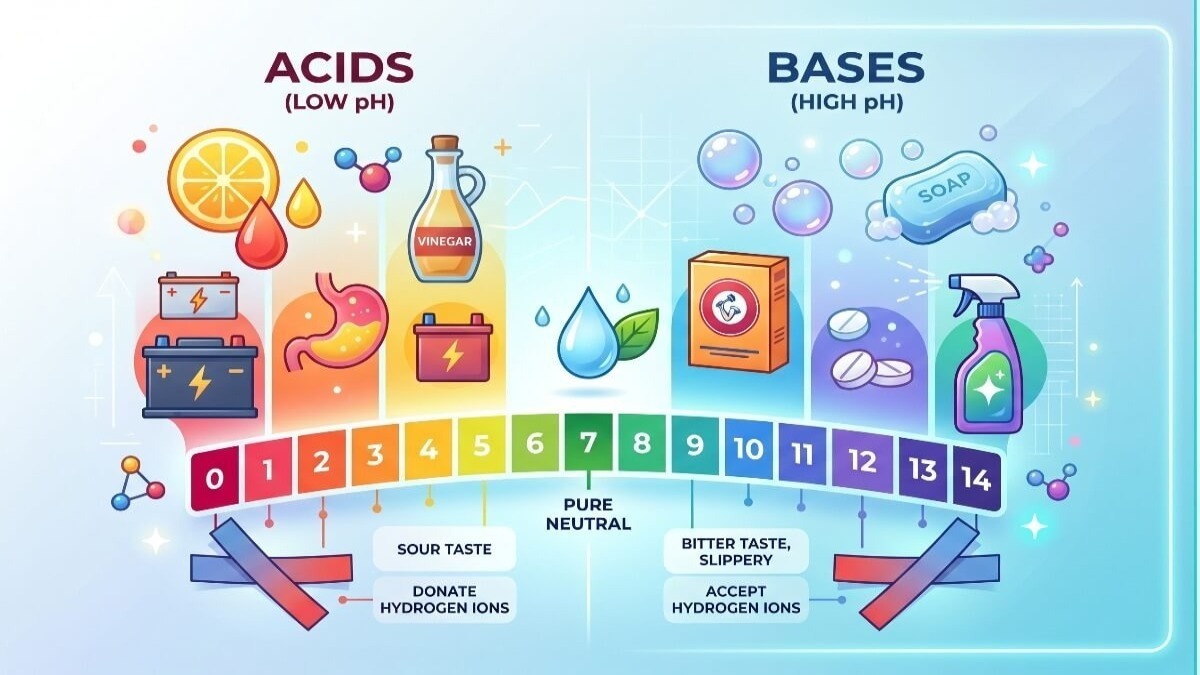
The pH scale usually ranges from 0 to 14. These numbers indicate how concentrated the hydrogen ions are in a liquid substance. The middle number on the scale is 7. This represents a neutral state.
This scale works logarithmically. This means that a change of 1 unit on the pH scale corresponds to a 10-fold change in acidity or alkalinity. That is, a liquid with a pH of 5 is 10 times more acidic than a liquid with a pH of 6.
How pH Measures Acidity and Alkalinity
If the pH value of a substance is less than 7, we call that substance acidic. The closer the value gets to zero, the stronger the acid will be. For example, the pH value of lemon juice is usually around 2 or 3.
On the other hand, if the pH value is more than 7, that substance is basic or alkaline. The closer the value gets to 14, the stronger the base is considered. The bleaching powder used for our cleaning tasks has a very high pH.
Understanding Neutral, Acidic, and Basic Substances
Substances that have a pH value of exactly 7 are neutral. Pure water is the biggest example of this. Drinking pure water does not have any acidic or basic effect on our bodies.
Our blood is also almost neutral. The pH value of blood is usually between 7.35 and 7.45. It is slightly alkaline. Our body always tries to maintain this specific blood value. If there is a slight change in this, a person can become seriously ill.
Common Examples of Acids in Daily Life
The use of acids in our diet and daily life is so extensive that it is hard to imagine our lives without them. They are present everywhere, from various fruits to cooking ingredients.
Citric Acid in Lemons and Oranges
Citrus fruits like lemons, oranges, and sweet oranges contain plenty of citric acid. This acid is very beneficial for our bodies. It is a great natural source of Vitamin C.
Vitamin C, or ascorbic acid, boosts our body’s immune system. It keeps our skin healthy and helps cuts and wounds heal faster. Therefore, keeping some citric acid in our daily diet is good for our health.
Acetic Acid in Vinegar
It is hard to find a house without vinegar in the kitchen. Vinegar is essentially a diluted solution of acetic acid. It usually contains 4 to 8 percent acetic acid.
Vinegar is unparalleled in making pickles and tenderizing meat. Also, vinegar works exceptionally well for cleaning the house, making glass cups sparkle, and removing bad odors from the fridge. It is a natural and safe cleaner.
Hydrochloric Acid in the Stomach
There is a powerful chemical factory inside our bodies as well. When we eat food, our stomach secretes hydrochloric acid. This is an extremely strong acid.
This acid keeps us healthy by destroying harmful bacteria and germs that enter our stomach with food. It also helps with digestion by breaking down hard proteins in food. There is a special mucous layer in the stomach, which is why this strong acid cannot damage it.
Common Examples of Bases in Daily Life
Like acids, bases are also an integral part of our daily lives. Especially when it comes to cleanliness, we are completely dependent on basic substances.
Baking Soda and Its Uses
Baking soda, or sodium bicarbonate, is a very well-known mild base. Using it during baking makes the dough mixture rise and makes cakes or bread soft.
It has many uses beyond food. Baking soda works wonderfully to remove bad odors from the fridge or shoes. It can also be used for light scrubbing to remove stains. If an insect bites, applying a little baking soda paste on the spot greatly reduces the burning sensation.
Soaps and Cleaning Products
All the products we use to keep our bodies and clothes clean are made of bases. Soap is made by mixing strong bases with fat or oil. This process is called saponification.
A special quality of a base is its ability to easily dissolve oil and grease. The dirt on our bodies or clothes is usually stuck with oil. The basic ingredient in soap breaks down oil and helps wash dirt away easily with water.
Ammonia-Based Household Cleaners
The liquid cleaners we use to clean window glass and mirrors contain ammonia. Ammonia is a basic gas that dissolves in water to create a cleaning liquid.
Ammonia evaporates very quickly. So, cleaning the glass with it leaves no streaks. However, the smell of ammonia is quite strong, and breathing it in can be harmful. Therefore, the room’s doors and windows should be kept open when using these.
How Acids and Bases React
Acids and bases are exact opposites of each other. When they mix, a fascinating scientific phenomenon occurs. They neutralize each other’s effects.
Explanation of Neutralization Reactions
The chemical reaction that occurs when an acid and a base are mixed together is called a neutralization reaction in scientific terms. In this reaction, the acid loses its acidity, and the base loses its alkalinity.
As a result, two substances with completely new properties are created. This reaction can produce a lot of heat. This reaction plays a very important role in our daily lives. For example, if we have stomach acid, we take antacids, which provide relief through a neutralization reaction.
Formation of Salt and Water
The main products of a neutralization reaction are salt and water. For example, if we mix hydrochloric acid with a base called sodium hydroxide, they react to produce common table salt (sodium chloride) and water.
This reaction is one of the most fundamental and important reactions in the science of chemistry. When farmers see that the soil on their land has become too acidic, they apply basic lime. As a result, a neutralization reaction occurs, and the soil quality returns to normal.
Acids and Bases in the Human Body
To keep our bodies healthy, it is essential to maintain a perfect balance of acids and bases. The body naturally does this wonderful job.
The Role of Stomach Acid in Digestion
As mentioned earlier, acid is produced in our stomachs to aid digestion. This acid activates an enzyme called pepsin. Pepsin breaks down the protein foods we eat into smaller pieces.
If, for any reason, this acid is produced in excess, that is when we experience heartburn or gastric problems. Then we have to seek the help of basic medicine to neutralize the excess acidity.
Maintaining pH Balance for Health
For every organ in our body to function properly, the blood pH must be within the normal range. The lungs and kidneys work constantly to maintain this balance in our body.
When we exhale, carbon dioxide is released, which helps protect the body from becoming overly acidic. Also, the kidneys remove excess acid or base from the body through urine. In this way, our body maintains the pH balance like a perfect machine.
Acids and Bases in Nature
Not only in our bodies but also in the entire natural environment, acids and bases play important roles. From the soil to the bottom of the ocean, their effects are noticeable.
Soil pH and Plant Growth
Not all plants grow well in all types of soil. Mildly acidic soil is good for some plants, while mildly basic soil is needed for others. The soil pH value affects the plant’s ability to absorb nutrients.
If the soil becomes too acidic, plants cannot absorb essential calcium and magnesium. Then farmers correct the soil’s pH value by mixing lime into the soil. A good crop yield is possible only by ensuring the correct pH value.
Ocean Acidification and Environmental Impact
Currently, a major problem in our environment is the increase in ocean water acidity. Due to increased atmospheric carbon dioxide, ocean water is absorbing more and more of it.
As a result, ocean water is gradually becoming acidic. Due to this change, marine corals and other shelled animals face a severe threat. Coral reefs are being destroyed, which is a major alarm bell for the entire marine ecosystem. Environmental research organizations like NOAA are constantly issuing warnings regarding this issue.
Everyday Uses of Acids and Bases
These chemical substances have many uses in making our daily tasks easier. Without these, our modern lifestyle could be disrupted.
Food Preparation and Preservation
The use of acid in food preservation is thousands of years old. Vinegar, or acetic acid, is used to preserve pickles and chutneys. Harmful bacteria cannot grow in an acidic environment, so food stays good for a long time.
Baking powder is used in the bakery industry to make bread, biscuits, or cakes. Baking powder is a mixture of a base and a dry acid. As soon as water or milk is added, the mixture reacts to produce carbon dioxide gas, which makes the food fluffy and soft.
Cleaning and Household Products
We use strong acid-based cleaners to remove stubborn stains from bathroom tiles or commodes. Also, the drain cleaner used when a sink pipe is clogged is basically an extremely strong base (sodium hydroxide).
This strong base dissolves hair, grease, and accumulated dirt, cleaning the pipe. Basic soaps or liquids also work well for cleaning sticky oil stains in the kitchen.
Industrial and Medical Uses
Their uses in industrial factories are endless. Large amounts of sulfuric acid and nitric acid are used in making fertilizers. They also play a huge role in making the plastics, paints, and paper we use every day.
They also have extensive uses in the medical field. Basic toothpaste is used to prevent dental cavities. Also, various types of medicines, especially those for bloating or acidity, are all made using the chemical neutralization process.
Safety Tips When Using Acids and Bases
Since these are chemical substances, we need to take some precautions when using them. Carelessness can cause major danger.
Understanding Chemical Hazards
If strong chemical substances come into contact with our skin, they can cause severe chemical burns. Also, there is a risk of blindness if they get into the eyes. Sometimes harmful gases are emitted by strong bathroom cleaners, which can damage the lungs if inhaled.
Two different cleaning liquids should never be mixed together. For example, mixing an acidic cleaner with bleaching powder produces highly toxic chlorine gas, which can be life-threatening.
Safe Storage and Usage Methods
Rubber gloves should always be worn when using chemical cleaners. These must always be stored in a safe place out of the reach of children. Chemical liquids should never be kept in drinking water bottles or old cold drink bottles.
When using these, the bathroom or room doors and windows should be kept open to ensure adequate ventilation. If acid or base accidentally gets on the skin or in the eyes, it should be washed immediately with plenty of clean water, and a doctor should be consulted promptly.
Common Misconceptions About Acids and Bases
People often have various misconceptions about scientific topics. We can break these misconceptions by acquiring proper knowledge.
Not All Acids Are Dangerous
Many people think that just hearing the word ‘acid’ means it must be something deadly that will burn hands and faces. This is a completely wrong idea. Many foods in our daily lives contain acids that are beneficial to us.
Vitamin C itself is an acid. Even the full name of the DNA present in every cell of our body is Deoxyribonucleic Acid. Our existence cannot be imagined without it. Therefore, not all acids are harmful; rather, some acids are essential for our survival.
Not All Bases Are Harmful
Similarly, a base does not necessarily mean it will damage the skin. Baking soda is a base that we regularly consume with food. Sometimes we brush our teeth with baking soda to keep them healthy.
So, whether a substance is harmful depends on how strong or concentrated it is. Substances with mild concentrations have proven to be extremely safe and beneficial in our daily lives.
Simple Experiments to Learn About Acids and Bases
The best way to learn chemistry is to test it yourself. You can do some fun science experiments yourself using common household items.
pH Testing with Household Items
You can easily make a natural pH indicator at home using red cabbage. First, boil some red cabbage in hot water. After a while, you will see the water has turned purple. Strain this purple water into a container.
Now, if you mix a few drops of lemon juice with this purple water, you will see the water turn red or pink because lemon juice is acidic. On the other hand, mixing a little baking soda into this water will turn the color blue or green because baking soda is basic. This is an excellent and safe science experiment for children and teenagers.
Safely Observing a Neutralization Reaction
The most popular way to observe a neutralization reaction at home is to create a vinegar-and-baking-soda volcano. Take a few spoons of baking soda in a glass. Then pour a little vinegar into it.
You will immediately see a lot of foam forming and overflowing the glass. Such foam forms when carbon dioxide gas is produced by the reaction between vinegar (an acid) and baking soda (a base). This is a highly enjoyable and educational experiment.
Frequently Asked Questions (FAQs)
What is the difference between an acid and a base?
The main difference is in their taste and chemical properties. An acid tastes sour and produces hydrogen ions ($H^+$) in water. On the other hand, a base tastes bitter, is slippery to the touch, and produces hydroxide ions ($OH^-$) in water.
What is a neutral substance?
Substances that are neither acidic nor basic are called neutral substances. Their pH scale value is exactly 7. Pure drinking water and normal saltwater are the best examples of neutral substances.
How does the pH scale work?
The pH scale basically works by measuring the amount of hydrogen ions in a liquid. Its value ranges from 0 to 14. If the value is below 7, the liquid is considered acidic; if it is above 7, it is considered basic.
What are common household acids and bases?
Common household acids include vinegar, lemon juice, and yogurt. Notable household bases include laundry soap, baking soda, and bathroom cleaning liquid.
Why are acids and bases important?
They are essential for everything from our digestive process to cleaning the house, producing crops, making medicines, and in various industrial factories. Without them, our modern and healthy lifestyle would be almost impossible.
Conclusion
Science is not a scary subject. Rather, if we pay a little attention, we can see how science has made our daily lives easier and more beautiful.
Key Lessons About Acids and Bases
We learned that almost every substance around us is acidic, basic, or neutral. We can measure their intensity through the pH scale. Through neutralization reactions, they reduce each other’s strength and create new beneficial substances. These simple rules govern the world around us.
Understanding the Chemistry Behind Everyday Substances
When we understand the chemistry behind everyday substances, we can live more consciously. We learn why we need to take antacids when we have gastric problems, or why washing our hands with soap removes the greasy feeling. This knowledge helps us see the world around us in a new light and increases our interest in science. Let us try to know and understand this amazing world of science around us even more.