
The Science of Motion: Why Objects Move
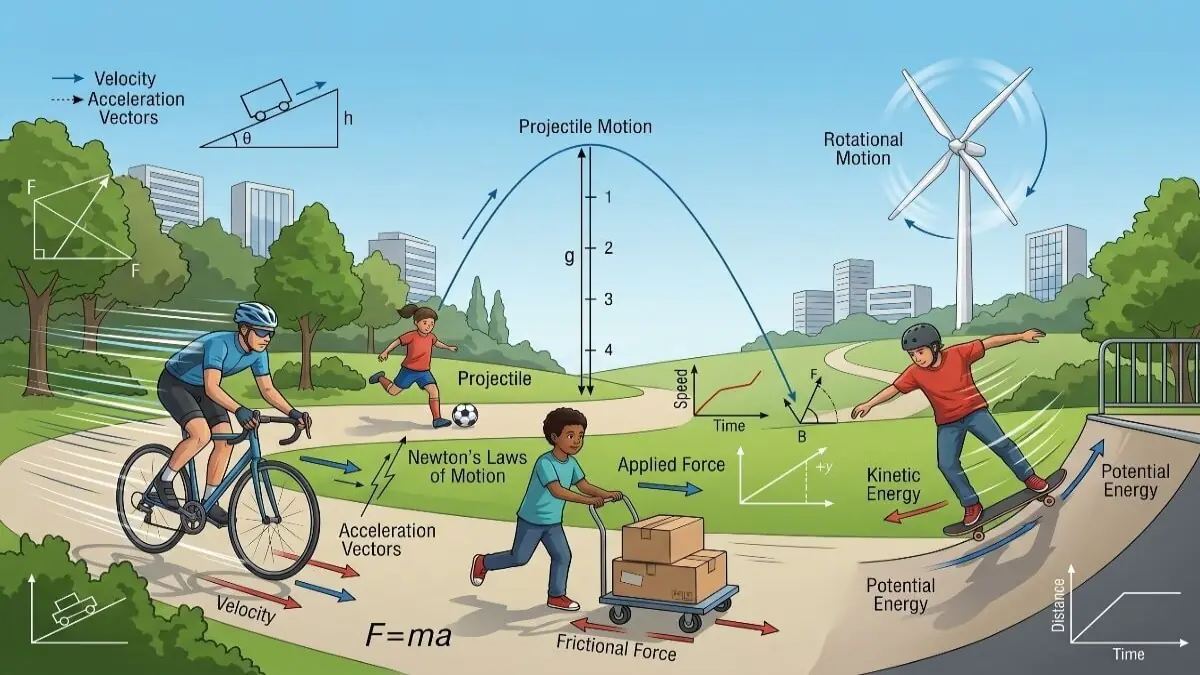
Introduction
The world around us is constantly in motion. We walk down the street, cars speed along highways, birds soar through the sky, and planets orbit the Sun in deep space.
There is a highly specific and fascinating science at work behind all this continuous activity. Understanding how and why things move helps us make sense of our surroundings.
Why Motion is One of the Most Important Concepts in Physics
Motion is one of the most fundamental and crucial topics in physics. Nothing in the entire universe is ever completely stationary.
Even when we are sitting quietly on a couch, our planet Earth is traveling around the sun at an incredible speed. Motion is the primary driving force behind all physical changes.
Without motion, absolutely no change in the universe would be possible. When we grasp the rules governing the motion of objects, we begin to understand how the entire cosmos operates. This foundational knowledge continuously helps us invent groundbreaking new technologies.
How Physics Explains the Movements of Daily Life
From the moment we wake up and start walking in the morning until we go to sleep at night, we are governed by the laws of motion. Everything we do involves physics.
When we throw a ball into the air, physics can perfectly predict exactly how and when it will fall back to the ground.
Understanding why a car stops when we press the brakes is easily explained through the principles of motion. Every single action in our daily lives depends on these scientific rules. These laws are incredibly simple to understand yet remarkably powerful in application.
What is Motion in Physics?
The word motion is familiar to all of us in our everyday conversations. However, science examines this concept from a slightly different, more precise perspective.
Definition and Basic Concepts of Motion
In simple terms, motion is the change in an object’s position over time relative to its surroundings.
If an object changes its location relative to the things around it, we consider it to be in motion.
The most important concept here is the reference point, often called the frame of reference. You must measure the position of an object relative to a fixed point. Without a frame of reference, determining motion is completely impossible.
Stationary vs. Moving: Understanding the Difference
The terms “stationary” and “moving” are entirely relative. Imagine you are sitting comfortably inside a moving bus.
Relative to the passenger sitting right next to you, you are completely stationary. However, relative to a person standing still on the side of the road, both you and the bus are moving very fast.
Therefore, whether an object is still or in motion depends entirely on where you are observing it from. In the grand scale of the universe, there is no such thing as absolute rest. Everything is moving relative to something else.
The Fundamental Laws of Motion
To truly understand the science behind motion, we need to learn a few specific rules. In the seventeenth century, the brilliant English scientist Sir Isaac Newton formulated some of the most important laws of motion.
A Brief Overview of Newton’s Laws of Motion. The scientist Isaac Newton published his famous book “Principia Mathematica” in 1687. In this historic book, he presented three fundamental laws of motion.
These three specific laws essentially laid the entire foundation for classical physics. They elegantly explain how an object’s motion changes when a force is applied.
If you want to dive deeper into the mathematics and history, you can read more from NASA’s guide to Newton’s laws of motion, which breaks down the concepts beautifully.
How These Laws Govern Everything That Moves
Newton’s laws are at work in everything from the simple tasks of our daily lives to the launch of massive rockets into outer space.
These formulas tell us exactly how much force we need to apply to make a car travel at a desired speed.
Even the simple act of an apple falling straight down from a tree hides its explanation within these very laws. These rules establish a fundamental mathematical relationship among the mass, velocity, and force of any given object.
Newton’s First Law of Motion (Inertia)
Newton’s first law is commonly referred to as the law of inertia. This rule tells us that objects have a natural tendency to maintain their current state.
Why Objects Resist Changes in Their Motion
According to the first law, a stationary object will remain stationary forever unless an external force is applied to it.
Similarly, a moving object will continue to move in a straight line at a constant speed forever unless a force stops it. This natural tendency of an object to hold onto its current state is called inertia.
The greater the mass of an object, the greater its inertia. Moving a heavy boulder from its resting place is very difficult because it has high inertia and “wants” to stay exactly where it is.
Everyday Examples of Inertia
We see excellent examples of inertia every time we travel on a bus. When a moving bus brakes suddenly, the passengers lean forward forcefully.
This happens because the lower part of the passenger’s body comes to a stop with the bus, while the upper part continues moving forward due to inertia.
Another great example is beating a dusty carpet with a stick. When the carpet is pushed away by the stick, the dust particles tend to remain in place due to inertia. As a result, they detach from the fabric and float into the air.
Newton’s Second Law of Motion
Newton’s second law explains exactly how the amount of force affects an object’s motion. It establishes a direct relationship between force, mass, and acceleration.
Explaining Force, Mass, and Acceleration
This law is mathematically expressed through one of the most famous equations in science: $F = ma$ (Force = mass × acceleration).
Here, acceleration simply means the rate at which an object’s speed increases.
The law states that the rate of change of an object’s momentum is directly proportional to the applied force. In simpler terms, the harder you push something, the faster it will accelerate.
How to Understand the Relationship Between Them
Understanding this concept in the real world is incredibly simple. Pushing a small, lightweight toy car is very easy and requires little effort.
However, pushing a real, full-sized car requires a great deal of effort. This is because the real car has a much larger mass.
To create the exact same amount of acceleration, you have to apply a significantly larger force to the heavier car. This dynamic relationship between force and mass explains why objects move the way they do.
Newton’s Third Law of Motion
Newton’s third law is perhaps the most well-known of the three. It clearly explains many of the physical actions we perform every single day.
Action and Reaction Forces in Real Life
The third law simply states that for every action, there is an equal and opposite reaction.
Whenever an object exerts a force on a second object, the second object exerts an equal and opposite force back on the first object.
These forces always work in pairs. A single, isolated force cannot exist anywhere in the universe. Force is always the direct result of an interaction between two different objects.
Why Every Force Has an Equal and Opposite Force
When we take a step, our foot pushes the ground backward. This backward push is the action force.
Instantly, the ground pushes our body forward with an equal and opposite force, which is the reaction force. This reciprocal pushing is exactly what allows us to move forward.
When swimming, we push the water backward with our hands, and the water pushes us forward in return. Even when a rocket launches into space, it violently pushes exhaust gases downward. The opposite reaction to the gas’s downward force pushes the massive rocket upward.
The Physics of Force and Motion
Motion is entirely dependent on force. It is completely impossible to change the movement of any object without applying some kind of force.
What Causes Objects to Move or Stay Still
Whether an object moves or stays still depends entirely on the net force acting upon it.
If an object is pushed equally from all sides, the total net force becomes zero. Under these conditions, the object remains perfectly still.
But if more force is applied in a specific direction, the object will move in the opposite direction. This is called an unbalanced force. You always need an unbalanced force to create a change in motion.
Different Types of Forces in Daily Life
There are many different types of forces working all around us at any given moment. Some forces require direct physical contact with an object to work.
Friction and muscular push are excellent examples of contact forces.
Other forces can act from a distance without any physical contact. Magnetic attraction and the Earth’s gravitational pull are great examples of invisible forces. These forces constantly control the movement of objects in our environment.
Gravity and Motion
Gravity is the invisible glue that holds the entire universe together. It is a fundamental natural force of attraction that exists everywhere.
The Impact of Gravity on Everything Around Us
This gravitational force exists between any two objects in the universe. Because the Earth is so massive, its gravitational pull is incredibly strong.
This specific force is the only reason we can stand firmly on the ground rather than float into the sky.
Scientist Isaac Newton was the first person to formally conceptualize this force of gravity. You can explore excellent lessons on gravity and basic physics through the Khan Academy Physics section.
Motion on Earth vs. Motion in Space
If you throw an object upward on Earth, the pull of gravity ensures it will eventually fall back to the dirt.
However, motion behaves quite differently in space or in Earth’s orbit, even though gravity is still very much present there.
Spacecraft travel around the Earth at such a high speed that they are constantly falling toward the planet, but because of the Earth’s curvature, they never actually hit the ground. Since there is no air resistance in the vacuum of space, objects can move freely without slowing down.
Friction: The Force That Slows Down Motion
When we roll a ball across the floor, it eventually slows down and comes to a stop. The primary reason for this stopping is friction.
How Friction Works
Friction is a force that arises when two surfaces come into contact and always opposes the direction of motion.
Even if a surface looks perfectly smooth to the naked eye, a microscope will reveal tiny grooves and bumps everywhere.
When two surfaces try to slide past one another, these tiny grooves catch and lock together. This interlocking creates a frictional force, causing moving objects to lose speed rapidly.
Why Friction is Both Helpful and Limiting
Friction is not always a bad thing. Without friction, we would not be able to walk on the ground without slipping and falling instantly.
The friction between a car’s rubber tires and the asphalt road helps the vehicle drive and brake safely.
However, in the world of machines, friction is often a massive problem. It slows moving parts and generates excess heat, wasting valuable energy. This is exactly why we use oil and lubricants to keep machine parts smooth.
Types of Motion in the Real World
Objects move in a wide variety of ways across the globe. Scientists have categorized these movements into several distinct types.
Linear Motion
When an object travels along a completely straight line, it is experiencing linear motion.
A car driving down a perfectly straight highway is a great example. Similarly, if an apple drops straight down from a branch to the grass, that is also linear motion.
Circular Motion
When an object moves in a circle around a central point, it is said to be in circular motion.
The movement of the hands on a clock or the spinning blades of a ceiling fan are perfect examples of this. The moon orbiting the Earth is also a grand-scale example of circular motion.
Rotational Motion
When an object spins around its own axis, it is in rotational motion.
When a toy top spins on a table, it remains in place while rotating around its center of gravity. The Earth spinning on its own axis to create day and night is also a prime example of rotational motion.
Oscillatory Motion
When an object regularly moves back and forth or up and down around a fixed central point, it is experiencing oscillatory motion.
The swinging pendulum of a classic grandfather clock is a wonderful illustration of this. A child swinging back and forth on a playground swing is another very common example.
Energy and Motion
Motion absolutely cannot exist without energy. Energy is defined as the capacity to do work, and making an object move requires a transfer of energy.
Kinetic Energy and Moving Objects
The energy an object has due to its motion is called kinetic energy.
The faster an object moves and the heavier its mass is, the more kinetic energy it possesses.
A fast-moving cricket ball carries a massive amount of kinetic energy, which is exactly why it can violently shatter wooden stumps upon impact.
Potential Energy and Stored Motion
When an object is moved from its natural resting position to a new position, it acquires potential energy.
If you pull back the string of a bow and hold it still, you are packing that bow with potential energy. The energy is waiting to be released.
Transformation of Energy in Motion
Energy is never actually created or destroyed; it merely changes from one form into another.
When a rollercoaster car is sitting at the very peak of the highest track, its potential energy is at its absolute maximum. As soon as the car begins to plunge downward, the stored potential energy rapidly converts to kinetic energy.
Motion in Everyday Life
The science of motion is practically applied in every single corner of our daily existence.
Transportation and Vehicles
Buses, trains, airplanes, and heavy ships all strictly follow the fundamental laws of motion.
Engines burn fuel to generate energy, which is transferred to the wheels or propellers to push the vehicle forward. By applying the brakes, vehicles create friction to safely manage and reduce speed.
Sports and Human Movement
How fast athletes run on a football pitch or how a kicked ball curves into the goalpost is entirely dictated by the rules of physics.
Our own muscles and bones act as biological levers to generate the forces required to move our bodies. Everything from jumping to swimming is a real-time physics experiment.
Motion in Nature and Space
The flowing currents of a river, the blowing wind, and the crashing waves of the ocean are all beautiful, natural examples of motion.
Looking upward, we see the endless orbits of planets and stars in deep space, reminding us that motion is an inescapable cosmic truth.
Common Misconceptions About Motion
People often develop incorrect ideas about how motion works. We need to use science to correct these common misunderstandings.
Why a Constant Force is Not Needed to Keep an Object Moving
In ancient times, philosophers such as Aristotle mistakenly believed that a constant force was always required to keep an object moving.
Newton’s laws eventually proved this idea completely wrong.
Objects on Earth only stop moving because invisible forces like friction and air resistance push against them. If you push an object in the vacuum of space, it will travel endlessly until another force finally stops it.
Clearing Up Popular Myths About Physics
Many people mistakenly believe that heavier objects fall to the ground much faster than lighter objects.
However, the legendary scientist Galileo proved that, in the absence of air resistance, all objects fall at the same rate. The speed of a falling object has absolutely nothing to do with how much it weighs.
Applications of Motion in Technology
Our deep understanding of motion science has directly led to the creation of incredibly advanced modern technologies.
Engineering and Mechanical Systems
Massive automated machines and towering cranes in factories operate strictly in accordance with the laws of motion.
Mechanical engineers utilize the laws of mechanics and dynamics to build tools that make heavy human labor infinitely easier. Building safe bridges and skyscrapers also requires a mastery of how forces act upon stationary objects.
Robotics, Artificial Intelligence, and Automation
Programming a robot to walk on two legs or grasp a delicate object requires incredibly complex mathematical calculations regarding motion.
Modern self-driving cars use advanced sensors and artificial intelligence to constantly calculate the speed and trajectory of surrounding objects. This allows them to navigate busy streets safely without human input.
Space Exploration and Orbital Motion
Rocket science is built entirely on Newton’s third law and complex equations of motion.
Satellites must be placed into space at highly specific speeds and angles. This precise mathematical calculation ensures they balance Earth’s gravitational pull and remain in a stable orbit.
The Future of Motion Science
Research regarding the science of motion is constantly evolving. Scientists are discovering new truths about movement every single day.
Advancements in Physics and Engineering
Quantum mechanics is currently showing us that the microscopic particles inside atoms do not follow the standard laws of motion we are used to.
Their physical world operates under completely different and strange rules. Scientists are aggressively harnessing this new realm of motion to build ultra-powerful quantum computers.
How Technology is Changing Our Understanding of Motion
In the near future, we will likely see widespread transportation systems, such as Maglev trains that float on magnets and travel frictionlessly.
Hyperloop technology may soon allow people to travel through vacuum tubes faster than by commercial airplanes. The deep science of motion is constantly expanding the boundaries of what humanity can achieve.
Frequently Asked Questions (FAQs)
What is motion in simple words?
In simple terms, motion is the process of an object changing its physical position over time relative to its surroundings. Whenever you move from one specific place to another, you are in a state of motion.
What are Newton’s three laws of motion?
Newton’s first law is the law of inertia. The second law is the formula that relates force, mass, and acceleration (F = ma). The third law states that for every single action, there is always an equal and opposite reaction.
Why do objects move or stop?
Objects only start moving when an unbalanced external force is strongly applied to them. Conversely, moving objects eventually stop because opposing forces, such as friction with the ground or air resistance, act to slow them down.
Which forces affect motion?
Motion is primarily affected by gravitational force, frictional force, muscular force, magnetic force, and electrical force. These specific forces can accelerate an object, decelerate it, or completely change its direction.
How is motion used in real life?
The laws of motion apply in almost every aspect of real life. This includes driving vehicles safely, playing competitive sports, manufacturing goods in heavy factories, and launching complex satellites into orbit.
Conclusion
Key Takeaways About the Science of Motion
The science of motion serves as the ultimate blueprint for understanding exactly how our physical world functions. The movement of objects is not random magic; it is a beautiful expression of strict and predictable natural laws.
Understanding How the Universe Moves
From Newton’s classical laws to the weird world of modern quantum physics, science has taught us that everything is connected. From the smallest vibrating atom to the largest spinning galaxy, everything is bound by the exact same threads of motion. Understanding motion truly means understanding the breathtaking universe we live in.