Physics in Everyday Life: The Science Around You
Introduction
Why Physics Is Everywhere Around You
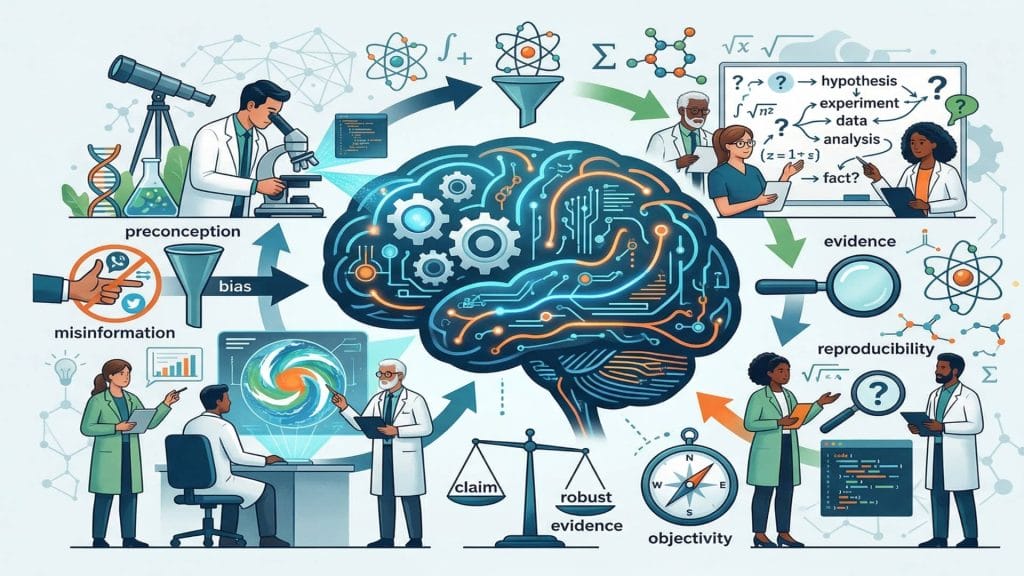
Have you ever wondered how the world around you works so beautifully? From waking up in the morning to going to sleep at night, science is hidden in every single action. Physics uncovers the mysteries of this vast and wonderful world around us.
Many people think physics is confined only to the pages of books or inside laboratories. The reality is completely different. The rules of physics work silently when you walk, talk, or breathe.
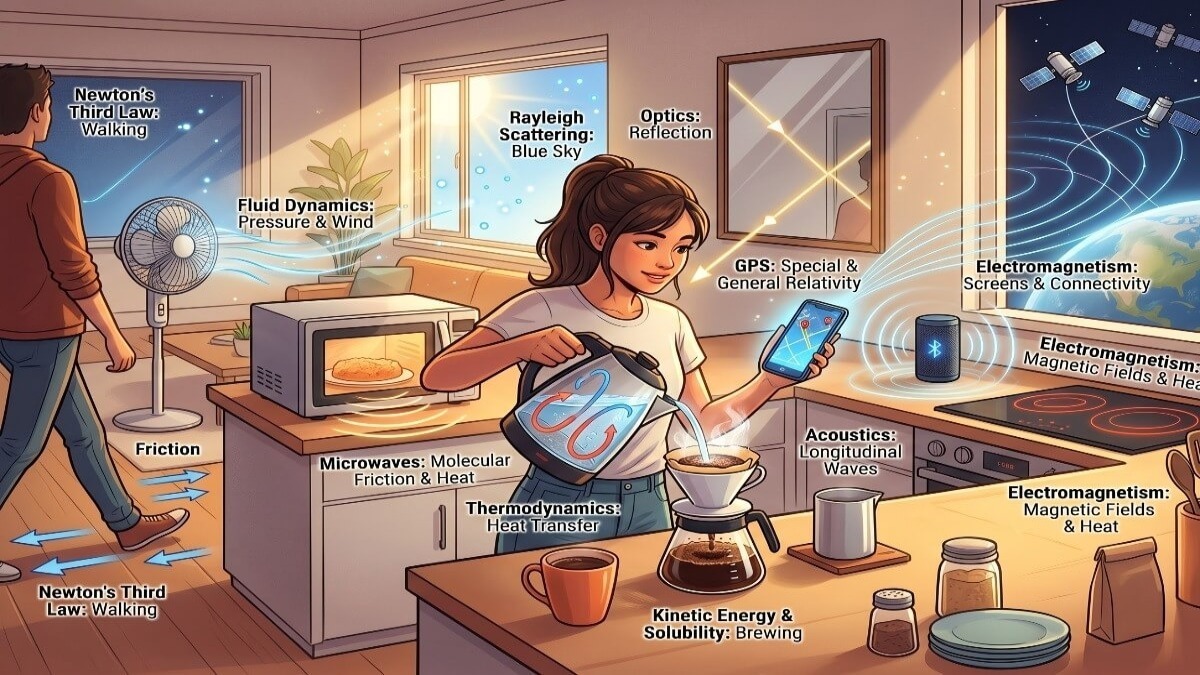
Everything from the smartphone in your hand to the stove in your kitchen relies on this science. Even if we do not consciously notice it, physics has become an integral part of our lives.
The Invisible Science Behind Daily Life
There is an invisible science working behind the scenes to make our daily tasks so effortless. When you drink a glass of water, gravity pulls that water downward. Although this is a very common action, it has a fascinating scientific explanation.
When we look at something, light enters our eyes. The laws of reflection and refraction of this light are also a part of physics. Many institutions, such as the National Science Foundation (NSF), are working to make this invisible science more accessible to the public.
Without us realizing it, these rules have made our lives easier and more beautiful. Learning about this invisible science can be quite an exciting journey for all of us.
What Is Physics and Why Does It Matter?
Understanding the Science of Motion, Energy, and Matter
Physics is the branch of science that deals with energy, matter, and their motion. It teaches us how objects move and how they interact with each other. All of this is governed by the fundamental laws of nature.
No work is possible without energy. That could be your physical energy or electrical energy. On the other hand, understanding the structure and properties of matter enables us to invent new things.
This excellent relationship between motion and energy has laid the foundation for our modern technology. Without it, our current civilization would be unimaginable.
How Physics Explains the Natural World
Every event in nature has a specific cause. Physics helps us find those causes. Everything from why a rainbow appears in the sky to why rain falls from clouds has a scientific explanation.
Everything from the planets and stars in the universe to tiny atoms operates under the laws of physics. Many brilliant minds, from Isaac Newton to Albert Einstein, have discovered these rules.
There is no alternative to this science for a deep understanding of the natural world. It helps us become more aware of our surrounding environment.
Physics in Your Morning Routine
Why Your Alarm Clock Works
We wake up in the morning hearing the sound of the alarm clock. Have you ever thought about how this clock rings at the exact right time? The tiny mechanical or electronic components inside it work according to the laws of physics.
Digital clocks use quartz crystals. When electricity flows through it, it vibrates at a specific frequency. This vibration helps the clock calculate the exact time.
The sound that comes out of the speaker when the alarm goes off is also a perfect example of sound waves. This wave vibrates the air, reaches your ears, and wakes you up.
The Science Behind Hot Water, Showers, and Heating
Taking a warm shower in the morning is quite relaxing. How a geyser or water heater warms this water is a beautiful example of thermodynamics. Here, electrical energy is converted into heat energy.
When water molecules absorb heat, their internal kinetic energy increases. As a result, the water starts to heat up. We can enjoy a comfortable shower thanks to this heat-transfer process.
When hot steam condenses on the bathroom mirror, condensation occurs. This is also a very common yet important law of physics.
How Electricity Powers Your Home
Every morning begins with the help of electricity. From turning on the room lights to running the coffee maker, electricity powers everything. Electricity is essentially the flow of electrons that reaches our homes through conductive wires.
As electrons rush through the wires, they carry energy. This energy is used by various appliances and converted into light or heat. According to the Department of Energy (DOE), this energy transformation has modernized our lifestyles.
Pressing the switchboard completes the circuit, and the flow of electricity begins. Because of this continuous flow, we can comfortably finish our morning chores.
Physics in Transportation
How Cars Move and Stop Safely
When you drive to the office or school, many scientific laws work simultaneously. The car engine burns fuel to create heat energy, which is then converted into mechanical energy. The car’s wheels turn because of this mechanical energy.
We use brakes to stop the car. Here, friction is created between the brake pads and the wheels. The moving car stops safely due to this frictional force.
Newton’s laws of motion apply directly here. Because of inertia, we lean forward when the car suddenly brakes. Seat belts are used to protect us from this danger.
The Role of Friction and Gravity in Driving
If there were no friction, we would never be able to drive a car on the road. The friction acting between the car’s tires and the road surface helps control the car. Friction decreases during rain or snow, creating a fear of the car slipping.
Gravity keeps the car firmly on the ground. If there were no gravity, the car would float in the air. The effect of this gravitational force is very well understood when driving on hilly roads.
Tire designs are made to create the right amount of friction with the road. This is absolutely essential for safe travel.
Why Airplanes Can Fly
How a massive airplane flies in the sky is one of the most fascinating aspects of physics. The wings of an airplane are shaped like an airfoil. Because of this, the air pressure on the upper part of the wing decreases, and the pressure on the lower part remains high.
An upward force called lift is generated by this difference in air pressure. This lift force overcomes gravity and keeps the airplane aloft.
At the same time, the engine’s thrust pushes the airplane forward. The famous scientist Bernoulli’s principle works wonderfully here.
Physics in Communication Technology
How Phones and the Internet Work Using Electromagnetic Waves
Nowadays, we cannot imagine a single moment without our smartphones. When you call someone or use the internet, electromagnetic waves go to work. These waves cannot be seen with the naked eye, but they carry data.
Your words are first converted into digital signals. Then the mobile antenna radiates this signal into the air as waves. A nearby cell tower receives those waves and delivers them to the recipient.
According to IEEE, this entire wireless communication system relies heavily on radio frequencies.
The Science Behind Wi-Fi and Mobile Networks
Wi-Fi routers provide internet connections to our homes. It also uses a type of radio wave that can penetrate walls and reach our devices. A router basically converts the wired internet signal from the modem into wireless signals.
Mobile networks work by dividing a large area into smaller sections or cells. Each cell has its own tower. When you are on the move, your phone automatically connects from one tower to another.
The speed of the internet depends on the frequency and length of the waves. These laws of physics have made our communication systems incredibly fast.
How Signals Travel Across the Globe
We can send messages from one country to another in an instant. Behind this are fiber optic cables. These cables transfer data using total internal reflection.
Thousands of kilometers of fiber optic cables are laid across the ocean floor. Data or information travels through these cables at extremely high speeds as light pulses.
Since the speed of light is the fastest in the universe, we can use the internet so quickly. This is a marvelous invention of modern physics.
Physics in the Kitchen
Heat Transfer in Cooking Food
The kitchen is a great physics laboratory. When we place a pot on the stove, heat transfer occurs. Heat always flows from a hotter place to a cooler one.
Through conduction, heat from the stove’s fire reaches the metal part of the pot. Then the water or food in the pot heats up by convection. The lower, warmer part of the liquid heats up and rises, while the upper, cooler part sinks.
Because of this cyclic flow, the food cooks evenly. Cooking at the right temperature is entirely a scientific process.
Why Pressure Cookers Work Faster
Food cooks very quickly in a pressure cooker. The reason is that it is a closed vessel where steam cannot escape. As a result, the air pressure inside the vessel increases significantly.
Due to the increased pressure, the boiling point of water rises. Normally, water boils at 100 degrees Celsius. However, in a pressure cooker, it starts boiling at 120 degrees or higher.
Because the temperature is higher, the food cooks much faster. This saves both time and fuel.
Explaining Microwaves and Energy Waves
The microwave oven is a popular appliance in modern kitchens. It does not use fire or general heat for cooking. Instead, it uses a special type of electromagnetic wave called a microwave.
These waves rapidly vibrate the water molecules inside the food. This rapid vibration of the molecules generates significant friction and heat. This heat warms the food from the inside out.
Foods with a high water content heat up faster in the microwave. This is a fantastic use of physics in everyday life.
Physics in Entertainment and Media
How Screens Create Images and Colors
How your television or smartphone screen shows such beautiful pictures is a marvel. LCD or OLED screens primarily use the principles of light polarization and emission. Every pixel on the screen is made up of red, green, and blue.
Millions of different colors can be created by changing the intensity of these three primary colors. When electricity flows through each pixel, they emit a specific amount of light.
Our eyes perceive these tiny dots of color together as a complete picture. This is a wonderful application of optics.
Sound Waves in Speakers and Headphones
We all love listening to music. Headphones or speakers convert electrical signals into sound waves. Inside them are a small magnet and a coil of wire.
When an audio signal or electric current flows through the wire, a varying magnetic field is generated. This starts vibrating the diaphragm inside. This vibration pushes the air, creating sound waves.
When these waves hit our eardrums, we hear the sound. If you increase the volume, the wave’s amplitude increases, making the sound louder.
The Science Behind Gaming and Virtual Reality
Playing video games is a very popular form of entertainment today. How the characters inside the game move so realistically depends on the physics engine. Game developers integrate the real laws of gravity, collision, and motion into the game through code.
Virtual Reality (VR) headsets take this a step further. They create a 3D environment in front of our eyes by refracting light through lenses.
Sensors inside the headset track our head movements and change the scene accordingly. This whole process is dependent on sensor technology and optics.
Physics in Sports and Movement
How Force Affects Running, Jumping, and Throwing
The laws of physics are hidden in every step of sports. When you run, your feet push the ground backward. According to Newton’s third law, the ground also pushes you forward with equal force.
When playing basketball or volleyball, players use muscle force to overcome gravity when they jump. The more force you apply, the higher you can jump.
Dynamics also work when throwing a ball in cricket or baseball. How far the ball will go depends on the mass of the ball and the speed of the arm.
Why Balls Curve and Bounce
In football or cricket, a ball can appear to curve or swing in the air. Aerodynamics is behind this. Due to the Magnus effect, a spinning ball changes its path as it travels through the air.
If the air pressure is higher on one side of the ball and lower on the other, the ball bends towards the higher pressure. This is also why one side of a cricket ball is polished, and the other is left rough.
Elasticity comes into play when a tennis ball or basketball hits the ground and bounces. The ball compresses slightly and bounces off the ground as it returns to its original shape.
Balance, Speed, and Energy in Sports
Maintaining body balance is crucial when doing gymnastics or riding a bicycle. Balance can only be maintained if the center of mass is in the correct position.
Runners try to reduce air resistance (air drag) to increase their speed. This is why they wear special clothing and lean slightly forward while running.
Proper use of energy determines victory and defeat in sports. Players unknowingly apply the laws of physics to improve their performance.
Physics in Medicine and Healthcare
X-Rays, MRI, and Medical Imaging
Modern medicine is crippled without physics. X-rays are a type of high-energy electromagnetic wave that can pass through our body’s soft tissues. Because it cannot pass through hard objects like bones, we can see pictures of the skeleton.
MRI (Magnetic Resonance Imaging) is a more advanced technology. It uses powerful magnetic fields and radio waves to create detailed images of the body’s interior.
Ultrasound machines work using sound waves. These imaging technologies help doctors detect diseases without cutting into the body.
How Physics Helps Diagnose Diseases
Various sensors and monitors are used in disease diagnosis. An ECG machine records the electrical signals of the heart. Our heart generates a small amount of electricity during every beat.
A pulse oximeter can determine the amount of oxygen in the blood by measuring light absorption. It absorbs different colors of light depending on the amount of oxygen in the blood.
According to the World Health Organization (WHO), the use of such scientific equipment has made healthcare much safer and more accurate.
Radiation Therapy and Medical Technology
Radiation therapy is widely used in the treatment of complex diseases like cancer. Here, cancer cells are destroyed using high-energy radiation, such as X-rays. Physicists control the dose of this radiation so that healthy cells suffer less damage.
Many delicate operations are now possible through laser surgery. The use of laser beams in cataract surgery or skin treatments is common.
An entire branch called biomedical engineering combines physics and medical science.
Electricity and Energy in Daily Life
How Power Plants Generate Electricity
The electricity we use every day is generated in a power plant. Most plants generate electricity through generators. There are massive magnets and coils of wire inside a generator.
Turbines are rotated using coal, gas, or hydropower. When the turbine rotates, the magnetic field inside the generator changes. According to Faraday’s law of induction, this change induces a flow of electric charge in the wire.
We get uninterrupted electricity because of this conversion from mechanical energy to electrical energy.
How Energy Reaches Your Home
The electricity produced at the power plant does not reach our homes directly. It has to travel a long way. First, the voltage of the electricity is increased significantly using a transformer.
The reason for increasing the voltage is to minimize energy loss when it travels through long wires. Then, it reaches our city’s substation through high-tension wires.
There, another transformer lowers the voltage to make it usable. After that, the electricity comes to the switchboard through our home’s meter.
Basics of Renewable Energy and Solar Power
People are now turning to renewable energy because fossil fuels will run out one day. Solar energy is one of the main ones. Solar-Panels convert sunlight directly into electricity.
Solar panels contain photovoltaic cells made of silicon. When photon particles of sunlight hit this cell, electrons are released. The flow of these free electrons is electricity.
Wind turbines also generate electricity by harnessing wind speed. The use of this technology is increasing day by day to protect the environment.
Physics in Modern Technology
Smartphones, Computers, and Semiconductors
The smartphone in your hand is an amazing creation of modern physics. It is primarily built on semiconductors. Materials like silicon conduct electricity under specific conditions.
Transistors are made utilizing this feature. Billions of tiny transistors make up a processor. This processor acts as the brain of the computer.
The branch of physics known as quantum mechanics has played the biggest role in the development of semiconductor technology. Without it, the digital age cannot even be imagined.
How Chips and Circuits Work
A microchip or integrated circuit (IC) is a small piece of silicon on which numerous electronic components are arranged. These circuits process information using logic gates.
Logic gates operate on two binary numbers: zero (0) and one (1). If there is voltage, it is considered 1; if not, it is considered 0.
Using this simple principle, chips can do incredibly complex mathematical calculations in an instant.
The Physics Behind Artificial Intelligence Hardware
Artificial Intelligence (AI) is incredibly popular now. Extremely powerful hardware is needed to run these AI programs. GPUs (Graphics Processing Units) are mostly used in this regard.
Heat management is a big challenge when making these processors. This is because a lot of heat is generated while working so fast. Cooling systems are designed following the laws of thermodynamics.
Transistor sizes are being made even smaller through nanotechnology, enabling AI to run faster with less power.
The Hidden Physics of Nature
Gravity Keeps Everything on the Ground
We can walk safely on Earth only because of gravity. There is an attractive force between any two objects in the universe. Since the Earth’s mass is very large, it always pulls us toward its center.
It is because of this force that apples fall from trees and ocean water does not fly away into space. The Earth and moon orbit the Earth under the influence of the same gravitational force.
Einstein’s general theory of relativity proved that massive objects bend space-time around them.
Light, Color, and Vision
The colorful world around us is basically a play of light. White light coming from the sun or a bulb is actually a mixture of seven colors. When light falls on an object, it absorbs some colors and reflects others.
We see the object in the exact color it reflects. Tree leaves look green because they reflect green light. The cells in our retina receive this light and send signals to the brain.
Without these simple rules of optics, the whole world would seem dark to us.
Weather, Wind, and Atmospheric Pressure
Atmospheric pressure and temperature play a massive role in weather changes. The sun cannot heat all parts of the Earth equally. It is hotter in the equatorial regions and cooler in the polar regions.
Hot air becomes light and rises, creating low pressure there. Then cold, heavy air from the surroundings rushes in to fill that space. We call this movement of air wind.
Natural events like earthquakes or rain occur mainly due to this huge change in pressure and temperature.
Examples in Daily Life You Never Noticed
Why Ice Floats on Water
Usually, when a substance changes from a liquid to a solid, its density increases, making it heavier and causing it to sink. But the exact opposite happens with water. When water freezes into ice, its molecules form a specific crystal structure.
Because this structure forms, a lot of empty space is created within the ice. As a result, the volume of ice exceeds that of the equivalent amount of water, and its density decreases.
Because it is less dense, ice can float beautifully in a glass of water or in river water. This is a wonderful blessing of nature.
Why Mirrors Create Reflections
We look at our faces in the mirror every day. A thin coating of silver or aluminum is applied to the back surface of the mirror. These metals can reflect light very well.
When light falls on the flat surface of a mirror, it causes regular reflection. That is, the angle at which light hits the mirror is exactly the angle at which it returns.
Because of this perfect reflection, we can see our clear image in the mirror. Light scatters on uneven surfaces, which is why images cannot be seen there.
Why Sound Changes in Different Environments
You might have noticed that if you talk in an empty room, the sound echoes or booms. But this does not happen in a room full of furniture. The reason for this is the reflection and absorption of sound waves.
Sound gets blocked by the hard walls of an empty room and bounces back repeatedly, creating an echo. But if there are soft surfaces, like sofas or curtains, in the room, they absorb sound waves.
When the surroundings are quiet at night, distant sounds can be heard due to changes in air temperature.
How Physics Improves Modern Life
Advances in Technology and Innovation
Physics is at the root of every new technological invention. From Bluetooth smartwatches to spacecraft, it is applied everywhere. Scientists are discovering new properties of matter and making new machines with them.
Because of quantum mechanics and nanotechnology, we can now carry powerful computers in the palm of our hands. GPS technology uses satellites and the theory of relativity to tell us our exact location.
Research institutions like MIT are constantly improving our standard of living through the invention of new technologies.
Safer Transportation and Better Healthcare
Scientists are constantly working to make the transportation system safer. A car’s airbag sensor works using the physics law of momentum. It inflates upon impact, protecting the passenger from major injuries.
The use of lasers and fiber optics in healthcare has made surgery much easier. Modern scanning machines have brought revolutionary changes to disease diagnosis.
Knowledge of mechanics is also being used to create artificial limbs or prosthetics, which is changing the lives of many people.
More Efficient Energy Systems
To meet the growing energy demand, scientists are looking for new energy sources. Research is underway on new materials to improve the efficiency of solar cells. A large amount of energy is generated by fission reactions in nuclear power plants.
In the future, attempts are being made to produce clean, infinite energy like the sun using fusion reactors. Improvements in battery technology are increasing the use of electric cars.
All of these help reduce environmental pollution and move towards a beautiful future.
Common Misconceptions About Physics
Physics Is Not Just About Complex Equations
Many people have a fear that physics is only about big mathematical equations and boring formulas. This idea is completely wrong. Mathematics is merely a language to express physics.
The main thing is to understand and realize the laws of nature. When you understand why the sky is blue or why stars twinkle, it feels like magic.
The equations only help to measure this magic perfectly. Therefore, it is more important to understand the story behind it without fear.
Everyday Science Is Simple Yet Powerful
Science is not just the work of scientists wearing white coats in a laboratory. When the spoon in your kitchen gets hot, that is also science. These small events around us are actually very powerful.
Ordinary people can also learn these things by being a little curious. It is a joy to understand the frictional force behind how a small pencil leaves a mark on paper.
These comprehensible aspects of science make our thinking more rational and sharp.
The Future of Physics in Everyday Life
Quantum Technology and New Inventions
The technology of the future will be even more unimaginable. Quantum computers have already started working. They can calculate millions of times faster than ordinary computers.
Through quantum cryptography, data exchange on the internet will be completely hack-proof. Utilizing the superconductivity feature of matter, there will be no loss or waste in transmitting electricity.
These technologies will completely change our daily lives within the next few decades.
Smart Cities and Advanced Engineering
The cities of the future will be smart. From traffic signals to streetlights, everything there will be controlled by sensors and data. With advances in mechanics and materials science, buildings will be built that will not collapse in earthquakes.
Maglev trains will float over tracks using magnetic repulsion and reach their destinations faster than the speed of sound.
Eco-friendly architectural designs will utilize sunlight and wind to drastically reduce electricity use.
The Next Wave of Scientific Discovery
Science never stops. After the discovery of gravitational waves, a new era has begun in space research. In the future, we may find cheaper and easier ways to travel to space.
Nanorobots will travel through our blood vessels and treat diseases. Artificial intelligence will discover new medicines using the laws of physics.
Our next generation will live in a highly advanced, science-based world, the foundation of which is being laid by today’s physics.
Frequently Asked Questions (FAQ)
How does physics affect daily life?
Physics affects our walking, cooking, entertainment, and every means of communication. Everything from electronics to vehicles runs on the rules of this science. It has made our tasks easier and faster.
Where do we see physics in everyday activities?
Everywhere. When you open a door, the lever principle applies. When you wear glasses, the lenses refract light. Even when you breathe, the rules of air pressure apply.
Why is physics important for technology?
Physics is the foundation of technology. If the properties of semiconductors were not known, smartphones would not have been created. Without the discovery of electromagnetic waves, Wi-Fi or mobile networks would not exist. It is essential for creating new technology.
Is physics only used in science labs?
Not at all. Scientists indeed discover new rules in the laboratory. But those rules are applied to every object in our home. Your fridge, TV, or car are all the results of the practical application of physics.
Can we live without physics?
No. Physics is not a man-made rule, but rather the rule of nature. Without the laws of gravity or thermodynamics, nothing in the universe would exist. Therefore, life is impossible to imagine without this science.
Conclusion
Core Lessons of Physics in Daily Life
From this entire discussion, we can understand that science is not something separate from us. It is intertwined with every step of our lives. Physics teaches us how to be curious and ask questions.
There is a logical reason behind every event around us. Knowing these reasons makes the world seem much more mysterious and beautiful. It helps us move away from blind faith and walk the path of logic.
Understanding the Hidden Science Around You
From today, try to look at the things around you with a slightly different perspective. Think about how a simple pen works or how the breeze from a fan cools a room.
Make science your friend without fearing it. These little curiosities of yours will broaden your knowledge. Learn to enjoy this wonderful and hidden science of nature. May your every day become more meaningful and joyful.