Top 10 Scientific Breakthroughs Shaping Humanity
Introduction
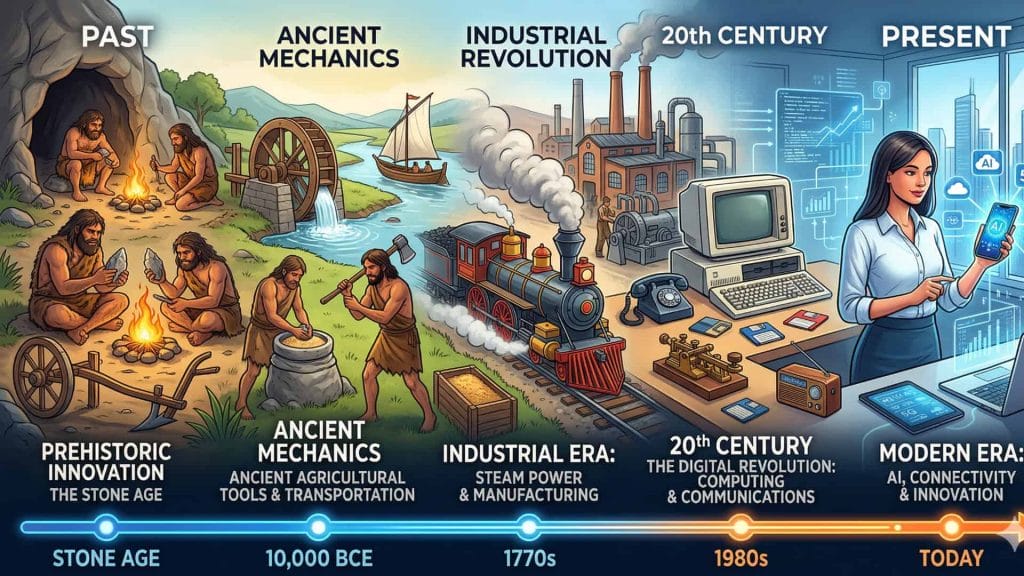
Human history is not just a record of kings, empires, or wars. It is fundamentally a continuous story of humanity’s indomitable curiosity and quest for knowledge. From the primitive ages to today’s modern digital era, science has constantly transformed our lives. The way we live today is the result of the tireless efforts of countless scientists from the past.
Science is a unique medium for understanding the world around us. Through it, we have been able to unravel the mysteries of nature. Before discussing the top 10 scientific breakthroughs shaping humanity, we need to understand how science brought us to this point. Every discovery has added a new dimension to our way of thinking.
How Scientific Breakthroughs Transformed Civilization
The role of science in the journey of human civilization is immense. Whenever humans discovered a new law of nature, the wheels of civilization turned faster. In ancient times, humans were helpless against the forces of nature. But thanks to scientific advances, humanity gradually managed to gain control over its environment.
From agriculture to the Industrial Revolution, the touch of science is present at every step. Science has not only reduced our physical labor but also multiplied our standard of living. Advancements in medical science have increased the average human lifespan. Meanwhile, improvements in communication have turned the entire world into a small global village.
The Lasting Impact of Discoveries and Innovations
The impact of any major discovery is never confined to a specific period. Its effects continue to ripple through the centuries. For example, the invention of the wheel happened thousands of years ago, yet it remains an integral part of our daily lives today.
A groundbreaking discovery often paves the way for new innovations. If electricity had not been discovered, we would not have computers or the internet today. Therefore, every scientific breakthrough actually acts like a massive chain reaction. It serves as the foundation for countless future innovations and propels humanity forward.
What Makes a Scientific Breakthrough World-Changing?
All discoveries are important, but not all of them are groundbreaking. There are fundamental differences between a general discovery and a world-changing breakthrough. A scientific achievement becomes world-changing only when it completely alters society’s conventional thinking.
Such breakthroughs have a profound impact on people’s lifestyles. They are not confined to laboratories but become part of the everyday lives of ordinary people. A groundbreaking discovery gives birth to new industries and strengthens the economy.
Defining Scientific Innovation and Progress
Scientific innovation is a process through which new knowledge or technology is created. It could be a completely new concept or a significant improvement of an existing technology. Scientific progress refers to the continuous expansion of our knowledge base.
True scientific progress always relies on evidence and logic. It breaks down old misconceptions and establishes new truths. This endless stream of innovation and progress has led human civilization from darkness to light.
How Groundbreaking Discoveries Affect Society and Technology
Groundbreaking discoveries have a deep impact on every level of society. They change the way we work, our communication systems, and even our mediums of entertainment. Technological advancement directly affects the economic structure of a society.
The Industrial Revolution is a prime example. The invention of the steam engine reshaped the economy and social system of all of Europe. In the exact same way, artificial intelligence is reorganizing our society today. Technology and society act as complements to each other.
Breakthrough Discovery #1: The Discovery of Fire
The use of fire is the oldest and most important scientific achievement in human history. It was not the discovery of any single scientist. Rather, it was the result of early humans’ long observation and experience. Fire completely transformed human life.
It is believed that the Homo erectus species first learned to control the use of fire. Before the discovery of fire, humans survived by eating raw meat and fruits. They knew of no way to protect themselves from the severe cold and attacks by wild animals. The use of fire freed them from these existential threats.
Humanity’s First Technological Revolution
Fire is considered humanity’s first technological revolution. This is because it taught humans how to control a powerful element of nature for the very first time. By mastering the technique of making fire, humans demonstrated their intelligence.
This technological revolution also played a massive role in human evolution. With the help of fire, humans learned to craft better tools. They could harden spear tips by burning wood or shape stones by heating them. This multiplied their hunting capabilities.
How Fire Transformed Survival, Cooking, and Society
The biggest advantage of discovering fire was learning how to cook. Cooked food was easier to digest and provided more nutrients. As a result, the human brain had the opportunity to grow larger and more complex. Cooked food also protected humans from parasites and harmful bacteria.
Furthermore, fire brought major changes to the social lives of early humans. With the fear of the dark removed, they began gathering around the fire at night. This created opportunities for communication and language development. The warmth of the fire also helped them survive in colder regions, ensuring the global spread of humanity.
Breakthrough Discovery #2: The Heliocentric Model of the Solar System
In ancient times, people believed that the Earth was located at the center of the universe and that all planets, including the Sun, revolved around it. This was called the geocentric model. But in 1543, Nicolaus Copernicus presented a new theory. He stated that the Sun, not the Earth, was the center of the solar system.
This theory is known as the heliocentric model. It was a massive shift in human thought. This groundbreaking discovery by Copernicus delivered a major blow to traditional religious and philosophical beliefs. It was the first big step in freeing science from superstition.
Understanding Earth’s Place in the Universe
Through the heliocentric model, humans became aware of their true place in the universe for the first time. They realized that Earth was not a uniquely privileged center but merely an ordinary planet. This realization made humanity much more humble.
Later, Galileo Galilei found evidence for Copernicus’s theory using his homemade telescope. He observed the moons of Jupiter and the phases of Venus. Galileo’s observations proved that not everything in the universe revolves around the Earth. This theory opened new horizons for space exploration.
The Scientific Revolution and Its Legacy
The work of Copernicus and Galileo sparked the Scientific Revolution in Europe. People began to place more importance on evidence and observation rather than blind faith. This laid the foundation for modern science.
The heliocentric model helped Johannes Kepler discover the laws of planetary motion. Based on these very laws, Isaac Newton later proposed his law of universal gravitation. Thus, the heliocentric model can be considered the parent of modern physics and astronomy.
Breakthrough Discovery #3: Newton’s Laws of Motion and Universal Gravitation
In 1687, Sir Isaac Newton published his famous book ‘Philosophiæ Naturalis Principii Mathematica’. This book is considered one of the most important works in the history of science. Newton proved that the reason an apple falls to the Earth and why planets orbit are essentially the same.
He named this force gravity. In addition to the law of gravitation, Newton provided three fundamental laws of motion. These laws were able to mathematically explain every mechanical event happening around us. Newton’s work took science to an entirely new height.
Unveiling the Mechanics of the Universe
Newton’s laws made the mechanics of the universe comprehensible to humanity. Before this, the movements of celestial bodies were largely mysterious. Newton showed that everything in the universe follows certain specific mathematical rules.
Using his formulas, scientists were able to calculate the positions and trajectories of planets and stars with perfect accuracy. Even the exact return date of Halley’s Comet could be predicted in advance using Newton’s laws. This was a massive testament to the predictive power of science.
The Foundation of Classical Physics
Newton’s laws of motion and gravitation established the foundation of classical physics. For nearly two and a half centuries, these laws were the ultimate authority in physics. Almost all the machinery invented during the Industrial Revolution operated on the principles of Newton’s laws of motion.
Even today, we use Newton’s laws when building bridges, manufacturing cars, or launching rockets. His discoveries banished superstition from the human mind and paved the way for a mathematical understanding of nature’s rules.
Breakthrough Discovery #4: The Theory of Evolution
In 1859, Charles Darwin published his theory of evolution through his book ‘On the Origin of Species’. This theory brought about the most revolutionary change in the history of biology. Darwin proposed that all animals and plants on Earth evolved over time from a common ancestor.
He introduced a process called natural selection. The animals that can adapt best to their environment survive and reproduce. This theory challenged all prevailing notions about the origin and diversity of life.
Explaining the Diversity of Life
The theory of evolution unraveled the mystery of life’s vast diversity for scientists. Darwin’s theory provided a logical explanation for why there are so many different species of animals on Earth. Nature is constantly changing, and animals are themselves accordingly.
Through this theory, humans realized that humanity is not outside of nature. We, too, achieved our current form through evolution, just like other animals. This brought new momentum to research in biology, paleontology, and genetics.
The Impact of Evolutionary Biology
The theory of evolution is the cornerstone of modern biology. Without this theory, it is impossible to understand biology accurately. From medical science to agricultural science, evolutionary concepts are applied everywhere.
For instance, how bacteria become antibiotic-resistant can only be explained through the theory of evolution. Furthermore, knowledge of evolution is essential for understanding new viral strains or mutations. Darwin’s groundbreaking discovery forever changed our perspective on life.
Breakthrough Discovery #5: The Germ Theory of Disease
Until the mid-nineteenth century, people believed that diseases spread through foul air or ‘miasma’. However, research by scientists like Louis Pasteur and Robert Koch revealed a new truth. They proved that certain microorganisms enter our bodies and cause diseases.
This is known as the germ theory of disease. This discovery is considered the most critical turning point in the history of medical science. Through this, doctors learned about the actual causes of diseases for the first time.
Understanding the Causes of Illness
After the discovery of germ theory, humanity understood that microscopic organisms such as bacteria, viruses, fungi, and parasites are responsible for various diseases. Louis Pasteur demonstrated that food and beverages could be sterilized by heating them. Today, we call this process pasteurization.
Robert Koch proved the existence of specific bacteria for specific diseases. He discovered the bacteria responsible for tuberculosis and cholera. Their work helped humanity understand the causes of pandemics that had plagued societies for centuries.
The Transformation of Medicine and Public Health
The germ theory brought revolutionary changes to healthcare systems and public health. Hospitals began to emphasize cleanliness and sterilization. Surgeon Joseph Lister introduced the use of antiseptics during surgery. As a result, patient mortality rates dropped dramatically.
Later, advanced vaccines and antibiotics were discovered based on the germ theory. Alexander Fleming’s discovery of penicillin was a direct continuation of the success of germ theory. According to the World Health Organization (WHO), the proper application of germ theory has enabled the control of global infectious diseases today.
Breakthrough Discovery #6: The Discovery of DNA
In 1953, James Watson and Francis Crick discovered the double helix structure of DNA. The X-ray crystallography work of Rosalind Franklin and Maurice Wilkins played a crucial role in this discovery. DNA, or deoxyribonucleic acid, is the molecule that carries the genetic instructions for all living organisms.
This discovery ushered in a new era in biology and genetics. Scientists finally understood how traits are transferred from parents to their children. It provided the solution to one of life’s deepest mysteries.
Unveiling the Blueprint of Life
The double helix structure of DNA is called the blueprint of life. It looks like a twisted ladder. The steps of this ladder are made up of four chemical bases. The specific arrangement of these bases determines the traits of an animal or plant.
Through this discovery, scientists understood how DNA replicates itself during cell division. Massive initiatives like the Human Genome Project were built upon the foundation of DNA discovery. This made it possible to know the location and function of every human gene.
How Genetics Revolutionized Biology
The discovery of DNA has brought revolutionary changes to modern medical science, agriculture, and forensics. Today, we can produce improved crop varieties through genetic engineering. Identifying criminals has become much easier through DNA testing.
In the medical field, gene therapy is being used to diagnose and cure genetic diseases. In cancer research, new treatment methods are being developed by analyzing DNA mutations. The discovery of DNA has literally reprogrammed our understanding of life.
Breakthrough Discovery #7: Electricity and Electromagnetism
Electricity was not discovered by a single individual. However, thanks to the contributions of scientists like Michael Faraday, James Clerk Maxwell, Thomas Edison, and Nikola Tesla, electricity is an inseparable part of our daily lives today. When Faraday discovered electromagnetic induction in the nineteenth century, the electrical age officially began.
This discovery made it possible to convert mechanical energy into electrical energy. It paved the way for the invention of the dynamo and the electric motor. Electricity filled human civilization with brilliant light, pulling it out of the dark.
The Driving Force of the Modern World
Today’s modern world is almost paralyzed without electricity. Our homes, hospitals, factories, and communication systems all rely on power. It has reduced human physical labor and increased reliance on machines.
Nikola Tesla’s discovery of Alternating Current (AC) allowed electricity to be transmitted easily over long distances. Consequently, power could be generated in remote locations and supplied to cities. Electricity accelerated industrialization worldwide and improved human living standards.
Innovations Made Possible by Electrical Science
The discovery of electricity gave birth to countless new technologies. Electric bulbs, telephones, radios, televisions, and today’s supercomputers are all gifts of electricity. Without power, we would not be able to enjoy any of the benefits of modern information technology.
The concept of electromagnetism has also played an essential role in medical science. Life-saving machines like MRI and X-ray operate using the principles of electrical science.
Breakthrough Discovery #8: The Theory of Relativity
At the beginning of the twentieth century, physicists believed they knew almost everything about the universe. However, in 1905 and 1915, Albert Einstein completely shocked the scientific community by publishing his theories of Special and General Relativity. He showed that space and time are not absolute or unchanging.
According to the theory of relativity, if you travel close to the speed of light, time slows down and mass increases. ..Einstein’s famous equation $E=mc^2$ proves that mass and energy are essentially two different forms of the same thing.
Einstein’s New Concept of Space and Time
Einstein’s theory of general relativity completely altered our understanding of gravity. He stated that gravity is not a traditional force. Rather, the curvature of space-time caused by heavy objects is what we experience as gravity.
Through this theory, scientists understood why even light cannot escape the massive gravitational pull of a black hole. It provided new insights into the birth, expansion, and evolution of the universe. This new concept of space and time brought about a massive philosophical shift in physics.
The Impact of Relativity on Modern Physics
The theory of relativity is one of the pillars of modern physics and astronomy. The Global Positioning System (GPS) that we use in our daily lives would not function properly without the theory of relativity. The clocks on satellites run slightly faster than clocks on Earth; Earth’s time is adjusted using Einstein’s theory.
The theory of relativity is extensively used in nuclear power generation and space exploration. The discovery of gravitational waves, which scientists recently proved, was predicted by Einstein in his theory exactly a century ago.
Breakthrough Discovery #9: The Invention of the Computer
The invention of the computer is one of the fastest-moving revolutions in human civilization. Although Charles Babbage is known as the father of the computer, the contributions of Alan Turing and John von Neumann to the development of modern computers are undeniable. In the mid-twentieth century, the first electronic computer, ENIAC, was built.
Early computers were massive, occupying entire rooms. However, with the invention of the transistor and later the microchip, computers became smaller and more powerful. The smartphone in our hands today is vastly more powerful than the supercomputers of that era.
The Birth of the Digital Age
The computer ushered humanity into a new era, which we call the digital age. It has completely redefined the methods of storing, analyzing, and sharing data. Calculations and data processing tasks can now be done in fractions of a second.
From banking to education, healthcare, and entertainment, the use of computers is indispensable. Scientists are creating complex mathematical models using computers to forecast the weather and control spacecraft.
How Computing Transformed Communication and Industry
Computing technology has brought automation to the industrial sector. Robots and computer-controlled machinery have made human tasks easier and more precise in manufacturing plants. This has multiplied industrial productivity many times over.
Computers have brought an unprecedented change to communication systems. Through email, video conferencing, and social media, people are now much closer to each other. Without computing power, the development of today’s artificial intelligence (AI) technology would have been utterly impossible.
Breakthrough Discovery #10: The Development of the Internet
The development of the internet is the most groundbreaking networking achievement in human history. In the 1960s, the first internet, called ARPANET, was created as part of US military research. Later, in 1989, when Tim Berners-Lee invented the World Wide Web (WWW), the internet became accessible to the general public.
The internet is essentially a global network of countless computers. It has connected the entire world on a single digital platform, crossing geographical boundaries. There is no alternative to the internet when it comes to ensuring the free flow of information.
Connecting the World in Unprecedented Ways
The internet has connected the world in ways previously unimaginable. Sitting in one corner of the world, communicating with someone in another corner in seconds is now a normal occurrence. It has accelerated globalization more than anything else.
Students can now participate in online courses from the world’s top universities. Services like distance learning and telemedicine have been made possible solely by the internet. It has granted humanity access to a vast repository of information and knowledge.
The Global Impact of Digital Communication
The internet has brought a major shift to the global economy. Through e-commerce sites, business and trade are no longer confined to specific areas. Through freelancing and remote work, people can work for international companies from home.
Social media platforms are playing a vital role in shaping public opinion and raising awareness. However, the internet has also created new challenges, such as cybersecurity and privacy concerns. Despite this, there is no denying the positive impact of the internet on the advancement of human civilization.
Honorable Mentions in Scientific History
In addition to the 10 discoveries mentioned above, many other groundbreaking achievements in the history of science have deeply impacted humanity. These discoveries have played a major role in making our lives safer, easier, and better. Let’s look at a few such honorable mentions.
It is impossible to imagine a complete picture of modern civilization without these scientific achievements. Each discovery is a milestone that has pushed us toward new possibilities.
Vaccines and Medical Advancements
The discovery of the smallpox vaccine by Edward Jenner is one of the greatest achievements in human history. Because of vaccines, terrifying diseases like polio, measles, and diphtheria have been nearly eradicated from the world. Alongside antibiotics, vaccination programs have saved the lives of millions of children.
In medical science, imaging technologies such as X-rays, CT scans, and ultrasound have made disease diagnosis highly accurate. Organ transplants and stem cell therapy have opened new horizons in treatment.
Quantum Mechanics and Modern Technology
At the beginning of the twentieth century, quantum mechanics was born, led by scientists such as Max Planck, Niels Bohr, and Erwin Schrödinger. It explains the behavior of atoms and subatomic particles.
Today’s semiconductors, laser technologies, and MRI machines operate on the foundations of quantum mechanics. Scientists believe that in the future, quantum computing technology will bring an unimaginable revolution to the world of technology.
Space Exploration and the Moon Landing
The moon landing by Neil Armstrong and Buzz Aldrin during the Apollo 11 mission in 1969 is an unforgettable event in human history. It proved that human capabilities are not confined to Earth.
The Hubble and James Webb Space Telescopes have allowed us to see the farthest galaxies in our universe. Sending rovers to Mars and establishing the International Space Station are proofs of our extraordinary progress in space exploration. NASA’s missions continue to provide us with new knowledge about our universe.
How Scientific Breakthroughs Affect Everyday Life
We often forget that every small task in our daily lives depends on science and technology. From waking up in the morning to going to sleep at night, we enjoy the benefits of numerous scientific discoveries.
Science is not just a subject confined to a laboratory. It improves our standard of living and makes life much more comfortable.
Healthcare and Medicine
Thanks to scientific progress, we are now receiving treatments for many complex diseases. Clean drinking water, nutritious food, and modern sanitation systems have vastly improved public health.
From blood pressure monitors to diabetes testing glucometers, everything is a gift of science. The discovery of new medicines allows humans to fight against incurable diseases much more effectively than before.
Transportation and Communication
From the wheel to today’s electric cars and bullet trains, transportation systems have undergone revolutionary changes. The invention of the airplane has turned world travel into a matter of mere hours.
Through smartphones and the internet, we can connect with anyone in an instant. With the help of GPS technology, getting lost in an unfamiliar city has become almost impossible.
Education and Access to Information
The spread of education has accelerated due to the internet and digital devices. People from any corner of the world can now access free information through Wikipedia or educational websites.
E-books and online libraries have made the habit of reading much easier. Education is no longer limited to the classroom; it is now in everyone’spalmd.
Common Traits Behind Great Discoveries
Flipping through the pages of history reveals that every great discovery shares some common traits. Even though scientists worked in different eras and environments, there is a striking similarity in their methods.
No groundbreaking discovery happens abruptly. Behind it lies long preparation, the ability to ask the right questions, and a mentality that accepts failure.
Curiosity and Critical Thinking
At the root of almost all major discoveries lies human curiosity. Newton wondered why the apple fell down precisely because he was curious.
Critical thinking teaches scientists to question conventional beliefs. If Copernicus had accepted conventional wisdom, the heliocentric model would never have been discovered.
Experimentation and Perseverance
Science is not limited to theoretical thinking alone. Thomas Edison failed a thousand times before inventing the electric light bulb. His perseverance proves that there is no substitute for patience when it comes to scientific success.
A theory is only established through proper experimentation and data collection. Scientists accept something as truth only after repeatedly getting the same results.
Collaboration and Knowledge Sharing
Scientists can never succeed by working in isolation. Isaac Newton himself said that he was able to see further by standing on the shoulders of giants.
Today, scientific research is much more collaborative. The discovery of DNA involved the combined work of several scientists. Knowledge sharing accelerates the pace of science.
The Future of Scientific Breakthroughs
Science is an ongoing process. Where we stand today is merely the foundation of a new beginning. Future scientific discoveries might be even more wondrous than we can imagine.
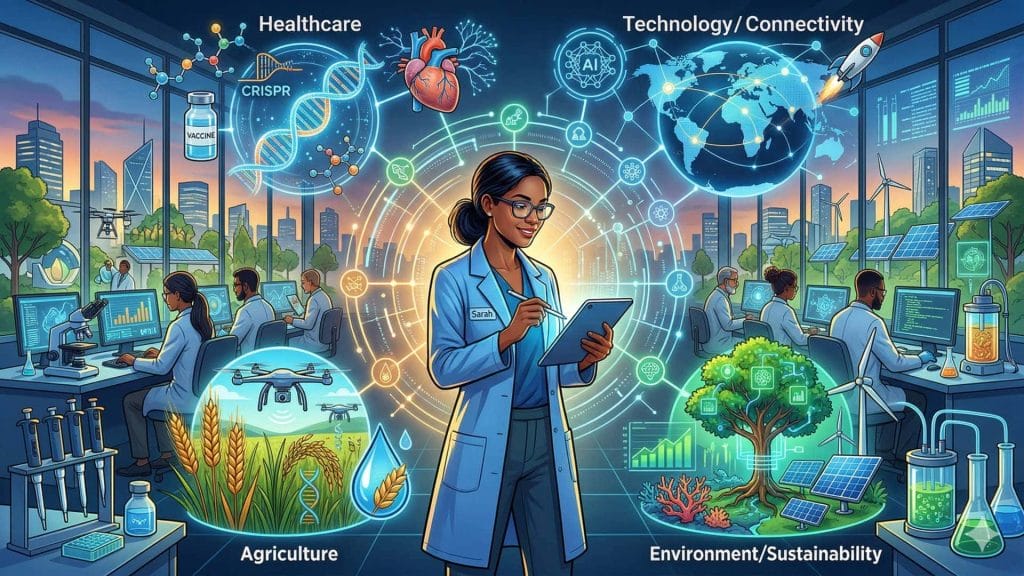
We will have to rely on science and technology to solve global issues such as climate change, energy crises, and emerging diseases. Scientists are constantly working to find new technologies.
Artificial Intelligence and Emerging Technologies
Artificial Intelligence (AI) is set to be the biggest breakthrough technology of the coming decade. AI will improve our decision-making capabilities and increase automation.
Using machine learning, formulas for new drugs are being discovered very quickly. Emerging technologies like blockchain and 3D printing are poised to bring major changes to the industrial sector.
Biotechnology and Human Health
Using gene-editing technologies like CRISPR, scientists are increasingly able to make changes to DNA. Through this, hereditary diseases might be cured permanently.
Research is ongoing to create artificial organs and produce lab-grown meat using biotechnology. The delivery of drugs directly to specific human cells using nanotechnology will revolutionize medicine
Exploring the Next Frontiers of Science
In space exploration, humanity will attempt to establish permanent settlements on Mars in the coming decades. Scientists are highly optimistic about nuclear fusion technology as a clean and limitless source of energy.
Furthermore, unraveling the mysteries of dark matter and dark energy is the next big challenge in physics. These new frontiers of science will take humanity to an entirely new level.
Lessons Humanity Can Learn from Scientific Progress
Science has not only given us technological advantages but also expanded the realm of our thought. There are quite a few important lessons we can learn from scientific progress.
Science teaches us how to seek the truth and how to correct our own mistakes. It helps us build a rational society.
The Importance of Evidence-Based Thinking
The core foundation of science is evidence. No matter how appealing a claim is, science does not accept it without proof. It is crucial to apply this evidence-based thinking in our daily lives as well.
In this age of rumors and misinformation, scientific thinking helps us make the right decisions. We should always verify everything on the touchstone of logic.
Embracing Innovation for a Better Future
Humanity has only progressed when it warmly embraced the new. Instead of fearing technological changes, we should ensure their proper use.
Through eco-friendly technology and sustainable development, we must gift our future generations. A beautiful Earth. Innovation alone can tackle all our future challenges.
Frequently Asked Questions (FAQs)
What is the most important scientific breakthrough in history?
This depends on perspective. However, the use of fire, the dawn of agriculture, the germ theory, and the discovery of electricity are considered the most critical milestones in human history. This is because they directly aided in human survival and improved living standards.
How have scientific discoveries improved human life?
Scientific discoveries have increased average life expectancy by improving medical systems. They have eliminated food scarcity through advanced agricultural technologies. Additionally, they have made human life much easier and more comfortable through improvements in transportation and communication.
Why are scientific breakthroughs important?
Groundbreaking discoveries change the conventional thinking of society. They create opportunities for new industries, employment, and economic growth. It is through these breakthroughs that human civilization continues to advance.
What recent breakthroughs are changing the world?
In recent times, Artificial Intelligence (AI), mRNA vaccine technology (used during COVID-19), and CRISPR gene-editing technology are rapidly changing the world.
What might be the next major scientific discovery?
Among the major future discoveries could be the full realization of quantum computing, the commercial production of nuclear fusion energy, and the direct connection of the human brain to computers (brain-computer interfaces).
Conclusion
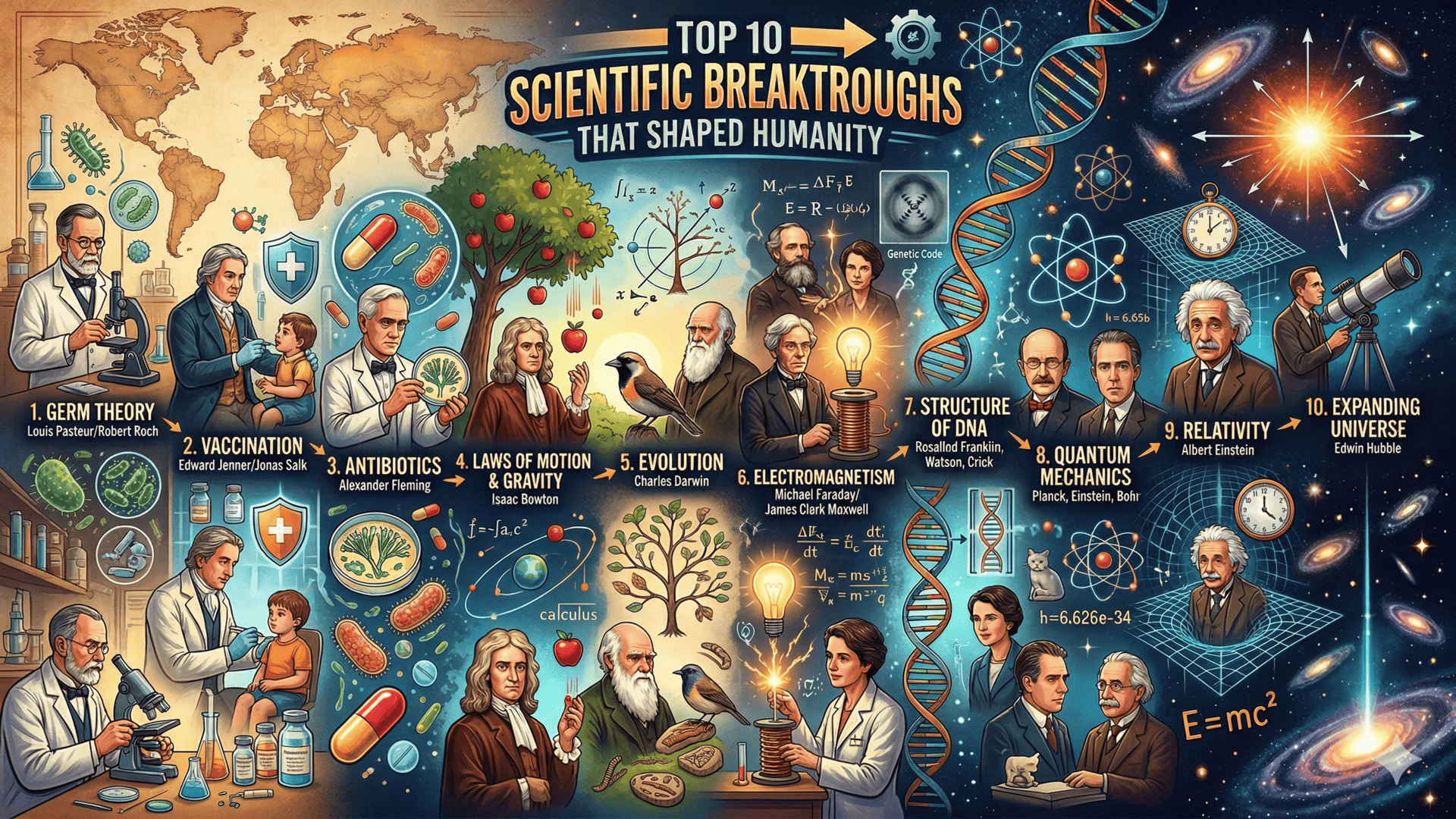
Our modern world was not built in a day. Today’s civilization is the result of the sacrifice, curiosity, and genius of countless scientists over thousands of years. The top 10 scientific breakthroughs shaping humanity show us exactly how much humans can achieve with their intellect.
Science is a continuous journey. Past discoveries have made our present easier, and current research will secure our future.
Key Lessons from Humanity’s Greatest Scientific Breakthroughs
We can learn from the greatest discoveries that by understanding the rules of nature, we can solve any problem. Working as a team, being patient, and welcoming new ideas are the keys to progress. True human welfare is only possible if we abandon superstition and build a science-based society.
How Science Continues to Shape Our Future
To protect ourselves from complex problems like today’s climate change or new pandemics, we must rely entirely on science. Renewable energy, space exploration, and artificial intelligence are redefining our future. Guided by the light of science, humanity will advance much further in the days to come.