
How Scientific Discoveries Changed the World
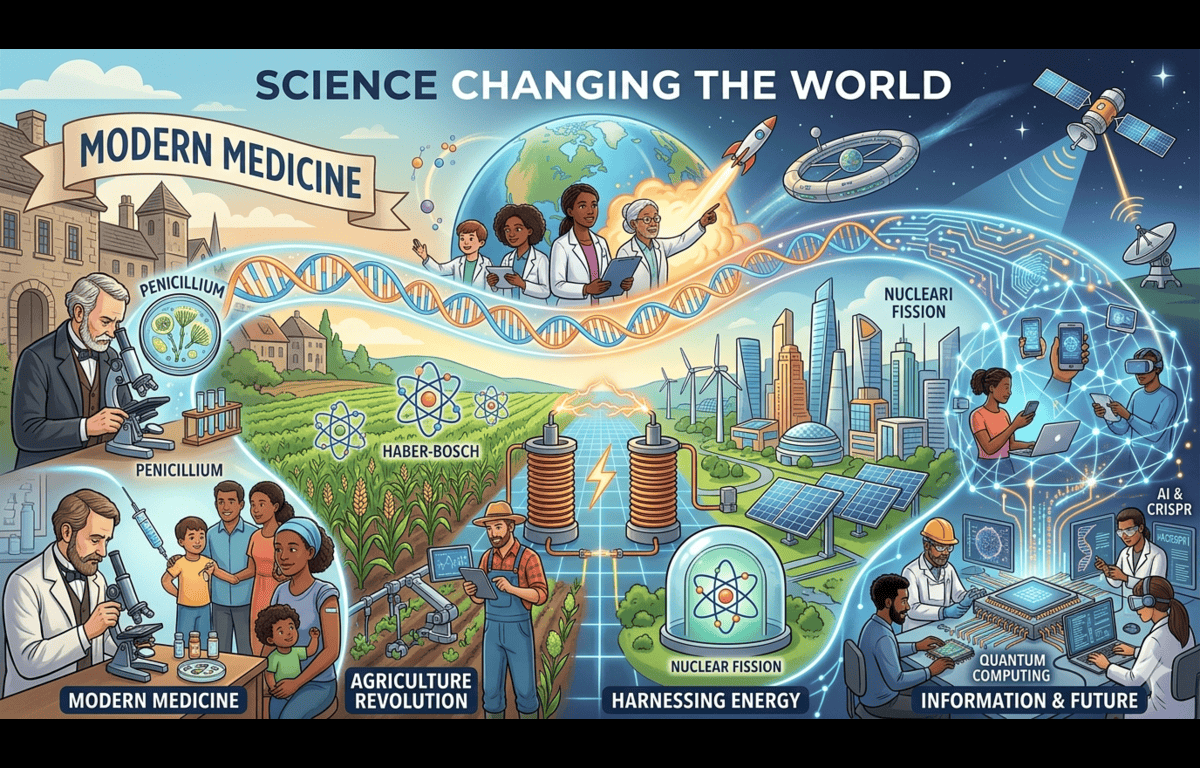
Introduction
Today, we live in a world that was beyond human imagination even a few centuries ago. From waking up in the morning to going to bed at night, we enjoy the many benefits of science. Everything around us is the result of some scientific research.
Science has not only made our lives easier but also expanded our way of thinking. Today, we can get news from all over the world right from our homes. Thanks to advances in medical treatment, average human life expectancy has increased significantly. All of this has been made possible by relentless scientific research.
The Transformative Power of Scientific Discoveries
Scientific discovery has a magical power. It brings us from darkness into light. A single new discovery can change the lifestyle of the entire human race overnight. This transformation began when humans first learned to control fire.
Since then, every step from the invention of the wheel to today’s smartphones has been a milestone. Science opens new doors to understanding the world around us. It teaches us to break old mindsets and think anew.
How Science Has Shaped Human Civilization
The history of human civilization is essentially the history of science. From cave dwellers in ancient times to people in today’s society, the contributions of science are undeniable. Science taught us agriculture and helped us build factories.
The development of cities, ports, and advanced communication systems all depend on scientific innovation. Science has left a deep mark on every level of society, economy, and culture. It helps us deal with natural disasters and build a better future.
What is a Scientific Discovery?
Put simply, a scientific discovery is the revelation of a new truth or fact about the world around us. It is a continuous process of figuring out the rules of nature.
Scientists acquire new knowledge through various experiments and observations. It is not just a sudden idea. Behind it lies years of hard work and rational thinking.
Understanding the Nature of Breakthrough Scientific Discoveries
Breakthrough discoveries usually bring massive changes to conventional thinking. They bring forward truths that no one could have imagined before. For example, the discovery that the Earth revolves around the Sun created a huge stir at the time.
Such discoveries are not limited to one branch of science. They impact other branches and pave the way for new research. A successful discovery often gives rise to hundreds of new questions, encouraging scientists to conduct further research.
How Discovery Advances Human Knowledge
Every new discovery is like adding a new brick to the repository of human knowledge. Scientists move forward by building on the work of previous scientists. As Sir Isaac Newton famously noted, he could see so far because he stood on the shoulders of giants.
This continuity of knowledge moves the human race forward. When we solve one problem, we gain the ability to solve even more complex ones. This is how human knowledge gradually expands, enabling us to unlock the deeper mysteries of the universe.
The Importance of Scientific Discoveries
The importance of science in our lives cannot be overstated. Modern life is unimaginable without it. Science helps us meet our basic survival needs.
From increasing food production to tackling pandemics, we rely on science in every aspect. It not only saves our lives but also improves our quality of life. Scientific knowledge helps us build a safer and more habitable planet.
Improving Lifestyles Through Innovation
Science has directly made our daily lives more comfortable. The discovery of electricity has multiplied our working hours and capacity. Thanks to refrigerators, we can preserve food for a long time.
Improved sanitation and the supply of pure drinking water have played a massive role in protecting human health. Modern household appliances save us a massive amount of time. People can spend the time saved on creative pursuits and entertainment.
Expanding Our Knowledge of the Universe
Science gives us the answers to questions about who we are and where we come from. Science has taught us to look beyond Earth’s boundaries into the infinite expanse of space. We can now learn about the birth and death of galaxies, stars, and planets.
Through telescopes and spacecraft, we are gathering information about the universe beyond our solar system. This knowledge has vastly expanded the scope of our thinking. It helps us understand how tiny yet significant Earth’s position is in this massive universe.
A Driver of Economic and Social Progress
Science and technology are the main drivers of the economy in the modern world. New scientific discoveries give rise to new industries and create jobs for millions of people. Due to the internet and computer technology, the global economy is now much more connected and dynamic.
Furthermore, science helps bring equality to society. When technology is affordable, education spreads and social inequality decreases. Only a knowledge-based society can ensure long-term economic stability.
Revolutionary Scientific Discoveries in History
The pages of history hold certain scientific discoveries that forever changed the course of the world. These discoveries shook the human realm of thought. They were not just theoretical knowledge but directly contributed to the development of civilization.
These discoveries proved that nature operates according to certain rules and that humans are capable of understanding them. Let us learn about a few such revolutionary discoveries.
The Heliocentric Model of the Solar System
At one time, people believed that the Earth was at the center of the universe and everything (including the Sun) revolved around it. However, Nicolaus Copernicus first proved that the Sun is at the center and the Earth revolves around it. This is known as the heliocentric model.
Later, Galileo Galilei proved the theory’s truth with his telescope. This discovery shattered human arrogance and laid the foundation for modern astronomy. It was a massive revolution in thought.
Newton’s Laws of Motion and Gravity
Sir Isaac Newton is known as one of the greatest scientists in the history of science. His discovery of the law of gravity explained why apples fall to the ground and why planets orbit the Sun.
His three laws of motion form the foundation of physics. It is through these laws that the creation of rockets and space travel later became possible. Newton’s work proved that the universe follows certain mathematical rules.
The Theory of Evolution by Natural Selection
Charles Darwin’s theory of evolution created a massive stir in biology. He showed how all living beings on Earth have changed over time and are related to one another.
Through the process of natural selection, the fittest creatures survive on Earth. This discovery scientifically explained the diversity of the biological world. It plays an extremely crucial role in medical science and modern biological research.
The Discovery of Electricity and Electromagnetism
The work of Michael Faraday and James Clerk Maxwell uncovered the relationship between electricity and magnetism. As a result of this discovery, we have been able to create electric motors and generators.
Today, we cannot imagine a single moment without electricity. Our homes, factories, and communication systems all depend on electricity. This single discovery pushed human civilization centuries ahead.
Medical Discoveries That Transformed Humanity
The contribution of science to medicine is a blessing for humanity. In ancient times, millions of people died from minor diseases or infections. However, thanks to scientific discoveries, we can now successfully treat many complex diseases.
Modern medicine is the primary reason for the increase in human life expectancy. It has boosted our immune systems and ensured healthy lives. You can read about the history of medicine on the World Health Organization (WHO) website to learn more in detail.
The Development of Vaccines
When Edward Jenner first developed the smallpox vaccine, he paved the way for saving millions of lives. Vaccines strengthen our body’s immune system.
Terrible diseases like polio, measles, and tetanus have been almost eradicated today due to vaccines. In recent times, the rapid development of vaccines against COVID-19 is a massive scientific success. It proved how quickly science can protect humanity.
The Discovery of Antibiotics
The discovery of penicillin by Alexander Fleming marked the beginning of a new era in medicine. Antibiotics work like magic to prevent bacterial infections.
During World War II, this discovery saved the lives of countless wounded soldiers. Before this, people would often die from infections caused by minor cuts. Antibiotics have made modern surgery and organ transplants possible.
Advancements in Medical Imaging and Diagnostics
Wilhelm Röntgen’s discovery of X-rays allowed doctors to look inside the human body. This method of understanding the condition of internal organs from outside the body revolutionized medical treatment.
Currently, using modern technologies like MRI and CT scans, it is possible to diagnose the exact cause of a disease. It is because of accurate diagnosis at the right time that the treatment of complex diseases like cancer or heart disease can be done easily today.
Modern Genetics and DNA Research
When James Watson and Francis Crick discovered the double-helix structure of DNA, a new door in genetics opened. We understood how hereditary traits are transmitted from one generation to the next.
Due to gene mapping and genetic engineering, we can now detect congenital diseases in advance. Gene editing has even created the possibility of permanent cures for many genetic diseases. This is giving the future of medicine a completely new shape.
Scientific Discoveries That Drove Technology
Science and technology complement each other. Scientific theories later transform into technological products. Behind almost every device used in our daily lives lies some scientific discovery.
Technology has made our work easier and brought the distant closer. It has taken our standard of living to a level that would have seemed magical just a few decades ago.
The Invention of the Transistor
One of the most important inventions of the twentieth century is the transistor. It replaced vacuum tubes and brought a revolution in the world of electronics. Transistors are small, cheap, and consume very little electricity.
Today’s computers, smartphones, radios, and televisions are all built on the foundation of transistors. Without them, the beginning of the modern digital age would never have been possible.
The Rise of Computers and the Internet
Early computers were as big as large rooms. However, thanks to scientific advances, they are now in the palms of our hands. Computers can perform complex calculations in the blink of an eye.
The internet has turned the whole world into a global village. We can communicate with people anywhere in the world in an instant. Everything from exchanging information to conducting business now depends on the internet.
Artificial Intelligence and Machine Learning
Artificial Intelligence (AI) is one of the most exciting discoveries in science. Giving machines the ability to think like humans is its main goal.
Currently, AI is being widely used in medicine, banking, customer service, and the transport sector. Through machine learning, computers can learn from experience and make decisions on their own. This will improve future technology to an unimaginable extent.
Space Age Technology in Daily Life
Many technologies created for space research are now being used in our daily lives. A major example of this is GPS (Global Positioning System), which helps us find our way.
Memory foam, scratch-resistant lenses, and wireless tools were all initially created for astronauts. Visiting the NASA Spinoff website shows us how space technology is making our lives easier.
Discoveries That Changed Our Understanding of the Universe
Humans are curious by nature. Looking up at the night sky, people have always felt a sense of wonder. Science has turned this wonder into knowledge.
Breakthrough discoveries in astronomy and physics have given us a clear idea about the birth, structure, and future of our universe. This knowledge has completely changed our perspective on the world.
The Big Bang Theory
According to the Big Bang theory, the universe began as a single point about 13.8 billion years ago. This is the most widely accepted scientific explanation for the origin of the universe.
This theory helps us understand how galaxies, stars, and planets were formed. Scientists found evidence for this theory by observing cosmic radiation. This is a huge milestone in learning the history of the universe.
Black Holes and Space-Time
Albert Einstein’s theory of relativity first combined space and time, introducing a new concept. He proved that mass bends space-time, which we call gravity.
A black hole is a place in space where the gravitational force is so strong that not even light can escape from it. Recently, scientists captured images of a black hole, an extraordinary achievement for science.
The Expansion of the Universe
Scientist Edwin Hubble observed and proved that galaxies are moving away from each other. This means our universe is constantly expanding.
This discovery forced scientists to rethink the future fate of the universe. Scientists believe a mysterious force called dark energy is accelerating this expansion. This is a major research topic in modern physics.
Exoplanets and the Search for Extraterrestrial Life
Planets orbiting stars other than our Sun outside the solar system are called exoplanets. Since the first exoplanet was discovered in the 1990s, scientists have found thousands of new planets.
Some of these planets are located in habitable zones like Earth. Scientists are analyzing the atmospheres of these planets using highly advanced telescopes. This attempt to find out whether life exists on other planets is one of the most thrilling chapters in science.
Scientific Discoveries in Energy and Industry
With the development of human civilization, the energy demand has also multiplied. From relying on muscle power and animal strength in ancient times, humans gradually moved into using mechanical energy.
The discovery of new energy sources accelerated the Industrial Revolution. Science taught us how to utilize various natural forces for human welfare.
The Utilization of Electricity
The discovery of electricity is one of the most important events in modern civilization. Thomas Alva Edison’s electric light bulb eliminated the darkness of human nights.
Later, Nikola Tesla’s AC (Alternating Current) system made it possible to deliver electricity over long distances. Today, everything from factories to hospitals and educational institutions depends on an uninterrupted power supply.
Nuclear Energy and Its Impact
Albert Einstein’s famous formula E=mc² shows that a large amount of energy can be generated from a small amount of mass. Nuclear reactors were built based on this principle.
Nuclear power plants can generate a lot of electricity using very little fuel. Although nuclear waste management is a major challenge, it is a powerful means of reducing carbon emissions.
Innovations in Renewable Energy
The use of fossil fuels is causing severe damage to the environment. Therefore, scientists have shifted their focus to eco-friendly renewable energy. Solar power and wind power are excellent examples of this.
Direct sunlight is converted into electricity through solar panels. As technology has improved, the efficiency of these panels has increased significantly, and their cost has decreased. This will play a massive role in meeting our future energy demands.
Sustainable Technologies for the Future
Inventing sustainable technologies to combat climate change is the greatest need of our time. Scientists are developing technologies that operate without harming the environment.
The use of electric vehicles (EVs) is increasing day by day, helping to reduce air pollution. At the same time, improvements in battery technology are bringing revolutionary changes to energy storage. Innovations like green hydrogen and carbon capture technologies will secure the future.
How Scientific Discoveries Impact Daily Life
Science is not just confined to large laboratories or space research. It deeply impacts every task of our daily lives.
From waking up in the morning to going to sleep at night, we cannot function without the blessings of science. It has made our lifestyle comfortable, safe, and enjoyable.
Communication and Digital Connectivity
In the past, it took months for a letter to reach one country from another. But today, thanks to optical fiber and satellite technology, we can make video calls to any part of the world in the blink of an eye.
Social media and messaging apps have completely bridged the distance between people. Digital connectivity has made it possible to conduct business and educational activities right from home.
Advancements in Transportation and Travel
The revolution in transportation that began with the invention of the steam engine has now reached supersonic aircraft and bullet trains. There was a time when people had to travel long distances on foot or on horseback.
Today, we can reach one continent from another within a few hours. Safe and high-speed transportation systems have accelerated globalization and made human life much more dynamic.
Food Production and Agricultural Innovation
Providing food for the Earth’s massive population is a major challenge. The Green Revolution was made possible by science. The use of high-yielding seeds and chemical fertilizers multiplied crop production.
Modern agricultural machinery and irrigation systems have made farmers’ work easier. Currently, technologies like genetically modified (GM) crops and vertical farming are being used to grow more crops on less land.
Improvements in Health, Safety, and Quality of Life
Today, we are surrounded by security systems like smart home technologies, CCTV cameras, and fire alarms. These provide us with peace of mind in our daily lives.
Water purification technology protects us from waterborne diseases. Wearable technologies or devices constantly monitor our heart rate and blood pressure. All of these are scientific efforts to improve our quality of life.
The Role of Curiosity and Critical Thinking
Science is not a magic wand; rather, it is the product of infinite human curiosity. Curiosity is what drives humans to learn new things.
Critical thinking keeps us away from blind faith. It teaches us how to ask questions and verify the truth based on evidence. This thoughtful mindset is the main driving force of scientific practice.
How Questions Lead to Discovery
A simple question hides behind every major discovery. Newton asked himself why the apple fell down. Einstein wondered what it would feel like to travel at the speed of light.
These questions guided scientists toward the discovery of new theories. It is extremely important to awaken curiosity in our children’s minds and encourage them to ask questions. A correct question often becomes more important than the answer.
The Application of the Scientific Method
Scientists follow a specific procedure to prove something, which is called the scientific method. The first step is to observe and collect data.
Then they create a hypothesis. Repeated experiments are conducted to test that hypothesis. If the test results support the hypothesis, it becomes a scientific theory. This systematic method is what makes science accurate.
Learning from Experiments, Observations, and Failures
There is no such thing as failure in science; instead, every mistake is a new lesson. Thomas Alva Edison failed a thousand times while inventing the electric light bulb. He famously noted that he had simply found a thousand ways that did not work.
Scientists do not get frustrated when experiments go wrong. They understand where the problem lies and start thinking anew. This perseverance and the mindset to learn from mistakes are what make science so powerful.
Challenges and Ethical Considerations
Just as the power of science is vast, the horrors of its misuse are also immense. Whether a new discovery will be used for human welfare or bring destruction depends entirely on human decisions.
Therefore, maintaining ethics in scientific research is extremely important. Scientists must always ensure that their work does not harm the environment or society.
Balancing Innovation with Responsibility
Science has given us nuclear energy, which can be used to generate electricity but can also be used to create nuclear bombs. Therefore, it is essential to maintain a balance of responsibility alongside innovation.
Technology companies must ensure that their products do not violate human privacy. The long-term impact of every new technology should be considered before bringing it to the public.
Ethical Questions in Modern Science
It is possible to alter human genes using the gene-editing tool CRISPR. While this can cure hereditary diseases, it also creates the possibility of unethical practices like creating designer babies.
The question of what will happen if artificial intelligence goes beyond human control is also being heavily discussed today. Scientists and policymakers must find the correct answers to all these ethical questions.
The Social Impact of Scientific Progress
New technology can create inequality in society if it is not accessible to everyone. There is a fear that many ordinary people will lose their jobs due to automation or automated machinery.
Therefore, society must ensure that people from all walks of life benefit from scientific progress. Arrangements must be made to teach new skills to people whose jobs are displaced by technology. Care must be taken to ensure that science unites society rather than dividing it.
Recent Scientific Discoveries Shaping the Future
Science never stands still. Every day, scientists in different parts of the world are making new discoveries. Some breakthrough successes of recent times could completely change our world in the next few decades.
These new technologies are much more precise and powerful. They are breaking many of our old notions and opening doors to massive new possibilities.
Advancements in Quantum Computing
Quantum computers are millions of times more powerful than ordinary computers. They operate according to the laws of quantum mechanics.
A quantum computer will be able to solve in seconds the complex mathematical problems that would take an ordinary supercomputer thousands of years to solve. This will bring about a massive revolution in drug discovery, weather forecasting, and data security.
Breakthrough Successes in Biotechnology
Unimaginable progress has been achieved in biotechnology. Lab-grown meat will reduce the need for killing animals for food in the future.
With mRNA technology, it is possible to develop effective vaccines against viruses very quickly. The use of nanotechnology in cancer treatment has begun, which can directly destroy cancer cells. These have initiated a completely new era in medicine.
New Horizons in Space Exploration
The James Webb Space Telescope has opened new horizons in space research. It is sending back pictures of early galaxies in the universe that have never been seen before.
Private organizations like SpaceX, alongside NASA, are working on establishing human settlements on Mars. Plans to extract mineral resources from the Moon are underway. Humans might travel to other planets within the next few decades.
Emerging Climate and Environmental Solutions
Scientists have found plastic-eating bacteria to prevent environmental pollution. This will greatly help reduce plastic waste in the oceans.
Giant carbon capture plants are being built to absorb carbon dioxide from the atmosphere. Research on producing fuel through artificial photosynthesis is also progressing. These discoveries can gift us a green and beautiful Earth.
The Future of Scientific Discoveries
Science has no final boundary. The more we know, the more unanswered questions we have. Future discoveries might be entirely beyond our imagination.
In the coming days, science and technology will merge together. The relationship between humans and machines will become even closer, transforming our lifestyles to an unimaginable extent.
What Major Breakthroughs Might Come Next?
In the future, humans might conquer aging, and human life expectancy will increase significantly. Through brain-computer interfaces, humans might be able to control computers using their thoughts alone.
If nuclear fusion technology succeeds, we will have an endless, clean energy source, just like the Sun. These successes will forever change the face of the Earth and elevate human civilization to a new level.
The Role of Artificial Intelligence (AI) in Accelerating Research
In future scientific research, scientists will no longer work alone; artificial intelligence will be their companion. AI is far more efficient than humans at analyzing massive amounts of data to find new patterns.
AI will be widely used in everything from discovering new chemical compounds to genetic research. It will significantly reduce both the time and cost of research, thereby multiplying the rate of new discoveries.
Building a More Knowledge-Driven World
The future world will be entirely knowledge-based, where mental skills will be valued more than physical labor. The spread of education and the free flow of information will tie people all over the world together.
Science will not remain the property of developed countries alone. In a knowledge-driven world, the benefits of science will reach everyone’s doorstep. This will help us build a prosperous and equitable world.
Frequently Asked Questions (FAQs)
What are the most important scientific discoveries in history?
Among the most important discoveries in history are the wheel, control of fire, penicillin, electricity, the internet, and vaccines. Each of these discoveries altered the course of human civilization and laid the foundation for our current modern lifestyle.
How have scientific discoveries improved human life?
Thanks to science, human life expectancy has increased, disease outbreaks have decreased, and agricultural production has multiplied. It has made our transportation, communication, and daily tasks much faster and easier. In short, science has gifted us a comfortable and safe life.
Why are scientific discoveries important?
Scientific discoveries help us understand the world around us more accurately. They assist us in developing new technologies to tackle global problems such as poverty, hunger, and climate change. The progress of science is essential for the survival of the human race.
Which recent discoveries are changing the world?
Recently, discoveries like Artificial Intelligence (AI), mRNA vaccine technology, gene-editing technology (CRISPR), and the James Webb Space Telescope are changing the world. These are bringing massive changes to medicine, technology, and space research.
How do scientists make new discoveries?
Scientists first closely observe their surroundings and identify a specific problem or curiosity. Then they create a hypothesis and conduct extensive experiments to prove it. New discoveries are made possible through this systematic research and learning from mistakes.
Conclusion
Key Takeaways on the Impact of Scientific Discoveries
We can understand from the history of science that human curiosity and indomitable willpower have no limits. Every small discovery later gives birth to a major revolution. Science has taught us that with the right methods and perseverance, even the toughest mysteries of nature can be uncovered. It is the greatest tool of the human race, with which we have conquered natural adversities.
Why Science Continues to Shape the Future of Humanity
We now face major challenges like climate change, new pandemics, and energy crises. The only way to combat these challenges is through more scientific research. Science has not only beautified our past and present; it is our only hope for securing the future. Scientific practice, guided by curiosity and ethics, will lead humanity toward infinite possibilities.