
How Is Abraham Described in Different Religions?
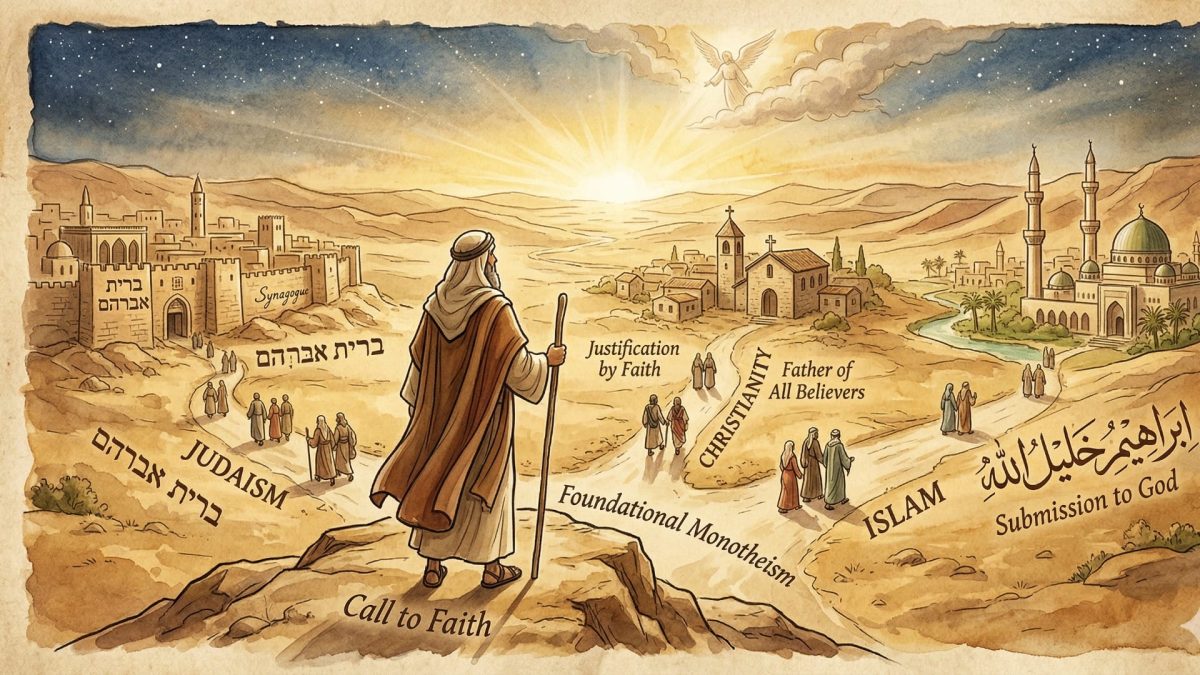
There are countless religions and beliefs worldwide. Among these differing faiths, disagreements are quite common. However, there is one historical and spiritual figure whom more than half of the world’s population remembers with the utmost reverence. He is Abraham. In Islam, he is known as Prophet Ibrahim.
The three major faiths of Judaism, Christianity, and Islam are known as the “Abrahamic religions.” This is because the roots of all three are deeply intertwined with Abraham’s life. In today’s article, we will discuss how Abraham is described in different religions and why he is so widely revered.
Who is Abraham?
Abraham is a prominent spiritual leader and patriarch from ancient times. According to religious texts, he was born in the ancient Mesopotamian city of Ur. While the people around him worshipped multiple deities, Abraham felt in his heart that there was only one Creator.
He rejected idolatry and began worshipping the one, unique God. This monotheistic belief is exactly what made him one of the most important figures in history. Under God’s command, he left his homeland and embarked on a journey toward an unknown destination. His life was a unique example of trials, sacrifice, and absolute faith.
Why Abraham is Important in Multiple Religions
Abraham is significant across multiple faiths because he is seen as the ultimate symbol of faith and obedience. The Jewish people consider him the first patriarch of their nation. For Christians, he is a shining example of faith who demonstrated how to rely completely on God.
On the other hand, in Islam, he is given the title of “Khalilullah” (the friend of Allah) and is regarded as one of the greatest prophets. Although these three religions follow different paths, they all agree on honoring Abraham. He has created a bridge that continues to carry the message of harmony among various religious communities today.
Understanding the Religious Perspectives on Abraham
While the main events of Abraham’s life are similar across most religions, their interpretation differs widely. Each religion interprets the story of Abraham through its own theological framework. One religion emphasizes his lineage, another highlights his spiritual faith, while another focuses on his role as a prophet.
By closely examining these different perspectives, we can understand how the life of a single man has influenced religious beliefs for centuries. According to the Encyclopedia Britannica, the life story of Abraham is not just history; it is a timeless metaphor for humanity’s spiritual journey.
Abraham in Judaism
In Judaism, Abraham’s position is incredibly high and unchangeable. He is not merely a preacher; he is the founder of the entire Jewish nation. A detailed account of his life can be found in the Book of Genesis within the Hebrew Bible (the Tanakh).
How Judaism Describes Abraham
Judaism refers to Abraham as “Avraham Avinu,” which translates to “Our Father Abraham.” According to Jewish belief, he was the first person to abandon idolatry and recognize the existence of a single, unique God.
The ancient Jewish text, the Midrash, states that from a young age, Abraham questioned the logic of the idol worship practiced by the society around him. Through his own intellect and spiritual contemplation, he understood that there is only one God of the universe. In Jewish tradition, he is described as a brave, hospitable, and deeply righteous man.
Abraham as the Father of the Jewish Nation
Jewish people believe that God chose Abraham to create a special nation. This nation was meant to establish God’s laws and justice on earth. God promised Abraham that He would make him into a great nation. Through Abraham and his wife Sarah, and their son Isaac, and his son Jacob, the lineage of the Jewish nation began.
Because of this, Jewish people consider themselves the direct physical and spiritual descendants of Abraham. His identity is not limited to being a prophet; he is the very foundation of the Jewish community’s identity.
The Covenant Between God and Abraham
The most important aspect of Abraham’s story in Judaism is his covenant with God. God established a special agreement with Abraham. God promised that He would bless Abraham’s descendants and that their numbers would be as countless as the stars in the sky.
In return, Abraham and his descendants had to remain faithful to God and walk in His guided path. The practice of circumcision was introduced as a visible symbol of this covenant. Today, this tradition is still practiced with great devotion in Judaism, serving as a reminder of the eternal covenant between God and the descendants of Abraham.
Abraham’s Journey to the Promised Land
Following God’s command, Abraham left his familiar surroundings, his relatives, and his birthplace in the city of Ur in Mesopotamia to travel toward the land of Canaan. God told him to leave his country and his kindred and go to the land that He would show him.
This land of Canaan is the Promised Land for the Jewish people. Abraham’s journey was an extreme test of leaving a comfortable life for an uncertain future. In Jewish theology, this journey is seen as a symbol of spiritual ascension.
Abraham in Christianity
Abraham’s importance in Christianity is also immense. However, in this tradition, his faith takes precedence over his ethnic identity. The writers of the New Testament have presented Abraham as the spiritual father of Christians.
How Christianity Describes Abraham
Christianity describes Abraham as a person who was considered righteous solely through pure faith in God, long before any law or religious code was introduced. The New Testament of the Bible states that Abraham rose above physical lineage to become the father of all people who put their faith in God.
In the eyes of Christians, Jesus Christ came to earth to fulfill the promise God made to Abraham.
Abraham as the Ultimate Example of Faith
One of the main pillars of the Christian faith is belief itself. Abraham is presented as the greatest example of this belief. The Apostle Paul wrote in his letter to the Romans that Abraham’s faith made him righteous in God’s eyes.
When God told him that he would have a child even in his old age, he did not doubt it. His unwavering faith is a massive inspiration for Christians. According to Christian teachings, to receive God’s grace, people must have unconditional faith like Abraham.
Abraham in the Old and New Testaments
In the Old Testament of the Bible, the events of Abraham’s life are described from a historical perspective. It talks about his journey, the covenant, and his sacrifices. But in the New Testament, the events of his life are used in a spiritual and metaphorical sense.
The New Testament portrays Abraham as a pioneer who paved the way for the arrival of Jesus Christ. In the Epistle to the Hebrews (Hebrews Chapter 11), Abraham is placed at the top of the list of the heroes of faith.
The Spiritual Legacy of Abraham in Christian Teachings
In Christian teachings, Abraham’s legacy is not confined to any specific race or geographical boundary. If people of any nation put their faith in God through Jesus Christ, they are considered spiritually descended from Abraham.
The Epistle to the Galatians states that those who believe in Jesus are the true children of Abraham. In this way, the Christian religion has given Abraham’s legacy a global and inclusive form.
Abraham in Islam
In Islam, Abraham is referred to as “Prophet Ibrahim.” He is mentioned numerous times in the Quran with great respect and importance. In Islamic belief, he is not just a prophet; he is the spiritual father of Muslims and an ideal human being who wholeheartedly submitted to Allah.
How Islam Describes Abraham (Ibrahim)
Islam describes Ibrahim as a “Hanif.” A Hanif is someone who turns away from all the false worship around them and exclusively worships the one true God. In the Quran, Allah has titled him “Khalilullah” (the friend of Allah). Ibrahim was a man with a very tender heart, extreme patience, and incredible hospitality. His character is presented as a role model for Muslims to emulate.
Abraham as a Great Prophet in Islam
Among the prophets of Islam, Ibrahim holds an extremely high position. He is considered one of the “Ulul’Azm” (the prophets of firm resolve). Prophet Muhammad (PBUH) is a direct descendant of his.
According to Islamic belief, Muhammad (PBUH) did not preach a new religion; rather, he revived the original and pure monotheistic religion of Ibrahim. Every day during their prayers, Muslims pray for peace upon Ibrahim and his family while reciting the Durood.
The Story of Ibrahim and His Family in the Quran
Many events in the life of Prophet Ibrahim are described in detail in the Quran. His father, Azar, was an idol maker. From a very young age, Ibrahim used logic to prove the futility of idol worship. Because he called his community and the king to the path of the one God, he was thrown into a massive fire. But by Allah’s command, that fire became cool and peaceful for him.
Furthermore, the event of leaving his wife Hagar (Hajira) and infant son Ismail in the desolate desert of Mecca is widely mentioned in the Quran and the Hadith.
Building the Kaaba and the Hajj Tradition
In Islamic tradition, one of Ibrahim’s greatest contributions is the construction of the holy Kaaba. Allah commanded Ibrahim and his son Ismail to build a house in Mecca for the worship of Allah. The father and son together built the Kaaba and called people to perform Hajj.
The Hajj, which millions of Muslims from all over the world perform every year, is essentially a remembrance of the sacrifices made by Ibrahim and his family. Running between the hills of Safa and Marwa specifically recalls Hagar’s search for water.
The Sacrifice of Ishmael (Ismail)
The hardest test of Prophet Ibrahim’s life was the command to sacrifice his son. Allah commanded him in a dream to sacrifice his beloved son. When Ibrahim told his son about this dream, the son was ready to obey Allah’s command without the slightest hesitation.
Just as Ibrahim was about to perform the sacrifice, Allah, pleased with this ultimate obedience, commanded him to sacrifice an animal instead of his son. In remembrance of this great sacrifice, Muslims worldwide celebrate Eid al-Adha (the festival of sacrifice) every year.
Abraham in Other Religions
Beyond Judaism, Christianity, and Islam, Abraham is also remembered with deep respect in some other religions. He holds a special place, particularly in the Baha’i Faith and other syncretic belief systems.
Abraham in the Baha’i Faith
Followers of the Baha’i Faith believe that Abraham is a “Manifestation of God.” According to them, God has sent various messengers throughout the ages to guide humanity, and Abraham is one of them.
According to Baha’i belief, Abraham’s role in solidifying the foundation of monotheism in world history is undeniable. Baha’u’llah, the founder of the Baha’i Faith, claimed to be a descendant of Abraham.
Abraham in Interfaith and Comparative Religion Studies
In today’s world, Abraham is a crucial link in interfaith harmony and dialogue. In comparative religion studies, he is seen as a common ground. When people of different faiths gather to discuss, the name of Abraham creates a feeling of unity among them.
Various universities and research institutions, such as the Pew Research Center, are conducting extensive research on his life to foster mutual understanding among the Abrahamic religions.
Philosophical Interpretations of Abraham
From a philosophical perspective, Abraham’s life has influenced many thinkers. The Danish philosopher Søren Kierkegaard provided a remarkable psychological and philosophical analysis of the event of Abraham sacrificing his son in his famous works.
According to Kierkegaard, Abraham reached such an extreme level of faith that even the moral codes of ordinary people became obsolete. His actions prove that a human’s relationship with God is above all worldly rules.
Comparing the Religious Views on Abraham
While the core tone of Abraham’s life story is the same in the three major religions, there are clear differences in their accounts in certain areas. Reviewing these similarities and differences is highly fascinating.
Similarities in Jewish, Christian, and Islamic Accounts
All three religions agree that Abraham rejected idolatry and started worshipping one God. In all three faiths, he is the friend of God and a man of extreme loyalty to Him. His wives, Sarah and Hagar, are mentioned in all religions.
The core events (such as having a child in old age, leaving his homeland by God’s command, and the test of sacrificing his beloved child) are widely recognized in all three traditions. All three religions teach that the path of Abraham leads to salvation.
Key Differences in the Story of Abraham
Alongside the similarities, there are also some fundamental differences. According to the Jewish and Christian Bibles, the son Abraham took to sacrifice was Sarah’s son, Isaac. On the other hand, Islamic tradition holds that the son was Ismail, Hagar’s child. Secondly, in Judaism, the center of Abraham’s covenant with God is the Promised Land and Jewish nationhood. In Christianity, the meaning of this covenant is the spiritual salvation of believers. And in Islam, Ibrahim’s mission is seen as the original form of preaching the oneness of Allah to all of humanity.
Why Abraham is Called the Father of Monotheism
Abraham preached the concept of one God at a time in history when almost everyone on earth worshipped multiple deities, nature, or idols. He came to the conclusion, entirely on his own initiative and through divine guidance, that the Creator could have no physical form.
Because of his groundbreaking ideas and his lifelong struggle to establish them, he is called the father or patriarch of all the world’s monotheistic religions.
Abraham’s Family and Legacy
The stories of Abraham’s family members are deeply intertwined with his life. From his family, many prophets and nations emerged in later eras.
Sarah, Hagar, Isaac, and Ishmael in Different Traditions
Abraham’s wife, Sarah, was a woman of great virtue and his lifelong companion. Isaac was born from her womb. On the other hand, Hagar was Abraham’s other wife and the mother of Ishmael (Ismail). In Judaism, Sarah and Isaac are shown as the heirs to God’s main covenant. Conversely, in Islam, special respect is shown to Hagar and Ismail. Because of Hagar’s struggles in Mecca and the arrival of the final Prophet, Muhammad (PBUH), from Ismail’s lineage, the importance of this lineage in Islam is immense.
The Lineage of Abraham in World Religions
Abraham’s lineage changed the religious history of the world forever. From the lineage of Isaac came Jacob, Joseph, Moses, David, Solomon, and Jesus Christ. This lineage laid the foundation for Judaism and Christianity. On the other hand, Ismail’s lineage flourished in Arabia, and Prophet Muhammad (PBUH) was born into that lineage. In this way, Abraham became the physical patriarch of billions of people worldwide.
The Abrahamic Covenant and Its Meaning
The Abrahamic Covenant refers to the eternal pledge made between God and Abraham. The meaning of this covenant is that God will support those who walk in His guided path. For Jewish people, it means adhering to a specific land and religious laws. For Christians, it means receiving God’s grace through Jesus. And for Muslims, it means absolute submission to the one God by following the complete way of life of Islam.
Historical and Symbolic Perspectives
Beyond religious beliefs, there is also extensive discussion of Abraham from historical and archaeological perspectives.
Was Abraham a Historical Figure?
Archaeological research has not found any direct physical evidence or inscriptions regarding Abraham’s existence. However, historians agree that the social, cultural, and geographical descriptions of Abraham’s era in the Bible and the Quran closely match those of ancient Mesopotamia and the Bronze Age. Therefore, even without direct proof, most scholars accept him as a real historical figure.
What Scholars Say About the Story of Abraham
Modern historians and theologians believe that the stories of Abraham were primarily passed down orally for centuries. Later, when religious texts were compiled, these stories took on a written form. According to scholars, the story of Abraham is not just the biography of one man; it is the core narrative that shaped the identity of an entire nation. This narrative has provided people with hope, faith, and the strength to survive.
Abraham as a Symbol of Faith and Obedience
Throughout the ages, Abraham has been seen as a massive symbol of obedience. In modern consumerist societies, where people easily fall into despair, the story of Abraham teaches them to have complete faith in an invisible power even in the darkest of times. He stands as a symbol of all those who are ready to let go of worldly attachments as they walk the path of truth.
Moral and Spiritual Lessons
From Abraham’s eventful life, we draw moral and spiritual lessons that are equally applicable to people of any era.
Faith, Trust, and Obedience in the Story of Abraham
The greatest lesson of his life is unconditional trust in God. When he was told to leave everything behind and go to a new land, he asked no questions. This event teaches us that we often have to step out of our comfort zones in life to achieve a greater purpose. This obedience to the Creator makes a person humble and removes arrogance.
Lessons from Abraham’s Sacrifice
The lesson of Abraham’s sacrifice is unparalleled. He did not just leave behind his property or home; under God’s command, he was ready to sacrifice his most beloved possession. This reminds us that true spirituality means not surrendering to worldly illusions. To achieve something great in life, one must definitely have the mentality to make significant sacrifices.
Why Abraham is the Standard of Devotion
Devotion is not just formal prayer; it means aligning one’s will with the Creator’s will. Abraham was a person who surrendered all his wants and desires to God’s will. There was no hypocrisy in him. In danger or in joy, his trust was always unshaken. Because of this genuine love, he is an eternal standard of devotion worldwide.
Frequently Asked Questions
Which religions believe in Abraham?
Primarily, Judaism, Christianity, and Islam hold Abraham in great esteem. These three religions together are called the Abrahamic religions. Additionally, some smaller religious groups, such as the Baha’i Faith, accept him as a holy messenger of God.
Is Abraham mentioned in the Quran and the Bible?
Yes, the name of Abraham (or Ibrahim) is mentioned with great importance in both the Quran and the Bible. His story is detailed in both the Old and New Testaments of the Bible. Similarly, many chapters of the holy book of Muslims, the Quran, describe his eventful life.
Why is Abraham called the father of faith? What is the difference between Abraham in Islam and Christianity?
Abraham is called the father of faith because he was the first to abandon idol worship and place his unconditional faith in one, invisible God. The main difference in his description between Islam and Christianity is that Christianity sees him as the one who prepared the way for the coming of Jesus Christ and as the spiritual father of believers. On the other hand, Islam considers him a great prophet and a devoted friend of Allah (Khalilullah) who built the Kaaba in Mecca.
What can we learn from the story of Abraham?
From the life of Abraham, we learn lessons of profound faith in the Creator, extreme sacrifice, humility, and patience, even in the direst dangers. His story teaches us that staying firm on the path of truth is more important than worldly attachments and affections.
Conclusion
Final Thoughts on Abraham Across Religions
In the history of human civilization, very few people have exerted such a far-reaching influence as Abraham. Although he is interpreted differently across religions, his core character remains the same everywhere. He is a truth-seeking man who gave up everything out of love for the one, unique God. His life reminds us that the search for truth is a difficult journey, but at its end lies ultimate peace.
Understanding Our Shared Heritage Through Abraham
In the modern age, where divisions and conflicts in the name of religion are constant, the life of Abraham can be a massive symbol of unity. If Jews, Christians, and Muslims can realize that they are all children of the same spiritual father, mutual respect will increase significantly. Abraham’s heritage allows us to break down the walls of division and sit together at one table to talk.
Why Abraham’s Legacy Still Influences World Faiths Today
Even after more than four thousand years, Abraham’s influence has not diminished one bit. Every day, billions of people around the world pronounce his name in their prayers. No matter how much modern humans advance in science and technology, for their spiritual peace, they need the life story of a man who created the ultimate example of selfless love. Abraham’s legacy will survive as long as faith, hope, and love exist on earth. His life inspires us to remain steadfast on the path of truth and justice in our own lives.