
The Chemistry of Cleaning Products Explained
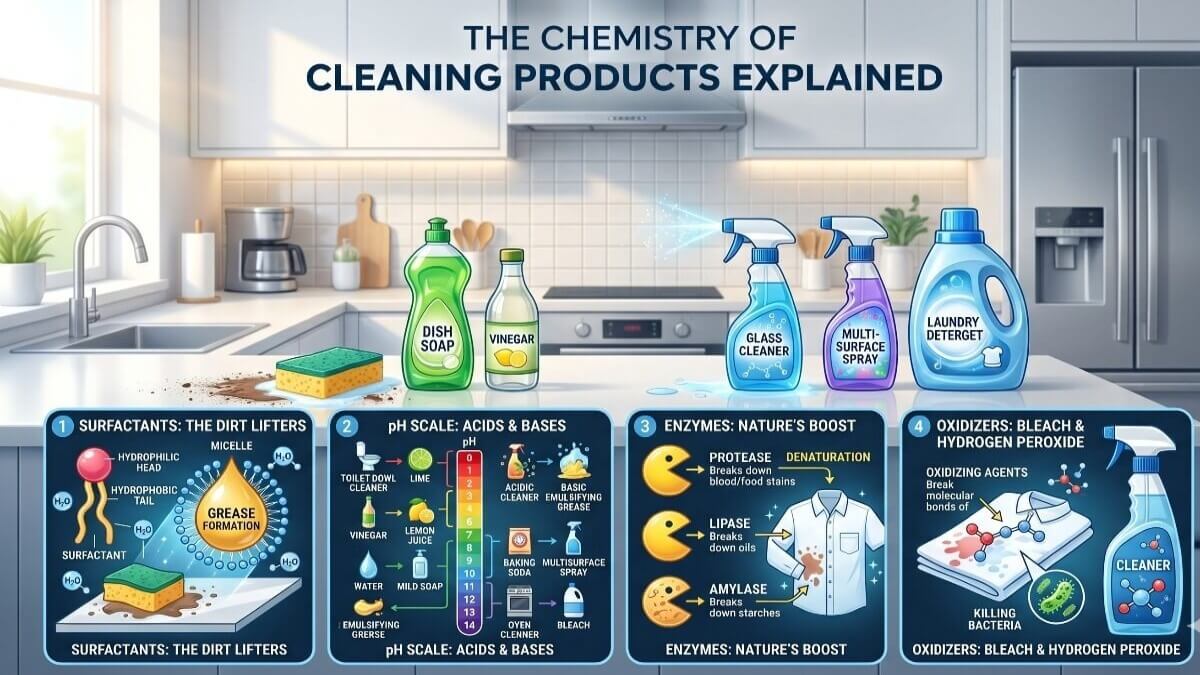
Cleaning your home can sometimes feel like a daunting chore, but have you ever paused to think about the incredible science happening right inside your spray bottle? When you spritz a greasy stovetop and wipe away the mess with ease, you are not just performing a household task. You are conducting a fascinating chemistry experiment.
Understanding the chemistry of cleaning products is the secret to cleaning more efficiently, saving money, and keeping your household safe. Whether you are dealing with a stubborn coffee stain, a baked-on oven spill, or cloudy glass windows, there is a specific chemical reaction designed to solve the problem.
In this comprehensive guide, we will explore exactly how your favorite household cleaners work on a molecular level. We will break down the roles of water, surfactants, pH levels, and enzymes, and we will highlight crucial safety rules to ensure everyone in your home stays protected.
The Basics: What Exactly Are We Trying to Clean?
Before we can understand the solutions, we need to understand the problem. In the world of chemistry, dirt and grime are generally referred to as “soils.” To a chemist, soils fall into a few distinct categories:
-
Organic Soils: These come from living things. Think of cooking oils, animal fats, body oils, sweat, blood, and food spills. Organic soils are typically acidic and require alkaline (basic) cleaners to break them down.
-
Inorganic Soils: These come from non-living, mineral sources. Examples include hard water stains, calcium deposits, rust, and scale. Inorganic soils are alkaline and require acidic cleaners to dissolve them.
-
Petroleum Soils: These include motor oil, grease, and lubricants. They contain no water and require strong solvents and heavy-duty surfactants to remove.
-
Particulate Soils: This is your everyday dust, sand, and clay. These particles often stick to surfaces because of an oily binder or static electricity.
The fundamental rule of cleaning chemistry is that “like dissolves like.” However, since most of the dirt in our homes is oily, and the primary liquid we use to clean is water, we run into a major scientific roadblock.
Water: The Universal Solvent and Its Limitations
Water is often called the universal solvent because it dissolves more substances than any other liquid. This is due to its molecular structure. A water molecule consists of two hydrogen atoms and one oxygen atom (H2O). The oxygen side holds a slight negative charge, while the hydrogen side holds a slight positive charge. This polarity allows water to act like a magnet, pulling apart the molecules of other substances.
However, water has a high surface tension. The molecules love to stick together, which is why water beads up on a newly waxed car or a greasy plate. Because water is polar and oil is non-polar, they repel each other. If you try to wash a greasy frying pan with just plain water, the water will simply slide right off the grease.
To make water wetter and to help it mix with oil, we need to introduce the real heroes of the cleaning world.
Surfactants: The Heavy Lifters of Cleaning
Surfactants, which is short for “surface active agents,” are the most crucial ingredients in almost any cleaning product. You will find them in dish soap, laundry detergent, body wash, and all-purpose sprays.
How Surfactants Work
A surfactant molecule is shaped somewhat like a tadpole, and it possesses a very unique dual-personality:
-
The Head: The head of the molecule is hydrophilic (water-loving). It desperately wants to attach itself to water molecules.
-
The Tail: The tail of the molecule is lipophilic (oil-loving) and hydrophobic (water-fearing). It wants to escape water and bury itself in fats, oils, and grease.
When you add a surfactant to dirty, greasy water, a remarkable microscopic dance occurs. The water-fearing tails of the surfactants quickly attach themselves to the oil and grease on your dishes or clothes. Meanwhile, the water-loving heads point outward, grabbing onto the surrounding water.
As the water moves around through scrubbing or the agitation of a washing machine, the surfactants pull the grease right off the surface. They surround the oil completely, forming a tiny spherical structure called a micelle. Once the grease is trapped safely inside this micelle, it is suspended in the water and can be rinsed right down the drain without redepositing onto your clean surfaces.
The Four Types of Surfactants
Not all surfactants are created equal. Formulators choose different types based on what needs to be cleaned:
-
Anionic Surfactants: These carry a negative charge on their water-loving head. They create a lot of luxurious suds and are exceptionally good at lifting particulate dirt and oily soils. You will find them heavily used in dish soaps, laundry detergents, and shampoos.
-
Nonionic Surfactants: These carry no electrical charge. Because they do not interact with the minerals found in hard water, they are excellent at resisting hard water scum. They are superior grease cutters and produce very few suds, making them ideal for automatic dishwashers and high-efficiency laundry machines.
-
Cationic Surfactants: These carry a positive charge. While they are not great at cleaning heavily soiled items, their positive charge helps them stick to negatively charged surfaces like fabrics and hair. This makes them the primary ingredient in fabric softeners and hair conditioners. Certain cationic surfactants are also effective antimicrobial agents used in disinfectants.
-
Amphoteric Surfactants: These can carry a positive or negative charge depending on the pH of the water. They are incredibly mild and are often used in personal care products like baby shampoos and facial cleansers to reduce irritation.
Acids and Bases: Navigating the pH Scale
If you want to master the chemistry of cleaning, you must understand the pH scale. The pH scale measures how acidic or alkaline a water-based solution is, ranging from 0 to 14.
The number 7 represents neutral (pure water). Anything below 7 is acidic, and anything above 7 is alkaline (also known as a base). The scale is logarithmic, meaning a pH of 5 is ten times more acidic than a pH of 6.
Cleaning products are carefully formulated at specific pH levels to target specific types of messes. Using the wrong pH can render your cleaning efforts useless or even damage your surfaces.
The pH Scale of Cleaning
| pH Level | Category | Best Used For | Common Household Examples |
| 1 to 3 | Strong Acid | Mineral scale, heavy rust, toilet bowls | Hydrochloric acid, heavy-duty rust removers |
| 4 to 6 | Mild Acid | Hard water spots, light soap scum | White vinegar, lemon juice, citric acid |
| 7 | Neutral | Daily surface wiping, sealed stone | Mild dish detergents, plain water |
| 8 to 10 | Mild Base | Everyday kitchen grease, organic dirt | Baking soda, multipurpose surface sprays |
| 11 to 14 | Strong Base | Heavy baked-on grease, plumbing clogs | Oven cleaners, drain openers, liquid bleach |
Cleaning with Acids
Acidic cleaners are the enemies of inorganic soils. When you have hard water stains on your shower glass, rust on your sink, or thick soap scum, you need an acid.
Acids work through a chemical reaction that breaks down hard mineral bonds. For instance, when you apply white vinegar (acetic acid) to a calcium deposit, the acid reacts with the calcium carbonate, transforming it into carbon dioxide gas, water, and soluble salts. You can literally see the chemistry happening as the scale begins to fizz and dissolve.
However, acids must be used with care. They can permanently etch natural stones like marble, granite, and limestone, which are chemically similar to the minerals the acid is trying to destroy.
Cleaning with Bases
Alkaline cleaners are the ultimate grease fighters. Organic soils like body oils, cooking fats, and proteins are easily broken down by bases.
When a strong base interacts with a fat, a chemical reaction called saponification occurs. The alkaline substance literally converts the grease and oil into a type of water-soluble soap. This is why highly alkaline products like oven cleaners are so effective against baked-on grease. They do not just loosen the grease; they chemically alter it into something that can be easily wiped away with a wet sponge.
Solvents: Dissolving the Stubborn Messes
While surfactants lift dirt and suspend it in water, solvents take a different approach. Solvents are liquid chemicals designed to completely dissolve other substances. Water is a solvent, but when we talk about household cleaning products, we are usually referring to organic chemical solvents.
Solvents operate strictly on the “like dissolves like” principle. Oily, sticky, and tar-based messes will easily dissolve in an oil-based or alcohol-based solvent.
Common household solvents include:
-
Isopropyl Alcohol (Rubbing Alcohol): Excellent for dissolving sticky residues, ink, and smudges on glass. It evaporates rapidly, leaving no streaks behind, which is why it is a staple in glass and window cleaners.
-
Ethanol: Similar to isopropyl alcohol but often used in natural and eco-friendly cleaning formulations.
-
D-Limonene: Extracted from the peels of citrus fruits like oranges and lemons. This powerful, naturally derived solvent is famous for dissolving heavy grease, tar, and adhesives while leaving behind a pleasant scent.
Solvents are particularly useful for spot-cleaning and tackling adhesives (like removing sticker residue from a new purchase) because they break down the structural integrity of the glue without requiring massive amounts of water.
Enzymes: Nature’s Little Pac-Men
One of the most exciting advancements in cleaning chemistry over the last few decades has been the inclusion of enzymes. You will frequently find these in modern laundry detergents, carpet stain removers, and pet odor eliminators.
Enzymes are specialized proteins that act as biological catalysts. They drastically speed up chemical reactions without being consumed in the process. You can think of enzymes as tiny, microscopic Pac-Men that are designed to chop up complex stain molecules into smaller, water-soluble pieces that surfactants can easily wash away.
Enzymes work on a very strict “lock and key” mechanism. A specific enzyme will only work on a specific type of stain. If the shape of the stain molecule does not fit the shape of the enzyme, no reaction will occur.
Common Cleaning Enzymes
| Enzyme Type | Target Stain Category | Common Household Sources |
| Protease | Proteins | Blood, sweat, egg yolk, grass stains |
| Lipase | Fats and oils | Butter, cooking oil, salad dressing, makeup |
| Amylase | Starches | Pasta, potatoes, gravy, baby food |
| Cellulase | Particulate soil | Mud, dust trapped in fabric fibers (also prevents fabric pilling) |
Because enzymes are biological molecules, they require specific environments to survive. They work best in warm water. If the water is too hot, the enzymes will denature (cook) and become useless. If the environment is completely hostile, they will simply stop working. This is why you must allow enzymatic cleaners a few minutes to sit on a pet stain or a dirty shirt. They need time to “eat” the stain before you throw the item into the washing machine.
To learn more about how biological mechanisms are transforming everyday products, you can explore resources from the American Chemical Society (ACS).
Oxidizers: The Power of Bleach and Hydrogen Peroxide
When you have a stain that simply will not go away, or a surface that needs strict sanitization, you turn to oxidizing agents. The two most common household oxidizers are sodium hypochlorite (chlorine bleach) and hydrogen peroxide.
Oxidation is a chemical process involving the transfer of electrons. Stains are often visible because their molecules contain structures called chromophores, which absorb and reflect specific wavelengths of light. Oxidizing agents aggressively attack these chromophores, breaking their chemical bonds.
When the bonds are broken, the molecule loses its ability to reflect colored light. The stain may still technically be present on a microscopic level, but it becomes completely invisible to the human eye. This is why bleach is so effective at making white clothes look pristine.
Additionally, oxidizers are highly effective disinfectants. They destroy the cell walls of bacteria, viruses, and fungi, effectively killing pathogens and keeping your home sanitary.
The Danger Zone: Why You Should Never Mix Cleaners
Understanding cleaning chemistry is not just about keeping a tidy home; it is fundamentally about keeping your household safe. Mixing different chemical cleaners is incredibly dangerous and can result in severe respiratory distress or even fatal consequences.
The Environmental Protection Agency (EPA) and countless health organizations strongly warn against mixing the following chemical compounds:
-
Bleach + Ammonia: This is one of the most dangerous combinations you can create in a home. Mixing sodium hypochlorite (bleach) with ammonia produces toxic chloramine gases. Inhaling chloramine gas causes coughing, shortness of breath, and severe irritation to the eyes and throat.
-
Bleach + Acid (Vinegar, Lemon Juice, Toilet Bowl Cleaners): When bleach is mixed with any acid, it releases pure chlorine gas. This is the same toxic gas that was used as a chemical weapon during World War I. Even low levels of exposure can cause chemical burns to your respiratory tract.
-
Hydrogen Peroxide + Vinegar: While both are considered relatively safe and natural cleaners on their own, combining them in the same container creates peracetic acid. This corrosive chemical can irritate your skin, eyes, and lungs, and it can damage the surfaces you are trying to clean.
The golden rule of cleaning safety is simple. Never mix products. Use one product at a time, rinse the surface thoroughly with plain water, and ensure your space is well-ventilated by opening windows or turning on exhaust fans.
The Rise of Eco-Friendly and Green Chemistry
As consumers become more aware of the environmental impact of their household chores, the demand for “green” cleaning products has skyrocketed. But what does “green” actually mean in the context of chemistry?
Green chemistry focuses on designing products and processes that minimize the use and generation of hazardous substances. In the cleaning aisle, this translates to a few key differences:
-
Plant-Based Surfactants: Instead of using petroleum-derived ingredients, green cleaners use surfactants derived from renewable resources like coconut oil, palm kernel oil, or corn.
-
Rapid Biodegradability: Traditional chemicals can linger in waterways for a long time, potentially harming aquatic life. Eco-friendly formulas are designed to break down quickly into harmless natural components once they go down the drain.
-
No Artificial Fragrances or Dyes: Many conventional cleaners rely on synthetic fragrances that contain phthalates and volatile organic compounds (VOCs). Green cleaners typically use pure essential oils for scent or offer entirely fragrance-free options to protect indoor air quality.
When shopping for safer chemistry, look for reputable third-party certifications. Labels like the EPA’s Safer Choice or the Environmental Working Group (EWG) verification let you know that the product’s chemical profile has been strictly evaluated for human and environmental health.
Conclusion
The next time you reach under the sink to grab a spray bottle, take a moment to appreciate the incredible science held within it. From the grease-trapping abilities of surfactants to the microscopic stain-eating power of enzymes, the chemistry of cleaning products is a marvel of modern formulation.
By understanding the pH scale, recognizing the difference between a solvent and an oxidizer, and adhering to strict chemical safety rules, you can transform your cleaning routine. You will use less elbow grease, avoid damaging your favorite surfaces, and create a healthier, cleaner environment for everyone in your home.
Frequently Asked Questions (FAQ)
Why do some cleaning products foam so much, and does more foam mean it is cleaning better?
Foam is primarily created by anionic surfactants to help hold dirt in suspension so it can be easily rinsed away. However, more foam does not necessarily equal better cleaning. In fact, for appliances like dishwashers and high-efficiency washing machines, excess foam acts as a cushion and actually prevents the clothes or dishes from rubbing against each other, leading to a worse wash.
Is natural cleaning chemistry always safer than synthetic chemistry?
Not necessarily. The safety of a chemical is determined by its dose and its specific properties, not whether it was made in a lab or harvested from a plant. For example, naturally derived essential oils can be highly toxic to household pets, and natural acids like lemon juice can severely etch expensive marble countertops. Always read the labels and use products as intended, regardless of their origin.
How long do enzyme cleaners take to work?
Enzymes require time to biologically break down stains. Unlike harsh solvents or acids that work on contact, you should generally allow an enzyme spray to sit on a stain for at least 15 to 30 minutes. For severe biological stains like old pet urine on a carpet, you may need to cover the treated area with a damp towel and let the enzymes work overnight.
Why do glass cleaners sometimes leave streaks behind?
Streaking happens when the water and solvents in the cleaner evaporate faster than you can wipe them away, leaving the actual cleaning agents (like surfactants or dyes) dried onto the glass. To avoid streaks, try cleaning your windows on a cloudy day or out of direct sunlight so the solution does not evaporate too quickly. Also, avoid using paper towels that contain added lotions or binders, as these can smear onto the glass.
Can I just use vinegar and baking soda to clean everything?
While popular in DIY cleaning circles, mixing vinegar (an acid) and baking soda (a base) together neutralizes both of them. The satisfying fizz you see is just carbon dioxide gas being released. Once the bubbling stops, you are essentially left with water and a tiny amount of salt, which offers very little cleaning power. They are fantastic ingredients when used separately, but ineffective when combined.