Seeing the Past with Telescopes: A Time Travel Guide
Introduction
When we look up at the night sky, we experience a strange and magical feeling. The stars shining above are not just simple points of light. They are massive celestial bodies located unimaginably far away from us. But did you know that looking up at the night sky literally means looking into the past?
In our daily lives, we only experience time moving forward. The rules are a bit different in the realm of astronomy. To astronomers, the sky is a gigantic time machine. Telescopes serve as the magical keys that unlock this experience for us.
In this blog post, we will explore how a telescope helps us see the past in a simple, engaging way. There will be no complex equations here. We will share only fascinating stories about the universe and some easy-to-grasp scientific concepts. Let us begin our cosmic time travel journey.
Can Telescopes Really Help Us Look Back in Time?
The simple answer is yes. Telescopes truly help us look back in time. However, this is not a time machine like the ones you see in Hollywood science fiction movies. You cannot hop inside one and physically travel back to the age of the dinosaurs.
But a telescope can show you the light from the universe’s own dinosaur age. It is an instrument that captures light from extremely distant objects. The further away an object is, the longer its light takes to reach us.
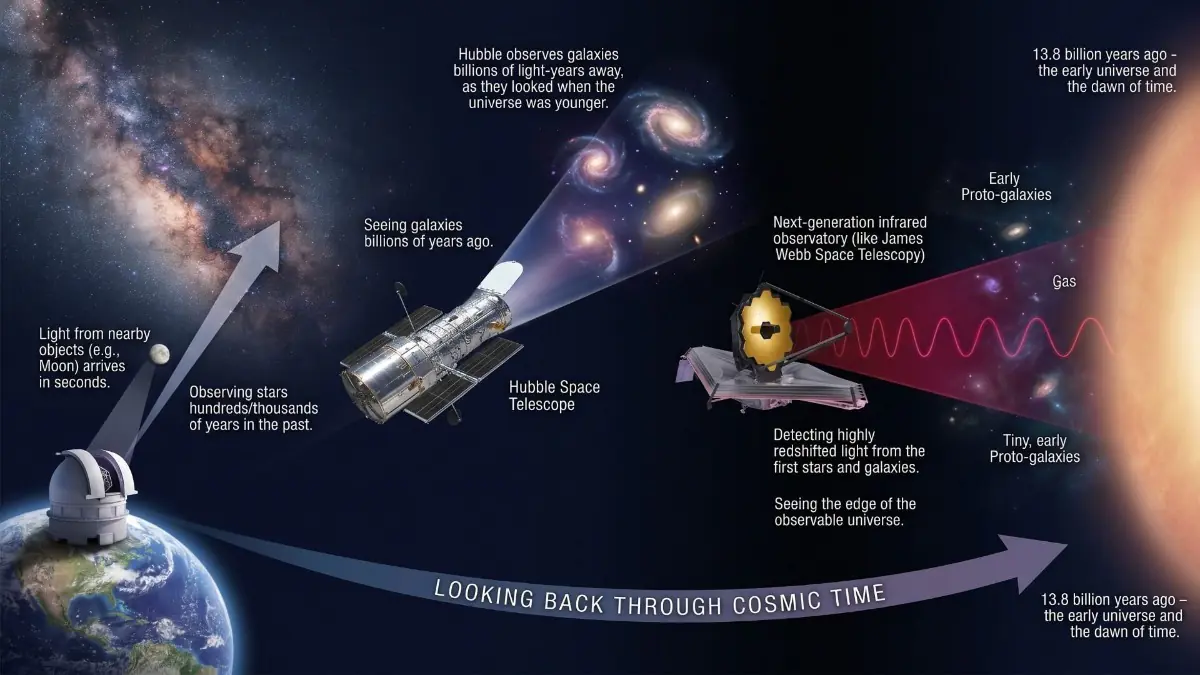
So when we look at that light through a telescope, we are actually seeing the object as it existed in the past. Telescopes multiply the power of our vision. As a result, we can peer deep into the universe and simultaneously travel deep into time.
The Fascinating Connection Between Light and Time
There is an inseparable relationship between light and time. Everything we see around us is visible simply because light bounces off those objects and enters our eyes.
The distances inside our homes are so incredibly short that light reaches us in the blink of an eye. That is why it feels like we are seeing everything exactly as it happens in the present moment. But this idea completely changes when we consider the vastness of space.
Distances in space are so massive that even something as incredibly fast as light takes a significant amount of time to travel from one place to another. This time gap is exactly what allows astronomers to look into the past. Astronomers map the history of the universe entirely based on this wonderful relationship between light and time.
Understanding the Science of Cosmic Time Travel
The universe is so massive that it is impossible to measure it using standard units like kilometers or miles. Scientists had to rely on a completely new concept to measure these distances. This is exactly where the science of cosmic time travel begins.
When we talk about the vastness of space, all of our everyday measurements become meaningless. We need to understand how light actually works. Light does not just magically teleport from one place to another in an instant.
Light is a form of energy. It travels through the vacuum of space like a wave. This journey requires a specific amount of time. Once you grasp this fundamental truth, understanding the science of cosmic time travel becomes very easy.
Why Looking at Space Means Looking at the Past
Imagine a friend sent you a letter. It took seven days for that letter to reach your mailbox. When you finally read the letter, you are actually reading the words your friend wrote seven days ago.
The exact same thing happens in space. Instead of a letter, we receive light. When light begins its journey from a star, it travels across the vast stretches of space to reach our planet.
This journey can take anywhere from a few years to several billion years. So the star you are looking at tonight might be showing its appearance from thousands of years ago. You are not seeing the star as it is today, but rather its past history.
How Light Travels Through the Universe
Particles of light are called photons. These photon particles are created by the intense heat and pressure at the core of a star. The photons then spread out from the surface of the star into the vacuum of space.
Space is almost entirely empty. There is no air or any other medium out there to block the light. Therefore, light travels in a straight line without facing any resistance. Light maintains its speed throughout this endless journey.
These light particles survive even after traveling for millions of years. We finally see that distant object when these photons pass through Earth’s atmosphere and reach the lenses or mirrors of our telescopes. This is how light carries information from one end of the universe to the other.
How Telescopes Work
A telescope is an instrument that makes distant objects appear larger and clearer. It multiplies the natural visual capacity of the human eye. Modern astronomy is simply unimaginable without telescopes.
Many people think a telescope just pulls distant objects closer. But its main job is actually quite different. A telescope primarily acts like a giant bucket designed to collect light.
The pupils of our eyes are very small. Because of this, they can only collect a tiny amount of light. On the other hand, the lenses or mirrors of a telescope are massive. This allows them to gather much more light, helping us see faint objects in the dark sky more clearly.
Collecting and Focusing Light from Distant Objects
The primary function of a telescope is to gather light. There is a large lens or mirror located at the front or back of the telescope. This is called the objective lens or primary mirror.
The larger this lens or mirror is, the more light the telescope can collect. Just as a larger bucket catches more rainwater, a larger mirror catches more light. The telescope then focuses all this collected light into a single point.
This focused light then travels to an eyepiece or a digital sensor, eventually reaching our eyes or a computer screen. This allows us to see very distant and dim stars or galaxies with great clarity. It is this light-gathering ability that allows us to peer deep into the universe.
Different Types of Telescopes and Their Purposes
Not all telescopes are built the same way. Telescopes are generally divided into three main categories based on their design and function. These are refracting, reflecting, and radio telescopes.
Refracting telescopes use glass lenses to bend light. Galileo Galilei was the first to observe the sky using this type of telescope. They are mostly great for viewing closer objects like the moon or nearby planets.
Reflecting telescopes use mirrors to collect light. Sir Isaac Newton invented this design. Almost all large modern telescopes use mirrors. There are also radio telescopes, which collect radio waves from space instead of visible light. Every type of telescope helps us discover new information about the universe. You can visit the official NASA website to read their detailed telescope guides.
The Speed of Light: The Key to Seeing the Past
The entire concept of seeing the past relies entirely on the speed of light. If light traveled at an infinite speed, we would never be able to see into the past. We would simply see everything exactly as it happens in the present moment.
But an absolute truth of science is that nothing in the universe can travel faster than light. The speed of light is specific and limited. It is because of this limited speed that we can perceive the difference in time.
The specific nature of the speed of light has helped us create a massive map of the universe. It measures not just distance, but also reveals the depth of time. Therefore, the speed of light is the true key to cosmic time travel.
Why Light Takes Time to Travel
The speed of light is incredibly fast. It travels at roughly 300,000 kilometers per second. At this speed, light could circle the Earth about seven and a half times in just one second.
Despite having such immense speed, the distances in space are so vast that even this fast-moving light takes time to get from one place to another. For example, Proxima Centauri is our closest neighboring star,s located about 40 trillion kilometers from Earth.
It takes light several years just to cross this enormous distance. The gaps in space are so unimaginable that crossing them is a time-consuming process even for the fastest energy in the universe. This is exactly why light takes time to travel and why we can see the past.
Measuring Distance in Light-Years
Since measuring space in kilometers or miles is practically impossible, astronomers invented a new unit of measurement. It is called a ‘light-year’.
Many people mistakenly believe that a light-year is a unit of time. It is actually a unit of distance. One light-year is the total distance that light travels through a vacuum in one Earth year. One light-year equals approximately 9.46 trillion kilometers.
When scientists say a star is 10 light-years away from us, it means the light from that star takes 10 years to reach our planet. That means we are seeing the star exactly as it looked 10 years ago. This calculation of light-years greatly helps us comprehend the massive scale of the universe.
How Telescopes Help Us See the Past
We now know that light takes time to travel. The real magic happens when we combine this simple truth with a telescope. Telescopes give our eyes the superpower to observe incredibly distant objects in space.
Because these objects are so far away, their light takes a very long time to arrive. The telescope captures this ancient light and magnifies it right before our eyes. It is very much like looking at a photograph taken thousands of years ago.
The farther away we point our telescopes, the deeper into time we travel. Let us try to understand this clearly by looking at some familiar cosmic examples.
Observing the Moon as It Was Seconds Ago
The moon is Earth’s closest neighbor. We can see the moon with our naked eyes almost every single day. But did you know you never actually see the moon’s present form?
The average distance from the Earth to the moon is about 384,000 kilometers. It takes light approximately 1.3 seconds to cross this distance and reach our planet.
So when you look at the moon through a telescope, you are seeing it as it was 1.3 seconds ago. If the moon were to magically disappear right this second, we would not notice it immediately. We would only find out about it 1.3 seconds later.
Seeing the Sun from Eight Minutes Ago
The sun is the beating heart of our solar system. Life on Earth cannot be imagined without the sun. The sun is located about 150 million kilometers away from Earth.
It takes about 8 minutes and 20 seconds for sunlight to cross this massive gap and reach our planet. This means the beautiful sunrise we witness every morning actually occurred over 8 minutes ago.
We never see the present sun. If the sun suddenly stopped shining, humanity would not realize it for 8 minutes and 20 seconds. Our telescopes and satellites are always capturing images of the sun from the past.
Viewing Distant Stars and Galaxies from Millions of Years Ago
This time gap increases dramatically when we move outside our solar system. Almost all the stars we see in the night sky are located anywhere from a few dozen to several thousand light-years away.
The Andromeda Galaxy is our closest large neighboring galaxy. It is located about 2.5 million light-years away from us. When we point a telescope at Andromeda in a dark sky, we are looking at a galaxy exactly as it was 2.5 million years ago.
Humanity as we know it had not even properly evolved on Earth 2.5 million years ago. The light from that exact era has been traveling through space all this time and is finally hitting our telescope lenses tonight. This is how telescopes bring millions of years of history right before our eyes.
Looking Back at the Early Universe
One of the primary goals of astronomers is to uncover the mysteries of how the universe was created. Humans have always been deeply curious about how the universe began and how it evolved into its current state.
The only way to satisfy this curiosity is to travel back to the very early conditions of the universe. Telescopes do exactly this. Scientists use ultra-powerful telescopes to focus their gaze into the absolute depths of space.
The deeper they look, the older the light they find. By analyzing this ancient light, scientists can learn about the history of how the universe was born and developed. It is just as thrilling as digging into the Earth to discover ancient dinosaur fossils.
Observing Ancient Galaxies
The estimated age of the universe is about 13.8 billion years. According to scientists, the universe was created through the Big Bang. After that event, gas and dust gradually clumped together to form the very first stars and galaxies.
Using powerful telescopes, scientists have found galaxies that are billions of light-years away from Earth. The light arriving from these galaxies today began its journey billions of years ago.
This means scientists are observing these ancient galaxies exactly as they were during the very early days of the universe. By observing these ancient galaxies, scientists can understand how galaxies’ shapes and structures have changed over time.
Studying the Early Universe Through Deep Space Images
To see deep into space, scientists point a telescope at a specific dark patch of sky and leave it there for a very long time. This is called ‘deep space observation’. Staring at one spot for a long period allows the telescope to gather light from incredibly distant and faint galaxies.
These images act as a snapshot of a specific era in the universe. By analyzing these images of the early universe, scientists can determine what kinds of stars were being born back then.
They can also determine what the universe’s environment was like at that time. These deep space images provide us with a very clear picture of the universe’s childhood. This helps scientists build a complete model of cosmic evolution.
Understanding Cosmic History
Scientists piece together cosmic history by combining all the data gathered from telescopes. They learn how the universe expanded from a hot, dense state into the massive, cold space we see today.
They collect images from various eras of the universe. For example, they learn when the first stars lit up, when massive black holes formed, and how modern galaxies like our Milky Way came into existence.
Understanding this entire process has only been possible because of the telescope’s ability to look into the past. Without telescopes, we might never have known where we came from and just how incredibly diverse our cosmic history truly is.
Famous Telescopes That Unveil the Past
Scientists have built many highly advanced telescopes on this journey to see the past. These telescopes have completely transformed our understanding of the universe. Some of these telescopes are built on Earth, while others float in space.
Telescopes in space can take pictures without the interference of Earth’s atmosphere. As a result, their images are much sharper and more precise.
Some landmark telescopes in the history of astronomy have pushed our ability to see the past beyond our wildest imagination. Let us briefly learn about a few of these famous telescopes.
Historic Discoveries of the Hubble Space Telescope
In 1990, NASA and the European Space Agency (ESA) jointly launched the Hubble Space Telescope into space. It remains one of the most successful and famous telescopes in the history of astronomy.
The Hubble Telescope operates high above Earth’s atmosphere. This allows it to capture extraordinary images of space that were once thought impossible. Hubble has shown us exactly how old the universe is and how it continues to expand.
Hubble’s images of black holes, nebulas, and distant galaxies have given scientists invaluable information about the universe’s past. Hubble proved that our universe is not just vast, but also continuously expanding. You can browse its incredible photos by visiting the official Hubble website.
How the James Webb Space Telescope Sees Ancient Light
The James Webb Space Telescope (JWST) is the most advanced and powerful in human history. It was launched into space in late 2021. The James Webb Space Telescope is many times more powerful than the Hubble Space Telescope.
Hubble primarily works with visible light. However, the James Webb Space Telescope is designed specifically to capture infrared light. As the ancient light from the distant universe travels through expanding space, it stretches out and turns into infrared light.
By viewing this infrared light, James Webb can see the very first generation of stars and galaxies that formed immediately after the Big Bang. It literally takes us incredibly close to the very birth of our universe.
Deep Space Exploration by Ground-Based Observatories
In addition to sending telescopes into space, there are many incredibly powerful telescopes right here on Earth. Excellent examples include the Very Large Telescope (VLT) in the Atacama Desert of Chile and the Keck Observatory in Hawaii.
Earth’s atmosphere often creates obstacles for clear observation. But modern technology has eliminated this barrier through a technique called ‘adaptive optics’. With this technology, ground-based telescopes can now take pictures just as clearly as space telescopes.
Massive networks of radio telescopes, like ALMA, are looking right through cosmic dust clouds to observe the earliest moments of star formation. These ground-based telescopes continue to play a crucial role in unveiling our cosmic past.
Deep Field Images That Changed Astronomy
Some images taken by telescopes are so groundbreaking that they have completely changed the history of astronomy. These are known as ‘Deep Field Images’.
There is a fantastic story behind how these images were taken. Scientists did something that no one had ever dared to do before. They pointed the telescope at a patch of sky that looked completely empty.
What scientists found while photographing this empty space shocked people all over the world. These images taught us that there is actually no such thing as empty space in the universe.
Explanation of the Hubble Deep Field
In 1995, astronomers pointed the Hubble telescope at a tiny, dark spot in the sky for 10 consecutive days. No stars were visible in that spot with the naked eye or even with regular telescopes. Many people thought this was a complete waste of the telescope’s valuable time.
But when the images were combined 10 days later, the result was staggering. Scientists found nearly 3,000 completely new galaxies packed inside that tiny dark dot. This image was named the ‘Hubble Deep Field’.
It was the deepest and oldest picture of the universe ever taken by humanity at the time. This single image proved just how massive and densely packed our universe is with galaxies.
The Discovery of Thousands of Ancient Galaxies
Following the success of the Hubble Deep Field, scientists created several additional deep-field images. These included the Hubble Ultra-Deep Field and the eXtreme Deep Field. Thousands of new and ancient galaxies were discovered in every single image.
Some of these galaxies are located so far away that their light took between 10 and 13 billion years to reach us. This means we are seeing those galaxies exactly as they were up to 13 billion years ago.
These discoveries helped scientists understand that galaxies in the early universe were much smaller and had irregular shapes compared to the galaxies we see today. Over time, they merged together to form the massive structures we are familiar with now.
How Astronomers Study the Early Universe
Learning about the universe’s past is not limited to just taking pictures. Scientists use many complex methods to extract information from light. By analyzing light, they can determine an object’s distance, speed, and chemical composition.
Light from the past looks slightly different than light from the present. Because the universe is expanding, light has to travel a much longer path, which changes its physical properties.
Astronomers use a special technique called spectroscopy to measure these changes. It splits light into its various colors or spectrums. Let us look at how scientists accomplish these tasks.
Detecting Redshift and Cosmic Expansion
The universe is not standing still; it is constantly expanding. Because the universe is expanding, distant galaxies are moving further away from us. When an object moves away from us, its light stretches out through space and shifts toward the red end of the spectrum.
In astronomy, this phenomenon is called ‘Redshift’. It works much like an ambulance siren. Just as the pitch of the siren drops when the ambulance drives away from you, light turns redder as it moves further away.
The farther away a galaxy is, the greater its redshift will be. By measuring exactly how much an object’s light has shifted toward red, scientists can perfectly calculate its distance and age. Redshift is the most reliable measuring stick for looking into the past.
Analyzing the Light of Ancient Stars
Telescopes do more than just take photographs; they can also perform chemical analysis on light. By analyzing the light from ancient stars, scientists can figure out exactly what those stars were made of.
The very first stars in the universe were made entirely of hydrogen and helium gas. They did not contain heavy elements like carbon, oxygen, or iron. Heavy elements were created much later after the deaths of older stars.
Scientists look for the absence of these heavy elements in ancient light. When they find light lacking heavy metals, they can be certain they are looking at some of the earliest stars in the universe. This chemical analysis of light is an incredible way to understand the environment of the past universe.
What is the Oldest Light We Can See?
There is a specific limit to our ability to see into the past. We cannot just look into the infinite past whenever we want. This is because there was a time in the universe when light did not even exist.
The oldest light we can see today did not come from any star or galaxy. It came directly from a massive burst of radiation that happened immediately following the birth of the universe, or the Big Bang.
This most ancient light is called the Cosmic Microwave Background, or CMB for short. It is a glowing remnant from the very early universe, now spread across the entire cosmos.
Understanding the Cosmic Microwave Background
The Cosmic Microwave Background, or CMB, is the oldest light in the universe. Two scientists, Arno Penzias and Robert Wilson, accidentally discovered this light in 1964 using a radio telescope. They won the Nobel Prize for this incredible discovery.
Right after the Big Bang, the universe was like a dense, scorching-hot soup of plasma. Light could not travel freely in that environment. But about 380,000 years later, the universe cooled down just enough for the first light to break free and spread across space.
That very same light has been traveling through space for 13.8 billion years and is being picked up by our radio telescopes today as microwave signals. You can read the European Space Agency’s articles on the CMB to learn more details.
A Glimpse into the Earliest Moments of the Universe
You can think of the CMB as the very first ultrasound or X-ray report of the universe. The blueprint of the universe’s infancy is drawn inside this light. When scientists analyze this background radiation, they can spot tiny density differences from the early universe.
It was from these tiny differences in density that all the galaxies and star clusters eventually formed. This is the oldest light we are physically capable of seeing.
We cannot see any light from before the CMB. The universe was simply too dense back then for light to pierce through it. Therefore, this ancient light marks the absolute final boundary of our cosmic time travel.
Limitations of Looking Back in Time
Even though telescopes help us look into the past, there are certain limitations. We cannot just decide to look at the absolute zero-second mark of the universe. Despite amazing advancements in science and technology, our vision cannot go past a certain point in time due to the very laws of nature.
There is a Dark Age in the history of the universe from which no light ever arrives. Furthermore, light from incredibly distant objects becomes so faint that capturing it is extremely difficult.
These limitations pose a massive challenge for scientists. Let us discuss the main obstacles we face in observing the cosmic past.
Why We Cannot See Before Certain Cosmic Events
We have already learned that for about 380,000 years after the Big Bang, the universe existed in a dense, fog-like plasma state. Light was completely trapped during this period.
Because light could not penetrate that dense shield, we cannot see any images or scenes from that era with any telescope. Astronomers refer to this period in the universe’s history as the ‘Dark Ages’.
We can only see events that happened after that Dark Age ended and the universe became transparent. It is because of this fundamental rule of nature that we fail to see the very first moment of the universe directly.
Technological Barriers in Deep Space Observation
Alongside natural barriers, technological limitations are also a major factor. The farther away an object is, the fainter and weaker its light becomes by the time it reaches us.
Light traveling from a galaxy billions of light-years away loses so much energy by the time it reaches Earth that detecting it with standard equipment is nearly impossible. This requires ultra-powerful, sensitive telescopes like the James Webb Space Telescope.
Additionally, Earth’s atmosphere blocks many light waves from ever entering the planet. Clouds of gas and cosmic dust often cover up views of deep space. Overcoming these technological and environmental hurdles to see the past is a truly enormous challenge for scientists.
Common Misconceptions About Telescopes and Time Travel
Hearing the phrase ‘seeing the past with a telescope’ often triggers wild imaginations. People frequently mix this scientific fact with stories they have seen in science fiction.
As a result, some misconceptions about science are born among the general public. Many people think that seeing the past through a telescope means we can physically travel back in time whenever we want.
Others might assume scientists are literally teleporting to the past to watch these events unfold. It is very important to clear up these misconceptions. The true beauty of science lies in reality, not in fiction.
Telescopes vs. Sci-Fi Time Machines
In sci-fi movies or books, we see people sit inside a time machine, press a button, and instantly arrive in the past or future. Once there, they can even change the past. But a telescope is absolutely nothing like those time machines.
We use telescopes only to collect information about the past. We do not actually travel to the past, nor can we change any past events. We are merely observing events that have already happened, strictly as an audience.
It is very much like watching a VHS or DVD recording. You can watch an old football game on television, but you cannot change the final score. Time travel via a telescope is a strictly one-way process just like that.
The Real Meaning of Seeing the Past
The scientific meaning of seeing the past is simply receiving ‘delayed information’. Nothing in the universe transmits information from one place to another instantly. This delay in information is entirely due to distance.
When we look at a distant star through a telescope, we are actually completely ignorant of its present condition. The star might have been destroyed millions of years ago, but from here on Earth, we still see it burning brightly in the sky.
Therefore, the true meaning of seeing the past is to observe the history of the universe in chronological order. This helps us understand how the universe changes over time and clearly shows the wonderful evolutionary process by which new stars and planets are born.
Future Telescopes and the Next Horizon
The journey of science never stops. Astronomers are always trying to invent new technologies. They want to peer even deeper into the universe and unlock even older mysteries.
Right now, we are all very excited about the James Webb Space Telescope. But scientists have already started planning the next generation of telescopes.
These future telescopes will be much larger and far more powerful than the ones we have today. They will likely show us things we cannot even begin to imagine right now. The story of cosmic time travel has just begun, and its best chapters have yet to be written.
Upcoming Space Observatories
NASA and the European Space Agency will launch several groundbreaking space telescopes within the next decade. One of these is the Nancy Grace Roman Space Telescope.
It will take images as sharp as Hubble’s, but its field of view will be about 100 times larger. It will be able to photograph massive sections of the sky all at once and provide brand-new information about the expansion of the universe.
Additionally, the European Extremely Large Telescope (ELT) is being built on Earth and will feature a 39-meter-wide mirror. This will take our ability to observe the sky to an entirely new level.
How New Technology Will Uncover Older Cosmic Mysteries
These new telescopes use sensors and mirrors that can collect far more light than any built before. They will be able to capture infrared and radio waves with incredible precision.
Because of this, scientists hope to finally see direct images of the universe’s very first stars. They might pierce right through the Dark Ages and discover entirely new information.
Future technology might even give us detailed information about the chemical composition of atmospheres on distant planets, or even signs of life. The grand tale of cosmic time travel is only just getting started.
Fascinating Examples of Cosmic Time Travel
We have discussed many scientific theories throughout this post. Let us now review this entire concept of cosmic time travel using some very simple and fascinating examples.
If you remember these examples, you can easily explain the time-traveling power of telescopes to anyone. Whenever you look up at the sky, these calculations of distance and time will leave you in awe.
This range of time travel extends from our neighboring planets to the edge of the universe. Let us look at a few fun examples.
Seeing Nearby Planets in the Recent Past
Imagine you are looking at the planet Mars through a telescope. Because of the distance between Earth and Mars, light from Mars takes roughly 3 to 22 minutes to reach Earth, depending on where the planets are in their orbits.
This means you are seeing Mars exactly as it looked 3 to 22 minutes ago. Similarly, viewing Jupiter takes about 35 to 50 minutes.
If scientists send a rover to Mars and that rover sends a picture back to Earth, it still takes several minutes for that data to arrive on the scientists’ computers. This is a small-scale time travel experience right inside our solar system.
Observing Galaxies from Billions of Years Ago
Now let us go a bit further away. In 2014, the Hubble telescope discovered a galaxy named GN-z11. It is so far away that its light took about 13.4 billion years to reach Earth.
When the light from that galaxy started its journey, our Earth and solar system did not even exist. The Earth was formed a mere 4.5 billion years ago.
This means the light from that galaxy began racing toward us nearly 9 billion years before the Earth was even born. Today, we are looking at that light through a telescope. This is a truly spectacular example of cosmic time travel.
Looking Back at the Birth of the Universe
Finally, we arrive at the Cosmic Microwave Background, or CMB. When we observe the CMB using a radio telescope, we are experiencing radiation from 13.8 billion years ago.
This is an echo from the very beginning of the universe. When an old analog TV had no channel signal, you would see static or black-and-white snow on the screen. A tiny fraction of that static was actually the leftover radiation from the Big Bang that happened 13.8 billion years ago.
Even though we cannot see it with our naked eyes, our telescopes and antennas are constantly picking up the faint cries of the universe’s birth. This is how science connects us directly to the deepest roots of our existence.
Frequently Asked Questions (FAQs)
How do telescopes help us see the past?
Telescopes gather light coming from incredibly distant objects in space. Because light travels at a specific speed and the distances in space are massive, it takes years for the light from distant objects to reach Earth. A telescope magnifies this old, arriving light, allowing us to see the object as it was in the past.
Why does light take time to travel?
Nothing in the universe can travel at an infinite speed. The speed of light is specific, clocking in at roughly 300,000 kilometers per second. Distances in space are so vast that even light traveling at this immense speed takes anywhere from a few years to several billion years to get from one place to another.
What is the most distant object observed so far?
One of the most distant galaxies observed to date is JADES-GS-z13-0, which was discovered by the James Webb Space Telescope. We are seeing it exactly as it existed a mere 320 million years after the Big Bang. Its light took more than 13.4 billion years to reach us.
Can we see the very beginning of the universe?
We cannot see the absolute zero-second mark of the universe. For about 380,000 years after the Big Bang, the universe existed as a thick, foggy plasma where light was completely trapped. We can only see the oldest radiation, called the Cosmic Microwave Background (CMB), which appeared after that period.
Is looking through a telescope actual time travel?
It is not physical time travel like in Hollywood movies where a person physically goes to the past. It is ‘observational time travel’. We are sitting right here in the present on Earth, simply observing the past light and information from cosmic objects.
Conclusion
Looking up at space means so much more than just seeing bright dots in a dark sky. It is a never-ending journey to understand our own existence and the history of the universe. The telescope is our most trusted companion on this journey.
Telescopes have proven that science is not just confined to laboratories. It brings our imaginations to life and helps us realize our place amidst the vastness of the universe. We are made of stardust, and through telescopes, we are searching for the very source of our creation.
How Telescopes Unveil the History of the Universe
Even though a telescope is a simple instrument, it acts as a pair of reading glasses for scientists trying to read the diary of the universe. Every page of this diary is located light-years away.
The deeper a telescope looks, the older the diary pages we can read. By piecing together fragments of images and light spectra, scientists have successfully uncovered a continuous history of the universe, right from the Big Bang down to the present day.
Why Every Observation is a Journey Through Time
When you stand on your roof at night and look at the moon or stars with your naked eyes, you are also traveling through time. You are seeing a one-and-a-half-second-old moon or a thousand-year-old star.
Astronomy teaches us that the ‘present’ does not really exist on a cosmic scale. Everything we see is already in the past. Simply understanding this truth is the greatest joy of cosmic time travel. Telescopes bring that wondrous past to life right before our eyes.